




 English (pdf)
 Article in xml format
 Article references

 Automatic translation
 Send this article by e-mail
 Cited by SciELO
 Similars in
SciELO

 Permalink


Introduction and background
This article is partly based on my PhD-thesis Ecclesiastical Heritage in a New Era (2023) that is a compilation of six published papers, four in Swedish and two in English. The thesis is about Swedish ecclesiastical cultural heritage, which consists of the church sites, buildings and other ecclesiastical objects that were owned and/or managed by the Church of Sweden when the State and the Church were separated in 2000. The comprehensive summary, which is written in Swedish, is not only summarising the papers but it also analyses and discusses the different discourses or approaches to cultural heritage that can be identified in the included papers and in other relevant sources. It also discusses the identified heritage discourses’ current and possible future impact on the management, use, and development of ecclesiastical heritage.
The article addresses the following questions:
How can the Church of Sweden’s church sites and buildings be sustained as living heritage, which is also realised as a societal resource and public good?
What factors can be identified that hinder or support the desired development?
In analysing these issues, the present situation and development of ecclesiastical heritage in Sweden is, based on a previous international study (Lindblad & Löfgren, 2016/2018; 2017), compared to the situation in other European countries. The conservation discourse, its impact on Swedish heritage legislation, and its consequences for keeping ecclesiastical heritage accessible and living, is illustrated by a case study on the redundant and closed Caroli church in Malmö (Lindblad, Eriksson & Gustafsson, 2022).
Initially, some conditions need to be described. These can be said to form both the starting point and the framework for the recent decades’ work with ecclesiastical cultural heritage in Sweden.
On 1 January 2000, the relationship between the Swedish State and the Church of Sweden changed. The reform took place after lengthy negotiations and several official investigations (see below). For the ecclesiastical cultural heritage, which here mainly is referring to material objects such as church buildings, church sites with burial grounds, and ecclesiastical artefacts, there were several uncertainties that needed to be clarified. Important questions included whether the State or the parishes should own and manage the church buildings, how their care and maintenance should be financed, who should distribute the financial compensation and how much it should be.
The principal decision to change the relationship was taken by the Riksdag (the Swedish Parliament) in 1995 following the proposals in the bill Changed relations between the State and the Church of Sweden (Ändrade relationer mellan staten och Svenska kyrkan, Prop.1995/96:80). The bill emphasised that the preservation of the cultural values of the church was a matter for the whole of society and for the Swedish people and that it was not reasonable for the total cost of this public interest to be borne solely by the members of the Church of Sweden. It was therefore concluded that the Church should receive some compensation for the restrictions and additional costs imposed by the protection provisions of the Cultural Heritage Act (from 2014 called the Historic Environment Act, in Swedish Kulturmiljölag). In the bill the State and the Faith Communities (Staten och trossamfunden, Prop. 1998/99:38), the ecclesiastical heritage compensation was written into the Historic Environment Act and the annual sum of SEK 460 million was proposed. The division of responsibilities between the State and the Church of Sweden was regulated in a formal agreement (Överenskommelse mellan staten och Svenska kyrkan, Ku2000/470/Ka). The agreement, which ‘runs until further notice’, states that the Church of Sweden is responsible for having sufficient competence for the management (in terms of care and maintenance) of the historic ecclesiastical properties, that these should be accessible to the public and that the State and the Church should co-operate in overall issues relating to the ecclesiastical cultural values (Ibid.).
The division of responsibilities and roles was thus clear: the Church of Sweden would take care of its historic properties in return for compensation from the State, which would ensure that the Church of Sweden complied with the agreed commitments. The actors in the co-operation were also defined. Briefly, they consisted of the government, the Church of Sweden at the national level, the National Heritage Board, the Church of Sweden Parish Association, the Church of Sweden’s thirteen dioceses, all County Administrative Boards and the County Museums (Ibid.).
This means that the questions regarding whose responsibility it was and how the ecclesiastical cultural heritage should be managed were resolved. The entire ecclesiastical heritage system, referred to as the church antiquarian system in my thesis, can be said to have been packaged and regulated. The system consists of the government bills, the agreement between the State and the Church of Sweden, the protection of churches in the Historic Environment Act and the regulations of the ecclesiastical heritage compensation, decided by the Church Council. This agreement has no time limit. Since it runs until further notice, the system can continue eternally, or perhaps for the period expressed by the Church of Sweden in the book on the Church’s cultural heritage entitled A Thousand Years More (Isaksson, 2014).
Nearly 25 years after the separation, however, it has become clear that what should be cared for and how it should be done was not so obvious. After the church antiquarian system was formed, the world has changed towards an increasingly multicultural, globalised and digitised society. When the foundations of the agreement between the State and the Church were laid in 1995, mobile phones were a new phenomenon, Internet as we know it hardly existed, the onset of social media would take at least another ten years, Sweden had just joined the European Union and urbanisation, integration and digitalisation would continue for many years to come. In the present, characterised by polarisation and mistrust between different actors and groups, the global decline of democracy and freedom of expression, repeated societal crises, and pivotal phenomena and events such as climate change, terrorist attacks, economic crises, the Covid-19 pandemic, Russia's invasion of Ukraine and wars in the Middle East, society has changed in directions that no one could have foreseen just a few years ago. In these tumultuous times, the Church of Sweden, which was a State Church for over 500 years, is trying to find a new identity and a new role in a new society. According to the Church of Sweden Act (Lag om Svenska kyrkan, SFS 1998:1591), it remains a people's church and a territorially based nationwide organisation. However, in terms of membership and finances, the Church is steadily shrinking while remaining responsible for about 3,400 churches. These are often located in places where fewer people live and are less and less in demand as places of worship. In practice, many churches owned by the Church of Sweden and its parishes are already closed for most of the year, as they are no longer needed for worship. This trend has been going on for a long time and, according to existing forecasts, will continue in foreseeable time. Neither the continued close relationship and co-operation between the State and the Church nor a possible post-secular State, where religion has regained some of its importance in society (Hagevi, 2007), has had a positive impact on the membership of the Church of Sweden. Since the separation in 2000 until 2023, membership has decreased by just over 1.8 million (Svenska kyrkan, 2024a). Concerning the economy of the Church, the number of members is crucial, as each member pays about one per cent of their annual income to the Church, bringing the estimated gross income in 2025 to SEK 16.8 billion or about €146 billion (Svenska kyrkan, 2024b). As the population has increased sharply at the same time, the proportion of members has decreased from 82.9 per cent to 53 per cent during the same period (Ibid.). The trend is for the decline to continue, and the Church of Sweden's forecasts have pointed to a membership of just over 45 per cent in 2030 and around 30 per cent in 2050 (Beckman, 2017; Svenska kyrkan, 2015; reasoning on the consequences of declining membership can also be found in Svenska kyrkan, 2018).
Considering the responsibility for the huge stock of protected properties, declining membership and, in many parishes, ageing and declining active members and churchgoers, there seems to be a risk that the Church will be transformed from a religious community to an increasingly secular organisation managing historic ecclesiastical properties, mirroring the National Property Board, a State agency managing all historic State properties.
Another way to understand the development of the Church is to show the number of activities and services over the years, and the number of people participating in them, detailed in table 1, below (all statistics from the Church of Sweden website: Svenska kyrkan, 2024a; see also forthcoming article Lindblad, 2025).
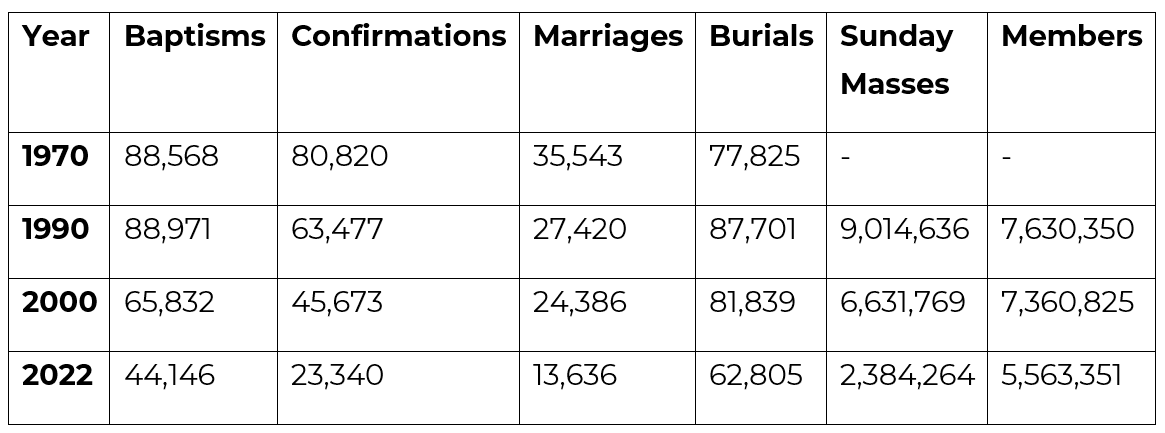
Figure 1 The number of religious activities, worshippers and members of Church of Sweden in 1970 (statistics of worshippers and members were not yet collected), 1990, 2000, and 2022
In 1996, four years before the division with the State, baptism became the basis for membership. This means that the sharp decline in the number of baptisms from 1990 to 2022 in the long term is very serious for the Church. It is also interesting to note the rapid decline in the number of participants in Sunday Masses, which does not correspond to the slower annual decline in membership. One consequence is probably a steady increase in the percentage of passive or even non-religious members of the Church. The decline in membership, income and religious activities, as well as the ongoing merger of small parishes into larger entities, is likely to increase the number of redundant churches.
International outlook: religious buildings in transition
The study Religious buildings in transition, Lindblad & Löfgren, 2016/2018), was part of the project “Old churches new values - use and management of churches in a changing society”, funded by the National Heritage Board and the Church of Sweden, which ran from 2012-2015. The project concerned the Church of Sweden’s church buildings as legally protected cultural heritage: their preservation, use and future development in an international context. The report to the study was performed in 2016 and translated to English in 2018. The results have been presented in the article Europe’s religious buildings in change (Europas religiösa byggnader i förändring) (Lindblad & Löfgren, 2017).
In many European countries, the traditional faith communities have long been dealing with declining membership and redundant church buildings (Ibid.). The focus of the study was on Christian society’s tangible cultural heritage, mainly church buildings. The main purpose was to describe the conditions that give perspectives on and highlight the Swedish situation (as further described in the section above), and which could provide a knowledge base for further research. This was done mainly through an overview of the confessional (church-related) and legal administrative conditions that affect the state of material religious heritage in several countries: how it is managed, the values that are enshrined in the heritage legislation and the development of possible redundancy problems.
The full report includes an overview of the situation of religious heritage in eleven European countries; Sweden, Denmark, Finland, Norway, England, the Netherlands, Bosnia-Herzegovina, Germany, Italy, Belgium and France. The boundaries and the selection have partly to do with timeframes and partly to the availability of source material. One approach has been to include both countries with conditions similar to those in Sweden, such as the Nordic countries, and countries with very different conditions such as Bosnia-Herzegovina and France.
Our analyses of the development of church redundancy are partly based on the paradigm or concept of secularism, as it is formulated by the British sociologist Steve Bruce in his book God is Dead (2002), where secularisation generally refers to the process whereby the role of religion and power in a community decreases (Lindblad & Löfgren, 2016/2018). In our report we note that, in recent decades, the secularisation paradigm has been challenged. Some researchers argue that, even if there is a steady decline in attendance of church services, which certainly is the effect of a change in religious practice, it does not necessarily mean a decline in religiosity. We also refer to researchers that speak of a re-sacralisation of society (Lindblad & Löfgren, 2016/2018; Bäckström, 2004; Hagevi, 2007).
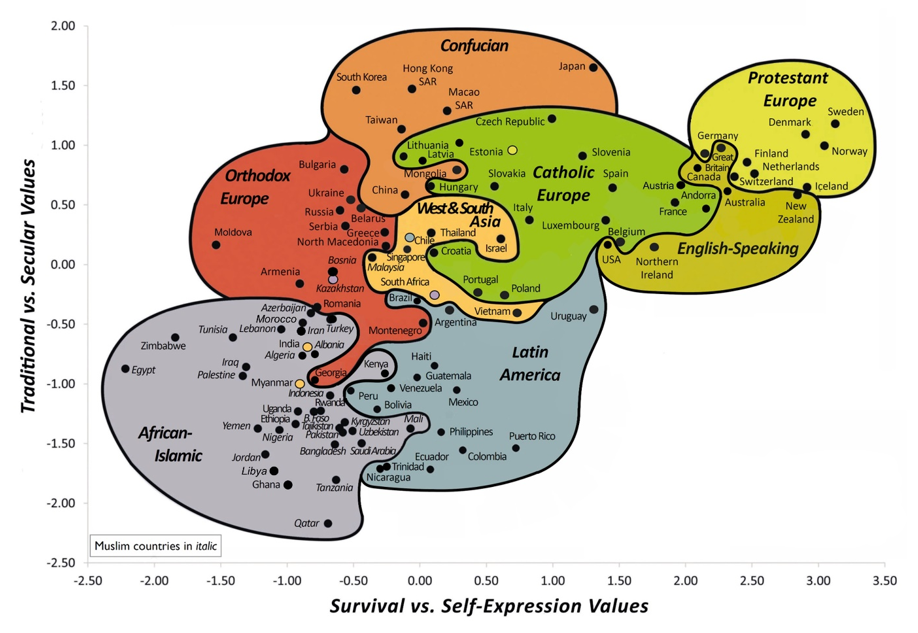
However, Sweden is still considered as one of the most secularised countries in the world, which for instance is illustrated by the cultural maps provided by the long-term global project World Values Survey. The investigated values consist of "survival values" versus "self-expression values" on the map’s horizontal axis, and "traditional values" versus "secular-rational values" on the vertical axis. The former category of values shows, in principle, the degree of the society’s modernisation, and the latter category shows how important religion is in various societies. In the most recent survey from 2023 (World Values Survey, 2024), Sweden, which according to the results of the survey could considered being the most modernised of all countries in the world, is situated in the far right of the map (figure 2). Concerning the importance of religion, Sweden is still very secularised, although some other countries in Europe are getting closer, compared to previous surveys. On a global scale, only Japan, Hong Kong, South Korea and Macao, seem to be more secular than Sweden.
In summary, our report, together with the concluding article, shows that, compared to several other countries, the Swedish model of church conservation, or the church antiquarian system (see above), with its clear distinction between religion and cultural heritage, its focus on the care and protection and a generous financial compensation, has proved materially successful. But it is also evident that the model risks contributing to churches becoming increasingly under-utilised and ultimately obsolete and abandoned. Since the model does not favour, but rather seems to discourage both religious and secular heritage use, the question is how sustainable it is in the long term. More and more churches risk being closed as they are not needed for church activities, and although most are well maintained today, the motivation to care for buildings that are not needed, and few can even enter, is most likely reduced. Furthermore, the motivation to make under-utilised and closed churches available for alternative uses may be weak among parishes, whose fundamental task is not to carry out cultural conservation or heritage management but to conduct worship, teaching, diakonia (pastoral care), and mission.
Other countries, such as the UK and the Netherlands, are characterised by a long-standing problem of redundancy (Lindblad & Löfgren, 2017). As funding in both countries is less favourable than in Sweden, with no or significantly lower government subsidies for ecclesiastical heritage, and with more differentiated legal protection, many churches have been sold and dismantled. However, various organisations have been created to take over churches, ownership or management, to ensure that they are cared for and can be kept open (Ibid.).
The report How do we keep our parish churches (Cooper, 2004) provides statistics on the Church of England’s church buildings that became redundant between 1969 and 2004. According to the report, the total number was 1,626, 925 of which had been sold and/or converted to alternative uses, 360 had been demolished, and 341 had been taken over by the Churches Conservation Trust (CCT) or other organisations (Cooper, 2004, p. 64). This compares with the total number of church buildings which, according to the report in 2003, was 15,242 (Ibid., p. 67). CCT was set up in 1969 by a special law, and is tasked with managing, and now developing activities in particularly valuable churches that are no longer needed for pastoral activities (Wetterberg, 2017). Some of these churches are still consecrated and can be used for worship; but where CCT, often in collaboration with local organisations, has developed various forms of use that are referred to as ‘extended use’ (Ibid., p. 71). CCT has also developed a model that can be used to create a business plan with a ‘business case’, which can be used by parishes and others who need to develop their churches so that they can also earn income from the additional activities (Ibid., p. 77).
In the most recent report to the Swedish government on the state of ecclesiastical heritage, the Church of Sweden reports that 132 church buildings have been sold, donated or, in rare cases, demolished since 2000. This can be compared to the total number of 3,389 churches owned by the Church in 2023 (Svenska kyrkan, 2024). The Church provides no statistics on redundant churches but, according to my own experience as heritage officer in a diocese with over 500 churches, many of these are in practice redundant and closed, even though they are in most cases still well maintained.
The problem of well-kept but unused churches has, after the international study was carried out, been raised in another context, during a presentation at an ICOMOS (International Council of Monuments and Sites) conference in Florence in 2019 under the title “Living or (un)Dead? - The Wellbeing of Swedish Ecclesiastical Heritage”, (Lindblad, 2019). In the presentation, which depicted the Swedish situation from the perspective of the Living Heritage Approach (see Lindblad, 2022, 2023, and forthcoming article, 2024), I argued that the Swedish churches were turning into what I called zombie churches:
“The Swedish (ecclesiastical) heritage practice is not only ignoring the importance of continuous use but even tends to discourage it. A consequence could be that living heritage gradually transforms into something that is dead or at least nearly dead” (Ibid.).
The concept of zombie churches, which is partly based on the living heritage approach (see below), can be seen as a term for well-maintained but closed church buildings without use and with no living content. These churches are therefore appearing as dead, nearly dead or even undead cultural heritage. The living heritage approach is developed by researchers such as Ioannis Poulios and Gamini Wijesuriya, both engaged in ICCROM (The International Centre for the Study of the Preservation and Restoration of Cultural Property). Living heritage can be defined as a category of cultural heritage characterised by continuity in four specific aspects; traditional use, community connections, evolving cultural expressions, and care and management (see Poulios, 2014; Wijesuryia, 2018; Lindblad, 2022, 2023).
In the case of redundant churches, the continuity of traditional use (religious services, practices and related activities) obviously cannot be maintained. However, if the concept of living heritage is broadened to include new or secular activities, as well as new groups, and where the focus is on keeping cultural heritage accessible to the public and beneficial to the local communities, closed churches can hopefully be revitalised with new content (Lindblad, 2022). In the next section of this article, I propose several measures. If implemented, these actions can contribute to reverse the Swedish trend towards closed churches with hardly any living content.
Redundant church buildings: resources for urban regeneration?
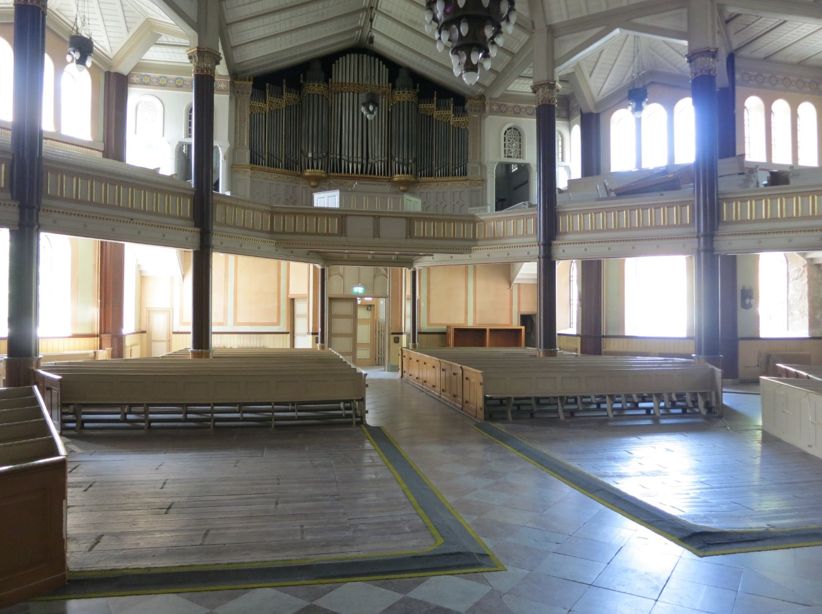
The next study to be discussed in this article, “[Title removed]”, (Lindblad, Eriksson & Gustafsson, 2022), is based on an example of a desacralised and closed church building that has been sold for non-religious use. The study analyses how cultural historical values and their legal protection are interpreted differently by different actors and what consequences this may have for the preservation, management and use of redundant churches. The example is Caroli church, which was built in 1879 in the historic city centre of Malmö, Sweden’s third largest city. Caroli church was designed as a central church with a characteristic Greek-cross plan. The architect, Emil Langlet, was a prominent advocate of a building type dating back to the early Christian churches and Italian renaissance architecture in Sweden. Langlet recommended a return to the central plan, favoured by acclaimed 17th century architects such as Jean de la Vallée and Nicodemus Tessin the Elder, as he considered it most appropriate for the protestant worship, with its emphasis on preaching the gospel. Caroli church is situated in an area of the historic city centre that was renewed in the 1960s and 1970s with the demolition of many older buildings. The church, for many years considered redundant, was sold by the parish in 2009 to the owner of the nearby shopping centre Caroli City and desacralised the following year. The County Administrative Board gave permission to remove most of the church’s furnishings. The National Heritage Board appealed to the Administrative Court on the grounds that these measures would reduce legally protected cultural and historical values under the Historic Environment Act. In 2016, the Supreme Administrative Court finally rejected the National Heritage Board’s appeals, which gave the owner the right to make significant changes to the interior. The church, which for many years fell into disrepair due to a lack of maintenance, was restored externally in 2021 but the owner has delayed the interior renovation until a new use can be found. The pandemic and following financial crisis have further delayed the planning. When I visited the church in June 2024, the interior was still not renovated, and the church was closed, since the owner was waiting for a possible new boom in the estate market (figure 3).
The article's analyses, which aimed to lead to proposals for solutions, were based on the concept of authorised heritage discourse (Smith, 2006), integrated and value-based conservation and adaptive reuse of cultural-historical buildings (Lindblad, 2023). The article also describes international policies and approaches as well as research on the inclusion of cultural heritage and adaptive reuse in the circular economy, strategies for smart specialisation, local entrepreneurship and various action plans for this.
In the article, we argue that the National Heritage Board, in its appeal, may have been right in its interpretation of the purpose of the law, which seems to be close to the recommendations included, for example, in the Venice Charter, with its focus on material preservation. The problem with this strict application of the law, to ensure that cultural-historical values are not reduced or distorted, is the long-term consequences for cultural heritage. In the short term, the church can be preserved in its entirety, but at the same time it risks becoming unusable with decreased motivation for maintenance and set for demolishing in the future. Even if the law is applied in a more balanced way than what the national agency advocated in the Caroli case, the Historic Environment Act can be interpreted as being established to prevent or reduce changes that, according to the church antiquarian system, should be seen as negative. My interpretation is that the chapter on ecclesiastical cultural monuments in the legislation is based on a conservation ideology from the 19th century, originating in the thoughts by John Ruskin and William Morris, that needs to be balanced against newer approaches to cultural heritage. Neither the law itself nor its application by National Heritage Board in the Caroli case are adapted to the recent decades’ changes regarding newer cultural heritage policies or of the development of the church and the society (Lindblad, Eriksson & Gustafsson, 2022).
Another question, which is not further discussed in the referred article, is the consequences of privatisation of a property that, according to the Historic Environment Act as well as the Church Ordinance, is considered a public building that should be accessible to all citizens (Svenska kyrkan, 2024d, p. 114). However, this issue is addressed in the article “Ecclesiastical Heritage as a Human Right” (Lindblad, 2022), which, based on analyses of international documents such as European Council’s Faro Convention (2005), International Covenant on Economic, Social and Cultural Rights (1966), and the United Nations Universal Declaration of Human Rights (1948), states that public access to legally protected and publicly financed ecclesiastical heritage should be considered as a human right. Consequently, the article concludes that the closure, privatisation, demolition or otherwise inaccessibility of ecclesiastical heritage may mean that people’s right to this cultural heritage is not fulfilled (Lindblad, 2022, p. 77). A remark here is that if the churches remain owned by the parishes, they will most probably not be commercialised and transformed for new uses such as shopping venues or private homes with the possible following reduction of heritage values, but the buildings are still at risk being permanently closed and in the long term neglected, since the motivation to care for properties without use is likely to be reduced.
Conclusion
The church antiquarian system, which was designed in connection with the separation of the State and the Church of Sweden in 2000, fulfilled an important function in the preservation of the material ecclesiastical heritage. Legal protection, state financial compensation, and the State-Church agreement on responsibility, roles and collaboration, helped the Church of Sweden to build up its heritage expertise, to professionalise property management and to ensure that church buildings and their environments could be cared for and maintained in accordance with laws and regulations. The Church and the State have assumed their responsibilities and, for the most part, have agreed on a common system of conservation that can be seen as formal, rational and effective. Although the Church of Sweden has separated from the State, by virtue of its tradition and size it still functions partly as a State agency and even as a church property agency. In this way, the national goal of preserving the material based cultural values can be met, with preservation being handled by professional property managers and church heritage officers, whose actions are controlled by the county administrative boards, the State agencies responsible for implementing the heritage legislation. As stated in the introduction of this article, the question is solved, the church antiquarian system is designed, the actors and roles are defined and the work can go on forever, or at least for another thousand years.
But as we have seen, society changes, the Church of Sweden is shrinking, the demand for its religious services is declining, the economy is deteriorating, with more and more churches becoming redundant and at risk of being sold or permanently closed without a living content and with diminishing connections to the local communities. Because all indications are that this trend will continue, the question must be raised whether it is a sustainable system in the long term. How long can the church antiquarian system be considered politically and economically legitimate? One possible conclusion is that the legislation - as well as the regulation of the state financial compensation - needs to be revised, to not only foster and subsidise preservation of values based on material cultural heritage, but also to encourage active use and development of both tangible and intangible heritage. If a revision is not possible within a foreseeable future, the interpretative space of the law and other regulations is probably wide enough to adapt its application to the contemporary situation of redundant churches requiring alterations, transformations and extended or alternative use. The church spaces could thus be more easily adapted to satisfy the needs of shrinking congregations. This may be achieved by combining the sacred areas, presently too large in most cases, with housing parish homes and/or offices for the staff, volunteers or other community groups. If this is realised, instead of a closed and empty church, open on Sundays at best, the visitor could meet a living space filled with people. Naturally, that depends upon assessed heritage values not being too compromised by the necessary interior transformations.
Furthermore, the system should be adapted to a current and probable future situation where antiquarians need to find new roles as active enablers instead of passive monitors and controllers. The antiquarian, conservation or material approach, with its focus on preservation, building care, reuse and traditional materials, has an important role in the development of an environmentally sustainable society. However, to also contribute to social, economic and cultural sustainability, this approach needs to be complemented and better interact cooperation with other current heritage approaches and paradigms.
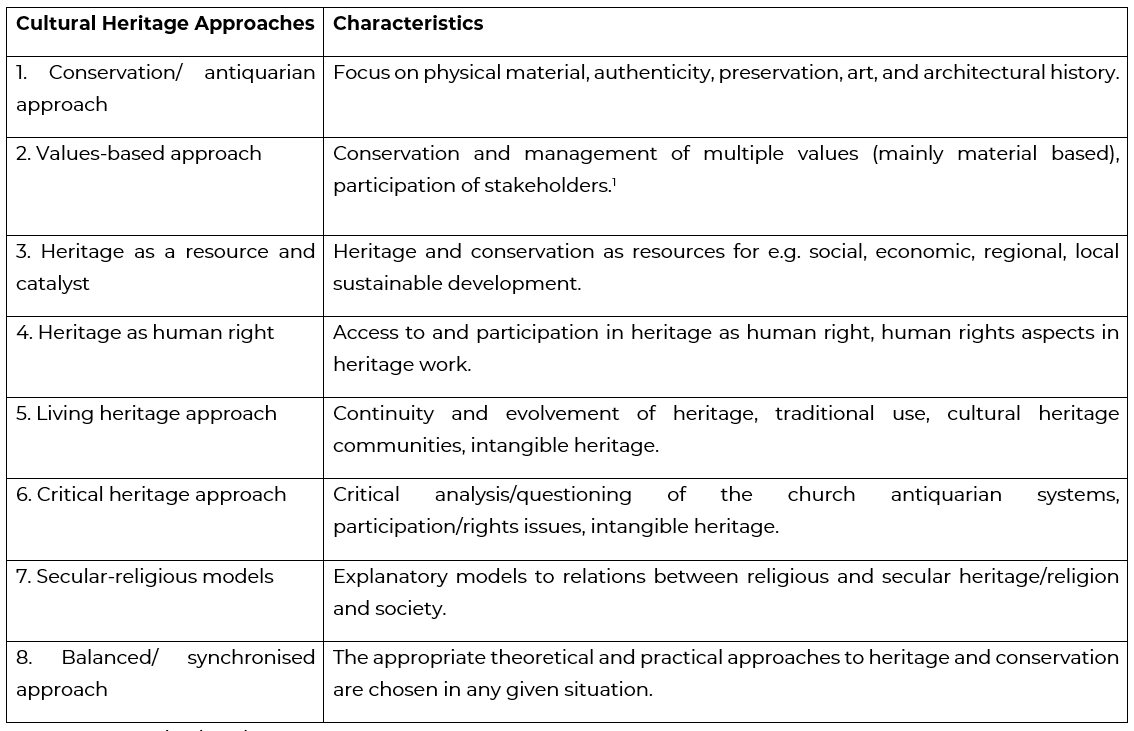
In my thesis, I have identified several heritage approaches that coexist with the still dominant conservation or antiquarian discourse (Lindblad, 2023, p. 23). My point is not that the conservation discourse should be abandoned, but that it needs to be complemented or synchronised and balanced by other contemporary, more dynamic and/or holistic approaches to cultural heritage, such as the values- and rights-based approaches, living heritage and heritage as a resource and catalyst (see figure 4, below). All the identified approaches can, when appropriate to use, be selected in any given situation.
More specifically, it can be expressed as the need for antiquarian specialisation in material and conservation issues to be supplemented with knowledge in adapted reuse of cultural-historical buildings, cultural heritage as a resource and catalyst for community development, circular economy and forms of support, dialogue and creative collaboration with different cultural heritage groups (Lindblad, Eriksson & Gustafsson, 2022; Gustafsson, 2019). New professional roles for church conservation officers, heritage specialists and other professionals can create a wider demand for the heritage conservation services and develop the heritage field so that it contributes to a greater degree to the sustainable society and circular economy. In the development of the use of the Church's cultural heritage, more actors need to be granted participation, because other actors than the dioceses and parishes of the Church of Sweden (which have completely different core tasks, namely to perform religious services) are likely to be better placed to find and/or support new areas of use and to develop the cooperation and financing forms needed to achieve this. In this way, the historic environment and cultural heritage sector, like the rest of society, can act proactively. Instead of hindering the development of creative use of cultural environments and heritage, the heritage sector can take initiative and contribute to turning churches and other cultural heritage into living spaces, as well as resources and catalysts for sustainable societal development.

