




 Inglês (pdf)
 Artigo em XML
 Referências do artigo

 Tradução automática
 Enviar este artigo por email
 Citado por SciELO
 Similares em
SciELO

 Permalink


Introduction
Sleep is a fundamental human need that influences children's growth and development (Liahuno et al., 2021; Trindade & Ramos, 2020). It is characterized by a neurophysiological state with reduced physical activity and a lack of response to the external environment. During sleep, cell renewal, hormone production, and antibody and protein production occur, contributing to the child's recovery (Salevassa & Vilariça, 2009; Ordem dos Enfermeiros, 2023; Galvão et al., 2018). Sleep should not be undervalued, especially in paediatric age groups, given that adequate sleep (consistent bedtime, fewer nighttime awakenings, less resistance to falling asleep, and longer sleep duration) is associated with better health outcomes and improved quality of life for children. Beyond promoting emotional control, a sense of happiness, and greater resilience, it also enhances learning, memory, behavior, and levels of attention and concentration (Ordem dos Enfermeiros, 2023; LIahuno et al., 2021; Stasio et al., 2020; Mindell & Williamson, 2018). In more developed countries, including Portugal, it is estimated that one-third to one-quarter of preschool-aged children may experience sleep problems, such as frequent nighttime awakenings and resistance to falling asleep (Torres et al., 2021). For preschool children aged three to five years, eleven to thirteen hours of daily sleep are recommended (Festas et al., 2020), along with a nap of one to three hours per day (Rangel et al., 2015). In Portugal, from the age of three, most public institutions do not encourage napping, which makes it difficult to meet the recommended sleep hours and contributes to symptoms of sleep deprivation. Typically, children in this age group struggle to initiate sleep or fall back asleep after nighttime awakenings (Sociedade Portuguesa de Pediatria, 2017). According to the principles of Anne Casey’s Partnership Model of Care, parents are the ones who know their children best and provide the best care (Sedrez & Monteiro, 2020). Often, parents find it challenging to set limits, but when they establish bedtime rules, they contribute to better sleep regulation and quality for the child. Thus, through parental education and empowerment, it is possible to strengthen and develop parenting skills to ensure the best quality of life for the child (Simões & Pereira, 2012). Given the benefits of sleep for children and the role of parents in this area, it is crucial to empower parents to adopt strategies that promote healthy sleep habits (Stasio et al., 2020; Mindell & Williamson, 2017). Based on the principle that prevention is preferable to treatment, addressing the topic of sleep hygiene in preschool-aged children becomes relevant. Sleep hygiene consists of a set of recommendations aimed at changing behavior, daily dynamics, and the environment in which the child is inserted, seeking to improve sleep habits (Liahuno et al., 2021; Gruber et al., 2011). Good sleep hygiene involves consistent, age-appropriate rules and routines, promoting longer sleep periods and reducing nighttime awakenings (Ordem dos Enfermeiros, 2023; Stasio et al., 2020; Mindell & Williamson, 2017; Gruber et al., 2011). Therefore, it is essential to include this concept in nursing processes. Nurses have the skills to identify sleep hygiene strategies used by parents and, by providing insight about the most appropriate measures, offer parental education and empowerment, it enables parents to feel responsible and capable of ensuring consistent rules and routines (Ordem dos Enfermeiros, 2023; Sociedade Portuguesa de Pediatria, 2017; LIahuno et al., 2021; Stasio et al., 2020; Mindell & Williamson, 2017). Thus, this Scoping Review aims to map the scientific evidence on strategies that promote parental empowerment in the sleep hygiene habits of preschool-aged children.
1. Methods
A review protocol was initially developed and registered on the OSF platform (registered on June 18, 2024, and accepted on June 21 - https://doi.org/10.17605/OSF.IO/AQ5H2). The Scoping Review was conducted following the recommendations of Joanna Briggs Institute, adhering to the Prisma-ScR checklist (Page et al., 2021).
1.1. Sample
The research question was designed using the PCC strategy, where P stands for “Participants,” C for “Concept,” and C for “Context.” The “Participants” - preschool-aged children’s parents, the “Concept” - Sleep Hygiene and Parental Empowerment, and the “Context” - all contexts involving parents of preschool-aged children, leading to the following research question: What is the available scientific evidence on strategies that promote parental empowerment in the sleep hygiene habits of preschool-aged children? The search had no time limit up to the date of data extraction and included sources in Portuguese, English, and Spanish that met the eligibility criteria:
(1) Population - all articles addressing parents of children aged three to six years (preschool age) without any pathology that could influence sleep (Festas et al., 2020);
(2) Concept - sleep hygiene is characterized by a set of consistently applied, age-appropriate rules and routines (LIahuno et al., 2021; Stasio et al., 2020; Mindell & Williamson, 2017; Ordem dos Enfermeiros, 2023). Regarding parental empowerment, the concept of Empowerment emerges: a process where the family is the resource, and the nurse facilitates decision-making. Empowerment involves providing parents with tools, resources, and an appropriate environment to achieve the desired goals (Ramos, 2020). Thus, enabling parental empowerment, defined by collaborative actions with parents to make them capable of protecting their children’s health, redefining the parental role (Haddad & Toney-Butler, 2020; Hockenberry & Wilson, 2014). Parental education programs aim to enable parents to care for their children and increase their knowledge about child development, using the most appropriate strategies. Given its importance, this intervention is included in the ‘Plano Nacional de Saúde Infantil e Juvenil’ as a nursing intervention aimed to empower parents (Ramos, 2020; Direção-Geral de Saúde, 2013);
(3) Context - intra-hospital (inpatient and paediatric consultations) and extra-hospital (primary healthcare, school, extracurricular activities) related to Child and Paediatric Health.
1.2. Research Strategy
The research process occurred in three phases: initially, preliminary research was conducted in the CINAHL, MEDLINE, and COCHRANE databases, the ‘Repositório Científico de Acesso Aberto de Portugal’ and in the ‘Biblioteca Virtual da Saúde’ using the initially defined keywords. By analysing titles, abstracts, and indexed terms, other relevant discriminators were identified, defining the Boolean phrase based on the PCC mnemonic (Population/Concept/Context): (“parent* AND “child, preschool” AND (“sleep” OR “sleep habits” OR “sleep hygiene”) AND (“Education” OR “Training Programs” OR “Educational Activities” OR “Literacy programs” OR “Empowerment”). The Boolean phrase used the operators (OR), (AND), and (*) to include all variations of the same word.
Subsequently, the Boolean phrase was adapted to each database and grey literature, and the references of the articles were analysed to identify any additional sources that might not have been included. Results were exported using a reference manager - Endnote®. Duplicated references were excluded, and the articles were then analysed and selected.
1.3. Data Collection Instruments
Independently, two researchers analysed the studies by title, abstract, and full text, based on the defined eligibility criteria. In cases of disagreement, a third researcher decided on the study’s inclusion. To address the review question, data extraction was performed using a table developed in the protocol, based on Joanna Briggs Institute guidelines (Joanna Briggs Institute, 2015), recording the most relevant study characteristics and the main evidence found.
2. Results
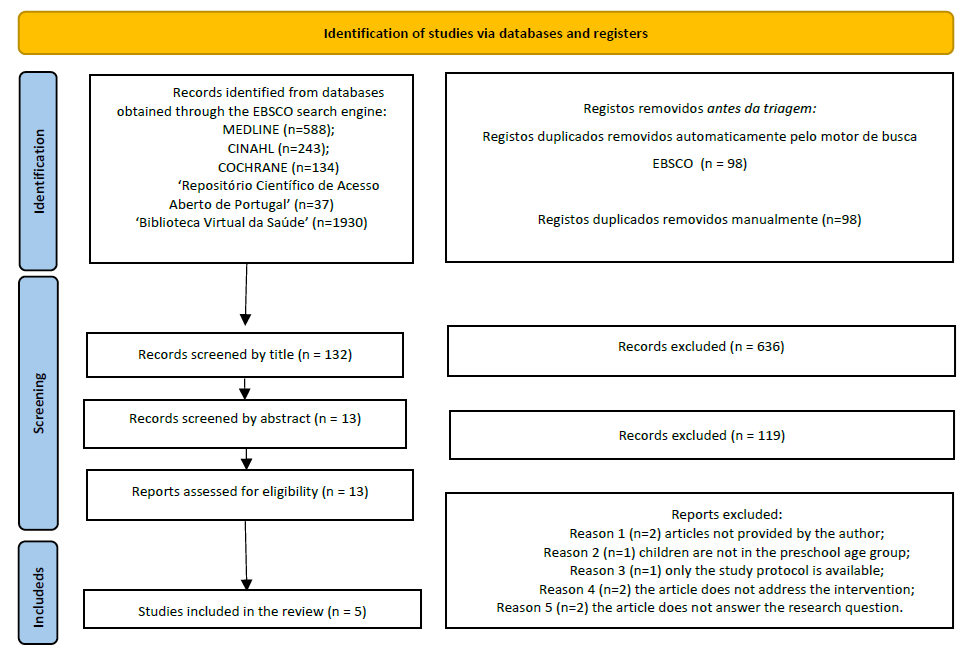
The search identified 964 articles related to the research question. After manual and automatic removal of duplicates, 768 articles were screened by title, with 636 excluded for not addressing the research question regarding participants, concept, and/or context. Subsequently, abstracts were analysed, resulting in a final sample of 13 articles for full-text review. Of these, three were not available in full, and only one was obtained directly from the authors, with the other two excluded. From the full-text review of the 11 articles, one was excluded for not addressing preschool-aged children, another for only including the study protocol, two for not addressing parental empowerment interventions on sleep hygiene, and two that, despite addressing interventions, did not answer the research question. Thus, five articles were included in this Scoping Review. The selection process is presented in the PRISMA ScR® flowchart - Figure 1 (Page et al., 2021)
From the full-text review of the five articles, data extraction and synthesis were conducted, ensuring methodological rigor throughout the process. Considering the theme of this Scoping Review, nursing interventions related to the promotion of sleep hygiene habits directed at parents of preschool-aged children were extracted, as well as interventions aimed at teachers and children, as these also have an influence, even if indirect, on parental empowerment, as presented in the descriptive synthesis in Table 1.
Table 1 Results of the articles included in the Scoping Review
| Author and Year | Title | Study Type | Objective | Results/Conclusions |
|---|---|---|---|---|
| Bonuck et al., 2022 | Effects of a Sleep Health Education Program for Children and Parents on Child Sleep Duration and Difficulties | Stepped-wedge cluster randomized clinical trial | Evaluate the effects of a healthy sleep education program related to sleep duration and difficulties of preschool-aged children, as well as on parents' knowledge, attitudes, self-efficacy, and beliefs about children's sleep nine and twelve months after the program. | Parent training strategy: a sleep health education program for parents and children, which includes: (1) a curriculum for children used by teachers in the classroom (eight 40-minute sessions using books, teddy bears, and songs) + (2) a one-hour workshop for parents (featuring a PowerPoint presentation and the distribution of a take-home guide) + (3) individual discussion sessions with parents (at home or at school). |
| High et al., 1988 | Evaluation of a Clinic-Based Program to Promote Book Sharing and Bedtime Routines Among Low-Income Urban Families with Young Children | Comparative study between two cross-sectional groups. | Evaluate an anticipatory guidance program that provides parents with books for their children, along with developmentally appropriate educational materials explaining why and how they should share the books. | Parent training strategy: anticipatory guidance program that includes: (1) the provision of two books for parents to use with their children as part of a bedtime routine + (2) educational materials given to parents during well-child visits between the child’s ages of six and 36 months (addressing the reasons for and ways of incorporating shared reading as part of the bedtime routine). |
| Wilson et al., 2014 | Evaluation of a Sleep Education Program for Low-Income Preschool Children and Their Families | Randomized Controlled Trial | Evaluate a sleep education program for low-income preschool-aged children and their families. | Parental training strategy: a sleep health education program for parents and preschool children, which includes: (1) a two-week classroom curriculum for children (using interactive lessons), + (2) a single 45-minute workshop for parents (using a PowerPoint presentation covering the following topics - the importance of sleep, recommended hours of sleep by age, and establishing a bedtime routine), with a guide provided at the end of the session (review of the topics covered and a summary of sleep tips), + (3) a single 45-minute workshop for teachers. |
| Folgueiras et al., 2014 | ‘Hábitos de sueño en lactentes y preescolares’ | Analytical Longitudinal Study | To understand sleep habits in infants and preschool-aged children; To identify incorrect sleep habits and behavioural insomnia of childhood (due to poor habits); To assess which strategies improve childhood insomnia. | Parental training strategy: an educational program to improve children’s sleep disturbances identified during interviews with parents at follow-up consultations (focusing on sleep habits, presence and characteristics of daytime sleep, bedtime and bedtime routine, and occurrence of nighttime awakenings). The program includes: (1) Distribution of a leaflet to parents titled ‘El Sueño’ + (2) Encouragement to read the method presented in the book ‘Duérmete Niño by Estivill’. |
| Lin et.al, 2021 | Effects of parental education on screen time, sleep disturbance, and psychosocial adaptation among Asian preschoolers: A randomized controlled study | Cluster Randomized Controlled Trial with a Parallel Group Design | To investigate the effect of a parental education program on screen time, sleep habits, and psychosocial adjustment in preschool-aged children. | Parental training strategy: a parental education program based on Self-Efficacy Theory (Bandura, 1986). The program lasts eight weeks, with one 50-minute session per week, aiming to increase parents’ knowledge and self-efficacy. Various strategies are used, including reflection, discussion groups, and role-play activities. Parents are also provided with a pocketbook containing the most important guidelines. |
3. Discussion
From the comprehensive analysis of the five articles, it was observed that there are strategies that promote parental empowerment in adopting sleep hygiene habits in preschool-aged children. These strategies target children, parents, and teachers across various contexts and highlight the central role of nurses in health education (Trindade & Ramos, 2020).
To synthesize the gathered evidence, the results were grouped into four conceptual categories: School Health Education Programs on Sleep, Anticipatory Guidance Programs, Educational Programs for Sleep Disorders, and Parental Education Programs Based on the Theory of Self-Efficacy (Bandura, 1986).
School Health Education Programs on Sleep
A promising approach to promoting sleep habits is implementing educational programs in school settings (Llaguno et al., 2020). Schools are privileged spaces where collaboration between health professionals, school staff, and families allows for health promotion through curriculum inclusion (Trindade & Ramos, 2020; Wing et al., 2015).
These educational interventions can be led by teachers in the classroom after receiving training provided by nurses (Schneider et al., 2022). Programs like those described by Bonuck et al. (2022) and Wilson et al. (2014) typically last around two weeks, with 40-minute interactive sessions that use playful materials such as books, teddy bears, and music. These activities can involve parents and raise children's awareness of the importance of sleep routines. The use of educational materials facilitates understanding and sparks children's interest, contributing to improved sleep habits for the entire family (Llaguno et al., 2020).
Moreover, maintaining a partnership with parents proves beneficial and enriching for achieving better outcomes in paediatrics. The ‘Enfermeiro Especialista em Saúde Infantil e Pediátrica’ (EESIP) is the health professional who accompanies the child and family during a crucial phase, making it essential to recognize their needs and intervene based on Anne Casey's Partnership-in-Care Model, which considers parents active partners in their child's care (Monteiro & Cerqueira, 2020). By providing family-centered care, the EESIP acknowledges the family's crucial role, considering all its specificities (Salustino et al., 2022). Thus, a partnership can be established between the nurse, child, and parents to achieve maximum quality of life and well-being for the child (Hockenberry & Wilson, 2014). This relationship is based on appropriate, effective, and bidirectional communication, where care negotiation is key (the EESIP recognizes the needs, beliefs, desires, and capabilities of the child and family and reaches an agreement regarding the care provided and each participant's role) (Nobre et al., 2023).
It is important to create teaching opportunities for parents within child care. In the School Health Education field, involving parents in training activities enhances their knowledge and skills related to sleep hygiene routines, enabling empowerment and self-efficacy perception, aiming to prevent long-term sleep issues (Direção-Geral de Saúde, 2015; Kitsaras et al., 2018; Bonuck et al., 2022; Wilson et al., 2014; Llaguno et al., 2020).
To promote parental empowerment in managing children's sleep routines, programs like those by Bonuck et al. (2022) and Wilson et al. (2014) include a 40-minute interactive workshop to enhance parents’ knowledge about sleep and its importance for child development. The workshop covers recommended sleep durations by age and strategies to establish and maintain proper sleep routines. Wilson et al. (2014) also propose providing a guide with tips and strategies to help parents manage children’s sleep routines.
Health education programs aimed at parents facilitate knowledge acquisition, promoting the management of children's sleep routines. This helps create a home environment that supports healthy sleep habits, contributing to children’s well-being and development (Kitsaras et al., 2018). Besides workshops, more personalized interventions like one-on-one or small group discussions are essential for addressing parents’ specific needs. These formats provide a safe space for parents to ask questions and understand which strategies are most suitable for their children (Bonuck et al., 2022).
For these programs to be implemented in schools, teacher training is essential. Given the complexity of the topic, it is important to offer opportunities for teachers to develop teamwork and communication skills, enabling them to understand children's fears, concerns, and beliefs (Direção-Geral de Saúde, 2015). In Wilson et al.'s (2014) program, a 45-minute interactive workshop is proposed for teachers covering several topics: the importance of sleep, recommended sleep hours by age, and effective strategies for establishing and maintaining good sleep routines. The session allows teachers to clarify doubts and share opinions, helping them feel confident addressing this topic with children. Throughout the program, teachers have access to tools to motivate children and support learning (educational posters, teddy bears, books, calendars, etc.) (Wilson et al., 2014).
The results suggest that a combined approach with classroom educational programs for children, workshops with individualized support for parents, alongside workshops for teachers, can be effective interventions for children and empower parents. Nurses, as educators and health facilitators, play a crucial role in implementing these interventions through a partnership with parents and teachers, contributing to children's and families’ overall well-being (Silva et al., 2018).
For such program to be successful, it must be planned according to the population's needs, assessed, and monitored to ensure the goals are being met. Wilson et al. (2014) developed a questionnaire and sleep diary for parents to complete before program implementation, aiming to identify difficulties, routines, and sleep habits to adjust interventions. Completing these tools during and after the program helps assess results, track progress, and adjust activities to ensure success (Wilson et al., 2014).
Other studies, such as Owens et al. (2011), highlight the importance of promoting healthy sleep not just for children but for the whole family. They emphasize using educational opportunities, such as museum visits, to creatively and playfully educate parents about sleep habits.
Additionally, aligning with technological advances, Yoshizaki et al. (2023) conducted a study offering a smartphone app called ‘Nenni Vani.’ The app provides personalized guidance based on family needs, using notifications and explanatory videos to remind parents of daily routines. The app proved effective in increasing parents’ adherence and motivation (Yoshizaki et al., 2023).
Anticipatory Guidance Programs
Another effective approach is anticipatory guidance, which focuses on child health promotion and fosters an active relationship between nurses and parents. This relationship aims to prepare parents to perform their parenting roles with greater confidence and competence. During the child development, parents often face doubts and challenges. Nurses play a key role by providing information that boosts parents’ sense of self-efficacy and equips them to handle these challenges (Burlamaqui et al., 2024).
Several studies highlight that families actively seek parenting information and appreciate access to educational materials, whether printed or digital (Blank, 2003). In this context, child and family-centred care becomes even more relevant, especially regarding the role of nurses. These professionals strategically use points of contact to recognize family competencies and increase knowledge, particularly concerning sleep hygiene (Trindade & Ramos, 2020). Anticipatory guidance can be integrated into parental education, especially during parenting preparation courses and throughout child development consultations (Burlamaqui et al., 2024). High et al. (1998) suggest nurses use these opportunities to teach parents about age-appropriate sleep hygiene practices and provide educational materials that facilitate understanding.
Among the various educational strategies, offering age-appropriate children's books to encourage bedtime reading is notable. This practice promotes children's autonomy in falling asleep and reduces nighttime awakenings (High et al., 1998). Halal and Nunes (2018) support this approach, emphasizing that calming activities like reading should be encouraged 20 to 30 minutes before bedtime, facilitating sleep onset and promoting a more restful environment.
Educational Programs for Sleep Disorders
Nurses intervene early through school health education and anticipatory guidance to promote healthy sleep and prevent issues. When a child struggles with sleep, it impacts not only the child but also the family’s daily life. In such cases, the intervention focuses on resolving the identified sleep disorder (Salavessa & Vilariça, 2009).
Sleep problems, though often underestimated, are common in children and cause significant concern and anxiety among parents (Salavessa & Vilariça, 2009). A key strategy to empower parents is implementing educational programs to manage sleep issues.
During healthcare encounters, nurses collect data to identify sleep-related problems, enabling early and appropriate intervention to minimize short- and long-term impacts (Salavessa & Vilariça, 2009; Torres et al., 2021).
Folgueiras et al. (2017) propose conducting an initial interview with parents during Child and Youth Health Consultations to collect relevant information (sleep routines, sleep duration, and quality) (Torres et al., 2021). They also recommend using a questionnaire and sleep diary to assess parental difficulties in managing sleep routines and better understand children's specific needs (Ogundele & Yemula, 2022).
Several questionnaires can be used by nurses to assess children’s sleep, with the most common being the Children’s Sleep Habits Questionnaire, validated in Portugal as the Child Sleep Habits Questionnaire. This tool, in its full or shortened version, is used to screen for sleep problems, assess sleep habits, and monitor results (Loureiro et al., 2013). Children’s self-reported sleep diaries can assess individual needs, but due to the cognitive development of preschoolers, understanding and self-assessment can be difficult. Therefore, tools like the Sleep Self Report (validated in Portugal) are best applied from age seven or used with younger children through parental collaboration (Loureiro et al., 2013).
Based on the collected data, Folgueiras et al. (2017) advocate for tailored educational interventions, encouraging parents to adopt healthy sleep habits to prevent more severe future consequences. Since sleep hygiene strategies are the first line of treatment for paediatric sleep issues, nurses must focus their interventions on educating children, parents, and caregivers (Ogundele & Yemula, 2022). Child and Youth Health Consultations, besides being ideal for data collection and identifying problems, are also ideal for teaching parents, empowering them to manage sleep routines at home (Folgueiras et al., 2017). To complement oral teaching, distributing educational materials (leaflets, posters, videos) or recommending relevant books (e.g., Estivill’s ‘Duérmete Niño’) helps consolidate concepts and increase parents' confidence (Folgueiras et al., 2017; High et al., 1998). After providing theoretical knowledge, it is important to help parents identify sleep routines best suited to their child’s individual needs. Nurses should then offer specific, personalized advice to support routine management (High et al., 1998).
Results show that nurses' involvement in sleep disorder education programs empowers parents to effectively manage sleep routines at home, improving children's quality of life.
Parental Education Program Based on the Theory of Self-Efficacy (Bandura, 1986)
According to the assumptions of the Transactional Model (2010), the behaviours adopted by parents regarding their children’s sleep influence the quality of the child’s sleep, and vice versa. In this way, another effective strategy for empowering parents on this topic is the use of Parental Education Programs Based on the Theory of Self-Efficacy (Bandura, 1986; Silva et al., 2018).
Children’s sleep affects various areas of their growth and development, making it a crucial area of intervention, particularly in paediatric age groups (Liahuno et al., 2021). Given the complexity of the topic, it is observed that although sleep is an important area, it is still a subject that is rarely addressed (Honaker & Meltzer, 2016).
Through sleep hygiene, parents can influence the initiation and maintenance of their children’s sleep. With the aim of preventing, identifying, and managing sleep problems, nurses play a fundamental role by contributing to parental education and empowerment through interventions that enhance their knowledge and skills in this area (Silva et al., 2018).
Regarding the role of parents in managing sleep hygiene routines, it is essential to explore the concept of parental empowerment. This is defined as the process through which parents adopt an active role in caring for their children, seeking solutions to problems, and strengthening the positive aspects of family dynamics (Oliveira et al., 2020). Parental empowerment is intrinsically linked to parental self-efficacy, which refers to the parents’ perception of their role and their capabilities to carry out parenting responsibilities (Bandura, 1997; Dumka et al., 2010).
Parental self-efficacy is influenced by the balance between parental knowledge and their ability to act. The greater the self-efficacy, the more likely parents are to overcome challenges and achieve their goals. This concept is characterized by the recognition, on the part of parents, of their competence to influence their children’s behaviour and to promote adjustment appropriate to their development (Cotrim & Neto, 2021).
Studies show that high levels of parental self-efficacy are associated with more positive and effective parenting practices, which in turn support empowerment (Glatz & Buchanan, 2023). Thus, it becomes evident that strengthening self-efficacy should be a focus of nurses, particularly in supporting the development of strategies that aim to improve parent-child interactions and facilitate the management of family routines.
Parental education plays a crucial role in promoting healthy sleep habits in children, making it essential that parents recognize the challenges and are willing to learn and improve their skills. In this context, parental self-efficacy emerges as a key factor for the successful management of sleep hygiene routines. Studies show that higher levels of self-efficacy in parents are associated with a reduction in children's screen time, resulting in a significant improvement in sleep quality (Lin et al., 2020).
To foster parental empowerment, strategies that promote increased parental self-efficacy are recommended. Lin et al. (2020) propose a parental education program for parents of preschool-aged children. This program consists of weekly sessions of approximately 50 minutes, held over eight weeks. During these sessions, parents could share knowledge and experiences through participatory activities, aimed at equipping them to properly manage their children's sleep hygiene routines, including reducing screen time.
To complement the sessions, a pocket-sized booklet is provided with a summary of the most relevant guidelines. This practical resource offers parents a quick and accessible reference tool, reinforcing their self-confidence and supporting the proper management of their children’s sleep (Lin et al., 2020).
Additionally, the sessions include activities such as roleplay and discussion groups, which allow parents to reflect on the challenges they face. These activities promote knowledge acquisition and foster a greater perception of parental self-efficacy. As a result, parents become better prepared to implement consistent and appropriate routines at home, contributing to healthier sleep and, consequently, to a better quality of life for their children.
Conclusion
This Scoping Review enabled the mapping of available scientific evidence regarding strategies that promote the empowerment of parents in establishing healthy sleep hygiene habits in preschool-aged children. The analysis revealed that educational interventions, particularly those involving a multidimensional and family-centred approach, have a positive impact on parental health literacy, parental self-efficacy, and the quality of children's sleep.
The implications for practice are clear: nurses should take an active role in the development, implementation, and evaluation of educational programs on sleep hygiene. These professionals are in a privileged position to act across various settings, promoting interventions tailored to the individual needs of families.
The systematic integration of educational actions on sleep into paediatric care should be considered a priority. The use of practical tools such as guides, leaflets, workshops, digital apps, and individualized or group teaching sessions has proven effective and should be encouraged. Moreover, it is essential that nurses have access to continuous training and appropriate resources to perform this role effectively.
Thus, this review reinforces the importance of incorporating the topic of sleep hygiene into daily clinical practice through evidence-based, family-centred interventions, contributing to the prevention of sleep disorders and to the physical, emotional, and cognitive well-being of preschool-aged children.
Acknowledgements
This Scoping Review is part of the course curriculum of the ‘Mestrado em Enfermagem de Saúde Infantil e Pediátrica’ provided at the ‘Escola Superior de Santa Maria’ in Porto.
Authors' contribution
Conceptualization, R.E., G.M. and S.S.; data curation, R.E.; formal analysis, R.E.; funding acquisition, R.E.; investigation, R.E.; methodology, R.E.; project administration, G.M. and S.S.; resources, R.E.; supervision, G.M. and S.S.; validation, G.M. and S.S.; visualization, R.E.; writing-original draft, R.E.; writing-review and editing, G.M. and S.S.

