




 Inglês (pdf)
 Artigo em XML
 Referências do artigo

 Tradução automática
 Enviar este artigo por email
 Citado por SciELO
 Similares em
SciELO

 Permalink


A previously healthy four-year old boy was admitted to the emergency department with recurrent forehead and periorbital swelling with onset a month before, shortly after an upper respiratory tract infection (with rhinorrhea, nasal obstruction, and low-grade fever). He had no other symptoms, namely headache, visual changes, vomiting or neurologic signs, throughout the infection’s clinical course, and there was no history of allergies or trauma.
His condition was initially managed by a primary care physician and treated with amoxicillin-clavulanate for seven days, leading to short-term clinical improvement, followed by recurrence of the swelling. At that time, an outpatient head computed tomography (CT) showed a 4-cm medial frontal soft tissue mass with underlying frontal bone cortical irregularity, without endocranial extension. These findings prompted a seven-day extension of the prescribed course of antibiotics, under primary care management, resulting in partial improvement. Nevertheless, following a new forehead swelling recurrence, he was referred to the emergency department for further evaluation.
At admission, he presented with marked frontal and left periorbital edema (Figure 1). He had no visual defects, eye movement restrictions, pain with eye movements, meningeal signs or other symptoms. A head and sinuses CT revealed extensive epicranial soft tissue swelling on the frontal bone, accompanied by areas of erosion in the frontal bone and continuity to the left frontal sinus with soft tissue content (Figure 2 A-B). Laboratory findings revealed leukocytosis (15100/L, 65% of neutrophils), thrombocytosis (583000/L), and C-reactive protein levels of 2,65 mg/dL.
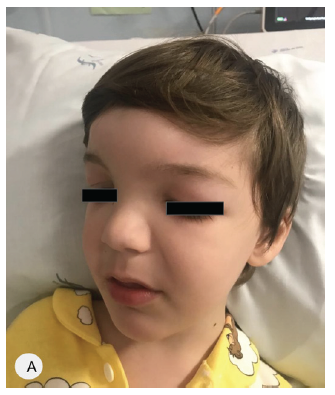
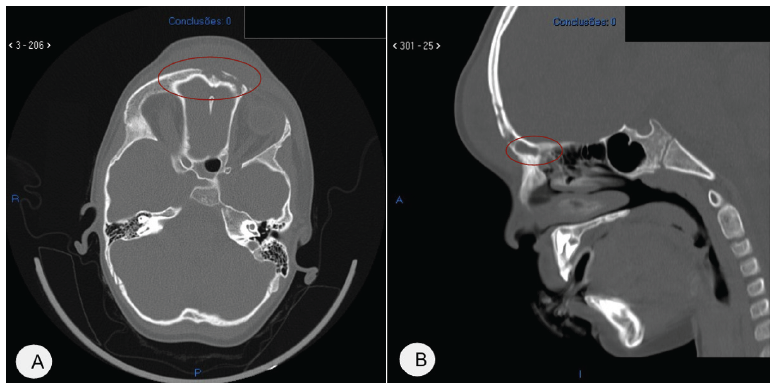
Figure 2A-B Head CT showing epicranial soft tissue swelling, areas of erosion in the frontal bone, and defined continuity to the left frontal sinus (A) and the left frontal sinus (B). (A - bone window, axial plane; B - bone window, sagittal plane).
Discussion
The patient was started on empiric intravenous ceftriaxone and methylprednisolone and underwent abscess drainage via an external surgical approach, through left supraciliary incision, by the Ear, Nose and Throat (ENT) team, which was uneventful. The analysis of the drained fluid identified Streptococcus intermedius, which was susceptible to ceftriaxone, linezolid, gentamicin, penicillin, clindamycin, and vancomycin. Blood cultures were sterile. During hospitalization, the patient showed progressive improvement of the swelling. He was discharged on the 9th day of hospitalization, and antibiotic therapy was switched to targeted oral clindamycin, to be continued for a total of three weeks. Upon follow-up with the ENT team, the patient showed complete recovery.
Pott’s puffy tumor is a subperiosteal abscess of the frontal sinus anterior wall with underlying osteomyelitis. It is a rare entity more often found in adolescence, when sinus pneumatization is completed and flow rate in the diploic veins increases.1-4 However, it can happen at any age, since pneumatization begins at the age of two years, with a few cases described in patients under ten years old.4
It presents as localized frontal swelling, frequently after misdiagnosed or inappropriately treated frontal sinusitis, as it happened in this case. Patients may also have headaches, fever, and purulent or non-purulent nose discharge.1,2 It can be a threatening disease leading to orbital and intracranial complications such as central nervous system (CNS) infection (meningitis or abscess).1,2,4 The spread of the infection can occur directly by erosion of the walls of the frontal sinus or by migration of septic thrombi through the diploic veins to the dura.1,2 Most infections are polymicrobial, from the sinus flora (Streptococcus spp, Staphylococcus aureus and anaerobes).
Prompt diagnosis and management are essential to avoid complications. A CT with contrast is the exam of choice to confirm the diagnosis and to exclude intracranial complications, but magnetic resonance imaging is more sensitive in detecting intracranial involvement, if not clearly characterized on CT or if any doubt persists.1,2
The approach is surgical-drainage and removal of bone affected by osteomyelitis-combined with prolonged administration of intravenous antibiotics. Empiric treatment should consist of broad-spectrum antibiotics with good bone and CNS penetration, subsequently adjusted according to the results of the microbiology tests. The prognosis is often favorable, with most patients recovering without long-term complications or sequelae.1
Authorship
Elda Marques da Costa - Conceptualization; Data curation; Investigation; Methodology; Project administration; Visualization; Writing - original draft; Writing - review & editing
Inês Alves Pereira - Data curation; Visualization; Writing - original draft; Writing - review & editing
Joana Sousa Martins - Conceptualization; Supervision; Visualization; Writing - original draft; Writing - review & editing
Maria Inês Marques - Visualization; Writing - original draft; Writing - review & editing

