




 Inglês (pdf)
 Artigo em XML
 Referências do artigo

 Tradução automática
 Enviar este artigo por email
 Citado por SciELO
 Similares em
SciELO

 Permalink


1. Introduction
This article seeks to analyse the current legal regime of the Portuguese higher education institutions (HEIs), in particular regarding one of the mandatory bodies - the general council (GC). It should be noted that this body assumes important functions in the governance of public HEIs, namely, in the election of the rector universities/and president of the polytechnic institutes.
It should be mentioned, first, that the literature review, particularly the book by Taylor et al., (2008), results in a clear demonstration of the existence of a diversity of higher education models. Moreover, it should also be noted that from very early on (2012) criticisms were raised against the actual model, particularly with regard to the GC (see Amaral et al.,2023 and Pedrosa et al.,2012), which on a general way remained the same, even though the legislative branch has not even tried to make any attempt to change it, at least until 2022. About higher education and its governance and policies see also (Amaral, 2022), (Austin & Jones, 2024) and (Cardoso, Rosa, & Amaral, 2024).
It should also be remembered that the Portuguese higher education system, in addition to being binary, composed of universities and polytechnic institutes, both public and private, also has a mixed legal nature regarding public HEIs, that is, can be foundational or non-foundational (the law simply calls them “legal persons under public law”).
This article presents the results of the extensive investigation carried out in 2021. An extensive survey and fifteen interviews were carried out with various HEIs stakeholders, which are perfectly current as no changes have yet been introduced to the regulatory legislation.
Finally, the conclusions are presented, which summarize the proposals presented, relating to the GC, for a future legislative change, announced about a year ago and for which the government of the time commissioned an independent commission to analyse and propose modifications, in consultation with all those involved, and the model defended.
2. Methodology
In this article, in addition to a brief review of the literature on the topic, is presented the data collected in the survey carried out in 2021, where a wide range of HEI stakeholders were questioned, namely their directors or their representatives (student unions, unions, business associations and professional orders, local authorities and administration bodies), and where around 472 responses were received, as well as the results of interviews carried out at the same time with fifteen top HEIs directors (ten Portuguese and five foreigners). Reports on Portugal from the Organisation for Economic Co-operation and Development (OECD) (OECD, 2019), Center for Higher Education Policy Studies/Conselho Coordenador dos Institutos Superiores Politécnicos [Coordinating Council of Higher Polytechnic Institutes] (CHEPS/CCISP) (File, Weert, & Vossensteyn, 2013) and European University Association/Conselho de Reitores das Universidades Portuguesas [Council of Rectors of Portuguese Universities] (EUA/CRUP) (Blattler et al., 2013) are alsoanalyzed, particularly in the part in which they advocate changes in the structure of the HEIs. A summary is presented here.
The proposed changes are therefore based on the conclusions of the survey, interviews, the aforementioned reports, as well as the authors' extensive experience in top management positions of Portuguese HEIs.
3. The government system resulting from Law No. 62/2007, of September 10 (RJIES)
The Law No. 62/2007, of September 10th, which approved the new Legal Regime of Higher Education Institutions (RJIES, acronym as it came to be known), standardized, although not completely, the governance system for public and private HEIs. Public universities and polytechnic institutes, as well other public non-integrated institutions, have now three bodies: the GC, the rector (or president, as far as polytechnic institutes are concerned) and the management council. In both cases, without prejudice to others, of a consultative nature, that the statutes of each institution provide and, in the case of universities, the academic senate, as a “mandatory consultation body of the rector on the matters defined in the statutes themselves” (Bilau, 2011), (Oliveira, Peixoto, & Silva, 2014), (Lourenço, 2017), with regard to private HEIs, the RJIES, in line with what the previous legislation already enshrined, attributed to the higher education institution that established the educational establishment. the competence to, through its statutes, define its organic structure, limiting itself to establishing which bodies must necessarily exist.
This article analyses the powers of the GC in public HEIs that have been the subject of highest criticism, particularly regarding one of its main powers, the election of rectors and presidents. In effect, it is up to the GC to elect the rector/president, as well as to approve changes to the statutes, powers that, until the entry into force of this new law, were the responsibility of the university assembly or an assembly specifically elected for that purpose. Thus, many of the functions of the previous senate (body existing in the legislation that preceded the RJIES) in universities were transferred to the new GC. Nevertheless, in the polytechnic institutes there was a reinforcement of the powers of this body that already existed before the entry into force of the RJIES.
It is worth highlighting the fact that, after the entry into force of RJIES, the role of the president of the GC and the rector/president no longer coincided. In fact, certainly resulting from the new functions that became the responsibility of the GC, namely the election of the rector/president, the legislator's option was to assign the presidency of the GC to one of the external members, elected by all and to whom the law attributed specific powers.
The management board (replaced the previous administrative board which, in general, maintains its powers. Despite not being part of the HEI structure, the RJIES provides for the existence of a single official auditor (article 117), who controls the asset and financial management of public HEIs. And so, it can be seen that very little or almost nothing has changed: the rector in universities and the president in the case of a polytechnic institute, the director, president or board of directors, in the case of other higher education establishments, the scientific council (or technical-scientific for polytechnics) and the pedagogical council continue to be the bodies whose existence is mandatory. For the rest, the statutes govern, including competence, without prejudice to the fact that, regarding the scientific or technical-scientific councils and the pedagogical council, a reference is made to the regime of public institutions.
Without prejudice, article 146 seeks to ensure that, in the statutes, the participation of students and academic staff in the academic management of educational establishments is guaranteed, establishing its obligation in the pedagogical or pedagogical and scientific councils or technical-scientific, respectively. The same is ensured, regarding the administrative management of the educational establishment, for teachers who, through their representatives on the scientific or technical-scientific council, have their participation guaranteed.
Regarding the topic we are dealing with here, namely the composition and competence of the GCs of HEIs, it should be noted that in 2012 Pedrosa et al. analysed these issues, presenting changes and suggestions (see, for example, p. 118). Also in 2023, in the report commissioned by the government, the independent Commission chaired by Professor Alberto Amaral (Amaral et al., 2023) made several proposals regarding the composition and competence of the GCs. It should be noted that this Commission was created by Order 764/2023 of January 16, 2023, of the Minister of Science, Technology and Higher Education which determined the constitution of an independent commission with the aim of evaluating the application of the Legal Regime of Higher Education Institutions, composed of nine personalities of recognized merit within higher education or who represented students. The report was published by the end of 2023 and, especially due to a change in the government, this process stopped and, until now, no measures have been implemented.
4. Findings
4.1. Survey of various HEI stakeholders
A survey was carried out (using Limesurvey) and answered online by 472 respondents responsible for public HEIs (rectors and presidents, vice-rectors and vice-presidents, pro-rectors and pro-presidents) and their stakeholders (teaching and non-teaching workers and students, through their representative structures, unions and student unions, and other leaders of professional and business associations). This survey took place in 2021, maintaining its relevance and, in part, confirmed by the survey also produced in 2023, by the Independent Evaluation Commission (Amaral et al., 2023). See Table 1 for better description of the sample:
Table 1 Statistical data on survey participants
| N | % | ||
|---|---|---|---|
| Age | Up to 40 years old | 55 | 11,7 |
| 41 - 50 years old | 53 | 11,2 | |
| >50 years old | 67 | 14,2 | |
| No information | 297 | 62,9 | |
| Total | 472 | 100,0 | |
| Academic background | Without high education | 10 | 2,1 |
| Bachelor degree | 16 | 3,4 | |
| Licenciatura degree | 80 | 16,9 | |
| Master degree | 28 | 5,9 | |
| PhD | 39 | 8,3 | |
| No information | 299 | 63,3 | |
| Total | 472 | 100,0 | |
| Institutional framework | Directors and former directors of HEIs - Polytechnics | 34 | 7,2 |
| Directors and former directors of HEIs - Universities | 9 | 1,9 | |
| Leaders and former leaders of higher education student unions - Polytechnics | 28 | 5,9 | |
| Leaders and former leaders of higher education student unions - Universities | 20 | 4,2 | |
| Directors and former directors of business and professional associations | 27 | 5,7 | |
| Other leaders and former leaders of trade unions, public administration and social economy | 50 | 10,6 | |
| No information | 304 | 64,4 | |
| Total | 472 | 100,0 | |
Regarding the GC, there was a question that was addressed directly to it, by including in the legal constraints that the respondents experienced as further conditioning the activity of the HEIs the composition of the GC in terms of balance between the different members, and in which it was considered that this was not the most appropriate way to guarantee the effective participation of external partners and, in this way, influence the functioning of the HEIs. The following table summarize the main results:
Table 2 Legal constraints that affect the activities of HEIs
| Legal constraints that you experience, or that you understand to exist, that most affect the activity of HEIs | Disagree | Indifferent | Agree | Total |
|---|---|---|---|---|
| The composition of the general board in terms of the balance in the number of members between the different bodies (partners) that are part of it, provided for in the Legal Regime of HEIs (RJIES) is not the most appropriate to guarantee an effective participation of external partners and, in this way, influence the functioning of HEIs | 23.5 | 44.9 | 31.6 | 100.0 |
One can notice that 31.6% agree that the composition of the GC, in terms of the balance in the number of members between the different bodies (partners) that are part of it, provided for in the RJIES, is not the most appropriate to guarantee effective participation of external partners and, in this way, influence the functioning of HEIs.
In another question, respondents were asked about the degree of importance they attribute to a set of skills, including the “freedom to reinforce the number and role of external stakeholders”, which obtained the result that appears in the following Table.
Table 3 Degree of importance attributed to some competencies regarding the institutional and management autonomy of HEIs
| Regarding the INSTITUTIONAL AND MANAGEMENT AUTONOMY of HEIs, identify the degree of importance you attribute to the following COMPETENCIES | Nothing important | Little important | Important | Very important | Total |
|---|---|---|---|---|---|
| Freedom to reinforce the number and role of external partners (stakeholders) in management | 2.1 | 8.6 | 59.9 | 29.4 | 100.0 |
As can be seen, 59.9% of the respondents agree that HEIs should have the freedom to reinforce the number and role of external partners (stakeholders) in management.
4.2 Interviews with ten current or former top directors of national HEIs
Regarding the interviews, these were carried out, as already mentioned, with fifteen former and current rectors/presidents/vice-rectors/pro-rectors/presidents/ vice-presidents, ten of whom were nationals (five from universities and five form polytechnics) and five internationals (universities and non-universities). However, it should be noted that in this question regarding the composition and method of election/co-optation of the GC and given its specificity, only the nationals were questioned about it.
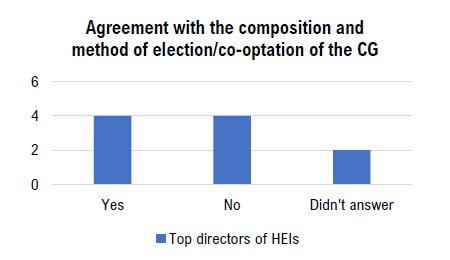
Respondents were also asked whether they agreed with the composition and method of election/co-optation of the GC. As we can see from the following figure (Figure 1), four of the ten national leaders interviewed agree, four respondents do not agree and two do not respond.
Regarding the role of the various stakeholders in the management of HEIs, this issue was the subject of the interviews, where there was a question that addressed it directly, just as it is addressed in the OECD, CHEPS/CCISP reports (although very little) and from EUA/CRUP. Now look at the results. As for the interviews, the answer given to the question regarding the role attributed to stakeholders and the solution they advocate is quite relevant (please see Figure 2).
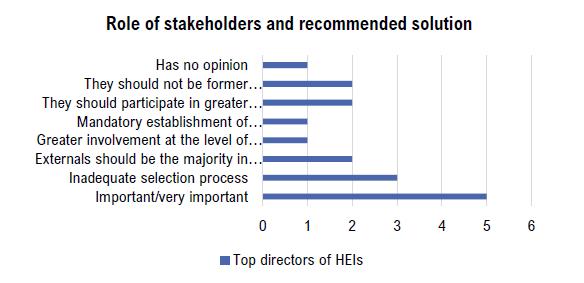
We highlighted among others the following answers: “Has no opinion”; “They should not be former academics or just public figures”; “They should participate in greater numbers”; “Mandatory establishment of advisory bodies”; “Greater involvement at the level of secondary education and business institutions”; “Externals should be the majority in the GC”; “Inadequate selection process”; “Important/very important.”
4.3 Reports from OECD, CHEPS/CCISP and EUA/CRUP
When analysing the reports, the following should be highlighted:
1) OECD - In this report starting by listing several stakeholders of HEIs, expressly referring to “government officials; agencies which are part of the governance of the higher education, research and innovation system; senior management in higher education and research institutions; entrepreneurs; business leaders and researchers; as well as the general public» (OECD, 2019, p. 3). It should be noted, that international experience shows that the benefit of a strategy often derives as much from the process of creating it as from its results and that strategies are not the result of a top-down approach rather than imposing priorities, they must involve a wide range of stakeholders, from the research community, funding agencies, businesses and civil society to regional and local governments in formulating and implementing policies. Portugal has been making progress in this regard, and although it is too early to evaluate these initiatives, the participatory approach adopted to develop the 2014 Smart Specialization Strategy, together with some recent national initiatives, has marked a change in the style of policy formulation for greater stakeholder participation in higher education, research and innovation policy (ibid., p. 25). This report expressly and specifically states that the various stakeholders may also increase their participation (take on the role of) in the following way:
In polytechnics, evaluating the proposed doctoral program to ensure that it is distinctly professional or practice-focused in its profile (ibid, p. 33);
Getting involved in the development and implementation of new access routes to higher education (ibid., p. 41 and 185);
Provide strategic advice to management bodies, particularly Fundação para a Ciência e Tecnologia (FCT) (ibid., p. 122);
Integrate the Conselho Coordenador do Ensino Superior (CCES) (ibid., p. 125);
Increasing participation or cooperation between academic research and the productive sectors and public services, which is traditionally limited (ibid., p.208).
2) CHEPS/CCISP - analysing this report again, now to check what it contains about the role of the various stakeholders , there is no great detail about their role, apart from the fact that it points out their importance for HEIs, which is mentioned many times, notably explicitly pointing to collaboration with external parties ( File, Weert, & Vossensteyn, 2013 , p. 26).
3) EUA/CRUP - finally, with regard to this third report, it can be noted that it is profuse in reference to stakeholders, especially because they were heard extensively during the fieldwork of the team that visited the HEIs. In fact, the report is explicit about the hearing that was carried out with them, on various aspects, namely their perception and which, naturally, was of great interest for the production of this report and which covered the different areas on which it focused. It will always be highlighted, however, that the report begins by calling on all subsectors of higher education and research, which should be mobilized to face Portuguese structural and economic difficulties, the most effective combination of education and training, basic research and applied, knowledge creation and transfer, innovation and international collaboration. Trans-binary cooperation, in particular, was already seen as crucial at that time, but, they noted, it could not operate to its full potential until the binary distinction was clearly defined. «To this end, the CCES (Conselho Coordenador do Ensino Superior), enshrined in legislation but never activated, should be convened, re-configured and re-empowered. Representative of all stakeholders, and acting as a buffer between government and institutions, it will be able to formulate a national higher education strategy based on consensus. It will retain advisory functions, but will gain important regulatory duties, allowing it to steer the creation of a flexible, user-friendly, effective binary system based on distinctiveness of mission and parity of esteem » ( (Blattler et al., 2013, p . 7).
Moreover, it should be noted that this report produced 43 recommendations addressed to the various stakeholders, as shown in the indicative roadmap, which also provides a better understanding of what each person is intended to do and, therefore, to whom the corresponding recommendation is addressed (ibid.)., p. 9/10). Interestingly, to all “All stakeholders”, recommendations 12, 13 and 20 are addressed.
5. Proposal to change the RJIES
None of the results presented surprise us either. In fact, for example, over time, the form of election/appointment of the rector/president has never been peaceful, namely whether the result should be a broad election, by the entire community directly or indirectly, in this case by a greater or lesser number of participants. Nevertheless, there have always been defenders of both solutions.
In view of all these results, in addition to the perception that we have been building over the years and the importance of finding a solution that is feasible and easily accepted by HEIs, we believe it is necessary to propose, in particular, the following regarding changes to the organization of institutions:
1) As a first principle, the HEIs (of an associative or foundational nature) must be left to choose the organization they best consider adopting to pursue the purposes of that specific institution, simply defining “minimums”, becoming the bodies of the HEIs for supervision (until now already existing, but not included in the organic structure);
2) In these “minimum” there will be a deliberation, control and supervision body (general and supervisory council) with a maximum (21) and minimum (11) number of legally established members, just as in associative-type HEIs there will be an assembly, opposed to the board of trustees existing in foundation-type HEIs, maximum bodies guaranteeing the greater autonomy that is sought to be conferred on HEIs and which assume powers hitherto held by the supervising minister, and it is established that the election of members of the different bodies, in representation or no, it must be done by single-member election and not by lists;
3) The rector/president body must be maintained for HEIs of a university or polytechnic nature, respectively, and the law does not provide for any further differences between university and polytechnic HEIs, other than those that may arise from the statutory autonomy of the institutions;
4) External elements must be a majority in the bodies in which they participate, under the consequence of seeing their role diminished or even neutralized, and the current form of co-optation must be changed, just as it must be guaranteed that they are “true” external, that is, from outside the higher education system and are not linked to any national legislative body; the internal elements will be composed of representatives of three groups (academic staff, students and non-academic staff) of which none may have more than a third of the total number of members in the case of the general or supervisory board or half or more of the number total number of members in the case of the assembly;
5) In order to prevent conflicts of interest, incompatibilities must be defined in the exercise of mandates in more than one body, namely in the deliberative, control and supervisory body;
6) To put an end to the current distortion of the GC, which is practically elected/chosen thinking about the personality to be elected as rector/president, this process must require the intervention of two bodies, one of which is responsible for proposing, through a selective process, a maximum of three names from among the candidates and the other one who is responsible for nominating from among the names proposed (a solution that can be observed in countries like Austria (Pedrosa et al., 2012), (Krüger et al., 2018)).
We cannot agree more with the proposal in the aforementioned reports. Leaning towards a management model in accordance with New Public Management (NPM) or Network Governance (NG) (Donina & Paleari, 2019) , the role to be played by the various stakeholders proves to be essential. On the “Board”, they play an important role, particularly the external members.
Hence, in our proposals regarding the organization of HEIs, the GC (which would be called the general and supervisory council) would be composed, mainly, of external members. Not external members designated or elected by internal representatives, but external members designated by external entities (those that can do so are identified), in order to increase their independence in relation to internal representatives.
For all this, the role of the various stakeholders must be clearly reinforced, and they might also begin to intervene in some strategic management acts. With all this, the aim is also to involve them in the management of the HEI, so that they participate in it and can better understand many of the conditions that surround it, at the same time that they are committed to the approved solutions. And this relationship or commitment is increasingly fundamental for HEIs. Ithas always been recognized, but the conditions for committed participation and truly promoting change in HEIs through the external influence of those outside the system have not always existed (if they ever existed).
The reinforcement of external members (external stakeholders), and those external to academia in all HEIs, aims above all to increase society's relationship and commitment with HEIs. It makes no sense to allow external members to be linked to the system, nor can HEIs withdraw benefits from those who, after all, are part of it even if retired or belonging to a different institution. Likewise, with regard to part of the political power, it is the legislative power. Does it make any sense that deputies to the Assembly of the Republic (in other words politicians) should be part of GCs as external members?
This is precisely the objective we aim to achieve by establishing that the general and supervisory council (a fundamental body in the management of HEIs) will include a majority of external members.
See, then in Table 4, what is proposed:
Table 4 Changes to be proposed
| Regarding organic structure |
|---|
| CHANGES TO PROPOSE |
| Article 77 Governing and supervisory bodies of universities and university institutes 1 - The following constitute mandatory bodies of universities and university institutes: a) The assembly of the university or university institute; b) The general and supervisory council; c) The rector; d) A collegial executive body, which exercises direction and management powers, particularly in administrative and financial matters; e) A supervisory body for asset and financial management, which includes an official auditor or a single auditor who, in this case, must be an official auditor or a company of official auditors. 2 - In addition to the bodies provided for in the previous paragraph, the statutes may provide for the existence of other bodies. |
| Article 78 Governing and supervisory bodies of polytechnic universities and polytechnic institutes 1 - The following constitute mandatory bodies of polytechnic universities and polytechnic institutes: a) The assembly of the polytechnic university or polytechnic institute; b) The general and supervisory council; c) The president; d) A collegiate executive body, which exercises direction and management powers, particularly in administrative and financial matters; e) A supervisory body for asset and financial management, which includes an official auditor or a single auditor who, in this case, must be an official auditor or a company of official auditors. 2 - In addition to the bodies provided for in the previous paragraph, the statutes may provide for the existence of other bodies. |
| Section III (formerly Section II) General and supervisory council Article 81 Composition of the general and supervisory council 1 - The general and supervisory council is made up of 11 to 21 members, in accordance with the statutes and according to the size of each institution and the number of its organic teaching and research units. 2 - The following are members of the general and supervisory council: a) Representatives of teachers and researchers; b) Student representatives; c) Representatives of non-teaching and non-research staff; d) External personalities of recognized merit, not belonging to the institution, with knowledge and experience relevant to it. 3 - The members referred to in paragraph a) of the previous paragraph: a) They are elected by all teachers and researchers of the higher education institution, on a single-member list, in accordance with the statutes; b) They must not constitute more than one third of the total members of the general and supervisory council. 4 - The members referred to in paragraph b) of paragraph 2: a) They are elected by all students of the higher education institution, on a single-member list, in accordance with the statutes; b) They must not constitute more than one third of the total members of the general and supervisory council. 5 - The members referred to in paragraph c) of paragraph 2: a) They are elected by all non-teaching and non-research staff of the higher education institution, on a single-member list, in accordance with the statutes; b) They must not constitute more than one third of the total members of the general and supervisory council. 6- The members referred to in paragraph d) of paragraph 2: a) They are appointed by the assembly, upon proposal from the respective organizations or external entities, in accordance with the statutes; b) They must constitute more than half of the total members of the general and supervisory council. 7- The statutes of each institution establish the way in which organizations or external entities are chosen to propose external members, with such organizations or external entities: a) They must be regional coordination and development committees for the headquarters area of the higher education institution, municipalities, metropolitan areas or inter-municipal communities where the higher education institution's facilities are located, regional entities from different sectors, business associations or professional public associations with headquarters or services in municipalities where higher education institutions have facilities; b) They cannot each propose more than two members for the same higher education institution, who cannot be higher education teachers or researchers nor be retired or retired from that profession, nor can they hold positions or functions in the bodies of national legislative power. 8 - The term of office of elected or appointed members is four years, except in the case of students, where it is two years, both of which can be renewed consecutively once, and cannot be removed, except by the general and supervisory council itself, by absolute majority, in case of serious misconduct, in accordance with the body's own regulations. 9 - The exercise of the mandate of member of the general and supervisory council is incompatible with the exercise of any other position in the bodies of any higher education institution or its organic units, as well as with the situation of being retired or retired. 9- The members of the general board, once appointed, do not represent organic units, groups or sectoral interests and are independent in the exercise of their functions. 10 - The results of the calculations referred to in paragraphs b) of paragraphs 3, 4 and 5 when they have a decimal part are rounded to the next lower integer. |
| Article 82 Competence of the general and supervisory council 1 - The general and supervisory council, among other powers assigned by the statutes of the higher education institution, is responsible for: a) Elect its president, by absolute majority, from among the members referred to in paragraph d) of paragraph 2 of the previous article; b) Approve its regulations; c) Approve proposals for changes to the statutes to be submitted to the assembly, in accordance with paragraphs 2 to 4 of article 68; d) Elect the rector or president, in accordance with the law, statutes and applicable regulations, from among the names presented to him by the assembly, resulting from the selection process, as well as approve his dismissal, in accordance with the law and regulations statutes; e) Propose to the assembly the members of the collegial executive body, and the supervisory body or the sole inspector, as well as their dismissal; f) Provide, in accordance with the law and statutes, the replacement of members of the collegial executive body, in case of permanent absence or temporary impediment; g) Permanently monitor the activity of the rector/president/director as well as the collegial executive body, providing them with advice and assistance regarding strategy, achievement of objectives and compliance with applicable legal standards; h) Monitor and evaluate internal procedures on accounting and auditing matters, the internal control system and the internal audit system; i) Supervise the activity of the collegial executive body; j) Permanently monitor the activity of the supervisory body or sole inspector, proposing to the assembly their appointment and dismissal and also commenting on their conditions of independence; k) Negotiate and establish the remuneration of the statutory auditor, member of the supervisory body, or sole auditor; l) Obtain the financial or other means necessary for its activity and request the rector/president/director to adopt the measures or corrections it deems relevant, proceeding to hire the necessary means for its own independent advice; m) Verify the regularity of accounting records and documents that support them, assets or values held by the higher education institution in any capacity, when deemed appropriate and in the manner deemed appropriate; n) Appreciate the actions of the rector or president; o) Supervise the process of preparing and disclosing financial information; p) Propose the initiatives that it considers necessary for the proper functioning of the institution; q) Request the convening of the meeting when deemed appropriate; r) Perform other functions provided for by law or statutes. 2 - The general and supervisory council, upon proposal from the rector or president, is responsible for: a) Approve for approval the medium-term strategic plans and the action plan for the four-year term of office of the rector or president; b) Approve for approval the general guidelines of the institution in scientific, pedagogical, financial and patrimonial terms; c) Create, transform or extinguish organic units; d) Approve for approval the annual activity plans and assess the annual report on the institution's activities; e) Approve the budget proposal for approval; f) Establish the fees owed by students; g) Issue a favourable opinion on mergers or integrations, given by an absolute majority of the members in full office, who must also approve, if applicable, the proposals for new statutes and/or the designation to be adopted, to be submitted for approval by the assembly; h) Issue a favourable opinion on the transformation of the institution into a foundation, given by an absolute majority of the members in full office, who must also approve, if applicable, the proposals for new statutes and/or the designation to be adopted, to be submitted to approval of the assembly; i) Give an opinion on other matters presented to you by the rector or president. 3 - The general and supervisory council, upon proposal from the collegiate executive body, is responsible for: a) Approve for approval the consolidated annual accounts, accompanied by the opinion of the supervisory body or the sole auditor; b) Issue a prior opinion on the acquisition or sale of the institution's real estate assets, as well as on credit operations; 3 - The deliberations referred to in paragraphs a) to d) of paragraph 2 and paragraph a) of paragraph 3 are necessarily preceded by the assessment of an opinion, to be drawn up and approved by the external members referred to in the paragraph d) of paragraph 2 of the previous article. 4 - The deliberations of the general board are approved by a simple majority, except in cases where the law or statutes require an absolute majority or a more demanding majority. 5 - In all matters within its competence, the general and supervisory council may request opinions from other bodies of the institution or its organic units, particularly bodies of a consultative nature. |
| Article 83 Competence of the chairman of the general and supervisory council 1 - The president of the general and supervisory council is responsible for: a) […]; b) Declare or verify vacancies on the general and supervisory council and make the necessary replacements, in accordance with the statutes; c) Institutionally represent the general and supervisory council; d) Coordinate the activity of the general and supervisory council and supervise the correct functioning of its eventual committees; e) Provide timely availability to the members of the general and supervisory council of the information necessary for the full development of their functions; f) Receive and request information from the rector/president/director about the activities of the higher education institution; g) Ensure the correct execution of the deliberations of the general and supervisory council. h) Carry out other tasks assigned to it by statute. 2 - […]. 3 - The president of the general and supervisory council or, in his absence or impediment, a member delegated by this body designated for this purpose, may, whenever he deems it convenient, and without the right to vote, attend meetings of the assembly and other collegiate bodies of the higher education institution and participate in the discussion of matters to be submitted to the general and supervisory council. |
| Article 84 General and supervisory council meetings 1 - The general and supervisory council meets ordinarily in accordance with the institution's statutes, but at least four times a year, in addition to the extraordinary meetings called by its president, on his initiative, at the request of the rector or president of the institution, the assembly or still a third of its members. 2 - The general and supervisory council operates in plenary or through specialized committees, and is governed in accordance with its regulations. 3 - By decision of the general and supervisory council, the following may participate in meetings, without the right to vote: a) The directors of the organic units; b) Personalities invited to speak on subjects of their specialty. 4 - The rector or president participates in meetings of the general and supervisory council, without the right to vote. |
6. Final thoughts
From the analysis of the literature, particularly that resulting from the publication by Taylor et al., (2008), a clear demonstration of the existence of a diversity of higher education models results. On the other hand, the Portuguese higher education system is binary, made up of public and private universities and polytechnic institutes, and it should be noted that within public HEIs it is still necessary to distinguish between those designated as foundational and non-foundational institutions.
The analysis of the answers to the questions formulated within the scope of the survey and the interviews carried out, as well the analysis of the reports prepared by Pedrosa et al., (2012) and Amaral et al., (2023), it seems to us that it can’t be said that Portuguese HEIs have an organization suitable for a good functioning.
From the research it emerges that the composition of the GC, in terms of balance in the number of members between the various bodies (partners) that form part of it, as provided for in the RJIES, it is not the most appropriate to guarantee the effective participation of external partners and, therefore, way, influence the functioning of HEIs. Moreover, HEIs must have the freedom to reinforce the number and role of external partners (stakeholder) in their management.
In the interviews with the top directors of the HEIs, there is clearly no agreement with the composition and method of election/co-optation of the GC, as four of the directors agree, four do not agree and two do not respond.
The reports from the OECD, CHEPS/CCISP and EUA/CRUP show the great importance attributed to the various stakeholders, who may not have the appropriate competences in the legislation in force for this importance.
A series of changes to the structure of the HEIs were proposed, and regarding the GC, whose proposed new name is the general and supervisory council, the following is expected to be most important:
1) That the general and supervisory council now have between 11 and 21 members, depending on the size of each institution and the number of its organic teaching and research units, and in accordance with what is established in the IES statutes;
2) The statutes of each institution establish the method for choosing external organizations or entities that are responsible for proposing external members, and such external organizations or entities must meet the conditions set out in paragraph 7 of article 81, as amended. proposed here;
3) The term of office of elected or appointed members must comply with the provisions of paragraph 8 of article 81, as proposed here;
4) The exercise of the mandate of member of the general and supervisory council must comply with the provisions of paragraph 9 of article 81 in the wording proposed here;
5) The powers of the general and supervisory council are readjusted due to the creation of the new body - the assembly - and the reconfiguration of the powers of the board of trustees.

