




 Inglês (pdf)
 Artigo em XML
 Referências do artigo

 Tradução automática
 Enviar este artigo por email
 Citado por SciELO
 Similares em
SciELO

 Permalink


1. Introduction
Covid-19 had an impact on education. In the context of our higher education institution, it can be reflected in how the Porto Accounting and Business School (ISCAP) of Polytechnic Institute of Porto can act when going from face to face to fully online education. There are internal and external factors to ISCAP that influence its level of institutional maturity, as well as recommendations that could be considered in order to have a positive impact on increasing the institute's maturity in relation to e-Learning. The problem at hand is to know at what level of maturity is the Higher Institute of Accounting and Administration of Porto, with regard to e-Learning. The present work is relevant, as this study intends to obtain a set of recommendations for possible needs for the implementation of e-Learning solutions. There is also the possibility of being replicated in other higher education institutions.
2. E-Learning
The concept of e-Learning is known for having a “complex, evolving and contextual definition, varying according to different institutions, professional groups, and companies, crossing different temporal spaces" and its evolution ends up being interconnected with the evolution of technologies covid. e-Learning consists of a distance learning modality that is based on internet technologies, and learning takes place remotely (Gonçalves, 2007). This type of teaching comprises "a wide range of variants ranging from occasional teaching and learning practices mediated by digital technologies to the development and provision of exclusively online courses" (Dias et al., 2015, p. 4). According to Peres and Pimenta (2011), e-Learning can be understood as the approximation between teaching and learning and online education. This education is student-centered, interactive, and can be done anytime, anywhere, which makes it flexible, with each student choosing their own pace of work.
Thus, e-Learning appears as a "product generated by the information society in the digital age that involves new lifelong teaching-learning models and allows for innovative applications in education" (Lemos, 2011, p. 9). This type of teaching, due to its characteristics, such as its low cost and the fact that it is flexible in social, economic and geographic terms, is usually able to stimulate a greater interest in potential trainees. According to Gonçalves (2007), the fact that there are no limitations with regard to time or physical space, as mentioned above, is a great advantage for people whose professional activity is demanding or who are far from the place of education.
Another feature that is important to mention is the fact that e-Learning allows information shared on the Internet to be changed, corrected quickly (Cação & Dias, 2003). It is also very important to mention that e-Learning is not intended to replace a teacher, because it will always be necessary the teacher to guide (Gonçalves, 2007).
Currently, teachers and students who interact through virtual teaching environments are in contact with various Internet tools (Junior, 2008). These virtual teaching and learning environments are based on online platforms that contain tools that allow the creation, tutoring and management of activities. These platforms< aim to provide content and create interactivity between the people involved in them, in order to obtain knowledge (de Souza, 2020). The tools available online are accessible resources to use, which enable ease of communication and interaction between academic communities, as well as encourage the collaborative work and knowledge sharing (Junior, 2008).
2.1. E-Learning in Higher Education in Portugal
Historically, universities play an important role in society, in the creation and development of leaders, entrepreneurs, good professionals and academics (Azeiteiro et al., 2015). With regard to education, Portugal follows the changes defined and suggested by the OECD and the European Commission, which determine “norms for the innovation of teaching systems and practices, even calling for changes in the current educational paradigms” (Lemos, 2011, p. 22)
The introduction of this teaching modality in higher education institutions is based on a "process with some systematization and some success at world level" (Magano et al., 2008, p. 79). In Portugal, despite e-Learning being used as part of pedagogical education, most e-Learning initiatives that are observed in Higher Education Institutions (HEIs) focus on this as a way to support classroom curricular units (Magano et al., 2008).
New technologies and online environments are a challenge for higher education institutions, due to their notorious growth (Pedro et al., 2011). The adoption of e-Learning in higher education institutions can be seen as a process of learning evolution and innovation, and a way to explore technological teaching tools.
According to Lemos (2011), higher education institutions have been able to boost themselves in order to be able to keep up with change, using e-Learning initiatives. Despite that, it has already been observed that “the traditional resistance to change delays the processes of adapting structures to the demands of a knowledge society. If, on one hand, HEIs are perceived as sources of knowledge that enable key social changes, on the other, they are understood as organizations with strong resistance to internal change, that is, in their own logic of operation" (Lemos, 2011, p. 21).
According to Pedro et al. (2011), in Portugal the e-Learning initiatives still cover a small percentage of Higher Education students. Still in a study by Lemos (2011), it is mentioned that the increase in distance learning initiatives follows the evolution of new technologies, "both in terms of the number of students involved, and in terms of the number of Higher Education Institutions that have started to adopt this type of teaching in their offer formative" (Lemos, 2011, p. 20).
There are several expectations registered by them with regard to the adoption of e-Learning, such as improving the quality of university education, greater productivity on the part of students and teachers, the development of institutions and greater recognition of their images (by Carvalho & Cardoso, 2003).
Considering the continuous technological advance, the socio-economic changes in Portugal, the consequences of its turmoil in education are unknown. However, it can be mentioned that HEIs are increasingly in competition with each other, both for their recognition and for the search for students and funding (Pedro et al., 2011).
E-learning can be found within the broad spectrum of innovative learning methodologies. This training approach is conceived as a virtual instruction, carried out through content management platforms to carry out the teaching and learning process in a digital environment (Moreno-Gerrero A. J, et al., 2020).
2.2. E-Learning Benchmarking
Benchmarking is a relatively new phenomenon in higher education. This is based on an internal organizational process, which aims to improve the performance of an organization, focusing on their possible improvements (Ossiannilsson, 2012a). According to Ossiannilsson (2012b), benchmarking over the past few years, has not been widely used in higher education, especially with regard to e-Learning. And according to the same, aspects such as quality assurance, quality indicators, benchmarks and critical success factors have not been fully considered with regard to the quality of higher education (Ossiannilsson, 2012b).
HEIs constantly face new challenges, in order to be competitive in educational, social, technological and management aspects, and also in order to be able to work in global perspectives, maintaining innovation (Ossiannilsson, 2012b).
Topics such as respect for students and their learning methods, the way they act through funding, the contribution to economic growth and the sustainability and quality of education become increasingly important in a higher education institution. Therefore, HEIs have to respond to the vast demand for teaching based on new technologies (Ossiannilsson, 2012b).
This process helps to identify the changes that are needed in an institution, in order to achieve the intended goals, although benchmarking is not only about changes, but also about improvements. Benchmarking is, therefore, a continuous process that aims to improve the performance of HEIs (Ossiannilsson, 2012b). By default, maturity models are supported by benchmarking practices or models (Monteiro, 2016).
According to Monteiro (2016), despite the benchmarking models being oriented towards quality, there are components that highlight strategies that can be implemented in institutions for their success and competitiveness.
In conclusion, “A successful benchmarking effort should be able to inform an institution's planning and resourcing processes and the outcomes of this pilot should lead to an informed decision about a method for benchmarking the embedding of e-Learning, both for the particular institution and for the sector, which in turn can lead to operational suggestions for improvement” (Petch et al., 2007, p. 1).
2.3. Institutional maturity towards e-Learning
The entry of e-Learning in a HEI requires a change at an organizational and cultural level, as well as a change in administrative and pedagogical practices adopted. Since the capacity of an institution at a strategic and institutional level, with the implementation of e-Learning, constitutes a decisive factor (Silva et al., 2007).
According to Berge (2004; cited by Silva et al., 2007), “there are five degrees of institutional maturity in relation to e-Learning, the institution that:
Never performed any activity related to e-Learning;
Performed specific and disaggregated activities;
Has the ability to organize and carry out activities if they arise;
It has a defined and planned strategy for implementing e-Learning;
e-Learning is part of institutional practice" (Silva et al., 2007, p. 3).
These degrees of maturity create a variety of obstacles depending on the positioning of HEIs. In the first four degrees mentioned, "organizational change, understood as the attitudes and habits that give an institution an identity is one of the difficulties to overcome, requiring an integrated institutional strategy that promotes the advantages of adopting complementary methodologies to face-to-face teaching" (Silva et al., 2007, p. 3).
According to Cação (2014), maturity in e-Learning consists of maximizing skills, optimizing responses to existing needs, reflecting on past experiences and recovering from situations that did not go well. According to it, maturity models make it possible to understand a complex reality, place an organization on a scale and simplify the identification of a progression path (Cation, 2014).
The evaluation of the maturity of an HEI allows e-Learning projects to be delineated, strategies and practices improved (Cation, 2014).
According to Cação (2014), there are seven dimensions of maturity:
Strategy (in short, it is based on the reasons why e-Learning is used, on its importance in the HEI's development strategy, on the development of procedures and on the attitudes taken by top management towards this teaching modality);
Structure (the structure of the organization and its evolution, the physical resources needed to support e-Learning and its strategies, the financial investment in it and the internal conduct of e-Learning as well as its degree of formalization and supervision);
Experience (safety in e-Learning initiatives, understanding of them being isolated experiences as well as their quality, ability to deal with and manage to overcome negative experiences and ability to think about new experiences);
Learning design (based on whether the platforms and tools chosen are appropriate, the degree of use and understanding of them, the methods chosen to update and develop courses, and pedagogical innovation);
Learning products (corresponds to the types and technological support of the training products developed or used and the complexity and variety of the training portfolio);
Learning process (this dimension is supported by the elaboration of individualized e-Learning projects, performance indicators, procedures and tools used to assess e-Learning practices, and its use as a way to promote informal learning);
People (for whom e-Learning courses are recommended and their maturity and attitudes, as well as the development and maturity of the training management team).
With this, knowing the maturity of an institution makes it possible to recognize the aspects that need to be improved, as well as to organize and develop for e-Learning projects (Cação, 2014a).
3. Methodology
This study aims to analyze the level of institutional maturity of ISCAP in relation to e-Learning. The methodology to be followed in this work is part of a case study. This choice is due to the fact that the case study represents “the preferred strategy when asking "how" and "why" questions, when the researcher has little control over the events and when the focus is on inserted contemporary phenomena in some real-life context" (Yin, 2001, p. 19). Case studies are tailor-made for exploring new processes or behaviors or ones that are little understood.
Moreover, researchers have argued that certain kinds of information can be difficult or even impossible to tackle by means other than qualitative approaches such as the case study. An important advantage of case study research is the opportunity for a holistic view of the process.
Related to the instruments, It was used the questionnaires and an interview. The method of data collection using questionnaires are usually relatively quick to complete, are relatively economical and are usually easy to analyse. The use of an interview intended to confirm some results of the questionnaire and help us understanding the holistic view of the process. In line with the explorative nature of the study, the goal of the interviews was to see the research topic from the perspective of the interviewee, and to understand why she came to have this particular perspective. To meet this goal, we used an unstructured interview.
3.1. Research Questions
This case study aims to answer the following generic questions:
What is the maturity level regarding ISCAP's e-Learning?
How can the adaptation of ISCAP to e-Learning systems be improved?
In addition to these, the following research sub-questions stand out:
3.2. Methodological approach
This case study will be guided by a mixed approach, as both quantitative and qualitative methods will be used. ‘Mixed methods’ is a research approach whereby researchers collect and analyse both quantitative and qualitative data within the same study. Mixed methods research draws on potential strengths of both qualitative and quantitative methods, allowing researchers to explore diverse perspectives and uncover relationships that exist between the intricate layers of our multifaceted research questions.
3.2.1. Study object and sample
This case study is applied at the Porto Accounting and Business School (ISCAP) of Polytechnic Institute of Porto (P.PORTO). Considering that the main objective of this case study is to know the level of institutional maturity in relation to e-Learning, this work seeks to analyze the practices and strategies of e-Learning at ISCAP. ISCAP is a school of P.PORTO. It presents an offer in the field of business sciences, containing eight degrees, fifteen masters, eleven postgraduate courses, five TeSP courses and year zero. In the current academic year, ISCAP has 228 teachers and 4928 students.
To carry out this study, it was considered essential to have ISCAP teachers as participants. It is through this sample that the necessary results will be obtained to fulfill the proposed objective of this study.
3.3. Categorization of responses
After a first reading of the answers to be analyzed, the intention was to code (highlight, classify, aggregate and categorize) into major themes. Categorized questions are a type of closed-ended questions that have multiple mutually exclusive answer options (Bukowitz & Williams, 2002; Vianna et al., 2017).
The evaluation criteria used in the categorization of responses suggest that: Strong (F) - the statement is strongly descriptive in the organization studied; Moderate (M) - the statement is moderately descriptive; Weak (Fr) - the statement is weakly descriptive (Vianna et al., 2017).
For data analysis and interpretation, Bukowitz & Williams (2002) explain that the higher the percentage obtained in the answers in a section, the better the performance.
4. Results
4.1. Pre-test of the questionnaire for teachers
4.1.1. Pre-test of the Faculty Questionnaire
Conducting a pre-test to validate the questionnaire became essential. In this way, it was possible to adjust some questions from the initial questionnaire in order to ensure that this instrument was clear to all respondents and that later the data obtained would be useful for the ongoing research work.
Considering the difficulty of predicting the different possible interpretations for the questions presented in the questionnaire, the use of the pre-test intends to solve these situations.
The questions presented in the questionnaire were related to the categories and dimensions of the e-Learning Maturity Model mentioned in the literature review. During the process of applying the pre-test, all groups of questions ended with an open answer that asked the professor who carried out the pre-test if there was any question that was not clear and the reason for this difficulty in understanding.
All comments and suggestions received were analyzed, resulting in the adaptation of the questionnaire in order to make this instrument more understandable and easier to answer by all those involved in the process.
With this, the pre-test ended up enabling the improvement of the questionnaire and its application.
4.1.2. Questionnaire for ISCAP faculty members
The questionnaire presented below resulted from the literature review process and from the observations received during the pre-test process. It presents the key concepts that help in the study of institutional maturity in relation to e-Learning. It is important to remember that this questionnaire has as its primary objective the determination of institutional maturity in relation to e-Learning at ISCAP. This determination allows for a greater clarity of what is happening in the institution in terms of e-Learning, which may result in obtaining a set of recommendations for improving the training offers under the e-Learning regime.
This questionnaire was completely anonymous. The questions presented in it are listed below (see next page):
Table 1 Questionnaire for teachers
| Category | Item to be evaluated | Text for the question |
|---|---|---|
| Learning | Q1 | In general, in the curricular units taught, the result of online learning responds to the defined objectives. |
| Q2 | In general, in the curricular units taught, the online learning process was previously planned. | |
| Q3 | There is a distance learning model at my institution. | |
| Q4 | In general, the support given to online teaching in the curricular units taught is adequate. | |
| Q5 | An analysis of the implemented distance teaching and learning process is carried out, which results in action measures for other editions. | |
| Development | Q1 | The resources used in distance learning in the curricular units taught are of high quality. |
| Q2 | The development of resources for distance learning for the curricular units taught are properly planned. | |
| Q3 | There are norms for the development of educational resources for teaching and learning at a distance in the curricular units taught. | |
| Q4 | There is a team to support the development of educational resources for teaching and learning at a distance for the curricular units taught. | |
| Q5 | There is a quality assurance system and a review of the processes for creating resources for distance learning in the curricular units taught. | |
| Support | Q1 | There is a support and training office for the distance learning process of the curricular units taught. |
| Assessment | Q1 | In general, in the curricular units taught, knowledge assessment is suitable for a distance learning course. |
| Q2 | The planning of evaluation processes in distance learning is carried out in the curricular units taught. | |
| Q3 | There are quality recommendations in evaluation for distance learning in the curricular units taught. | |
| Q4 | There is a personal process of quality assurance and review of evaluation processes in distance learning in the curricular units taught. | |
| Organization | Q1 | There is a team in the organization responsible for the distance learning strategy. |
| Q2 | There is a process for monitoring the institution's distance learning strategy. |
Source: Own elaboration
4.1.3. Results of the questionnaire to teachers
The questionnaire to teachers gathered a total of 68 responses. This contained 17 questions built through the analysis of the key concepts mentioned in the literature review, essentially in the concept of e-Learning Maturity Model.
In order to know the degree of agreement of teachers regarding the questions in the questionnaire, the Likert scale of 5 points was chosen. This scale first appears around 1930, through Rensis Likert. This one wanted to introduce it with the objective of being able to measure attitudes, through personality measurement techniques. The Likert scale is thus based on a scale that allows respondents to specify the level of agreement regarding the subject to be studied (Guil Bozal, 2006; Matthiensen, 2010).
For this questionnaire, the following scale was considered, 1- “I totally disagree”, 2- “Partially disagree”, 3- “Indifferent/I don't know”, 4- “Partially agree” and 5- “I totally agree”.
In the area of social and behavioral sciences, reliability and validity are two key aspects of any data collection technique (Virla, 2010). Therefore, in this study, Cronbach's Alpha Coefficient was used, which consists in determining the degree of consistency and reliability of questionnaires applied in an investigation. This measures the correlation between the responses obtained in a questionnaire through their analysis (Matthiensen, 2010).
In the case of the questionnaire applied in this study, the alpha coefficient obtained a value of 0.86, verifying a strong reliability and guarantee of consistency and stability of the collected answers.
Below are graphs representing the questions and answers of the 68 ISCAP teachers who participated in the questionnaire, as well as the respective analyses.
In order to complement the results obtained by the questionnaire, an email interview was conducted with the EIPP coordinator, as this is the unit responsible for e-Learning at P.PORTO., and it appeared in order to complement the study and help answer the research questions.
This interview consisted of five questions that were based on the five categories of the e-Learning Maturity Model, mentioned in the literature review, namely, learning, development, support, assessment and organization. This model was also used in the construction of the interview and the questionnaire for ISCAP teachers, so that, in this way, the techniques of data collection and triangulation complemented themselves and were related.
5. Results Analysis
The questionnaire to teachers consisted of several groups of questions, resulting from the process categories that support e-Learning in institutions, according to the e-Learning Maturity Model mentioned in the literature review. The five process categories listed by this model are learning, development, support, assessment, and organization. These define the capacity that an institution has to perform positively, with regard to e-Learning.
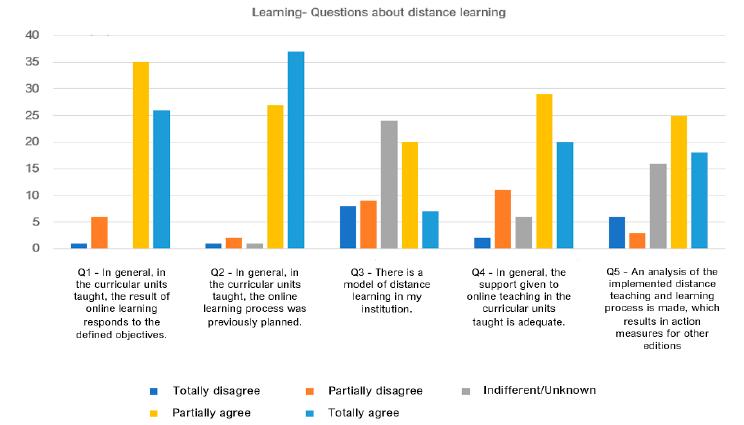
The first group of questions corresponds to the learning category, which contains questions that have a direct impact on pedagogical aspects of distance education at the level of learning. The first question of this group, “In general, in the curricular units taught, the result of online learning responds to the defined objectives”, 61 of the 68 teachers partially or totally agreed with the question. With this, it appears that the majority of the sample agrees that it is possible to achieve the learning objectives of the CU that teach online. This question is related to that e-Learning does not rule out face-to-face education and may even adopt different perspectives that reflect learning moments appropriate to the context and moment.
In the second question, “In general, in the curricular units taught, the online learning process was previously planned”, 64 of the 68 teachers who are part of the sample, partially or totally agreed with the question.
This result is in line with the dimension of the e-Learning Maturity Model process related to planning, which mentions the use of pre-defined goals and plans. This can be associated with online learning, as for it to have better results, it is important that it is planned. In addition to the aforementioned dimension, the “eMM” has other dimensions of the process, such as delivery, definition, management and optimization, and an institution that manages to develop capacity in all these dimensions is better prepared than other institutions that can't do it. In addition, it is important to remember that this model suggests a set of good practices and guidelines, so that success is achieved, considering what students, teachers and institutions need.
In the third question, "There is a model of distance learning in my institution", 7 teachers totally agreed, 20 of the teachers partially agreed with the question and 24 teachers considered "Indifferent/Unknown", however, 17 teachers partially or totally disagree with the question. With this, it is possible to verify that most of the teachers who answered the questionnaire are not aware of the existence of the distance learning model existing in the institution. It is important to note that, according to the “eMM” described above, and the Critical Success Factors associated with the organizational dimension of e-Learning, the existence of an adequate strategic plan and the use of guidelines and models defined by the institution, are important in the implementation of e-Learning processes, so that, by following the established model, the institution and its teachers act in an appropriate manner. With this, it is important to remember that once the CFs are known, it is possible to plan action strategies in order to innovate and improve teaching. This is because CFs end up guiding an institution so that it obtains results and becomes more competitive. This question refers to the decree of law 133/2019 which requires, for the approval of higher education courses online, a specific pedagogical model.
In the fourth question, “In general, the support given to online teaching in the curricular units taught is adequate”, highlights the responses of 49 teachers, who partially or totally disagreed with the question. This suggests that there needs to be improvements in the support offered in online learning. This point is important because there is a need for a support team (teaching training) and also the Decree Law 133/2019 which refers to the importance of this team.
In the fifth question, "An analysis of the implemented distance teaching and learning process is made, which results in action measures for other editions", 43 teachers disagreed partially or totally with the information, 16 are not aware if this analysis is carried out, and only 9 teachers partially or totally agree on the question. With this, it appears that despite the teachers' opinions being quite different, the reality is that most of the answers obtained are centered on the disagreement of the issue. Considering that, taking this into account, we can refer to how relevant it is for distance learning, resorting to constant evaluation and feedback in distance learning courses. This is because, according to the literature review, this is based on a continuous process focused on improving performance and achieving the institution's goals,
If distance teaching and learning processes are recurrently analyzed, there will always be room for improvement and specific action measures for other editions.
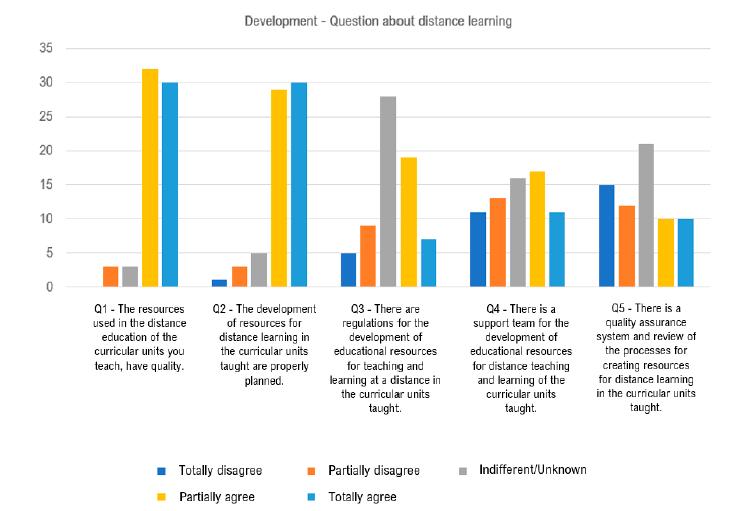
The second group of questions corresponds to the development category, which contains questions related to processes that involve the maintenance and creation of distance learning resources. In the first question of this group, “The resources used in the distance education of the curricular units you teach, have quality”, positive answers stand out, since 62 teachers partially or totally agreed with the question.
In the second question, “The development of resources for distance learning in the curricular units taught are properly planned”, the answers were mostly positive, as 59 teachers partially or totally agreed with the question. The result obtained by the teachers in this question is in line with the dimensions of maturity mentioned in the previous question. In this case, more specifically the dimension related to the planning process, since it is directed to the procedures, tools, project elaboration, in an individualized way, therefore, planned. In addition, the importance of using pre-defined plans can also be mentioned again, according to the “eMM”.
In the third question, "There are regulations for the development of educational resources for teaching and learning at a distance in the curricular units taught", 26 teachers partially or totally agreed with the question, 28 of them considered "Indifferent/Unknown" and 14 teachers partially disagreed or totally with the question. Although a large number of teachers agree with the question, the reality is that most teachers who responded to this questionnaire are unaware of the existence of these regulations, which turns out to be a failure. The importance of an institutional strategic plan, the use of established guidelines and standards for e-Learning processes, has already been mentioned in “eMM”. In addition, in the literature review, one of the dimensions suggested by Cação (2014a) can be observed, the definition,
In the next question, "There is a support team for the development of educational resources for distance teaching and learning of the curricular units taught", the answers were more varied, with 28 teachers agreeing partially or totally with the question, 16 teachers considered “Indifferent/Unknown”, 24 teachers partially or totally disagree with the question. It can be seen that the answers are different, because there are teachers who are aware of this team, as there are teachers who are not aware or simply believe that this support team does not exist, which ends up being a failure considering that it is It is important for an institution to have a support team for the development of e-Learning projects and that all teachers know of its existence and benefit from it.
In the last question of this group, "There is a quality assurance system and review of the processes for creating resources for distance learning in the curricular units taught", 27 teachers partially or totally agreed, 21 teachers considered "Indifferent/Unknown" and 20 teachers partially or totally disagreed with the question. Although a large number of teachers agree, the number of teachers who do not know and who disagree with the issue is high. This issue can be associated with the importance of benchmarking in a higher education institution that intends to evolve and work with distance learning, because this process is continuous and assesses the quality of the processes, and it is essential for an institution to have a system that ensure the quality and review of processes for distance learning.
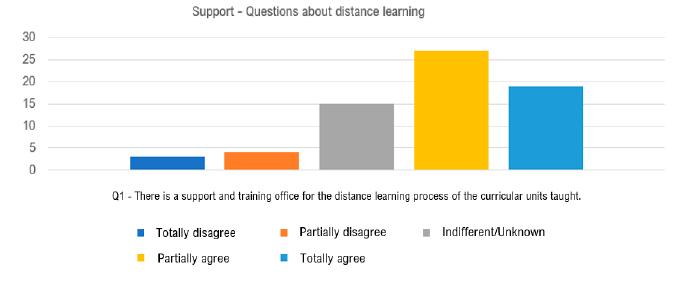
The third group of questions corresponds to the support category, which contains a question directed to the processes that involve the management and supervision of distance education. In this question, "There is a support and training office for the distance learning process of the curricular units taught", 46 teachers partially or totally agree, 15 teachers considered "Indifferent/Unknown" and 7 teachers partially or totally disagreed with the question, thus concluding that a large part of the answers obtained by the teachers was positive. This issue can be reflected in the importance that an institution has in having a support and training team dedicated to distance learning. Considering the CFs, it is important that in a HEI the institutional strategic plan for e-Learning is guided, as well as the issues and eventual implications that may arise are ensured, and for this, the support of a responsible team is necessary.
The fourth group of questions corresponds to the category of assessment, which contains questions related to the processes that involve the evaluation and quality control of distance education.
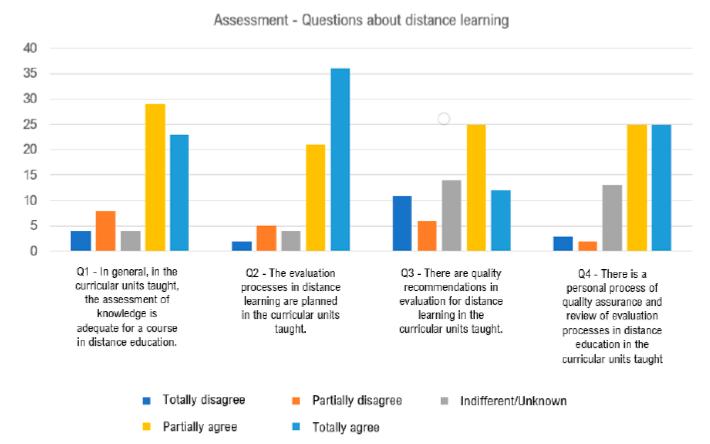
In the first question of this group, “In general, in the curricular units taught, the assessment of knowledge is adequate for a course in distance education”, 52 teachers partially or totally agreed with the question. With this, it is possible to verify that a large part of the teachers agrees that the assessment of knowledge in the curricular units they teach is adequate, which is quite positive.
In the second question, “The evaluation processes in distance learning are planned in the curricular units taught”, 57 teachers partially or totally agreed with the question. These answers end up going against the importance of planning in “eMM”, in this specific case, the importance of planning the assessment processes, and it can be concluded that most teachers agree with the issue.
In the next question, "There are quality recommendations in evaluation for distance learning in the curricular units taught", 37 teachers partially or totally agreed with the question, 14 teachers considered it "Indifferent/Unknown" and 17 teachers partially or totally disagreed with the question. Although a large number of teachers agree with the issue, there are still some teachers who do not know or do not agree with the issue, and it is very important that they are aware of this type of recommendation. In this case, it can be mentioned, as previously mentioned, the CFs and the eMM and the importance they give to the existence of a strategic plan, use of guidelines and recommendations for the effectiveness of e-Learning processes in an institution.
In the last question of this group, “There is a personal process of quality assurance and review of evaluation processes in distance education in the curricular units taught”, 50 teachers partially or totally agreed with the question. The fact that 50 of the 68 teachers who answered the questionnaire have this opinion is very positive for the institution, since in addition to ensuring the quality of these processes is essential, its review is equally important, so that improvements can be made, if necessary, which goes against the use of benchmarking as a resource for a continuous process of performance improvement.
The fifth group of questions corresponds to the category of organization, which meets the processes associated with institutional planning and management in relation to distance learning.
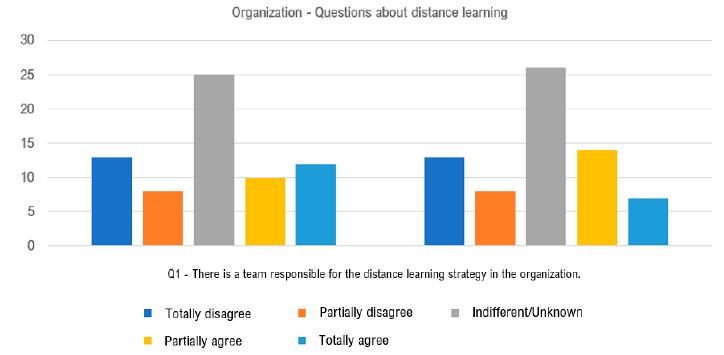
In the first question of this group, “There is a team responsible for the distance learning strategy in the organization”, 22 teachers partially or totally agreed with the question, 25 teachers considered it “Indifferent/Unknown”, 22 teachers partially or totally disagreed with the question. In this question, it is possible to verify that the opinions among the teachers were very different, however, it can be reflected that it is in fact very important that there is a team responsible for distance learning, so that the processes in e- learning are guided and follow, for example, the models mentioned in the literature review.
In the last question of this group, "There is a process to monitor the distance learning strategy in the institution", 21 teachers partially or totally agreed with the question, 26 teachers considered it "Indifferent/Unknown", 21 teachers partially or totally disagree with the question. On this issue, the views of the teachers were again very different, even so, it is important to stress again that for an institution it is essential to have planning, in addition to the monitoring process, this because the adequacy of the processes should not only be planned, but also monitored and oriented.
6. Suggestions and Recommendations
After analyzing the results of the first group of questions in the questionnaire to teachers, the recommendation to share the distance learning model by the institution's teachers can be considered. This template is available on the EIPP website in eBook format, called “Instruments to Transform the Learning Experience” (site link:https://e-ipp.ipp.pt/2021/03/lancamento-do-ebook-instrumentos-para-transformar-a-experiencia-da-aprendizagem/). This eBook is available to all interested people, teachers and students, and presents a set of recommendations, tools and techniques that can be used by teachers, in order to enhance learning in the context of distance learning.
This recommendation arises, as part of the teachers are unaware of the existence of a distance learning model, and it is important that they get to know it, since if they comply with established guidelines and follow a pre-defined model, they will be able to obtain better results in the institution's e-Learning processes.
Furthermore, it is important to mention the importance of self-assessment and benchmarking in the institution, as this is a continuous process that aims to improve its performance and practices. With this, self-assessment and benchmarking could be a process of interest at ISCAP, as it will allow comparison with other higher education institutions that implement e/b-learning systems, while also highlighting the changes that are necessary to improve the performance of the institution. With the use of self-assessment, the institution could initially identify the needs and difficulties of the institution, specifically of the people who constitute it and who collaborate in the e/b-learning processes. Knowing this, the institution can move on to the analysis of the causes of these problems or failures, then thinking about possible solutions. After this analysis, the institution can implement and adapt the necessary measures, and, finally, it must evaluate the results obtained with these practices, and periodically repeat this analysis. In this way, the institution will look for ways to improve its performance with regard to e-Learning practices.
Also in this first group of questions, it is relevant to mention the use of the MIPO Model, since this is a model recommended by the EIPP and which offers guidelines to guide good practices in b-learning in P.PORTO schools.
After analyzing the second group of questions, taking into account the fact that the dimensions suggested by Cação were mentioned. (2014a, 2014b), such as strategy, structure, experience, learning design, learning products, the learning process and people, it is recommended the use of these dimensions in the planning and guidance of e-Learning processes in the institution. These can help the institution to recognize, at all times, its level of maturity in relation to e-Learning, the aspects it needs to improve, as well as to organize and develop projects in e-Learning.
In addition, it is also important to mention the e-Learning Framework, as it is based on an approach that focuses on the factors that help in creating a suitable learning environment.
In addition, it is worth highlighting as a suggestion, informing teachers of the existence of regulations for the development of educational resources for distance teaching and learning, as well as presenting the distance learning support team, so that all teachers know of its existence, how useful the team can be and its importance for e-Learning processes.
The following group of questions has the clearest recommendation, the existence of greater contact between the support and training office for the process in distance learning and the teachers, so that the institutional strategic plan is followed, the teachers oriented in the case of need, to know how to act in complicated situations, and have room to improve. This responsible team exists, being constituted by the EIPP.
With the analysis of the fourth group of questions, one can consider the recommendation to share the documents called “Recommendations for Online Assessment” and “Assessment Mode”, both available on the EIPP website for everyone. (link to the website where the eBooks are available: https://e-ipp.ipp.pt/guias-de-utilizacao/)
These documents are practical, simple, and can help teachers who are not aware of these recommendations. Also, about the online assessment, it is known that, through the interview conducted with the EIPP coordinator, that this unit provides a set of resources and recommendations for the online assessment¸ and these guidelines appear in the documents available on the aforementioned website, but also in training actions, workshops, webinars and gatherings.
The analysis of the last group of questions ends up going against what was mentioned above, therefore, it is suggested the presentation of the team responsible for the strategy in distance learning at ISCAP, so that can the pre-plans and practices defined can be followed, and above all, work so that the level of institutional maturity of ISCAP is the highest with the most appropriate practices. If there is greater communication between teachers and this team, working together and following, for example, the models aimed at e-Learning mentioned in the literature review, ISCAP is more likely to act effectively with regard to teaching the distance.
Table 2 Process categories that support e-Learning and respective recommendations
| Categories | Recommendations |
|---|---|
|
Learning |
-Sharing the EIPP Distance Learning model; -Use of self-assessment and benchmarking as a model that helps to improve practices and achieve goals; -Recourse to the MIPO Model as a model that guides best practices. |
|
Development |
-Recourse to the dimensions of institutional maturity for continuous monitoring; -Disclose the existence of EIPP regulations for the development of educational resources for teaching and learning at a distance. |
| Support | - Existence of greater contact between the Distance Learning support and training team at the institution and the teachers. |
| Evaluation | -Recourse to EIPP online assessment recommendations. |
| Organization | -Create greater contact and communication between the team responsible for the Distance Learning strategy and the teachers. |
Source: Own elaboration
7. Conclusion
Since e-Learning represents a change in the educational paradigm, for all those involved in their learning environment, it is important for an institution to be able to keep up with these changes in the best possible way.
With regard to the question “What is the level of maturity in relation to ISCAP's e-Learning?”, it is possible to perceive an average level, essentially justified by the general panorama we are currently experiencing, the Covid-19 pandemic, mentioned above. Many institutions started teaching and working at a distance in the various sectors that constitute them.
As mentioned in the literature review, there are five levels of institutional maturity regarding Berge's e-Learning:
“Never performed any activity related to e-Learning;
Performed specific and disaggregated activities;
Has the ability to organize and carry out activities if they arise;
It has a defined and planned strategy for implementing e-Learning;
e-Learning is part of institutional practice" (M. Silva et al., 2007, p. 3)
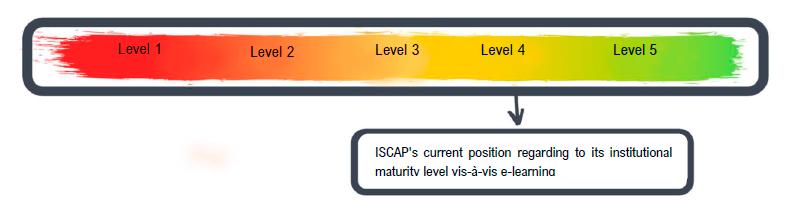
Taking these levels into account, and the analysis of the results of the questionnaire for teachers, it is possible to indicate that ISCAP is currently at level 4 of institutional maturity compared to e-Learning. The table below shows the arrangement of the 5 maturity levels, associated with colors, from red to green
Source: Own elaboration
Figure 6 The 5 levels of institutional maturity vis-à-vis e-Learning and the current position of ISCAP *Iscap is currently in the level 4 of institutional maturity regarding e-Learning practices
Although ISCAP has a strategy for e-Learning, it is not yet part of the institutional culture, essentially due to the lack of communication. However, it could be an interesting challenge for ISCAP to promote action measures that try to make its institutional maturity level in relation to e-Learning higher.
With this, regarding the question “How can the adaptation of ISCAP to e-Learning systems be improved?”, this adaptation to e-Learning systems could come from the improvement of communication with the EIPP, which is the responsible unit by e-Learning at P.PORTO, which has a lot to offer to its HEIs. According to the interview carried out with the entity's coordinator, the EIPP team prepares an action plan every school year, offers technical, scientific and pedagogical support to all P.PORTO teachers who intend to implement Distance Learning in their practices.
However, it is important to mention that the difficulty of communication is one of the flaws in ISCAP with regard to the implementation of e-Learning, taking into account the existence of a team responsible for the e-Learning strategy at P.PORTO, which provides training to teachers in the development of educational resources to support distance education, which offers services for the development of educational resources and also receives files and adapts them to educational resources to support distance education.
With this, considering the fact that the lack of communication in the institution was mentioned, the suggestion of an internal communication plan directed towards e-Learning was considered pertinent.
Communication plan for the implementation of e-Learning as an integral part of the institutional culture of ISCAP
The use of a communication plan is important, since planning is a way of organizing actions, with the aim of reaching a final objective.
With regard to the question “What are the internal and external factors to ISCAP that may influence its level of institutional maturity?”, factors such as the lack of involvement of teachers in the general activities of the institution can be considered, a lot of work per part of the teachers, the fact that the classes are too large that they take up a lot of the time of the teachers, and one of the factors that could have a positive influence, could be a greater involvement of the teachers in international projects related to e-Learning.
In the question, “How is e-Learning projected in the institute's internal strategy?”, it can be said that e-Learning is projected by P.PORTO's policy in the sense of shared services.
Regarding the question “Which recommendations can have a positive impact on increasing institutional maturity in relation to e-Learning?”, these recommendations arise from the analysis of the results obtained, as well as the interview carried out, and even the documental analysis. With this, some topics mentioned above are presented below, and not only that, which can constitute positive recommendations for ISCAP:
Greater proximity to teachers;
Use existing models mentioned in the literature review, as good practice guidance guides, such as the e-Learning benchmarking, the e-Learning Maturity Model, the critical success factors, e-maturity and the dimensions and degrees of institutional maturity;
Seek innovation in e-Learning initiatives;
There is greater communication between ISCAP and EIPP;
Use documents on various relevant topics made available by the EIPP;
Ensure that all teachers are aware of the existence of the EIPP and its guides;
Internationalize e-Learning initiatives;
Create incentives for the adoption of e-Learning;
Thinking about strategies to attract students through e-Learning course offerings;
Greater collaboration between the organizational units of P.PORTO in this area;
Improve ISCAP's internal communication with regard to e-Learning;
Creation of a support plan for e-Learning specific to ISCAP, which is regularly evaluated, so that the institution knows which action measures have worked or not, where improvement is needed and what has already been achieved.
In order to achieve level five of institutional maturity regarding e-Learning, ISCAP has to define specific strategies, and the main objective must be to ensure that online teaching has quality and that the learning experiences are positive.
In the next future, we will apply the recommendations described above and analyze de results obtained in order to improved and innovate the learning process

