




 Inglês (pdf)
 Artigo em XML
 Referências do artigo

 Tradução automática
 Enviar este artigo por email
 Citado por SciELO
 Similares em
SciELO

 Permalink


INTRODUCTION
In competitive swimming, the objective is to cover a given distance in the shortest possible time (Barbosa, Bragada, et al., 2010; Barbosa, Costa, et al., 2010); therefore, swimming velocity is the main variable for performance analysis (Barbosa et al., 2011, 2013).
According to Franken et al. (2008), the determining factors in swimming performance are the forces of resistance and propulsion, which are related to the kinematics of swimming, that is, to stroke rate (SR), stroke length (SL), and average swimming velocity (V). In fact, Santos et al. (2016) reported a direct correlation between peak force in tied swimming and clean swimming speed. Speed, in turn, can be described by the independent variables SL and SR (Barbosa et al., 2011; Grimston & Hay, 1986), which are easy to collect and have ecological significance for designing, controlling, and evaluating training (Barbosa, Bragada, et al., 2010), and are used in most biomechanical evaluations of swimming technique (Barbosa et al., 2013). Different combinations of SR, SL, and V depend on the chosen event and are decisive in the outcome (Barbosa, Bragada, et al., 2010; Maglischo, 2003). According to Campos et al. (2009), the main physical capacities involved in swimming performance are strength, power, muscular endurance, velocity and flexibility.
Among these variables, Maglischo (2003) emphasises the importance of maintaining good levels of flexibility for athlete performance since flexibility is often necessary for certain movements in the sport. In fact, reduced flexibility may interfere with swimming practice, as a greater range of motion could generate more efficient gestures for the sport and may reduce the risk of injury (Dantas, 2017). For example, McKenzie et al. (2023) reported moderate evidence of an inverse association between the range of internal and external movement, shoulder pain, and injury risk in swimmers. However, Raffini et al. (2024) noted that, on the one hand, hypermobility might confer an advantage in joint range of motion for executing gestures such as those required at the shoulder level by swimmers. On the other hand, however, hypermobility may increase the risk of pain, which in turn may reduce performance.
It is assumed that flexibility is directly related to competitive swimming, as athletes in the sport tend to exhibit higher levels of flexibility than practitioners of other modalities (Maglischo, 2003; Martins & Monte, 2011). Moreover, Carpes et al. (2005) found that regular swimming training increases flexibility in the shoulder and ankle joints. In their research, Martins and Monte (2011) found that correct kick execution across the four swimming techniques depends on good ankle flexibility, whereas stroke movement in crawl swimming depends on good shoulder flexibility.
On the other hand, Franken et al. (2007) did not find a significant correlation between the general flexibility of swimmers and several performance measures (e.g., SF, V, SL). Tsalis et al. (2004), for their part, reported that high-level swimmers improved their kicking performance after combining swimming training with stretching exercises focused on the ankle joint. Meanwhile, Jorgić et al. (2010), when evaluating student swimmers, found a very low relationship between flexibility and crawl swimming race time. Additionally, studies by Kuhn and Legerlotz (2022) and Willems et al. (2014) found that athletes with low ankle range of motion exhibited lower kicking speed and undulation than those with normal or high joint range of motion.
Although the role of flexibility in swimming performance has been discussed in the literature, no study has verified its interference across different crawl swimming distances. Kinematic variables exhibit altered behaviours depending on the race distance (Barbosa, Bragada, et al., 2010; Caputo et al., 2000; Castro et al., 2005) and may be indirectly influenced by joint movements, such as those of the shoulder joint (Grimston & Hay, 1986).
According to Maglischo (2003), SF values at crawl technique are higher at 25 and 50 meters than at 100 meters. Conversely, SL tends to increase as SR decreases; therefore, flexibility may be more relevant at the 100-meter distance than at shorter distances, where a longer stroke is required. The author also notes that the kicking rhythm varies with distance, with longer races requiring fewer kicks. Consequently, greater mobility in the ankle joint could contribute to better technical execution and practical application of kicking force, especially over longer distances where the frequency is lower. Although it is argued that the speed of the upper limbs has the greatest influence on swimming performance (Barbosa et al., 2011), a good kick is essential to maintain proper body position in the water (Cala Mejías & Cejuela Anta, 2011).
Regarding lumbar spine flexibility, Maglischo (2003) concludes that body roll and trunk rotation are essential for efficient crawl swimming, even though these movements do not directly influence propulsion. According to the author, insufficient roll, joint limitations, or lack of flexibility can harm forward propulsion, negatively affect lateral alignment, and compromise stroke movements. Therefore, lumbar spine flexibility may be equally important for all crawling swimming distances.
Determining the influence of flexibility on crawl swimming performance across different distances allows for the inclusion or exclusion of specific joint exercises as a complement to swimming training that caters to the characteristics of the distances of interest. If flexibility has a positive influence, its inclusion is valid for improving athletes’ performance, representing a practical, easy-to-apply training method. However, if flexibility shows no significant effect on performance, time spent enhancing this component could be saved and, more specifically, targeted by coaches and athletes aiming for peak performance. Thus, the present study aimed to analyse the correlation between flexibility and crawl swimming performance in amateur swimmers over distances of 25, 50, and 100 meters. The study hypothesises that shoulder, lumbar spine, and ankle flexibility are positively correlated with swimming performance, especially at the 100-meter distance, where range of motion is expected to be prioritised over stroke rate.
METHOD
This study is characterised as cross-sectional, correlational, and quantitative research. The study procedures were approved by the UTFPR Ethics Committee (CAAE No.: 70224923.3.0000.5547).
Participants
The sample size was calculated using G*Power 3.1, with a statistical power of 0.80 and a moderate effect size (0.5), yielding a sample size of 26 participants. However, given the possibility of outliers, 29 amateur swimmers, both male and female, aged 17-33 years, were evaluated; 28 were included in the study (one outlier was excluded). All adult participants provided an informed consent form, and underage athletes signed an informed assent form for participation in the research.
The inclusion criteria were:(i) having trained and competed in swimming for at least one year; (ii) a weekly training frequency of two or more sessions; (iii) crawl/free swimming as one of their main competitive styles; (iv) no pre-existing limitations in the shoulder, lumbar spine, or ankle joints. The exclusion criterion was: (i) failure to complete any of the tests.
Measures
The acrylic goniometer used to assess the participant’s range of motion was manufactured in Brazil under the Arktus brand. It features a scale ranging from 0° to 360° and a large size of 35 cm. Two trained evaluators conducted the measurement. A previous study demonstrated moderate to excellent inter-rater (ICC 0.70-0.97) and intra-rater (ICC 0.66-0.99) reliability for measuring joint angles in humans (Kiatkulanusorn et al., 2023).
Procedures
For the purposes of the present study, three shoulder movements (flexion, extension, and horizontal abduction), one lumbar spine movement (lumbar rotation), and one ankle movement (plantar flexion) were used. These angles were selected for their possible influence on swimming performance, namely, stroke length (shoulder joint), body roll (lumbar spine rotation), and kick (plantar flexion) and are in accordance with previous studies reported in the literature (Andersen et al., 2020; Sanders et al., 2016). All measurements were performed on the participant’s right side, and the best of two executed attempts was recorded, without any prior warm-up or stretching to avoid interference with the measurements.
Following Marques’ (2014) guidelines:
• Shoulder Flexion (Figure 1A): This movement ranges from 0° to 180° and occurs in the glenohumeral joint in the sagittal plane. The participant remained seated with the arms alongside the body, maintaining good overall alignment. The fixed arm of the goniometer was placed along the midaxillary line of the trunk, pointing toward the greater trochanter of the femur. The movable arm was positioned on the lateral surface of the humerus, directed toward the lateral epicondyle, with the instrument’s axis located near the acromion.
• Shoulder Extension (Figure 1B): Also occurring in the sagittal plane, this movement has a range of motion from 0° to 45°. The participant remained seated with their arms along their body. The fixed and movable arms of the goniometer were positioned similarly to the flexion movement, with the axis over the lateral-lateral axis of the glenohumeral joint near the acromion.
• Shoulder Horizontal Abduction (Figure 1C): This movement occurs in the transverse plane and has a range of motion from 0° to 90°. The participant sat with the elbow, wrist, and fingers extended. The instrument’s fixed arm was positioned parallel to the anterior midline, while the movable arm was placed on the lateral surface of the humerus. The axis was positioned over the acromion.
• Lumbar Spine Rotation (Figure 1D): Occurring in the transverse plane, this movement has a range of motion from 0° to 35°. The participant sat as upright as possible and rotated the spine to the evaluated side. The fixed arm of the goniometer was positioned at the centre of the head, along the sagittal suture. The movable arm followed the rotation, remaining parallel to the ground and along the sagittal suture.
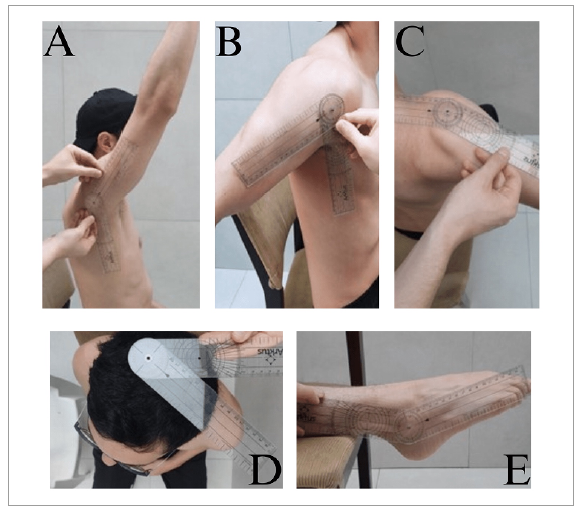
Plantar Flexion (Figure 1E): Taking place in the sagittal plane between the tibia, fibula, and the superior surface of the talus, this movement has a range of motion from 0° to 45°. The participant was seated in an anatomical position. The fixed arm of the instrument was placed parallel to the lateral face of the fibula, and the movable arm was positioned parallel to the lateral surface of the fifth metatarsal. The axis was located over the ankle joint, near the lateral malleolus.
Time trials for 25, 50, and 100 meters of crawl swimming were conducted in a 25-meter (short-course) pool with a controlled temperature of approximately 28 °C. The evaluation was scheduled to coincide with the participants’ regular training sessions, and a ten-minute low-intensity free warm-up was performed beforehand. Additionally, participants were asked not to engage in intense physical activities during the 24 hours preceding the test. Each test was conducted individually, starting from within the pool, and the time was recorded using a digital stopwatch. The order of the time trials was randomised, and athletes were given twenty minutes of active recovery between each test. This recovery period has been described in the literature as sufficient for blood lactate levels to return close to baseline values (Lomax, 2012). Participants received verbal encouragement throughout the tests.
During the time trials, several kinematic performance variables were recorded: average swimming velocity, stroke length , and stroke rate. The SL represents the distance covered by the participant with each stroke, while the SR is determined by the number of stroke cycles (defined as two consecutive entries of the same hand into the water) completed within one minute. The SR is calculated using a manual stopwatch to measure an average of three stroke cycles in the middle part of the pool (to minimise the influence of underwater phases and turns) by dividing the time taken for three complete cycles by the number of cycles. The results for these stroke cycles are then extrapolated to represent a one-minute period. The V is determined by dividing the distance covered (25, 50, or 100 meters) by the execution time. Finally, SL is calculated as the ratio of V to SR (Caputo et al., 2000). These measurements are performed simultaneously by two experienced evaluators, with one designated as the primary evaluator and the other as the verifier. Additionally, the literature reports good reliability (ICC = 0.90) for kinematic measures of swimming performance (Vantorre et al., 2010).
Statistical analysis
Statistical analysis was conducted using IBM SPSS Statistics (2023). After verifying the normality of the data using the Shapiro-Wilk test, descriptive statistics (mean and standard deviation) and Student’s t-test for independent samples were applied to analyse flexibility variables. To quantify the magnitude of differences between groups, effect size (d) was calculated as proposed by Cohen (1988) as the ratio of the mean difference to the respective standard deviations. Additionally, comparisons between distances (25, 50, and 100 m) and sexes (male vs. female) were performed using a two-way ANOVA, followed by Bonferroni post-hoc tests. Finally, the correlation between flexibility and swimming performance variables was assessed using Pearson’s correlation test. For the interpretation of Pearson’s correlation coefficients, the methodological criteria of Mitra and Lankford (1998) were followed: values between 0.20 and 0.40 indicate a weak correlation; between 0.40 and 0.60, a moderate correlation; and values above 0.60, a strong correlation. For all analyses, the significance level was set at p < .05.
RESULTS
Table 1 presents data on sample characteristics, flexibility measurements, and comparisons of variables between sexes.
Table 1. Mean and standard deviation of sample characterisation variables and joint flexibility in the shoulder, hip, and ankle.
| Variable | Overall | Male | Female | p-value | d |
|---|---|---|---|---|---|
| Age (years) | 22.21 (± 4.33) | 23.20 (± 4.73) | 21.08 (± 3.66) | .20 | 0.49 |
| Weight (kg) | 67.35 (± 11.78) | 74.53 (± 10.60) | 59.07 (± 6.55) | .00* | 1.72* |
| Height (cm) | 172.78 (± 9.46) | 178.86 (± 7.37) | 165.76 (± 6.20) | .00* | 1.91* |
| Arm span (cm) | 176.17 (± 10.86) | 182.53 (± 9.54) | 168.84 (± 7.12) | .00* | 1.60* |
| Shoulder flexion (degrees) | 169.29 (± 8.84) | 169.60 (± 11.26) | 168.92 (± 5.25) | .84 | 0.07 |
| Shoulder extension (degrees) | 73.11 (± 15.43) | 74.27 (± 17.29) | 71.77 (± 13.54) | .67 | 0.16 |
| Shoulder horizontal abduction (degrees) | 41.86 (± 12.40) | 39.93 (± 12.08) | 44.08 (± 12.87) | .38 | 0.33 |
| Lumbar spine rotation (degrees) | 42.96 (± 10.57) | 45.00 (± 9.79) | 40.62 (± 11.34) | .28 | 0.42 |
| Plantar flexion (degrees) | 77.29 (± 6.89) | 73.87 (± 4.85) | 81.23 (± 9.91) | .00* | 1.23* |
d: effect size; *Significant effect.
Table 2 presents the results of performance variables between sexes for each distance analysed. Male swimmers were faster and exhibited a higher stroke rate compared to female swimmers. Swimming velocity and SF decreased with increased distance, while stroke length increased.
Table 2. Mean and standard deviation of swimming performance variables by sex and distance.
| 25m | 50m | 100m | p-value | Effect size (ƞ) | ||||||
|---|---|---|---|---|---|---|---|---|---|---|
| Mean and standard deviation | Sex | Distance |
|
Sex | Distance |
|
||||
| SR | Male | 62.53 (± 5.37) | 54.87 (± 5.66) | 45.40 (± 5.56) | .000* | .000* | .054 | 0.368* | 0.485* | 0.072 |
| Female | 50.77 (±7.29) | 45.08 (± 5.69) | 41.08 (± 5.40) | |||||||
| Overall | 57.07 (± 8.61) | 50.32 (± 7.46) | 43.39 (± 5.82) | |||||||
| SL | Male | 1.71 (± 0.18) | 1.84 (± 0.18) | 2.03 (± 0.22) | .686 | .000* | .094 | 0.002 | 0.179 | 0.059 |
| Female | 1.78 (± 0.21) | 1.86 (± 0.17) | 1.88 (± 0.17) | |||||||
| Overall | 1.74 (± 0.19) | 1.85 (± 0.17) | 1.96 (± 0.21) | |||||||
| V | Male | 1.77 (± 0.15) | 1.67 (± 0.15) | 1.52 (± 0.18) | .000* | .000* | .823 | 0.533* | 0.345* | 0.005 |
| Female | 1.48 (± 0.08) | 1.39 (± 0.07) | 1.28 (± 0.08) | |||||||
| Overall | 1.64 (± 0.19) | 1.54 (± 0.18) | 1.41 (± 0.19) | |||||||
SF: stroke frequency; SR: stroke rate; V: swimming velocity; *Significant effect.
Table 3 presents the correlations found between flexibility variables and performance in the 25m test. Moderate inverse correlations were identified between shoulder extension and horizontal abduction with stroke length (p = .037; p = .047, respectively), and moderate direct correlations with stroke rate in the male group. However, the latter were not statistically significant (p = .075 and p = .122, respectively).
Table 3. Correlation for the overall, male, and female groups between flexibility variables and average velocity, stroke rate, and stroke length in the 25 m test.
| Variable | Group | V | SR | SL |
|---|---|---|---|---|
| Shoulder flexion | Male | 0.10 | 0.26 | -0.11 |
| Female | 0.32 | 0.08 | 0.05 | |
| Shoulder extension | Male | -0.16 | 0.47 | -0.54* |
| Female | -0.10 | -0.05 | 0.03 | |
| Shoulder horizontal abduction | Male | -0.20 | 0.41 | -0.51* |
| Female | 0.26 | -0.05 | -0.16 | |
| Lumbar spine rotation | Male | 0.20 | 0.26 | -0.04 |
| Female | 0.15 | 0.19 | -0.17 | |
| Plantar flexion | Male | -0.13 | 0.05 | -0.12 |
| Female | 0.12 | -0.12 | 0.23 |
SR: stroke rate; SL: stroke length; V: average velocity; *p < .05.
Correlation data between flexibility and performance variables in the 50-meter front crawl are presented in Table 4. Stroke length showed a moderate negative correlation with shoulder extension in the male group (p = .043), and a moderate positive correlation with horizontal shoulder abduction flexibility in the female group, although not statistically significant (p = .177).
Table 4. Correlation for the overall, male, and female groups between flexibility variables and average velocity, stroke rate, and stroke length in the 50 m test.
| Variable | Group | V | SR | SL |
|---|---|---|---|---|
| Shoulder flexion | Male | 0.08 | 0.00 | 0.12 |
| Female | 0.31 | -0.14 | 0.30 | |
| Shoulder extension | Male | -0.16 | 0.35 | -0.52* |
| Female | -0.21 | -0.11 | 0.05 | |
| Shoulder horizontal abduction | Male | -0.20 | 0.26 | -0.44 |
| Female | -0.21 | 0.46 | -0.40 | |
| Lumbar spine rotation | Male | 0.12 | 0.20 | -0.05 |
| Female | 0.26 | 0.19 | -0.12 | |
| Plantar flexion | Male | -0.16 | -0.10 | -0.00 |
| Female | 0.19 | -0.24 | 0.47 |
SR: stroke rate; SL: stroke length; V: average velocity; *p < .05.
Finally, Table 5 displays the correlations between flexibility data and performance variables in the 100-meter front crawl. The average swimming velocity in the female group showed a moderate positive correlation with shoulder flexion and a moderate direct correlation between plantar flexion and stroke length. However, neither were statistically significant (p = .154 and p = .125, respectively).
Table 5. Correlation for the overall, male, and female groups between flexibility variables and average velocity, stroke rate, and stroke length in the 100 m test.
| Variable | Group | V | SR | SL |
|---|---|---|---|---|
| Shoulder flexion | Male | 0.19 | 0.02 | 0.17 |
| Female | 0.42 | -0.01 | 0.28 | |
| Shoulder extension | Male | -0.16 | -0.02 | -0.14 |
| Female | -0.15 | 0.02 | -0.08 | |
| Shoulder horizontal abduction | Male | -0.17 | -0.02 | -0.16 |
| Female | -0.15 | 0.02 | -0.21 | |
| Lumbar spine rotation | Male | 0.22 | 0.20 | -0.00 |
| Female | 0.27 | 0.24 | -0.13 | |
| Plantar flexion | Male | -0.06 | -0.09 | -0.00 |
| Female | 0.21 | -0.20 | 0.44 |
SR: stroke rate; SL: stroke length; V: average velocity; *p < .05.
DISCUSSION
The present study aimed to analyse the correlation between flexibility and front crawl performance over different distances. Initially, we sought to assess the flexibility of specific joints in participants, focusing on the ankle, shoulder, and lumbar spine. Women demonstrated greater plantar flexion flexibility than men, which is consistent with previous reports (Chung & Wang, 2009). The average shoulder flexion in the overall sample was consistent with Cho et al. (2017), whereas our results for shoulder extension and plantar flexion were higher than those reported in the aforementioned studies. In contrast, horizontal shoulder abduction was lower than reported by Campos et al. (2009). Specific characteristics of the samples and variability in assessment methodologies may justify these differences. Indeed, factors such as the age range of the evaluated group may influence the results of flexibility tests. Although age can negatively affect joint movement patterns across broader age ranges, among young adults, only some joint movements show an inverse correlation with age (Moromizato et al., 2016).
Additionally, the study involved an evaluation of performance variables, namely, swimming velocity, stroke rate, and stroke length across the different distances analysed, providing deeper insight into the factors associated with swimming performance. Male swimmers were faster and showed higher SR than females, which was expected. Moreover, average velocity and SR decreased with increasing distance, while SL increased, consistent with the literature (Caputo et al., 2000; Castro et al., 2005). The average stroke frequency and length over 50 and 100 meters were slightly higher than those reported by Voltolini et al. (2017), whereas Caputo et al. (2000) found higher speed and frequency and a similar stroke length. Again, the differences can be attributed to sample variability, such as performance level, group characteristics (males only vs. both genders in this study), and age range. The literature describes a performance progression in swimmers from childhood to adulthood (Born et al., 2024), with peak ages of 25 and 26 years for the 100m and 50m events, respectively (Allen et al., 2014).
To meet the study’s objective, correlation tests were conducted between flexibility levels and performance parameters. The results revealed moderate, positive correlations between shoulder extension and horizontal abduction flexibility and stroke frequency in the 25-meter front crawl for the male group (Table 3). These findings align with Campos et al. (2009), who highlighted the importance of elbow-high recovery in front-crawl swimming. This technique reduces the likelihood of lateral body misalignment by limiting the arm’s tendency to pull outward. The data suggest that adequate shoulder flexibility may facilitate quicker arm turnover among swimmers performing short-distance swims. This finding is accompanied by a moderate inverse correlation between the aforementioned joint ranges and stroke lengths at 25 and 50 meters. Generally, in shorter events, SR tends to dominate over SL, with peak velocity more closely associated with quick arm turnover than with stroke amplitude (Caputo et al., 2000; Castro et al., 2005).
In the female group, analysis of the correlation between shoulder flexion and performance in the 100-meter swim (Table 5) revealed a direct correlation with swimming speed, that is, as shoulder flexion amplitude increased, average swimming velocity also increased. Maglischo (2003) reported that flexibility can enhance an athlete’s performance by being a key factor in increasing propulsive force over longer efforts. In this case, shoulder flexion may influence arm extension after hand entry into the water, reducing drag and increasing arm leverage and propulsion during the underwater phase.
Furthermore, the data showed a moderate positive correlation between plantar flexion and stroke length in the 50 and 100-meter events (Tables 4 and 5). Increased plantar flexion may contribute to a more efficient kick and, consequently, to a more consistent swimming speed (Maglischo, 2003). During the front crawl, excessive variation in swimming speed leads to higher energy expenditure (Barbosa, Costa, et al., 2010), and a technique that favours smooth, consistent movements helps athletes swim faster (Cala Mejías & Cejuela Anta, 2011). In this sense, a more efficient kick may promote smoother, more elongated swimming, which, in turn, may increase the distance travelled per stroke cycle.
Analysis showed that both groups showed weak or insignificant correlations between lumbar spine rotation and all swimming performance variables. As described by Maglischo (2003), the lumbar spine plays an important role in maintaining horizontal body alignment, supporting proper positioning of the hips and legs, and in body roll movements, enabling effective angles and synchronisation during front crawl. Therefore, athletes must have sufficient spinal flexibility, but higher levels of flexibility may not necessarily influence swimming performance. Indeed, Gonjo et al. (2021) reported hip roll values around 35° during maximal velocity front crawl trials, which is below the flexibility values found in the present study for lumbar spine rotation (~43°).
Although some isolated joint ranges correlated with performance variables for specific groups or distances, most analyses showed weak and insignificant correlations. Factors such as technical level and training history may have influenced the results. Nonetheless, these findings are supported by Campos et al. (2009), who, even after specific joint training, found no significant improvement in swimmers’ times as a result of increased flexibility. Similarly, Jorgić et al. (2010) stated that flexibility does not significantly influence performance in swimmers who lack the development of an efficient swimming technique, for example, those with insufficient training time. This may be due to the predominance of other factors influencing performance in amateur athletes, such as strength, power, endurance, and race strategy. Further investigation involving swimmers with higher efficiency levels where technical refinement is expected and minimal details may influence performance, as well as in middle- and long-distance events (e.g., 200, 400, and 1500m), where stroke amplitude is prioritised over frequency, may yield different results and is therefore encouraged.
Thus, although flexibility is a highly important physical capacity in swimming-helping reduce injury risk and enabling correct movement execution, it appears that greater ranges of motion (beyond what is necessary for technical execution) do not significantly influence performance improvement. It is assumed that sample heterogeneity is a limitation of this study. Additionally, only short-distance events were tested; the same relationships may differ in longer events.
CONCLUSIONS
The results highlighted weak to moderate specific correlations between flexibility in key joints, such as the shoulder joint, and the performance variable stroke length. Therefore, the hypothesis that flexibility is positively correlated with swimming performance was only partially accepted. Although flexibility is recognised as a crucial component in swimming practice for injury prevention and proper technical execution, this study suggests that pursuing excessive ranges of motion may not be the key to performance improvement among amateur swimmers. For this group, normal flexibility levels appear to be sufficient for practising the sport in front crawl events ranging from 25 to 100 meters.

