




 Inglês (pdf)
 Artigo em XML
 Referências do artigo

 Tradução automática
 Enviar este artigo por email
 Citado por SciELO
 Similares em
SciELO

 Permalink


ASSISTED STRETCHING
Assisted stretching is a common technique used by professionals to conduct specific sections of an exercise session in accordance with pre-specified goals. It is a form of static stretching that can support flexibility development, help reduce injury-related limitations, and promote feelings of relaxation and well-being at the end of a session (Behm et al., 2016; Imagawa et al., 2023; McAtee, 2013).
Although it can be considered a useful tool for exercise professionals’ practice, it lacks methodological guidelines for proper operationalisation and external credibility. For example, these techniques have been portrayed several times as an intrusive and sometimes sexually charged approach to stretching (McAtee, 2013). This notion has been frequently parodied in popular sitcoms, movies, and online media because professionals sometimes interact with, contact, and position themselves and their clients during stretching. This issue has already been reported in other contexts, as in physical therapy settings during bodily manipulations (e.g., Boissonnault et al., 2017). As such, unstructured or methodologically unguided interventions may cause discomfort when prescribing or receiving this approach, thereby limiting its potential as a professional tool (Melton et al., 2008; Melton et al., 2011).
Another relevant aspect that justifies advancing with a methodological proposal concerns the professional technique required to ensure the applicant’s postural safety while still allowing the correct stretching stimulus. For example, a 52-kilogram (115 pounds) professional applying assisted stretching exercises to a 100-kilogram (220 pounds) client may be unable to apply adequate tension due to the size and weight distribution of the segments/body. Proper technique can ensure that, even with considerable weight differences, the professional can apply assisted stretching techniques effectively and safely for both. As such, this research note aims to present a methodological approach to assisted stretching while considering ways to avoid these issues.
To illustrate both points above (i.e., intrusive stretching positioning; technique not prone to facilitate force application), we present Figures 1, 2, and 3 for analysis. The first case is a reproduction of hamstring-assisted stretching (Figure 1) as presented in a manual by the National Strength and Conditioning Association (Haff & Triplett, 2015, p. 326). As can be observed, the professional is performing the stretch on top of the exerciser to allow the manipulation of one leg and the stabilisation of the other. This issue can be found in several other examples in this manual, such as those by other entities and authors (e.g., McAtee, 2013; Ratamess, 2012), which represent intrusive and overly contact techniques. Also, we can argue that the stretch in Figure 2 could be performed with the same efficiency without being so close to the client, thereby limiting body contact. We will sustain with our proposed methodology that this type of approach is unnecessary and that an outward, less contact-dependent position can be used, ensuring the same muscle-stretching quality. For example, in Figure 3, a much smaller and lighter professional is applying tension to a larger (and thus heavier, lengthy, and more difficult to stretch) exerciser, which may pose some risk to the applicant’s health (due to the amount of force needed to apply in a non-optimized and poor postural technique) and may even be unfeasible, given the strength needed to promote adequate tension. Again, proposing guidelines for the development of a technique that enables a higher level of strength and applies to most assisted stretching exercises will enable an adequate approach to this tool’s use, safety, and external validation.
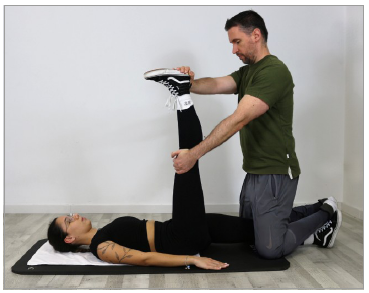
Figure 1. Reproduction of assisted stretching to the hamstring muscles as proposed by an international entity (7, p. 326). As can be observed, the professional is unnecessarily overlapping the client’s leg while applying force with a cross-motion of the arms.
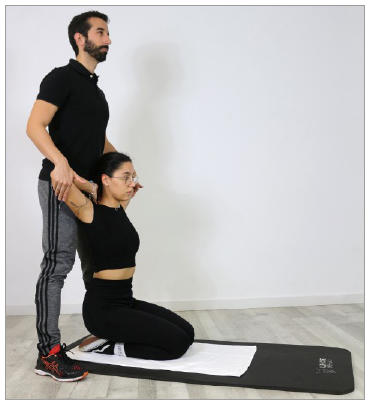
Figure 2. Representation of an assisted pectoralis major stretch as proposed by an international entity (Haff & Triplett, 2015, p. 327); the professional is adopting a position that is not posturally adequate (unneeded back tension due to an advanced centre of mass) with unnecessary proximity and potentially inadequate body contact.
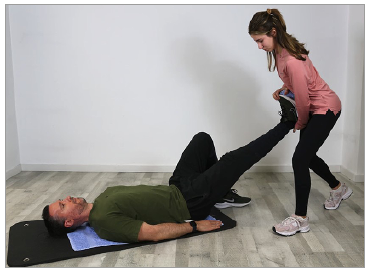
Figure 3. A suggestion of a possible technique for gastrocnemius and soleus stretch performed by a professional with a considerable weight difference. Note that the arm/hand applying the force is the one closer to the client’s hypothetical medial line, and the other arm/hand is responsible for support and control. This stretch uses the weight of the trunk to support force application (and reduce hand/arm strength limitations) while performing a pivotal movement of the ankle.
METHODOLOGICAL PROPOSAL FOR OPERATIONAL-ASSISTED STRETCHING TECHNIQUES
Our methodological proposal for assisted stretching exercises is structured in four major points: i) contact and communication - the professional should avoid unnecessary contact during the stretches while establishing a clear communication of what sort of contact will be performed; ii) client and practitioner positioning - the professional should avoid intrusive positions (excessive leaning towards the client; overlapping bodies) while performing the stretching exercises, assuming whenever possible an outward position related to the client position; iii) definition of the force applying hand - the medial line of the client body defines for each stretch the professional force applying hand and the control/assist hand; and iv) body weight usage for assisted stretching - the force application should be used mainly through the use of the body weight and not merely the hands/arm strength.
Contact and communication
Every physical contact during professional practice should be kept to a minimum and used only when strictly necessary. This ensures not only an adequate approach to the dynamic expected between an exercise professional and the client, but also reinforces a trust-building process in which the individual exposed to an exercise or position can feel respected and protected. This can be particularly true when there is uncertainty about what and how some exercises can/will be performed, which may lead to an unexpected reduction of the client’s personal zone. Because this will happen often and as needed according to the defined exercise program, it is up to the professional to provide a clear explanation of not only the technical aspects of the exercise but also the necessary contact. As such, a (brief) prior clarification of what exercises will be performed and how the segments/body will be manipulated will help reduce uncertainty and allow the client to be prepared or to manifest his concerns.
Another important aspect to remember is preventing diseases transmitted through skin or sweat contact. An exercise towel is mandatory in most fitness centres, as it helps keep machines, exercise mats, and other equipment dry and reduces skin contact. In assisted stretching, the exercise towel (one used solely by the professional for this purpose) can help with the exercises and reduce contact, including sweaty clothes and training shoes. The towel placement area should be chosen based on the body areas to be manipulated (e.g., see Figure 3; to avoid contact with the shoe sole while allowing force application) or on the professional’s body weight and postural manipulation (e.g., Figures 4 and 5).
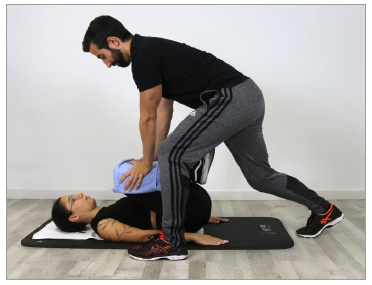
Figure 4. Gluteus maximus assisted stretch suggestion. The towel is used to prevent skin/sweat contact and to assist with the stretch in a safe and comfortable manner.
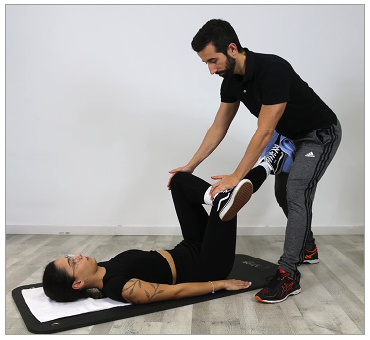
Figure 5. Gluteus medius assisted stretch suggestion. The professional i) adopts a lateral position to the client, ii) assumes a forward position to allow body weight force application (on the stabilisation hand), iii) applies force with the hand/arm more aligned with the client’s medial line, and iv) uses the towel for hygiene purposes.
Client and practitioner positioning
Given that some stretching poses may leave the client uncomfortable, some measures can be taken to reduce this problem. These are grounded on the assumption and identification of an outward/external position undertaken by the professional in all exercises that can consider this. For example, for the gluteus maximus stretch (Figure 4), the professional can take a lateral position while applying force instead of an overlapping approach. This is not as intrusive as other techniques and allows a safer, more comfortable position for the professional while applying body-weight force as needed, according to each client. Another example of this approach is shown in Figure 5. In this case, the applicant assumes a lateral and forward position, avoiding being on top of the client’s leg, while still able to apply force and tension to the muscles.
Definition of the force applying hand
In every stretching position, it is possible to identify the exerciser’s medial line (an imaginary line originating at the top of the head and extending towards the pelvic region). With this line, a lateral-medial orientation can be used to define the force-applying hand (although supported by the professional’s body weight) and the control/assist hand. Given that most unilateral stretching will be performed in a lateral position to the exerciser, the hand closer to the medial line should be used to apply force to the segment, and the one further apart should be used for control, stabilisation, or postural correction purposes. This technique promotes maintaining an outward position while sustaining proper force application. For example, the approach shown in Figure 1 presents this issue: the hand applying force (right) must cross a plane to move the leg farther away. An alternative grounded on our recommendations is now presented in Figures 6a and 6b. This approach is also relevant if you need to perform Proprioceptive Neuromuscular Facilitation (PNF) stretches, as it allows proper positioning for force application and segmental movement in all exercises (e.g., hold-relax with agonist contraction).
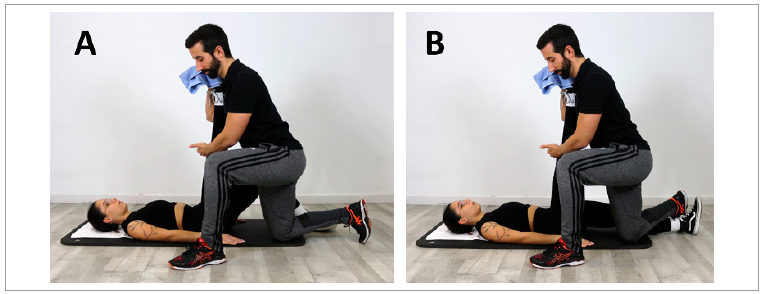
Figure 6. (a) Assisted stretch for the hamstring muscles suggestion and (b) one potential exercise progression. In the first case (a), and although not always needed, pushing forward (i.e., exerciser leg back) with the shoulder allows a higher force output. Moreover, it allows the hand closer to the medial line to be free and to perform stretching progressions as needed by manipulating the degree of dorsiflexion, thus working on a more regional kinetic chain stretch (Freitas, 2010). Alternatively, a progression can be made by forcing the muscle insertion-origin length by pushing down the feet and thus working more focused on the hamstring alone. In both cases, having one hand free is paramount. In the second case (b), extending the non-manipulated knee may be useful when targeting a more global stretch. This approach allows the stabilisation of the leg without the usual overly overlapping position (e.g., Figure 1).
Of note is the need to adjust the force applied by the hand in some circumstances. For example, in Figure 7a, the stretch performed is aligned with the proposed methodological considerations in this article. Nonetheless, in the progression presented (Figure 7b), the hand must be switched so that the hand closer to the medial line applies force (up), while the farther hand controls the segment (keeps the ankle near the gluteus). The contrary would put the arms crossed, limit the ability to generate force, and increase the risk to the professional’s posture.
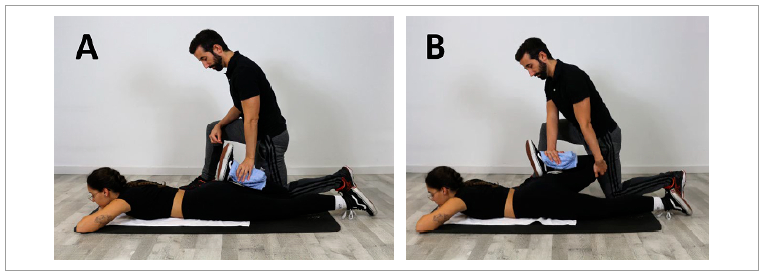
Figure 7. (a) A quadriceps-assisted stretch suggestion and (b) progression, where, in the latter, a pivotal force is applied to allow an additional stretch of the quadriceps muscle origin to produce additional tension. Note that in both cases, the professional maintains a safe posture while applying force.
Body weight usage for assisted stretching
Performing stretches on bigger individuals may pose some challenges. Moreover, for some exercisers, the force required to achieve adequate stretching tension is high. For this, the use of the professional’s body weight is crucial. In fact, i) we do not recommend relying solely on arm or hand strength to perform the exercises, as this may lead to repetitive strain and potential injury, and ii) it may not generate sufficient force. As such, and despite in some cases being more prone to body contact, the position defined for stretching must allow the application of the professional’s weight. As seen in Figure 3, the professional is applying her trunk weight over the feet, thus allowing the transfer of more force to the dorsiflexion. In this example, if only “hand strength” were being utilised, one would struggle to apply enough force. This can also be observed for the gluteus maximus (Figure 4), gluteus medius (Figure 5), and hamstring (Figures 6a and 6b) assisted stretches, all of which are more easily performed when combining arm strength and body weight.
Although several other assisted stretching exercises can be used for the same purposes, the methodological guidelines presented here should help professionals improve the majority of their technical approaches, thereby promoting an external assessment of an adequate and professional intervention while ensuring safer, more efficient stretches. In situations where these recommendations cannot be accommodated, professionals should strive to find solutions and adaptations that align with the client’s safety, personal space, and stretching efficiency.
Performing exercise in a supervised setting is probably one of the most helpful approaches to sustaining one’s health. As exercise professionals, it is our responsibility to help our field of practice continue to grow and uphold increasingly high standards of quality. Upgrading assisted stretching was a long-overdue topic of interest, and we hope this note helps all those interested in developing these techniques.

