




 Inglês (pdf)
 Artigo em XML
 Referências do artigo

 Tradução automática
 Enviar este artigo por email
 Citado por SciELO
 Similares em
SciELO

 Permalink


Introduction
Quality of care and patient safety are essential pillars of nursing practice. Continuous quality improvement in care is both an organizational and ethical priority, requiring strategic planning, effective leadership, and evidence-informed practices (Fragata, 2022).
Perioperative nursing integrates technical and scientific knowledge with relational skills, playing a key role in achieving health gains for perioperative patients. Nevertheless, there is an overemphasis on technical and procedural aspects to the detriment of therapeutic communication and the helping relationship, which are core components of the caring process and essential to safe and humanized transitions (Meleis, 2010; Santos et al., 2014).
In this context, the preoperative nursing visit (PNV) emerges as an essential moment of encounter between the nurse and the perioperative patient that goes beyond a technical step. The PNV represents the first step in the perioperative process, enabling nurses to anticipate needs, reduce anxiety, and plan individualized and safe care (Associação dos Enfermeiros de Sala de Operações Portugueses [AESOP], 2006). However, despite reported benefits, the PNV is still not consistently delivered in a structured manner across many Portuguese healthcare institutions.
Recognizing this gap, the structured implementation of the PNV provides an opportunity for continuous improvement in the quality of perioperative care, contributing to the consolidation of patient-centered practices and to strengthening nurses’ autonomy and their distinctive professional role.
This continuous quality improvement project (CQIP) is an opportunity for professional and organizational development, aiming to standardize the PNV in a hospital in the central region of mainland Portugal. It follows the framework proposed by the Portuguese Nursing Regulator - Southern Regional Section (Ordem dos Enfermeiros - Secção Regional do Sul [OE-SRS], 2013).
1. Theoretical framework
Healthcare and its environments have become increasingly complex and challenging. Patients are better informed and more demanding, making high-quality healthcare essential (Despacho n.º 14223/2009, de 24 de junho). Accordingly, evidence-based practice has been established as a method of solving problems in clinical decision-making (Conselho Internacional de Enfermeiros, 2012).
The surgical process is a stressful and frightening transition period that can threaten physical and mental integrity (Santos et al., 2014). Therefore, effective preoperative preparation is necessary and must encompass the PNV.
The PNV is the first step in the perioperative care process and should be conducted in advance (Pires & Rego, 2017), which is in line with the recommendations from the Portuguese Operating Room Nurses Association (AESOP, 2006).
This autonomous nursing intervention should be performed by the anesthesia support nurse to initiate perioperative nursing care. Its purpose is to support perioperative patients and their families or significant others in understanding and preparing for the perioperative process while identifying and analyzing individual needs (Neves, 2024; Jesus & Abreu, 2020). Studies have shown that the PNV effectively minimizes anxiety, facilitates recovery, shortens hospital stays, and reduces healthcare costs (Hatami et al., 2021).
Adequate perioperative patient preparation is crucial to surgical success and timely recovery. The PNV involves more than providing information; it requires the nurse’s attention and empathy to create a more humanized, individualized interaction tailored to the needs of the perioperative patient and their family or significant other. According to Neves (2024), perioperative nursing communication should be clear and objective, adjusted to each person’s health literacy level and individual characteristics.
According to Afaf Meleis's Transitions Theory (2010), since surgery is a transition event, the operating room (OR) nurse should facilitate this transition by establishing a supportive relationship with the perioperative patient during this vulnerable period.
Implementing the PNV aligns with the Quality Standards for Specialized Care in Medical-Surgical Nursing, as defined by the Portuguese Nursing Regulator (Ordem dos Enfermeiros [OE], 2017). These standards focus on patient satisfaction, safety, and quality of care. The PNV contributes directly to meeting these standards by promoting safe, informed, and humanized admission to the OR.
Recognizing the importance of the PNV shows that it is more than just a step in the surgical pathway; it is a transformative practice in perioperative nursing care that reinforces nurses’ autonomy. Structured implementation of the PNV reflects a commitment to quality, personalized care and recognizes the nurse’s contribution in the perioperative period.
2. Methods
This study is part of a prospective, descriptive, and participatory CQIP conducted in the OR of a hospital in the central region of mainland Portugal. The project was structured based on the Plan-Do-Check-Act (PDCA) cycle adapted for nursing practice (OE-SRS, 2013). This adaptation provides a systematic, iterative, and context-sensitive approach through eight sequential steps.
This article reports exclusively the results of the diagnostic phase of the CQIP, which corresponds to the initial stages of the PDCA cycle. This phase aimed to identify perceptions, barriers, and facilitators regarding the implementation of the PNV.
2.1. Identification and description of the problem
The initial phase consisted of identifying the gap relative to best practices. It was determined that the OR did not formally implement the PNV. The OR nurse's first contact with the perioperative patient occurred only at the time of admission. This deficit could compromise therapeutic communication and the safety of the perioperative patient. The adopted theoretical reference framework was the recommendation from the Portuguese Operating Room Nurses Association for a structured preoperative visit conducted by perioperative nurses (AESOP, 2006).
2.2. Situation analysis
Direct observation of the OR admission process was conducted to understand the extent of the problem, together with reflective analysis of the clinical practice context. A literature review on PNV and its associated health and organizational outcomes was also performed. Then, a questionnaire was developed and administered to the OR nurses.
2.3. Definition of objectives
The overall objective of this CQIP was to implement the PNV as a standardized practice in the institution’s OR. The following specific objectives were defined: to structure the PNV process based on scientific evidence and national and international standards; to develop support tools, including a protocol, a checklist, and an informational leaflet for perioperative patients; to train the nursing team in conducting the PNV; and to implement a pilot project and monitor PNV-related quality and satisfaction indicators.
2.4. Identification of root causes
Several approaches were used to identify the main causes underlying the absence of PNV, including brainstorming, an Ishikawa (fishbone) diagram, a Strengths, Weaknesses, Opportunities, and Threats (SWOT) analysis, and administering a questionnaire to the OR nursing team via Google Forms.
The SWOT analysis revealed the following strengths: a young, dynamic nursing team, and nursing leadership that encourages the adoption of best practices. The weaknesses identified were workload, a complex practice context, staff turnover, and the presence of freelance staff within the nursing team. Opportunities included the consolidation of the service’s safety culture and the enhancement of satisfaction and confidence in perioperative patients. The identified threats included potential coordination difficulties with the inpatient unit, time management constraints, perioperative patient admissions on the day of surgery, and the lack of a dedicated physical space.
2.4.1. Sample
The study was conducted in the OR of a private hospital in the central region of mainland Portugal and involved perioperative nurses. This setting is characterized by high organizational complexity and strong interdependence between inpatient units and the OR, which makes the implementation of structured continuous quality improvement strategies particularly relevant.
The target population was the institution’s OR nurses. All nurses working at the time of data collection who voluntarily agreed to participate were included. A non-probability convenience sample was used to reflect the specific reality of the institutional context under analysis.
2.4.2. Data collection instrument
For the diagnostic phase of the CQIP, an exploratory questionnaire was developed for this specific project. It comprised five sections: participants’ sociodemographic and professional characteristics; contextualization of the PNV; identification of advantages and disadvantages of conducting the PNV; and facilitators and barriers to PNV implementation. Data were collected between May and June 2025 by emailing each participant a link to the questionnaire and informed consent form.
Before developing the questionnaire, a focus group of 10 experts was organized to ensure the clinical and conceptual relevance of the included items. The experts were selected based on their relevant professional experience in perioperative care, specialized training in medical-surgical nursing, and/or prior involvement in quality and safety projects related to perioperative patients. The group included nursing teachers, a nurse manager, a nurse director, and medical-surgical nurse specialists in perioperative nursing. One session was held and guided by a semi-structured script that focused on identifying key PNV dimensions, existing practices, perceived difficulties, and training needs.
The focus group contributions were used to define the questionnaire domains, refine the items, and ensure that the language was appropriate for the clinical context, thereby strengthening the instrument’s content validity. The questionnaire was not subject to formal psychometric validation because it was not designed to measure latent constructs or support inferential analyses. Rather, its purpose was to inform situational diagnosis and intervention planning within the continuous quality improvement framework. The collected data were intended to support organizational decision-making and guide the subsequent implementation phase of the CQIP.
The study received a favorable opinion from the hospital ethics committee, and written informed consent was obtained from all participants. Data were collected at a single time point through the questionnaire applied to the OR nurses during the diagnostic phase. Participation was voluntary, and anonymity and confidentiality were ensured.
Given the exploratory and diagnostic nature of the study, data were subjected to descriptive statistical analysis using the Statistical Package for the Social Sciences (SPSS), version 24.0. Variables were analyzed using absolute and relative frequencies, enabling characterization of nurses’ perceptions of the PNV and its implementation in the study context. No inferential analyses were performed because the study did not aim to establish causal relationships or statistical generalizations; instead, it aimed to support organizational diagnosis within the CQIP.
2.5. Planning and implementation
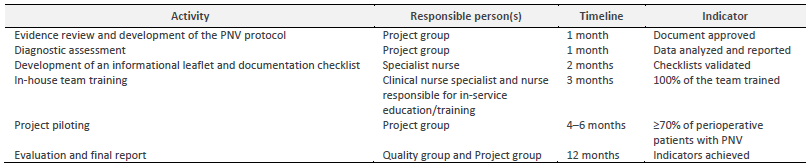
An action plan was developed that defined responsibilities, timelines, and indicators. Implementation follows a participatory model, involving several nurses from the unit. The following table provides an overview of the main stages of this CQIP.
3. Results
The results refer exclusively to the diagnostic phase of the CQIP and are based on OR nurses’ responses to the administered questionnaire.
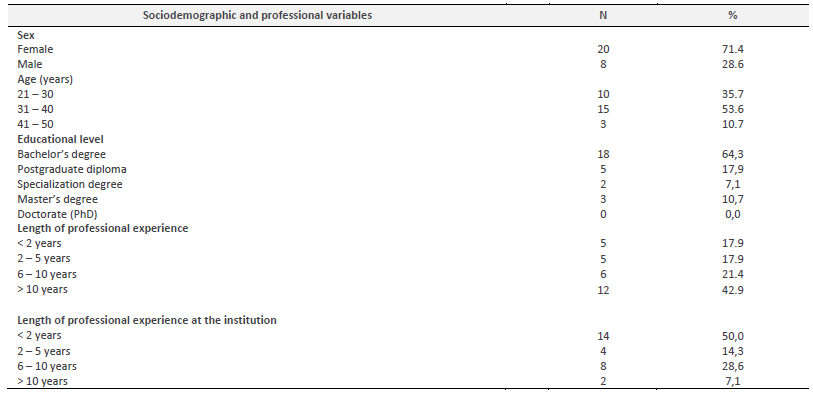
The sample comprised 28 nurses, most of whom were female (71.4%). The most represented age group was 31-40 years (53.6%). The mean age was 31.57 years (SD = 6.09), ranging from a minimum of 23 to a maximum of 43 years. The least represented age group was 41-50 years (10.7%). Concerning educational level, most participants held a bachelor’s degree (64.3%), while 7.1% held specialization degrees and 10.7% held master’s degrees. Regarding professional experience, 42.9% of respondents had been working for more than 10 years. In addition, 17.9% reported having worked for less than 2 years. Half of the nurses had been working in the institution for less than 2 years, and 7.1% had been working for more than 10 years in the institution, as shown in Table 2.
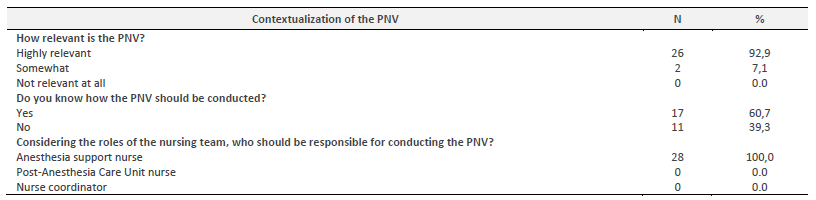
In this sample, 92.9% of respondents considered PNV implementation to be highly relevant, while 7.1% considered it somewhat relevant. When asked if they knew how to conduct the PNV, 60.7% answered affirmatively, whereas 39.3% reported not being familiar with the procedure. Regarding responsibility for conducting the PNV, the sample was unanimous in agreeing that it should be performed by the anesthesia support nurse, as shown in Table 3.
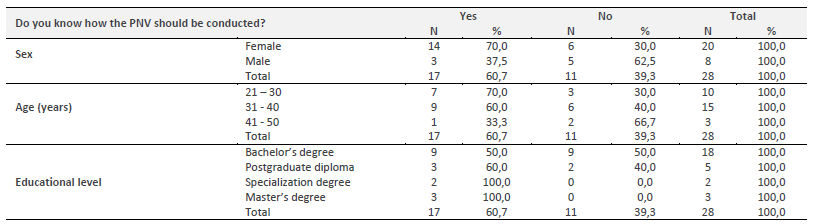
As this quality improvement project aims to implement the PNV, it was considered relevant to further examine differences between respondents who reported knowing versus not knowing how to conduct the PNV. When asked whether they knew how to conduct the PNV, a higher proportion of positive responses was observed among female respondents compared with male respondents (70.0% vs. 37.5%). Younger age groups also reported greater knowledge of the PNV procedure: 70% of nurses aged under 30 reported knowing how to conduct the PNV, whereas 66.7% of nurses aged over 40 reported not knowing how to conduct the PNV. Regarding educational level, all nurses holding a master’s degree and/or a specialization degree reported knowing the procedure. In contrast, self-reported knowledge was lower among nurses with fewer academic and professional qualifications: 50% among respondents with a bachelor’s degree and 60% among those with a postgraduate diploma (Table 4).
Table 4 Knowledge of the PNV by sociodemographic and professional variables
Note. N = frequency; % = percentage
Regarding the length of professional experience, all nurses with less than two years of experience reported knowing the procedure, whereas 66.7% of those with 6-10 years of experience reported not knowing it. Regarding length of professional experience at the institution, 75% of nurses with 6-10 years of experience reported knowing how to conduct the PNV, while nurses who had been working at the institution for 2-5 years reported not knowing how to conduct the PNV (Table 5).
Table 5 Knowledge of the PNV procedure by length of professional experience
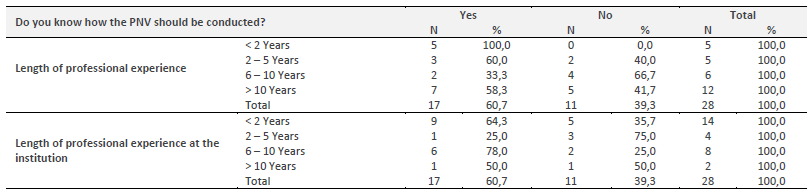
Note. N = frequency; % = percentage
Table 6 presents participants’ responses regarding the perceived advantages and/or disadvantages of the PNV. Regarding the importance of the PNV for perioperative patients, nurses identified reduced anxiety (100%) and the opportunity to clarify doubts and ask questions (100%) to be the most relevant advantages, followed by improved adherence to preoperative instructions (89.3%), facilitated identification of risk factors (89.3%), and increased patient safety (82.1%). Most participants (96.4%) believed that implementing the PNV could reduce adverse events and intraoperative complications, while increasing perioperative patient satisfaction (96.4%). Participants also emphasized the need for effective coordination between the inpatient unit and the OR (96.4%) to ensure that implementation does not disrupt workflows and internal service dynamics. In addition, 92.9% of participants considered the PNV to be an essential component of the nursing process, and 75% believed it could increase nursing teams’ satisfaction.
Table 6 Identification of advantages and/or disadvantages of the PNV
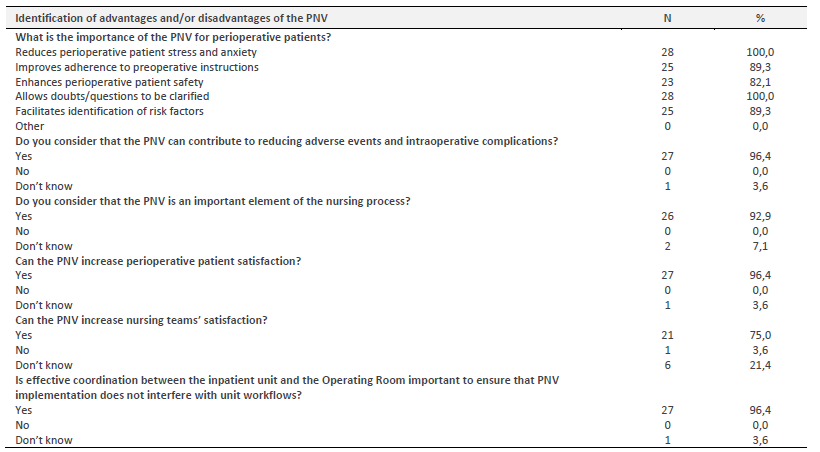
Note. N = frequency; % = percentage
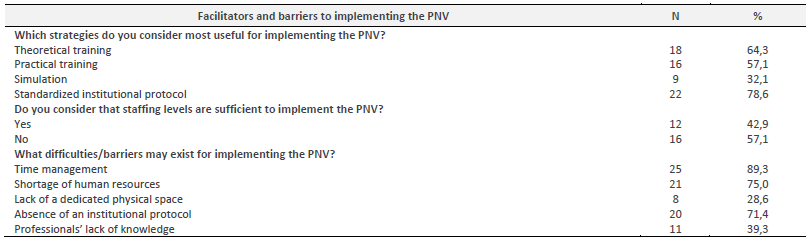
When asked about facilitating factors for implementing the PNV (Table 7), participants highlighted the existence of a standardized protocol (78.6%), followed by theoretical training (64.3%), practical training (57.1%), and simulation-based techniques (32.1%). When asked about staffing levels, 57.1% of respondents considered staffing insufficient to implement the PNV, whereas 42.9% reported that it was adequate. In response to the question, “Which institutional resources do you consider necessary for implementing the PNV?”, 57.1% of respondents emphasized the need for human and structural resources (e.g., an office/consultation room, telephone, computer, computerized documentation/recording systems, informational leaflets), protected time allocated to the PNV, and nurses’ training/capacity-building.
Regarding barriers to PNV implementation, time management was identified as the most limiting factor (89.3%), followed by human resource shortages (75.0%), absence of an institutional protocol (71.4%), professionals’ lack of knowledge (39.3%), and the lack of a dedicated physical space (28.6%). As suggestions for implementation, 25% of nurses proposed having a well-defined protocol aligned with the operational dynamics of the PNV (e.g., more rigorous perioperative patient admission procedures with sufficient advance notice to enable the PNV and an electronic assessment checklist), as well as training for the nursing team.
4. Discussion
The results of the diagnostic phase of the CQIP help to clarify nurses’ perceptions of the PNV and identify barriers and facilitators to its implementation in the OR under study. It is important to note that the data presented reflect professionals’ perceptions and expectations; therefore, no inferences can yet be made regarding the actual clinical or organizational impact.
Participants were predominantly female and young, with a bachelor’s degree and substantial professional experience but relatively short length of experience at the institution. These characteristics do not reflect the overall nursing workforce in Portugal, as only about 22% of nurses are under 31 years of age. Moreover, although 59.6% of nurses in Portugal work in hospitals, only 11.7% work in private hospitals (Instituto Nacional de Estatística, 2025). As this sample was drawn from a private institution, this may partly explain the lower mean age observed.
Regarding participants’ age, greater perceived knowledge was found among younger age groups; that is, younger nurses reported better knowledge of the PNV procedure than team members in older age groups.
The cross-analysis between overall professional experience and knowledge of the PNV procedure revealed higher levels of knowledge among nurses with the shortest and the longest professional experience. Notably, nurses with 6-10 years of professional experience more frequently reported not knowing how to conduct the PNV. When examining knowledge of the PNV procedure in relation to length of experience at the institution, nurses with 2-5 years of experience reported greater lack of knowledge. Nurses with less than two years and those with 6-10 years of experience in the institution more often reported knowing the procedure compared with the remaining groups. These differences may be explained by younger nurses having more recent and updated training, as well as closer contact with evidence-based practices.
Tadesse et al. (2023) reported that having six years of professional experience, adequate time, training, and knowledge were significantly associated with good preoperative patient education practices, highlighting the impact of both experience and knowledge on nursing practice.
In this study, nurses showed strong conceptual endorsement of the PNV: 92.9% of nurses rated it as “very relevant”, indicating professionals’ awareness of its role in perioperative patient safety. However, 39.3% of respondents reported not knowing how to conduct the PNV, pointing to training and organizational gaps. Despite recognizing the importance of PNV, nurses’ knowledge of preoperative education is often insufficient due to the lack of specific training and standardized guidance (Bazezew et al., 2023). The literature recommends developing nurse training programs and providing adequate resources to improve PNV effectiveness. Organizational support and leadership engagement are also essential to ensure the implementation of evidence-based practices (Gonçalves et al., 2024; Wei et al., 2024).
The unanimous agreement that the PNV should be conducted by the anesthesia support nurse aligns with professional recommendations and the literature. It is well established that the PNV is usually conducted by the nurse anesthetist on the day before surgery (Duarte & Martins, 2014).
Respondents highlighted multiple benefits of the PNV, including reducing perioperative patients’ stress and anxiety, clarifying doubts/questions, improving adherence to preoperative instructions, enhancing perioperative patient safety, and reducing adverse events and intraoperative complications. They also considered the PNV fundamental to the nursing process and suggested that it could increase perioperative patient satisfaction, promote effective coordination between the inpatient unit and the OR, and improve nursing team satisfaction.
These findings are consistent with evidence indicating that structured preoperative visits can reduce anxiety and improve postoperative recovery (Almeida, 2023; Guo et al., 2025). During the PNV, nurses provide emotional support and build a trusting relationship with perioperative patients, thereby contributing significantly to anxiety reduction (Almeida, 2023; Guo et al., 2025; Xu et al., 2020). In addition, systematic perioperative assessment enables nurses to identify early risk factors or situations that may influence surgical outcomes (Malley et al., 2015; Plauntz, 2007).
Regarding facilitators for PNV implementation, nurses emphasized the importance of a standardized institutional protocol, followed by theoretical and practical training and simulation-based techniques. Ensuring the quality of PNVs requires a formal structure, specialized professional training, and clinical competencies (Almeida, 2023; Plauntz, 2007). In this study, nurses with higher academic qualifications (specialization and master’s degree) reported greater perceived knowledge regarding PNV implementation, reinforcing the contribution of advanced training to clinical practice.
The main barriers identified were time management constraints, shortages of human resources, and the absence of an institutional protocol. Lack of a dedicated physical space and professionals’ lack of knowledge were also identified as barriers, although less frequently. Almeida (2023) similarly identified human resources, time, and dedicated physical space as implementation challenges. The absence of standardized nursing protocols for the PNV and insufficient knowledge and training to conduct a comprehensive PNV may lead to inconsistent practices (Fitzpatrick & Hyde, 2006; Wei et al., 2024).
These barriers are consistent with challenges described in other CQIPs and should not be interpreted as insurmountable obstacles, but rather as structural issues requiring planning, leadership involvement, and workflow redesign. Conversely, the facilitating factors identified by nurses, such as procedure standardization and combined theoretical-practical training, provide concrete starting points for the next phase of the project.
This study has limitations. First, the sample is not representative of Portuguese nurses as a whole. The local and contextual nature of the study limits the generalizability of the findings, as it was conducted in a single private institution. Nevertheless, the methodology and diagnostic process adopted may be transferable to other contexts, allowing nursing teams to adapt the intervention model to their specific realities while upholding the principles of continuous quality improvement.
The next phase of the CQIP will involve implementing and evaluating process and outcome indicators. Expected targets include: (i) >80% of perioperative patients with a documented PNV in their clinical records; (ii) perioperative patient satisfaction with the PNV ≥4, assessed using a questionnaire rated on a 1-5 scale; (iii) nurses’ satisfaction with the PNV ≥4, assessed using a questionnaire rated on a 1-5 scale; and (iv) a mean PNV duration <15 minutes, verified through direct observation.
As an institutional standardization and sustainability measure, the PNV will be formalized as an institutional procedure and incorporated into the OR nursing manual, supported by annual continuing education and internal audits.
The PDCA-based methodological approach facilitated team engagement and alignment around shared goals, as well as the establishment of evidence-based practices. Standardizing this process is expected to yield organizational and ethical gains by ensuring a patient-centered approach to perioperative care.
Conclusion
The PNV is a key intervention within the perioperative pathway, recognized as being highly relevant to care quality and patient safety. This CQIP conducted a situational diagnosis by identifying OR nurses’ perceptions of the PNV, as well as barriers and facilitating factors for its implementation.
Findings from the diagnostic phase indicate that nurses recognize the high relevance of the PNV and its potential to reduce perioperative anxiety, clarify doubts/questions, and improve coordination between the inpatient unit and the OR. It should be emphasized that these results reflect professionals’ perceptions and expectations and do not yet correspond to measured clinical or organizational outcomes.
From an organizational standpoint, the diagnostic assessment provides a critical foundation for planning the PNV implementation phase, allowing the development of strategies adapted to the unit’s reality, particularly regarding procedure standardization, team training, and resource management. This framework reinforces the value of the CQIP as a tool to support decision-making and structured improvement in nursing practice.
Although this study is limited to a specific institutional context, the results provide valuable insights into PNV implementation in other perioperative settings, provided that local organizational characteristics and available resources are taken into account. The adopted methodology appears suitable to support gradual and sustainable change processes.
In summary, this project highlights the importance of initiating quality improvement through a rigorous and participatory diagnosis based on professionals’ perceptions and real-world practice conditions. The PNV emerges as an intervention with the potential to strengthen person-centered care and safety in the perioperative period; however, its effective implementation and impact should be evaluated in subsequent project phases.
Authors' contribution
Conceptualization, A.M., F.A. and J.R.; data curation, A.M., F.A. and J.R.; formal analysis, J.P.; investigation, F.A., J.R. and V.G.; methodology, M.C.B-, F.A., J.R. and V.G.; project administration, V.G., J.P., A.M., F.A. and J.R.; resources, V.G.; supervision, M.C.B.; validation, J.P.; writing - original draft, F.A. and J.R.; writing - review & editing, F.A., J.R. and J.P.

