




 Inglês (pdf)
 Artigo em XML
 Referências do artigo

 Tradução automática
 Enviar este artigo por email
 Citado por SciELO
 Similares em
SciELO

 Permalink


Introduction
Mpox: an emerging infectious disease
Mpox, also known as monkeypox, is an emerging zoonotic disease caused by a virus of theOrthopoxvirusgenus. Clinically, it is characterized by fever, lymphadenopathy, and a progressive rash evolving from papules and vesicles to pustules and crusts. Transmission occurs through direct contact with skin lesions or body fluids, contact with contaminated materials, and, under certain circumstances, via respiratory droplets during prolonged close exposure (World Health Organization [WHO], 2025).
Historically restricted to Central and West Africa, Mpox became a global public health concern in May 2022 when outbreaks were reported in multiple non-endemic countries (European Centre for Disease Prevention and Control [ECDC], 2024).
Between January 2022 and March 2025, more than 137,000 confirmed cases and over 300 deaths were reported worldwide, underscoring its broad geographic spread and sustained transmission (WHO, 2025).
In July 2022, the WHO declared Mpox a Public Health Emergency of International Concern, reinforcing the need for robust surveillance, prevention, and control strategies (Eurosurveillance editorial team, 2024).
In Europe, several countries experienced localized outbreaks during the 2022-2023 epidemic wave, followed by sporadic cases, highlighting the importance of preparing healthcare professionals for timely recognition and response (ECDC, 2024).
Mpox: relevance of nursing interventions
Nurses play a pivotal role in the multidisciplinary response to Mpox, contributing to prevention, early detection, clinical management, surveillance, and psychosocial support. As the first point of contact for many patients, nursing professionals are strategically positioned to recognize symptoms, initiate isolation measures, and ensure timely referral for diagnosis and treatment (Dubey et al., 2023).
A central area of nursing intervention is epidemiological surveillance and early case detection. In community and primary care settings, nurses often identify initial signs of Mpox, support sample collection for laboratory confirmation, and notify suspected cases to public health authorities, thereby strengthening outbreak response (Gilmore et al., 2024).
Infection prevention and control is another key domain of nursing practice. Nurses ensure the appropriate use of personal protective equipment, implement isolation precautions, and manage contaminated materials safely in both hospital and community environments (CDC, 2024; Gilmore et al., 2024).
They are also central to vaccination campaigns, with responsibilities that include vaccine administration in pre- and post-exposure contexts, identification of at-risk individuals, and monitoring for adverse events following immunization. Evidence shows that healthcare professionals, including nurses, are instrumental in influencing vaccine uptake by fostering patient trust and providing education (ECDC, 2024; Suleiman, 2025).
Beyond the biomedical dimension, nursing professionals assume a strategic role in health education and risk communication. They actively address misinformation, reduce stigma, and promote preventive behaviours such as safe contact practices, appropriate hygiene, and adherence to isolation measures (Gilmore et al., 2024; WHO, 2025).
The psychosocial aspects of Mpox further highlight the importance of nursing interventions. Patients frequently experience distress associated with painful lesions, isolation, and stigma. In response, nurses provide psychological support, facilitate coping strategies, and coordinate referrals to multidisciplinary services (Dubey et al., 2023).
Their close relationship with patients and families positions them uniquely to ensure continuity of care, promote adherence to treatment, and enhance quality of life during recovery.
For these reasons, nursing interventions are not merely operational but also strategic, reinforcing the capacity of health systems to prevent, contain, and mitigate the impacts of Mpox and future infectious disease outbreaks.
Mpox: nursing students' education
Beyond its clinical and epidemiological dimensions, Mpox has been associated with significant social stigma, particularly due to initial public perceptions linking the infection to men who have sex with men. WHO has emphasized the importance of preventing and addressing stigma and discrimination, highlighting the role of clear, non-judgmental language and awareness of bias (WHO, 2024).
Early media and public framing that suggested Mpox was confined to certain populations likely contributed to prejudice and discrimination. Evidence also suggests that insufficient knowledge and a lack of specific educational content about Mpox may perpetuate negative stereotypes, reduce empathy, and compromise the quality of care in some contexts (Umar et al., 2024).
Studies show that higher knowledge correlates with more favorable attitudes and lower anxiety among nurses (Karacan et al.,2025).
Effective control of Mpox and similar emerging infectious diseases requires that nursing students possess both a strong theoretical understanding and practical competencies. However, education on Mpox preparedness is not yet standardized across institutions or countries, resulting in variability in awareness, risk perception, and preparedness (ECDC, 2022).
Moreover, social and psychological factors (including fear of contagion, perceived personal risk, and societal stigma) can negatively impact learning outcomes. Anxiety and low confidence have been documented among nursing students and healthcare workers in relation to Mpox, which may reduce engagement with course content or willingness to seek further training (Karacan et al.,2025).
Educational interventions that integrate up-to-date scientific information with principles of inclusive and non-stigmatizing communication have been shown to improve knowledge, awareness, attitudes, and confidence among students. Toolkits, guides, and higher education materials provide useful frameworks (CDC, 2021; CDC, 2024).
Standardized, evidence-based curricula addressing infection prevention, ethics, psychosocial aspects of disease, and professional communication can help reduce anxiety and stigma while enhancing readiness among nursing students (Umar et al., 2024; Suleiman, 2025).
A scoping review provides an appropriate methodological approach to map the available evidence, highlight gaps in education and training, and potentially inform the development of targeted educational strategies and policies. Is particularly suitable for clarifying research phenomena and identifying knowledge gaps that can inform subsequent research questions (Peters et al., 2020).
By synthesizing current evidence, this review can support educators, policymakers, and nursing schools in designing interventions that enhance nursing students’ competencies and strengthen the healthcare workforce’s capacity to respond effectively to Mpox and other emerging infectious diseases.
The research question guiding was: “What is the knowledge, education, understanding, and awareness regarding Mpox among nursing students?”
2. Methods
This scoping review, conducted in accordance with the methodological guidance of the Joanna Briggs Institute (JBI), aims to map the available evidence regarding nursing students’ knowledge, education, understanding, and awareness of Mpox, with the goal of informing the development of future educational strategies and research initiatives in this field.
The PCC mnemonic (Population, Concept, Context) was used to define the inclusion criteria: Population (P): nursing students (regardless of educational level or type of institution); Concept (C): knowledge, education, understanding, and awareness of Mpox; and Context (C): studies conducted in any geographical setting.
An initial exploratory search was conducted to identify relevant keywords and index terms. This was followed by the development of a structured and comprehensive search strategy. The keywords used were: (Mpox OR monkeypox) AND (knowledge OR education OR understanding OR awareness) AND (nursing students), combined using Boolean operators.
Searches were conducted between 25 and 31 August 2025 in the following electronic databases: Google Scholar, ProQuest, RCAAP, PubMed, MEDLINE, CINAHL, and the Cochrane Library. In addition, the reference lists of all included studies were manually screened to identify other potentially relevant sources.
Eligibility criteria included quantitative, qualitative, and mixed-methods studies, systematic reviews, and grey literature available in full text. Studies published in Portuguese, Spanish, or English were considered, as these are the languages spoken by the research team. No date restrictions were applied, given that Mpox is an emerging topic with limited research in this context.
The selection process was conducted independently by two reviewers. After removing duplicates, all records were imported into the Rayyan QCRI, which facilitated the blinded screening of titles and abstracts. Conflicts between reviewers were flagged by the platform and subsequently discussed.
Full texts of potentially eligible studies were retrieved and assessed for inclusion. Studies not meeting the eligibility criteria were excluded, and reasons for exclusion were documented in the Preferred Reporting Items for Systematic Reviews and Meta-analyses (PRISMA) flow diagram (Figure 1).
Any disagreements during the selection process were resolved through discussion or consultation with a third reviewer.
Data extraction was also performed independently by two reviewers, using a predefined data extraction form (Table 1) developed in line with the objectives and inclusion criteria of the review.
The form included the following variables: title, authorship, year of publication, study type, population, objectives, main results, and conclusions.
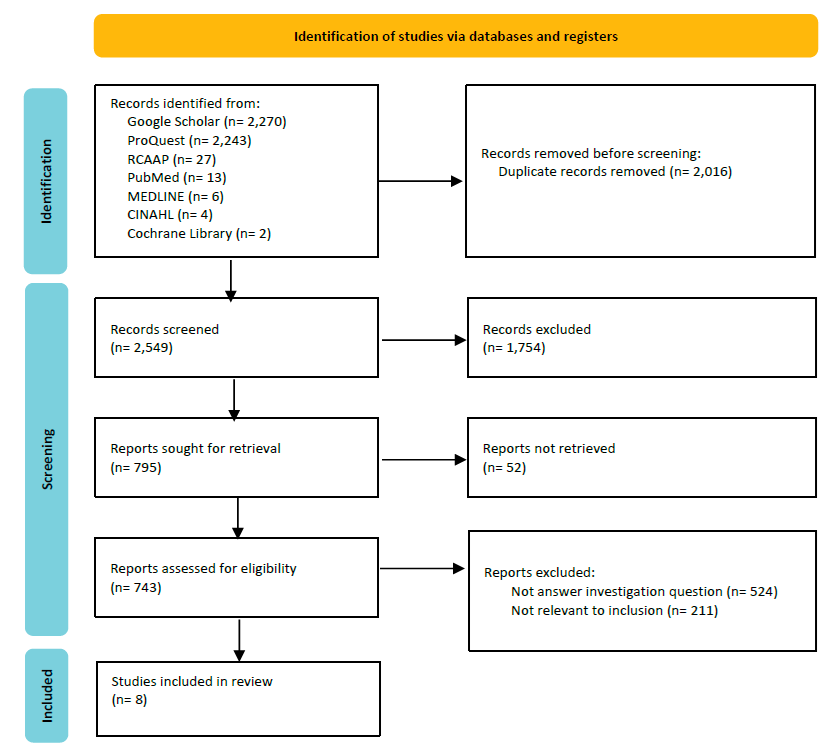
A total of 4,565 records were identified across multiple databases: Google Scholar (n= 2,270), ProQuest (n= 2,243), RCAAP (n= 27), PubMed (n= 13), MEDLINE (n= 6), CINAHL (n= 4), and the Cochrane Library (n= 2).
After the removal of 2,016 duplicates, 2,549 records remained for screening. Title and abstract screening led to the exclusion of 1,754 records, leaving 795 reports to be sought for retrieval. Of these, 52 could not be obtained, while 743 reports were successfully retrieved and assessed for eligibility.
Following full-text review, 735 reports were excluded, either because they were not relevant to the research question (n= 524) or did not meet the inclusion criteria (n= 211). Examination of reference lists did not yield additional eligible studies.
Ultimately, eight studies met the inclusion criteria and were incorporated into the scoping review.
3. Results
The eight studies included in this scoping review were published between 2023 and 2025. Six employed cross-sectional survey designs, while two used experimental approaches (one quasi-experimental and one pre-experimental).
All studies focused on nursing students. The research was conducted across lower-middle-income countries (Egypt, Rwanda, India) and upper-middle-income countries (Türkiye, Thailand, Saudi Arabia). The characteristics of the included studies are presented in Table 1.
Table 1 Characteristics of the included studies
| Title, authorship and year of publication | Study type | Population | Objective | Main results and conclusions |
| Navigating the fear: assessing nursing students concerns and preventive practices in response to Monkeypox in Egypt (Amin et al., 2025) | Cross-sectional descriptive | Nursing students (Egypt) | To assess fear, concerns, and preventive practices regarding Mpox among nursing students | Moderate fear and concerns; high adherence to preventive practices; fear strongly predicted preventive behaviours. Educational programs addressing Mpox-related concerns and reinforcing preventive practices are needed. |
| The mediating role of e-health literacy in nursing students’ knowledge and anxiety about monkeypox: a cross-sectional study from Türkiye (Artan et al., 2025) | Cross-sectional | Nursing students (Türkiye) | To assess knowledge and anxiety about Mpox among nursing students and the mediating role of digital health literacy | Moderate knowledge; moderate-to-high anxiety; digital health literacy predicted greater knowledge and reduced anxiety; vaccine hesitancy was a negative predictor. Digital health literacy positively influences knowledge and anxiety; it should be integrated into nursing curricula. |
| Health education programme for nursing students regarding the monkeypox pandemic and the necessity for palliative care (Ibrahim & Zaghamir, 2025) | Quasi-experimental | Nursing students (Saudi Arabia) | To evaluate the impact of an educational program on Mpox and palliative care in nursing students | The intervention group showed higher scores in knowledge and attitudes regarding both Mpox and palliative care compared to the control group. Educational programs improve knowledge and attitudes; curricular integration is recommended. |
| Factors related to nursing students' behavior for personal protection against Monkeypox at Western University, Buriram Campus, Thailand (Ruanphet et al., 2025) | Cross-sectional descriptive | Nursing students (Thailand) | To explore the relationship between personal factors, knowledge, attitudes, and self-protection behaviours against Mpox | High levels of knowledge and attitudes; protective behavior associated with greater knowledge and positive attitudes. Knowledge and attitudes directly influence preventive behaviours. Prevention should be reinforced even after media attention declines. |
| Knowledge of Mpox, Media Exposure, and Clinical Experience: Their Influence on Nursing Students’ Preparedness for Disease Outbreaks at the University of Gitwe, Rwanda (Ndayiragije et al., 2024) | Quantitative, cross-sectional | Nursing students (Rwanda) | To examine how knowledge, media exposure, and clinical experience influence preparedness for outbreaks | High knowledge and media exposure; preparedness is strongly associated with media exposure. Recommended to integrate media literacy and clinical training. |
| Nursing Students’ Perception of Monkeypox Virus at the Technical Health Institute of Imbaba (Abd Elrahim, 2024). | Descriptive | Nursing students (Egypt) | To assess perceptions (knowledge, practice, attitudes) about Mpox | 50% poor knowledge, 45% satisfactory practice, 30% positive attitudes. Need for educational programmes. |
| Knowledge Regarding Human Monkeypox (HMPX) Among Nursing Students (Rexline, 2024) | Pre-experimental (one-group pre/post-test) | Nursing students (India) | To evaluate laptop-assisted teaching effectiveness on Mpox knowledge | Pre-test: 88% poor knowledge; Post-test: significant improvement (22% adequate, 38% moderate). Laptop teaching is effective. |
| Monkeypox Knowledge Assessment among the Undergraduate Nursing Students of Hyderabad (Qureshi et al., 2023) | Descriptive, cross-sectional | Nursing students (Hyderabad) | To assess knowledge of Mpox | Knowledge gaps identified; recommended enhanced formal education and training on emerging diseases. |
4. Discussion
This scoping review identified eight studies that examined nursing students’ knowledge, education, understanding, and awareness of Mpox.
Mapping the evidence highlighted diverse contexts, methodological approaches, and outcomes, while also revealing notable gaps for nursing education and future research.
Overall, nursing students’ knowledge ranged from poor to moderate, with wide variation across countries and study settings.
Attitudes toward infection prevention were generally positive but often shaped by external factors such as risk perception, media exposure, and digital literacy (Abd Elrahim, 2024; Amin et al., 2025; Artan et al., 2025; Ibrahim & Zaghamir, 2025; Ndayiragije et al., 2024; Qureshi et al., 2023; Rexline, 2024; Ruanphet et al., 2025).
Limited knowledge was frequently accompanied by anxiety or fear, which in some cases predicted protective behaviours (Amin et al., 2025).
Intervention studies confirmed that structured educational programs, whether classroom-based or digitally delivered, effectively improved knowledge and preparedness (Ibrahim & Zaghamir, 2025; Rexline, 2024).
These findings underscore the importance of integrating emerging infection content, along with digital and media literacy, into nursing curricula to sustain preparedness.
Students’ knowledge
Knowledge of Mpox varied substantially across settings. In Egypt and India, nearly half of the students had poor knowledge, while in India, 88% scored inadequately prior to instruction (Abd Elrahim, 2024; Rexline, 2024).
A survey in Hyderabad likewise revealed significant gaps, recommending stronger formal education on emerging diseases (Qureshi et al., 2023).
By contrast, higher knowledge scores were observed in Thailand and Rwanda, where preparedness and protective behaviours were closely linked to stronger knowledge bases (Ruanphet et al., 2025; Ndayiragije et al., 2024).
Moderate knowledge was reported in Egypt and Türkiye, reflecting partial awareness but limited confidence and preparedness (Amin et al., 2025; Artan et al., 2025).
Experimental evidence reinforced the value of education. A quasi-experimental program in Saudi Arabia significantly improved knowledge outcomes, while a laptop-assisted teaching intervention in India produced notable post-test gains (Ibrahim & Zaghamir, 2025; Rexline, 2024).
Collectively, the evidence indicates that students’ baseline knowledge is often inadequate but can be strengthened through structured interventions, media exposure, and digital literacy (Abd Elrahim, Z., 2024; Amin et al., 2025; Artan et al., 2025; Ibrahim & Zaghamir, 2025; Ndayiragije et al., 2024; Qureshi et al., 2023; Rexline, 2024; Ruanphet et al., 2025).
These findings align with broader nursing education literature showing that baseline knowledge of emerging infections is typically limited but responsive to targeted instruction (Suleiman, 2025).
Students’ education
Educational dimensions emerged across all studies, either through direct interventions or recommendations for curriculum development.
In Egypt, moderate fear and high adherence to preventive practices led authors to recommend educational initiatives to address concerns and reinforce behaviours (Amin et al., 2025).
In Türkiye, digital health literacy predicted both knowledge and anxiety, suggesting its integration into curricula to enhance preparedness (Artan et al., 2025).
Intervention studies confirmed the effectiveness of structured teaching. A quasi-experimental program in Saudi Arabia improved both knowledge and attitudes, while laptop-assisted teaching in India produced significant learning gains (Ibrahim & Zaghamir, 2025; Rexline, 2024).
Findings from Thailand emphasized the need for continuous reinforcement of preventive education beyond peaks of media attention (Ruanphet et al., 2025).
In Rwanda, preparedness was strongly linked to media exposure and clinical experience, leading to recommendations for media literacy and clinical training in nursing education (Ndayiragije et al., 2024).
Cross-sectional studies in Egypt and India also pointed to poor knowledge and suboptimal practices, further supporting the need for educational programs (Abd Elrahim, 2024; Qureshi et al., 2023).
Collectively, these findings highlight education (whether through curricular integration, structured interventions, reinforcement strategies, or digital/media literacy) as a central mechanism for improving students’ preparedness for emerging infectious diseases.
Students’ understanding and awareness
Understanding was limited in most studies, with preventive behaviours often driven by fear rather than informed reasoning (Abd Elrahim, 2024; Amin et al., 2025).
Structured interventions improved applied understanding: in Saudi Arabia, a quasi-experimental program enabled students to better translate technical knowledge into clinical practice, while in India, digital teaching approaches fostered deeper comprehension (Ibrahim & Zaghamir, 2025; Rexline, 2024). Persistent gaps identified in Hyderabad reinforced the need for systematic training (Qureshi et al., 2023).
Awareness was shaped by risk perception, concern, and readiness to act.
In Egypt, adherence to preventive measures was driven by fear (Amin et al., 2025), while in Rwanda, awareness was strongly influenced by media and clinical experience (Ndayiragije et al., 2024).
In Thailand, awareness initially promoted protective behaviours but declined with reduced media coverage, highlighting its fragility without educational reinforcement (Ruanphet et al., 2025).
In Türkiye, digital literacy strengthened critical awareness, while vaccine hesitancy reflected weaker awareness (Artan et al., 2025).
Overall, awareness among nursing students was evident but unstable, requiring sustained educational support to consolidate into lasting competency.
This is consistent with external evidence showing that structured interventions (such as quasi-experimental Mpox-focused programs in Saudi Arabia and Pakistan) significantly improved knowledge and attitudes. Similar gaps have been reported in Algeria and Saudi Arabia, where health sciences and pharmacy students demonstrated poor knowledge, often acquired through social media rather than formal education, reinforcing the need for curricular integration (Hakami et al., 2025; Lounis et al., 2024).
Evidence strengths and limitations
The available evidence is subject to important limitations. The predominance of cross-sectional designs constrained the ability to draw causal inferences and to assess long-term knowledge retention (Abd Elrahim, 2024; Amin et al.,2025; Artan et al., 2025; Ndayiragije et al., 2024; Qureshi et al., 2023; Ruanphet et al., 2025).
Measurement tools were heterogeneous and often lacked formal validation, while the frequent use of convenience sampling reduced representativeness. The scarcity of qualitative research further limited understanding of students’ perceptions and lived experiences.
Despite these methodological weaknesses, experimental studies provide stronger evidence for the effectiveness of educational interventions. In India, laptop-assisted teaching produced substantial knowledge gains (Rexline, 2024).
In addition, structured programs improved both knowledge and attitudes (Ibrahim & Zaghamir, 2025).
Conclusion
This scoping review shows that although nursing students possess some knowledge of Mpox, it is often fragmented and insufficient to support practice.
Persistent knowledge gaps, limited understanding, and awareness shaped by external influences highlight weaknesses in current educational approaches.
Evidence from intervention studies demonstrates that curriculum-integrated programmes, particularly those grounded in active pedagogical methodologies, can enhance knowledge, reshape attitudes, and develop practical competencies.
For nursing education, the implications are clear: curricula should systematically integrate content on emerging infectious diseases, adopt active learning strategies such as simulations and case studies, strengthen digital health literacy, and promote sustained preventive behaviours.
Collectively, these measures can better equip nursing students to respond effectively to future outbreaks and contribute meaningfully to public health preparedness.
Authors' contribution
Conceptualization, R.G. and L.L.; data curation, R.G., J.C., T.A. and L.L.; formal analysis, R.G., J.C., T.A. and L.L.; investigation, R.G., J.C. and L.L.; methodology, R.G., J.C., T.A. and L.L.; project administration, R.G.; resources, R.G. and L.L.; software, R.G. and J.C.; supervision, R.G. and L.L.; validation, R.G., J.C., T.A. and L.L.; visualization, R.G., J.C. and L.L.; writing - original draft, R.G., J.C., T.A. and L.L.; writing - review & editing, R.G., J.C., T.A. and L.L.

