




 Inglês (pdf)
 Artigo em XML
 Referências do artigo

 Tradução automática
 Enviar este artigo por email
 Citado por SciELO
 Similares em
SciELO

 Permalink


Introduction
An E-wallet acts as a physical wallet, allowing users to reload electronic money with mobile banking services. E-wallet promotes time-saving as users do not need to constantly log on to mobile banking systems (Kasirye and Masum, 2021). E-wallet payment platforms are imperative and adopted by both consumers and merchants to create critical mass and network externalities (Sedigheh et al., 2020). From a business’s perspective, impulsive buying is relevant for improving sales revenue (Miao et al, 2020).
An e-wallet is an electronic service designed to store various payment instruments, including electronic money and payment applications. Additionally, this service enables users to store funds and make online payments to other users. Each E-wallet account comes with the account owner's identity data, as it contains electronic money. E-wallets have various functions, not only as a means of payment, but also as a verification tool in buying and selling activities (Christian et. al, 2024). According to the newspaper Dinheiro Vivo (2020), during the pandemic of COVID-19, most Portuguese people (around 45%) have adopted or intensified the use of digital payment methods in Portugal. However, despite this use being enhanced by a need for security because of the situation experienced, society ended up realizing the convenience associated with these systems, which strongly influenced the continuity of use.
While numerous studies have examined E-wallet adoption in Asian markets such as China, Malaysia, and India, where platforms like Alipay, WeChat Pay, and Paytm dominate, Portugal presents a distinct context. The Portuguese digital payment ecosystem is characterized by the prominence of MBWay, a locally developed E-wallet service that is directly integrated with the national banking network. Unlike many global E-wallet platforms, MBWay allows seamless linkage between bank accounts and mobile payments, offering both convenience and high consumer trust due to its association with established financial institutions. This unique integration of traditional banking infrastructure with digital innovation distinguishes Portugal from other markets, where E-wallet systems are often operated by fintech or non-bank providers. Furthermore, Portuguese consumers have shown a rapid and sustained adoption of MBWay, surpassing the use of debit and credit cards in online commerce (Barómetro E-commerce, 2022), surpassing Payment by Debit or Credit Card, used by around 3.2 million Portuguese people. In the following positions are PayPal (1.8 million), Bank transfer (1.6 million), and Online Cards such as MBNet or Revolut (1.3 million). This report also asked Portuguese about the preferred payment method, regardless of the one they use most. This local specificity provides a valuable setting to examine the factors influencing the continued intention to use E-wallets, contributing contextually to the global discourse on digital payment adoption.
Thus, the purpose of this investigation is to analyze the factors affecting the continued intention to use E-wallets in Portugal.
1. Literature review
E-wallet adoption has been widely examined across various contexts using models such as the Technology Acceptance Model (TAM) and the Unified Theory of Acceptance and Use of Technology (UTAUT). Prior studies emphasize factors such as perceived usefulness, perceived ease of use, trust, and security as key determinants of users’ behavioural intention and continued usage (Davis, 1989; Venkatesh et al., 2003). More recent research has incorporated additional constructs such as convenience, hedonic motivation, and habit to explain long-term engagement with digital payment platforms (Aji et al., 2020; Leong et al., 2022).
Most existing studies on E-wallet adoption and continued use have been conducted in Asian markets, where fintech ecosystems and mobile-first economies have driven rapid digital payment adoption (Nguyen & Nguyen, 2021; Tan et al., 2024). These markets often exhibit high digital literacy, which facilitates rapid consumer acceptance of E-wallet technologies. These contexts typically emphasize convenience, performance expectancy, and social influence as dominant predictors of behavioural intention (Daragmeh et al., 2021). In contrast, adoption in Western countries has been slower, frequently influenced by different cultural attitudes toward cashless transactions, institutional trust, and financial regulation (Liu et al., 2022).
In Europe, E-wallet adoption has generally been slower than in Asia due to higher reliance on traditional banking systems and credit card infrastructures (Capgemini, 2021). Yet, recent studies show an acceleration of digital payment use after the COVID-19 pandemic, driven by hygiene concerns and increasing consumer familiarity with contactless transactions (European Central Bank, 2022).
While global E-wallet research provides valuable insights, Portugal presents a distinctive case that has not been extensively explored in prior literature. The Portuguese digital payment landscape is dominated by MBWay, a locally developed E-wallet service that is deeply integrated into the national banking network. Unlike many global E-wallets operated by independent fintech companies, MBWay’s linkage with users’ existing bank accounts fosters a high level of trust, security, and accessibility. This integration reflects a hybrid model that merges traditional banking reliability with modern mobile convenience.
Given this unique configuration, the Portuguese case offers a valuable opportunity to extend existing E-wallet adoption models.
The performance expectancy of E-wallets is the extent to which users believe that using E-wallets will help them achieve high performance in payment methods (Venkatesh et al., 2003). The research results show that performance expectancy (Daragmeh et al.,2021) and social influence significantly predict behavioural intention to use E-wallets in payment (Phan et al, 2020). Therefore, we propose the following hypothesis:
H1: Performance expectancy will have a positive impact in behavioural intention to use E-wallets.
The effort expectancy refers to the way the system is used efficiently. It includes users interacting with the system clearly and in an easily understandable manner, and is easy to use (Venkatesh et al, 2003). Besides this, Sfenrianto and Saragih (2017) used the scale of effort expectancy, including easy-to-use payment systems, flexible transactions, and easy-to-learn payment systems. It is considered that these scales are quite adequate for research. According to Nguyen et al (2023), the less effort you make in using E-wallets, the more you intend to use them. Also, a study conducted by Tan et al. (2024) showed that effort expectancy, network externalities, and satisfaction positively affect merchants ' continuous intention to use the E-wallet system. Therefore, we propose the following hypothesis:
H2: Effort Expectancy will have a positive impact on behavioural intention to use E-wallets.
Facilitating conditions are defined as the degree to which an individual believes that an organizational and technical infrastructure exists to support system usage (Venkatesh et al., 2003). Peñarroja et al. (2019) confirmed that facilitating conditions positively influenced the knowledge-sharing behavior of using technology during this digital era. Therefore, we propose the following hypothesis:
H3: Facilitating conditions will have a positive impact on behavioural intention to use E-wallets.
Reputation is a key variable as it helps consumers cope with the uncertainty caused by information asymmetry between providers and buyers. Perceived reputation reflects users’ confidence that a service provider is reliable, competent, and adheres to ethical standards (George & Sunny, 2021). Consumers address reputation based on their previous experiences (previous providers’ performance) and those of others (word-of-mouth, recommendations, and comments, among others) to secure themselves via limiting transactional risks (Kaushik et al., 2020). So, the customer perception of the mobile wallet provider’s reputation may form the basis of their trustworthiness (George and Sunny, 2021). In the Portuguese context, this construct is particularly powerful because most E-wallets, notably MBWay, are operated or endorsed by traditional banking institutions with long-standing reputations for security and regulatory compliance. As a result, Portuguese consumers inherit a baseline level of trust from their existing relationships with banks rather than forming new evaluations based on technological novelty. Reputation in important for trust formation, where the established credibility of the provider substitutes for perceived technological uncertainty (Kaushik, Mohan, & Kumar, 2020). Therefore, we propose the following hypothesis:
H4: Perceived reputation will have a positive impact on Perceived Trust.
According to Donald and Remy (2012), the security of E-wallets is defined as the degree to which customers believe that using a specific payment method via the mobile application will be kept safe. Privacy and security also increase the consumer experience, and they also significantly affect customers in terms of the risks involved (Tran, 2020). Besides, the privacy of E-wallets is the right that customers expect their information and transactions to be kept confidential. It consists of keeping information intact, without unauthorized access, and no use of private information for secondary purposes. Donald and Remy (2012) have shown that security and privacy in personal information positively affect behavioural intention. Security assurance plays an important role in building trust by reducing consumer concerns about misuse of personal data and tamper-evident data transactions (Silalahi et al., 2022). Perceived security can mitigate such concerns and enhance consumers’ trust in mobile wallets (George and Sunny, 2021). Security mechanisms such as multi-factor authentication and regulatory compliance certainly contribute to trust. However, in mature financial systems like Portugal’s, where users already associate banking platforms with strong institutional safeguards, security is viewed as an expected baseline feature, not a differentiating factor. Consumers assume that bank-affiliated systems meet strict European regulatory standards, and thus rarely evaluate security independently when deciding whether to continue using an E-wallet (European Central Bank, 2022). Consequently, while perceived security still exerts a positive effect on trust, its marginal impact is weaker than that of reputation because users perceive security as a given rather than a variable attribute. Therefore, we propose the following hypothesis:
H5: Perceived Security will have a positive impact on Perceived Trust.
In connection with mobile wallets, trust is the extent to which consumers identify mobile wallet application providers to be trustworthy regarding the security, reputation, regulatory support, and service quality pursued by them (George and Sunny, 2021). Wong and Mo (2019) stated that when consumers feel that the service provided is honest and reliable, it would mostly increase the consumer's intention to use the service since they have high levels of belief in it. Consumers’ trust can greatly affect the intention to use mobile service-by-service providers or payment services. Confidence in technologies contributes to improved assessments and attitudes towards technologies, in which the technology criteria meet the promise and are reliable and safe, which will have a positive effect on the intention to use these technologies (Yang et al., 2021). In Portugal, trust plays an enabling rather than initiating role. Since the provider’s reputation already establishes a trust baseline, users’ behavioural intentions hinge on whether the trusted system performs as expected, reinforcing the interplay between trust and performance expectancy. This differs from emerging markets, where trust is often the primary barrier to initial adoption. Therefore, in the Portuguese case, trust functions as a stabilizing mechanism that sustains continued usage, but its strength depends on institutional reputation rather than ongoing security verification. Therefore, we propose the following hypothesis:
H6: Perceived trust will have a positive impact on behavioural intention to use E-wallets.
Behavioural Intention is the degree at which customers construct a plan for their behavior to respond or not respond in the future. Behavioural Intention or user behavior intention can be interpreted as a person's willingness to use information technology according to their wishes. The willingness to use a system is the user's intention to continue using the system continuously, with and they have access to the system used (Donan et al., 2023). Among a pool of massive research studies investigating about mobile wallet adoption in Vietnam, the number of studies discussing continuance usage is rare, while its vital role cannot be ignored. Practically, when innovative technology is launched in a market, immediately, the public responds inquisitively and desires being an owner. Therefore, consumers may intend to adopt a mobile wallet at first; however, their willingness for continued usage does not ensure (Ly, Nguyen, and Tran, 2022).
Some factors used to describe intention to use E-wallet, such as perceived usefulness, perceived ease of use, perceived risk, social influence, price, trust, and the like, have been applied to measure behavior intention towards the adoption of technology (Lim, Ahmad, and Talib, 2019). Therefore, we propose the following hypothesis:
H7: Behavioural intention will have a positive impact on E-wallets' Continued Usage Intention.
2. Methods
This study utilized a convenience sampling approach to collect data from E-wallet users. The questionnaire contained two parts: the first included the background information of the respondents, while the second part contained questions about the theoretical framework proposed constructs with questions adapted from previous studies (Venkatesh et al., 2003; Tan et al., 2024). The online questionnaire created by Google Form technology was disseminated through various social media platforms. Individuals who use E-wallets were invited to participate voluntarily by completing the survey link. This approach allowed the researcher to reach a wide range of respondents while ensuring that all participants had relevant experience with E-wallet usage. A total of 185 valid responses were obtained and included in the analysis. To measure each item of the survey, we used a Likert scale of 5 points. In addition to Cronbach´s Alpha, the local fit indices - indicator reliability, variance extracted, factor reliability, and total variance explained - were employed to test the validity of the obtained factor. We also tested the composite reliability and the variance extracted. After this analysis, we estimated the final structural models with Amos 26.0 for the Structural Equation Modelling.
3. Results and discussion
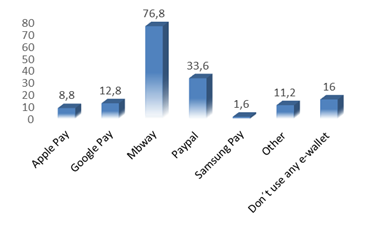
The wide use of geographic, demographic, socio‐economic, and psychographic variables has not always been accepted as good predictors in predicting buying behaviour in financial services by past and recent studies, which claimed that the benefits customers seek for banking services and/or the product attributes should be identified instead. In Table 1, we present the demographic characteristics of the sample, and in Figure 1, the most used E-wallets for the respondents in our sample, and the preferred by the Portuguese respondents in the sample is MbWay, with 76,8% of preference.
Table 1 Demographic characteristics of the sample
| Demographic variable | % |
|---|---|
| Age | |
| >65 | 1,6 |
| 18-30 | 16,8 |
| 31-40 | 25,6 |
| 41-65 | 56 |
| Education | |
| Phd | 13,6 |
| MASTER’S Degree | 13,6 |
| Degree | 49,6 |
| High Scholl | 20,8 |
| Other | 2,4 |
| Income | |
| >2000 | 20 |
| 1501-2000 | 21,6 |
| 1001-1500 | 30,4 |
| 501-1000 | 18,4 |
| < 500 | 9,6 |
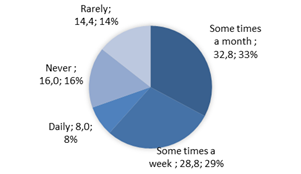
In Figure 2 the results suggested that most of the respondents use the E-Wallets sometimes a month (32,8%) and sometimes a week (28,8%).
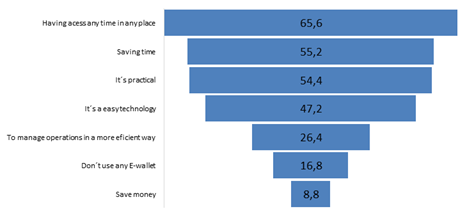
The main advantages of using E-wallets (Figure 3) were having access at any time and place (65,6%) and saving time (55,2%); only 8,8 % referred that the main advantage was saving money.
Nevertheless, the findings indicated a penetration in the target market and therefore, the potential of this market should not be underestimated. Equally, there is still some good potential for developing other e-wallets from other companies.
In Appendix A we present the design of the scale and the percentage of agreement with some statements about the use of E-wallets: a high percentage of respondents answered they strongly agreed with the statement that they have the necessary resources and skills to use digital wallets and also a big percentage found it was easy to learn how to use the E-wallets; also, 44 % agreed with the statement that the use of E-wallets increased their productivity and 39% strongly agreed that E-wallets are useful in their daily life. A major concern is that if E-wallets are compatible with other technologies, and in our sample, 41% of the respondents answered that they agree, and 39% strongly agree with this statement. We also asked the respondents about security, and 44 % agree that they feel the E-wallet providers are secure, and 42% agree that the possibility of any financial loss from using an E-wallet is very low.
Table 2 Exploratory and confirmatory analysis
| Constructs | Name | Factor scores | Total variance extracted % | Cronbach Alpha | CR | AVE |
|---|---|---|---|---|---|---|
| Performance Expectancy | PE1 | 0,799 | 76,7 | 0,848 | 0,908 | 0,767 |
| PE2 | 0,925 | |||||
| PE3 | 0,899 | |||||
| Effort Expectancy | EE1 | 0,962 | 92,464 | 0,918 | 0,763 | 0,617 |
| EE1 | 0,962 | |||||
| Facilitating conditions | FC1 | 0,901 | 79,682 | 0,925 | 0,941 | 0,841 |
| FC2 | 0,924 | |||||
| FC3 | 0,926 | |||||
| Perceived Trust | TR1 | 0,938 | 88,819 | 0,937 | 0,96 | 0,888 |
| TR2 | 0,945 | |||||
| TR3 | 0,944 | |||||
| Perceived Reputation | REP1 | 0,931 | 86,711 | 0,844 | 0,733 | 0,578 |
| REP2 | 0,931 | |||||
| Perceived Security | PSC1 | 0,928 | 86,14 | 0,839 | 0,729 | 0,574 |
| PSC2 | 0,928 | |||||
| Continued usage intention | CUI1 | 0,955 | 91,271 | 0,904 | 0,756 | 0,608 |
| CUI2 | 0,955 | |||||
| Behavioural intention | BI1 | 0,928 | 86,063 | 0,838 | 0,729 | 0,574 |
| BI2 | 0,928 |
In general, the brand reputation of the e-wallet is a major concern and gives them confidence, for most of the respondents. Most of the mobile wallet providers are either traditional banking service providers or other technology giants already possessing a good reputation, which will result in consumers trusting mobile wallets (George and Sunny, 2021). In relation to trust issues, most of the respondents trust transactions carried out with E-wallets; they trust that the E-wallet will not disclose any of their information, and believe that the brand of E-wallet they use complies with consumer laws.
Our confirmatory factor analysis showed that all standardized loadings were significant with a reliability level of 95% and reached values up to 0,5 (Table II).
In relation to the internal consistency and reliability, Total Variance Extracted, Cronbach Alpha, Composite Reliability (CR), and Average Variance Extracted (AVE) were analyzed. We obtained Cronbach Alpha values from 0,838 to 0,937, thus being acceptable.
The Composite Reliability exceeded the value of 0,7, satisfying the criteria by (Hair et al, 1986), and the Average Variance Extracted varied from 0,574 to 0,888, thus confirming convergent validity.
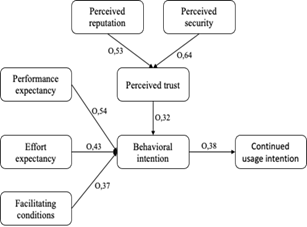
In Figure 4, we present the Structural Equation Model, and the global fit for the present structural equation model was acceptable: X2 = 131,5, df = 73; CFI = 0,919; TLI = 0.906; GFI = 0,812; RMSEA =0,089, and AGFI = 0,803. We also tested discriminant validity for all the constructs.
We found a positive impact of Performance expectancy on Behavioural intention, with a total effect of 0,54, thus supporting the hypothesis H1. Similar results were found in studies conducted in Malaysia and India that proved a significant relation between performance expectancy and mobile wallet’s behavioural intention and continuous usage (Revathy and Balaji, 2020; Saraswati et al., 2021). Possible implication is that respondents believe and are aware of innovative technology from mobile wallets, which enhances their performance (Ly, Nguyen, and Tran, 2022). Effort expectancy also impacts positively on Behavioural intention; thus, we can accept Hypothesis H2. This result is also supported by previous studies (Arning and Ziefle, 2009) and (Cimperman and Trkman, 2016).
We found a significantly positive relation between Facilitating conditions and Behavioural intention with a total impact of 0,37. These results are aligned with other authors who concluded that researchers must be cautious when adding Facilitation conditions in research models because this variable is the least impactful factor when users decide to adopt innovative technology (Patil et al., 2020).
Perceived reputation has a strong positive impact of 0,53 in Behavioural intention. In other studies, the perceived reputation of the mobile service provider was found to be an important trust-building factor (Chandra, Srivastava, and Theng, 2010), (Daştan and Gürler, 2016). So, the customer perception of the mobile wallet provider’s reputation may form the basis of their trustworthiness (George and Sunny, 2021). Perceived security has a strong impact on perceived trust. Also, according to Donald and Remy (2012), security and privacy in personal information positively affect behavioural intention. Our data also revealed that Trust has a positive impact on Behavioural intention with a total effect of 0,32. Thus aligned with several studies (Putri, 2018), (Slade et al., 2015). We found a positive relation between Behavioural intention and Continued usage intention with an impact of 0,38. Also according to a study conducted by Ly, Nguyen and Tran (2022), in Vietnam, they found that Behavioural intention positively impact continuance usage, arguing that Behavioural intention is reliable enough to explain for continuance usage, once owners of mobile wallets understand and take all intentions arisen by users into serious consideration, they will not only hook but also retain existing adopters simultaneously.
Our finding that Performance expectancy is the strongest predictor of Behavioural intention in the Portuguese sample can be understood considering Portugal’s payment ecosystem and consumer expectations. Unlike many markets where independent fintech providers lead the mobile-payment landscape, Portugal’s E-wallet usage is dominated by MBWay, a platform natively linked to traditional bank accounts and the national banking network. This bank-backed integration has driven rapid adoption and frequent usage, so Portuguese users tend to evaluate E-wallets primarily on their practical utility-speed, convenience, and reliability-rather than novelty alone. National market data confirm MBWay’s wide penetration and continued growth (Barómetro E-commerce, 2022). Consequently, performance-related benefits such as time savings and transactional efficiency become particularly salient for Portuguese users when forming behavioural intentions.
When comparing these findings with those of Ly et al. (2022) in Vietnam, notable cultural and economic nuances emerge. These authors found that trust and security were dominant determinants of continuance intention during the COVID-19 pandemic, reflecting higher user sensitivity to privacy, fraud, and provider reliability in an emerging-market context. Vietnam’s fragmented fintech environment-with multiple competing providers and varying levels of regulatory oversight contrasts with Portugal’s highly centralized and bank-integrated digital payment system. As a result, Vietnamese users emphasize trust and perceived security as prerequisites for continued use, while Portuguese consumers operating within an already trusted banking framework prioritize system performance and convenience over perceived risk concerns (Ly et al., 2022; Donald and Remy, 2012).
These contrasts are consistent with prior studies in Malaysia and India, where performance expectancy and trust alternated in prominence depending on market maturity and institutional trust levels (Revathy and Balaji, 2020; Saraswati et al., 2021). In mature, bank-centric markets like Portugal, users view E-wallets as established utilities; thus, performance becomes the main differentiator. In contrast, in developing or fintech-dominated markets, where institutional trust is lower, users’ confidence hinges more on perceived security, privacy, and provider reputation (George and Sunny, 2021; Kaushik et al, 2020).
Practically, these differences suggest that strategies to increase continued E-wallet use in Portugal should focus on enhancing transactional performance, improving speed, reliability, and service integration, while in emerging markets, interventions that strengthen trust and security assurances remain more critical. This highlights the importance of considering both market structure (bank-backed vs. fintech-driven) and ecosystem maturity when interpreting which determinants most strongly influence continued usage intention.
Conclusion
This study proposed a model to generalize the determinants of E-wallets' continued user intention with data from Portugal, that are important for online payment management and researchers. Data analyzed from 185 customers yielded essential findings that support the research hypotheses.
This research has been successful in confirming that Behavioural intention positively influences continued use intention, marking a new level of research in the Portuguese context. In a study conducted by Mohd et al. (2023), Behavioural intention had a significantly positive relationship with continuous adoption of E-wallets in Malaysia. It means that the higher the intention the consumer is likely to have, the higher the actual behavior and vice versa. When mobile wallet owners fully grasp and prioritize users' needs, they can not only attract and keep current users but also advance the product life cycle to a more advanced stage, such as growth or maturity. Our data also found evidence to support the fact that customer perception of the E-wallet provider’s reputation and security may form the basis of their trustworthiness.
Performance expectancy was found to have a major impact on Behavioural intention, also confirmed by other previous studies (Revathy and Balaji, 2020), (Saraswati et al., 2021). Companies must increase users’ beliefs and perceptions that e-wallet technology is able to improve their performance.
Furthermore, our contribution also consolidates the recent conclusion that Effort expectancy is significant in the Portuguese context, and its role remains as an indispensable determinant of Behavioural intention.
In the context of innovation, ease is a requisite for early adopters. Once the perceived ease of use experiences an upward trend, users recognize that new technology is beneficial and helpful. Thus, ease of use is considered an effective instrument so that users reduce their effort to get used to usage (Ly, Nguyen, and Tran, 2022). Facilitating conditions can make adoption behavior less difficult by removing any obstacles to acceptance and can thereby ensure sustained usage (Rao and Troshani, 2007).
Also, according to Ly, Nguyen, and Tran (2022), Behavioural intention of adopters depends on performance expectancy, effort expectancy, social influence, facilitating conditions, hedonic motivation, habit, trust, and price-saving orientation.
Future research could expand this study by incorporating emerging forms of digital payment technologies that go beyond traditional, centralized e-wallet systems. The rise of decentralized digital markets and blockchain-based wallets, such as MetaMask and other Web3 payment applications, introduces new paradigms of trust, privacy, and user autonomy. Unlike conventional E-wallets managed by financial institutions, decentralized wallets operate without intermediaries, relying on cryptographic trust and smart contracts. Future investigations could examine whether determinants such as perceived trust, security, effort expectancy, and facilitating conditions behave differently in these decentralized contexts. Understanding user intention in blockchain-based ecosystems would not only enrich the theoretical framework of e-wallet adoption but also align with the broader evolution of financial technologies toward decentralization.
This study presents several limitations that should be acknowledged. First, the research focused exclusively on the Portuguese context, which may limit the generalizability of the findings to other countries with different technological infrastructures, payment ecosystems, and consumer behaviors. The dominance of MBWay in Portugal, for instance, creates a distinctive environment that might not reflect conditions in markets where global or non-bank fintech providers are prevalent. Second, the data were collected through a convenience sampling method with 185 respondents, which may not fully represent the entire population of E-wallet users in Portugal. Additionally, the cross-sectional nature of the study restricts the ability to capture changes in user behavior or perceptions over time. Future studies could address these limitations by adopting longitudinal designs, expanding the sample to include multiple countries, and comparing results across different cultural and financial systems.
Authors' contribution
Data curation, A.F. and D.P.; formal analysis, A.F., D.P., L.C.L. and C.O.; funding acquisition, A.F.; investigation, A.F., D.P., L.C.L. and C.O.; methodology, A.F. and D.P.; project administration, A.F.; resources, A.F.; software, A.F.; supervision, A.F.; validation, A.F.; writing- original draft, A.F., D.P., L.C.L. and C.O.; writing- review & editing, A.F., D.P., L.C.L. and C.O.
Acknowledgements
This work is funded by National Funds through the FCT - Foundation for Science and Technology, I.P., within the scope of the project Refª UIDB/05507/2020. Furthermore, we would like to thank the Centre for Studies in Education and Innovation (CI&DEI) and the Viseu Polytechnic Institute for their support.

