




 Inglês (pdf)
 Artigo em XML
 Referências do artigo

 Tradução automática
 Enviar este artigo por email
 Citado por SciELO
 Similares em
SciELO

 Permalink


Introduction
Diabetes mellitus is a metabolic disorder mainly characterized by the presence of chronic hyperglycemia due to insufficient insulin production or high insulin resistance(Perez-Favila et al., 2019; Williams et al., 2019). The International Diabetes Federation reported that in 2019, about 463 million people aged 20-79 years globally had diabetes mellitus, and that by 2045, it is estimated to increase to 700 million people(Williams et al., 2019).
Diabetic foot ulcers (DFUs) are one of the main complications that result from diabetes mellitus and are defined as a wound that destroys the deep tissues(Medeiros et al., 2023; Perez-Favila et al., 2019). These wounds are difficult to heal, since the healing phases are altered due to hyperglycemia, which can result in a reduction of peripheral blood flow to the wound(Medeiros et al., 2023; Rai et al., 2023). It accounts for 84% of most amputations in patients with diabetes mellitus(Su et al., 2022). This type of ulcer, with or without signs of infection, and amputations are the main causes of morbidity, mortality, and disability in these patients, reducing their quality of life. Treatment and prevention are important to ensure the quality of life of these patients, reduce comorbidities, and reduce the risk of death(Perez-Favila et al., 2019; Schaper et al., 2024).
According to the International Working Group on the Diabetic Foot (IWGDF) 2023 guidelines, the prevention and treatment of the diabetic foot should be provided by an interdisciplinary foot care team. Successful results have been shown in well-organized teams that use a holistic approach in which the ulcer is seen as a sign of multiorgan disease. These teams include different health professionals such as nurses, orthopedists, plastic surgeons, vascular surgeons, and other experts from several fields(Schaper et al., 2024), that sometimes include physiotherapists, to present a decrease in the frequency of diabetes-related lower extremity amputations, and healing time, which improves the patient's quality of life(Schaper et al., 2024). Some interventions that are in the guidelines can be undertaken by any professional from the multidisciplinary team, but in some contexts, they are not assumed by the physiotherapists, as is the case in Portugal. So, any highly skilled member of the diabetic foot care team with expertise in the biomechanics of the diabetic foot and offloading strategies can provide these treatment interventions to improve wound healing outcomes as per the evidence base(Bus et al., 2020; Schaper et al., 2024).
In the literature, physiotherapists are not always included in multidisciplinary teams, since their approach to the treatment of ulcers is more restricted and not fully recognized(Musuuza et al., 2020; Wennberg et al., 2019). However, several studies have been published about the benefits of physiotherapeutic interventions in the management of DFUs. For example, Vangaveti et. al (2023) applied shockwave therapy, combined with standard care, in the experimental group to increase angiogenesis and growth factor production, and decrease inflammation within the wound bed and the surrounding tissues, stimulating the healing process. At 6 weeks, the experimental group showed more patients with healed DFU than the control group that received only standard care (Vangaveti et al., 2023). Medeiros et. al (2023) published a systematic review of literature that demonstrates the different skills and competences that physiotherapists have regarding the treatment of DFUs. The review concluded that therapeutic exercise, electrotherapy, manual therapy, and assistive technologies are physiotherapy modalities that also prove to be an asset as an adjuvant therapy in the healing process when combined with standard care(Medeiros et al., 2023). Overall, physiotherapeutic intervention can be beneficial as there are several resources available that can improve joint mobility and promote and accelerate tissue repair through the control of blood glucose level, increased peripheral blood flow, through modalities with analgesic and biostimulant effects, when combined with standard treatment(Medeiros et al., 2023; Najafi et al., 2016).
Considering the complexity of the treatment of ulcers and all the repercussions they cause, and the lack of scientific evidence on the physiotherapist’s intervention in DFUs, there is a need to investigate ways to optimize the intervention of physiotherapy in the treatment of DFUs through a non-invasive intervention. Therefore, in the present study, the following research question is: “What are the physiotherapeutic interventions for the management of foot ulceration in people with diabetes?”.
1. Methods
1.1 Research design and prospective methodology
This article is structured according to STROBE, and it emerges from a broader study on physiotherapeutic interventions in the treatment of venous ulcers and DFUs. Considering that the data sources and the results obtained were independent and disaggregated by wound type, this article focuses on the results related to physiotherapeutic interventions in the treatment of DFUs. These results have not been reported in another paper included within the larger study.
This study has an exploratory and descriptive design, which allows the investigation of an area with a lack of knowledge(Medeiros et al., 2024), since a physiotherapeutic systematic intervention management for treatment of DFUs was not found. It also has a qualitative methodology using the Delphi method. This technique is characterized by presenting the synthesis of the opinions of experts who are geographically distant(Medeiros et al., 2024). The group of experts has to answer a set of surveys, individually, in order to reach a consensus on the answers(Medeiros et al., 2024). Depending on the type of study, the percentage needed to reach consensus typically varies between 50 and 80%(Medeiros et al., 2024). Given that a systematic review of the literature has already been carried out, a consensus of experts in the area is now needed.
1.2 Participants
The sample defined is non-probabilistic with a snowball effect, since it is intended to use a very specific and small population(Medeiros et al., 2024) and due to the fact that in this area there are few physiotherapists at national level (in Portugal) who work in an evident way in the treatment of wounds, as well as other professionals who are part of multidisciplinary teams for the prevention and treatment of wounds. So, this strategy was considered as the most suitable for selecting the sample of professionals with conditions to integrate the panel of experts. The experts were identified by the research team and by the professors of the master's degree in physiotherapy from Aveiro University. Communication was also established with Portuguese national entities that represent physiotherapists in Portugal.
The panel of experts was defined according to the following criteria: a) be a doctor, nurse, or physiotherapist who provides wound care; b) have experience of at least 5 years with ulcers, preferably DFUs; c) agree to participate in the study. Exclusion criteria: a) be a researcher with no experience in the area of ulcers.
The selection of participants was initially carried out by the research team by creating a list of people as possible candidates who met the inclusion criteria. The initial list consisted of 11 experts who were contacted directly by the investigator, and 5 more were added by the expert’s recommendation.
The sample consisted of 12 experts in the first round and 9 experts in the second. There is no consensus on the number of participants, but in general, the Delphi method must have at least 10 experts, and this number is considered sufficient to generate relevant information(Medeiros et al., 2024). The experts who took part in the first round of the study were the same experts who took part in the second round. In the second round, three of the experts did not respond to the survey within the established deadlines, so they were not included.
1.3 Delphi survey process and timeline
An email was sent with the survey link in order to collect data from the experts in the first round. The body text of this email was intended for the operationalization of data collection according to the Delphi method. Therefore, it presented an informative note on the presentation of the researchers, the objectives of the study, a request for collaboration, the link to the online survey, and the request for recommendations of other experts, by providing their respective emails with their consent. The email also had the deadline for completing the form. The deadline for completing the first survey occurred from the 3rd of June to the 29th of July, 2021, and the second round from the 1st to the 15th of September 2021.
1.4 Data collection
In the first round, a survey was created in Google Forms with 2 sections, the first being intended for the collection of sociodemographic data, and section 2 aimed at the intervention of the physiotherapist in the treatment of DFUs, with two subsections (therapeutic exercise and assistive technologies).
The interventions included in the survey were elaborated based on the results obtained in the systematic review of the literature previously carried out(Medeiros et al., 2023). Only two modalities were chosen for this study to be better understood by the experts.
For each type of intervention, a scale of agreement/disagreement regarding the intervention was used, with open-ended questions reserved for additional information/comments, so that participants could freely express their thoughts about the topic(Medeiros et al., 2024). For the agreement/disagreement scale, a Likert scale from 1 to 5 was used(Medeiros et al., 2024), with 1 referring to “strongly disagree” and 5 to “strongly agree”. The first-round form is available in the online supplementary material.
For the second round, the structure of the form was identical to the first, with some adjustments made based on the feedback from the first round. Open-ended questions were also added in this round for comments and suggestions. The filling out of the form was carried out online through a link, and all of the data was transferred to a database.
1.5 Data analysis
The quantitative analyses regarding the sociodemographic data and consensus between experts were analyzed using the IBM Statistical Package for Social Sciences - SPSS 19.0 software. Descriptive statistics were used, using the mean and standard deviation for continuous variables and frequency and percentage distribution for ordinal and nominal variables. Descriptive statistics were also used in the data obtained for the interventions, through the distribution of frequencies and percentages for the ordinal variables.
For each intervention, the experts' comments and observations were qualitatively analyzed in order to adjust and standardize the information.
The present study defined that the consensus in the first form was obtained through the answers 3, 4 and 5 on the Likert scale, namely the answers “neither agree nor disagree”, “agree” and “strongly agree”, while in the second form the consensus was defined with the answers “agree” and “strongly agree” on the Likert scale. The percentage necessary to consider consensus between the answers given in each round was set to 80%. In both rounds, “don't know/ no opinion” answers were not included in the percentage of agreement and disagreement calculation.
The analysis process ended with the second round, since the desired levels of consensus were obtained.
1.6 Ethics
Ethical approval was obtained from the Ethics Committee of the Health Sciences Research Unit: Nursing (UICISA: E) of the Coimbra Nursing School, on October 14, 2020 (Number 705/09-2020).
The informed consent was available in the first part of the form, and without its consent, the form would not advance. All information about the study was available in the informed consent form. The participants' emails were obtained and sent with their prior authorization, and the participants obtained through the snowball effect were previously contacted by the expert who recommended them in order to provide their contact details. This study was conducted in accordance with the standards required by the Declaration of Helsinki.
2. Results
2.1 Participants characterization
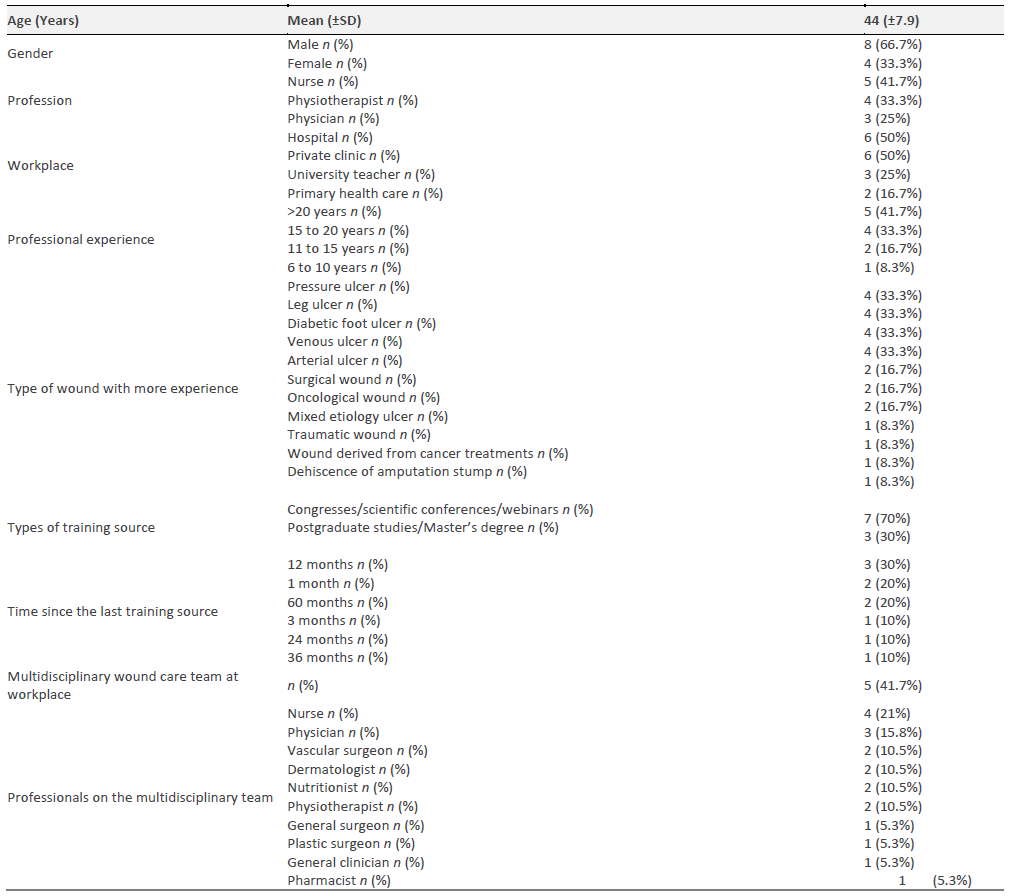
The sample of this study consists of 12 experts, of whom 25% are physicians, 41.7% nurses, and 33.3% physiotherapists. Regarding the workplace, the participants are dispersed across several different work contexts, except for the physiotherapists who work mostly in private clinics (75%) and hospitals (50%). About 41.7% of the experts have been working in the field of wound care for more than 20 years. The participants have experience in treating various types of wounds, but specifically the physiotherapists of the expert panel intervene mostly with venous ulcers (50%), surgical wounds (50%), and oncological wounds (50%). Only 41.7% have a multidisciplinary wound care team at their workplace (Table 1).
2.2 Round 1
A total of 7 questions were presented to the experts, and 5 of them reached consensus to move on to the next round.
The minimum consensus was 66.7% and the maximum 100% for therapeutic exercise, and the agreement obtained for assistive technologies was 55.6% and 100% (Table 2). The questions with a percentage inferior to 80% went to the next round together with the remaining questions, since the questions had errors in the wording and, thus, they would be analyzed again for a final decision.
Table 2 Round 1: consensus of the use of therapeutic exercise and assistive technologies in the treatment of diabetic foot ulcers
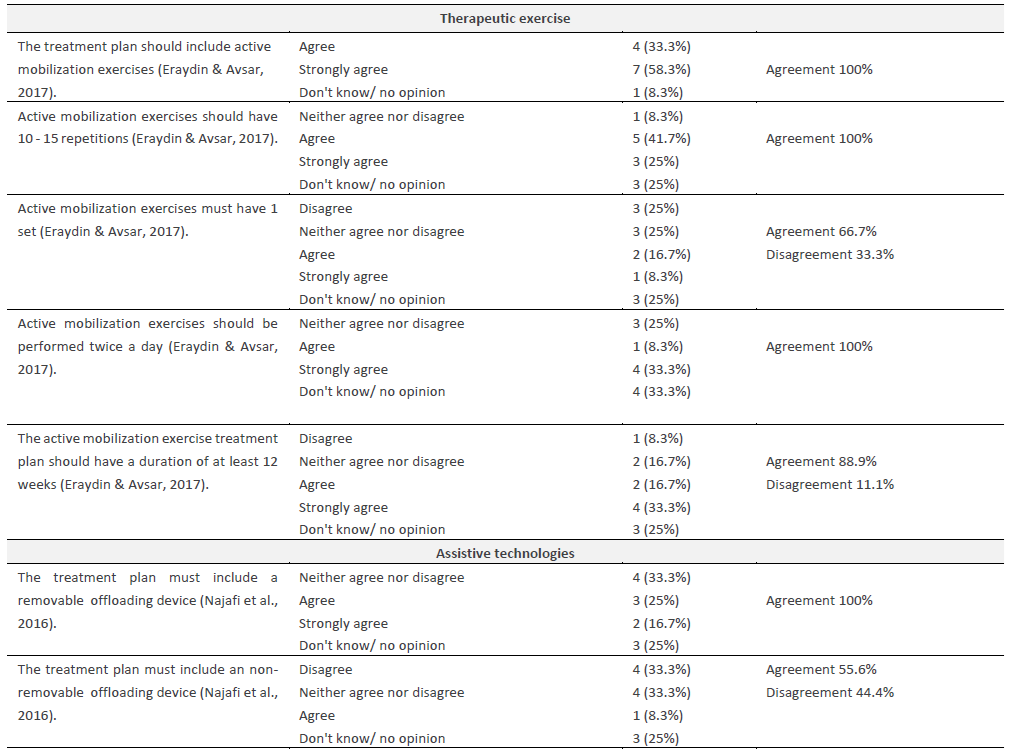
The participants also proposed the “adaptation” of the exercise to the “characteristics of the patient” and their “pathology”, changing the way in which some statements were written, and they also made a future recommendation to develop a study on “arterial wounds”. In view of the comments regarding the wording of the interventions, the word “must” was changed to the word “should have”. Therefore, due to the alterations in the text, it was considered that the questions with 55.6% and 66.7% of agreement would pass to Round 2.
2.3 Round 2
All questions had a minimum consensus of 80%, so consensus was reached on all questions. Only the issue related to the number of series received a disagreement of 14.3%. The percentages of consensus of therapeutic exercise and assistive technologies are available in Table 3.
Table 3 Round 2: consensus of the use of therapeutic exercise in the treatment of diabetic foot ulcers
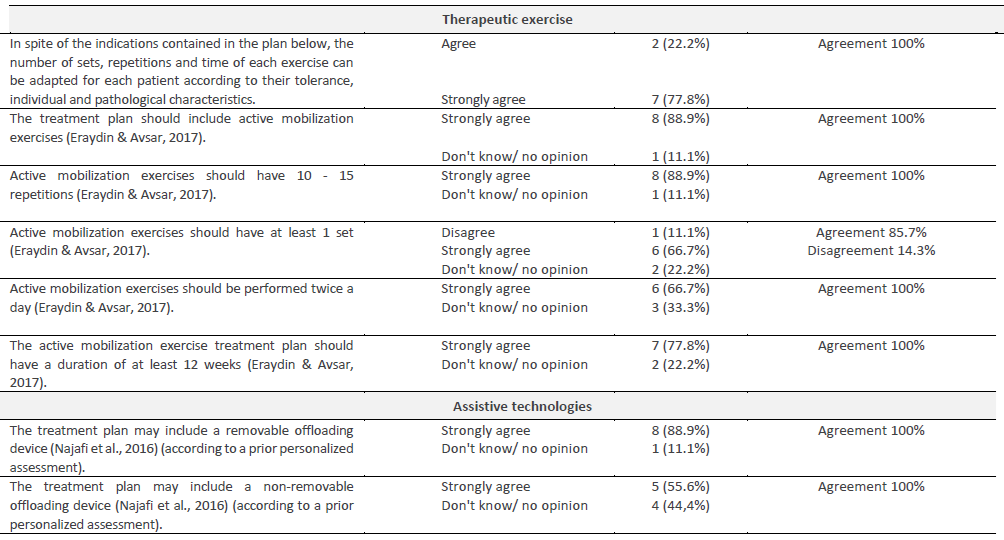
Only one comment was made in the last round about assistive technologies. The comment reinforced that assistive technologies must be considered in specific cases in order to protect the structure and allow the function, which is in accordance with the question statement.
2.4 Final analyses
The physiotherapist's intervention management in the treatment of DFUs includes therapeutic exercise (active foot mobilization) and assistive technologies (Table 4).
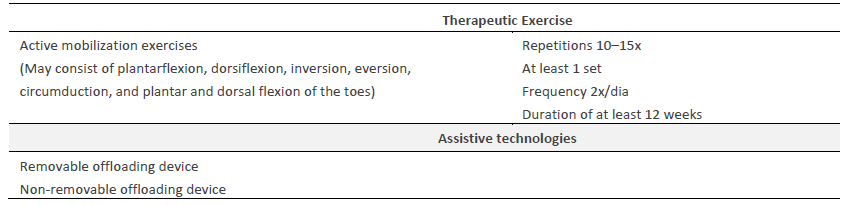
Preliminary note: Despite the indications in the plan, the number of sets and repetitions and the duration of each exercise may be adjusted for each patient according to their tolerance, individual characteristics, and pathology. It is also important to consider that certain clinical situations may require interdisciplinary assessment.
Active mobilization exercises, for example active movements of the tibiotarsal joint and toes, should be performed 10 to 15 times, with at least 1 set, with a daily frequency of 2 times/day, and with a minimum duration of 12 weeks. The assistive technology includes the use of a removable offloading device or a non-removable offloading device, according to a previous personalized assessment by a wound professional.
All physiotherapeutic interventions mentioned above were complemented with standard treatment.
3. Discussion
Taking into account that the physiotherapist’s interventions are adjuvants to the standard treatment used for healing DFUs, and knowing that the defined interventions can be adapted according to the patient's pathology, it was possible to obtain consensus on a specific intervention approach according to the physiotherapist's area of competence.
The American College of Sports Medicine (ACSM) and IWGDF have defined guidelines for prescribing therapeutic exercise in populations with diabetes mellitus(Lindberg et al., 2018), but they have not described an exercise prescription for healing DFUs. IWGDF guidelines support various types of foot exercises, such as muscle strengthening and stretching, to improve modifiable risk factors for the incidence of DFUs(Huang et al., 2023; Suryani et al., 2021; Tran & Haley, 2021; Win et al., 2020). However, in places where there are ulcer-forming lesions or the presence of an active ulcer, it is recommended that weight bearing on the foot and foot exercises should be avoided(Tran & Haley, 2021).
Although the IWGDF recommends not performing foot exercises when an ulcer is present, several studies have been carried out to investigate the effect of exercise on the healing of active DFUs. A systematic review of the literature was recently published to determine whether exercise promotes healing of DFUs. The review concluded that there is insufficient evidence to support performing exercise without load as an intervention that promotes healing of DFUs. However, the results demonstrate that there is a certain degree of reduction in the size of the wound and that there were no negative consequences of the intervention on the participants. They suggest that exercise without load should be encouraged as part of the DFUs treatment plan(Tran & Haley, 2021).
A meta-analysis by Qiu et al. (2018) suggests that exercise induces an increase in blood flow, leading to an increase in nitric oxide synthesis and reduced oxidative stress in people with type 2 diabetes. The combination of vasodilation and increased tissue blood flow can potentially facilitate the healing of DFUs(Qiu et al., 2018).
In the presence of loss of sensation on the plantar surface of the foot, increased plantar pressure during gait is an important factor in the development of plantar foot ulcers. If the high pressures are not reduced properly, ulcers can develop, or they can affect the healing of active ulcers(Park et al., 2023; Rodrigues et al., 2022; Su et al., 2022; Yalla et al., 2020). The most effective way to relieve the load on the foot is through the use of an off-loading device, such as an irremovable orthosis or a removable orthosis. These devices help reduce peak pressure by up to 87% compared to non-therapeutic footwear. This effect is achieved by redistributing forces not only on the plantar surface of the foot, but also on the lower leg through the device’s wall, which limits ankle movement (Park et al., 2023; Yalla et al., 2020) and affects gait speed(Ling et al., 2020; Park et al., 2023; Yalla et al., 2020). Non-removable offloading devices lead to reduced activity levels. The main limitation of the removable offloading device is due to the lack of adherence to the use of the device, which contributes to the lesser effectiveness of ulcer healing(Lazzarini et al., 2020; Park et al., 2023; Yalla et al., 2020).
In the study by Khalifa et al. (2023)(Khalifa et al., 2023)The results indicated that a greater proportion of the ulcers healed in the group that used a removable offloading device. The results were strongly associated with predictors such as adherence, total SINBAD score (Site, Ischemia, Neuropathy, Bacterial Infection, Area and Depth ulcer score), and 4-week area reduction.
According to the IWGDF guidelines, to aid in the healing process of non-ischemic and uninfected DFUs, a removable offloading device should be considered when non-removable knee-height devices are contraindicated or not tolerated by the patient, but only if the patient can adhere to the use of the removable device(Park et al., 2023; Yalla et al., 2020).
Despite the consensus achieved in this study, some methodological limitations should be acknowledged. The expert panel composition may present selection bias, as the majority of the participants were identified through professional networks and existing contacts in the field. Additionally, the limited number of physiotherapists included in the study may have restricted the diversity of clinical perspectives and experiences incorporated into the consensus process. The relatively small number of experts with specific expertise in DFUs could have influenced the comprehensiveness of the recommendations. Some experts indicated "don’t know/no opinion” for certain interventions, reflecting the highly specialized nature of some physiotherapy approaches for DFU management. Future research would benefit from larger, more diverse expert panels to strengthen the findings. Additionally, clinical studies are needed to verify the optimal intensity and parameters of active mobilization exercises for DFU.
Conclusion
With this study, it was possible to confirm the importance of a multidisciplinary approach in the assessment and treatment of patients with DFUs, which includes the physiotherapist. The multidisciplinarity of the panel of experts and all the suggestions they made in the content of the interventions were extremely important to adjust and add interventions. In conclusion, physiotherapy can act as an adjuvant therapy in the treatment of DFUs. The DFUs interventions include therapeutic exercise (active mobilization exercises) and the use of assistive technologies (removable or non-removable offloading devices). All physiotherapy interventions should include standard local treatment.
Acknowledgements
We would like to thank all of the expert participants for their valuable contributions to the Delphi survey.
Authors' contribution
Conceptualization, S.M., A.R. and R.C.; data curation, S.M. and A.R.; formal analysis, S.M. and A.R.; investigation, S.M., A.R. and R.C.; methodology, S.M. and A.R.; project administration, S.M.; resources, S.M.; software, S.M.; supervision, A.R. and R.C.; validation, S.M., A.R. and R.C.; visualization, S.M., A.R. and R.C.; writing-original draft, S.M.; writing-review and editing, S.M., A.R. and R.C.

