




 Inglês (pdf)
 Artigo em XML
 Referências do artigo

 Tradução automática
 Enviar este artigo por email
 Citado por SciELO
 Similares em
SciELO

 Permalink

INTRODUCTION
Russian thistle (Salsola tragus), kochia (Bassia scoparia), and prickly lettuce (Lactuca serriola) are three important weed species in the wheat cropping systems of the Pacific Northwest (PNW), but particularly Russian thistle (Schillinger & Young, 2004). Although, these three weed species might have morphological and ecological differences, the three of them share a common characteristic, all of them can regrow after wheat harvest and produce seeds. Besides producing seeds, they can produce a significant amount of biomass growing without competition and at the expense of the available soil water. The same situation happens when these species escape spring control in fallow fields or germinate after the spring herbicide application.
Controlling these species chemically in summer is expensive and the success is not guaranteed. When the environmental conditions are dry and hot, systemic herbicides tend to work poorly, especially if they are sprayed on adult and/or hardened plants (Oreja et al., 2023). For this reason, many of these weeds are left uncontrolled post-harvest causing reinfestations in the field where they are growing and in neighboring fields.
There are many studies documenting the yield loss caused by weeds growing in competition with the crop (e.g. Swinton et al., 1994; Izquierdo et al., 2003; Barroso et al., 2011), but we are not aware of any quantifying the potential yield loss when annual weeds grow one season or two before the crop, which it would happen if the water taken by weeds is not refilled with the precipitation before the following crop is seeded. This research seeks to quantify the competitive ability of Russian thistle, kochia, and prickly lettuce compared to spring wheat by studying how each species interacts with soil water. An understanding of a potential below-ground advantage for each weed species, and quantification of the water extracted if weeds are left untreated after harvest, will provide scientific information to farmers seeking a return on investment for controlling weeds post-harvest and guide researchers and breeders to develop more competitive varieties.
MATERIALS AND METHODS
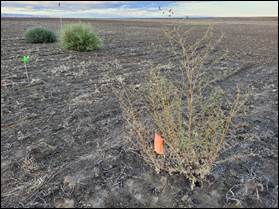
At the Columbia Basin Agricultural Research Center (CBARC), Adams, Oregon, a fallow trial was established in the spring of 2021, 2022, and 2023 in three different fields. Twenty plots measuring 1 m2, separated by 4 m center-to-center, were assigned to Russian thistle, kochia, prickly lettuce, spring wheat, and control (no plant) in a completely randomized blocked design with five replications (Figure 1). Multiple seeds of each species were hand seeded within each plot in the field in early March. Plants were thinned to a single individual following establishment. If all seeds failed to germinate in a plot, a seedling of that species was moved to the plot from a near field. Aerial plant biomass per plot was collected in early October to obtain the fresh and dry plant weight.
Each year, soil cores were taken three times during the growing season, in March (at seeding time), in July (at wheat harvest), and when the plants were about to die in early October. The soil depth evaluated was the maximum of each field, that was about 1.5 m the first and second year and 1.8 m the third year. Soil samples from each one-foot increment were assessed for gravimetric water content. The soil samples were taken on a radius from the center of the plot to 30 cm maximum, trying to be as close as possible to where the plant was growing, but without causing damage.
Analyses of variance were conducted to determine differences in the water consumption taken by each species. Transformations to the data were conducted when the Shapiro test or Levene test were significant to fulfill the ANOVA requirements (normal distribution and homogeneity of variance). Tukey test was conducted when the analysis of variance was significant to identify the different groups at p-value < 0.05. Analyses were conducted using Rstudio.
RESULTS AND DISCUSION
The results varied depending on the annual precipitation and plant biomass, but on an average year (excluding 2022) and at the end of the season (early October), the soil under a single Russian thistle and kochia plant was 0.04 kg water/kg soil drier than the control (soil without any plant), and the soil under a prickly lettuce was 0.028 kg water/kg soil drier than the control. In general, these differences between species decreased for the top 60 cm of soil and increased for the deeper soil profile (Table 1). Russian thistle and kochia roots dried the deeper soil more than prickly lettuce and spring wheat. The soil water under a spring wheat plant was not significantly different from the control.
Table 1 Water loss per species (kg water/kg soil) compared with the control plots in the upper soil (from 0 to 60 cm), middle soil (60 to 90 cm) and deeper soil profile (from 90 to 150 cm), plant dry biomass (kg), and a ratio between plant biomass (kg) and water consumed (kg water/kg soil) (R)
| Species | Water Loss*1 (0 - 60 cm) | Water Loss (60-90 cm) | Water Loss*2 (90 - 150 cm) | Dry biomass (kg) | R |
| Russian thistle | 0.053 | 0.040 | 0.038 | 3.244 | 81.1 |
| Kochia | 0.061 | 0.059 | 0.034 | 2.790 | 69.8 |
| Prickly lettuce | 0.045 | 0.029 | 0.008 | 0.221 | 27.8 |
*1 This is an average between the measures taken at 0-30 cm and 30-60 cm. *2 This is an average between the measures taken at 90-120 cm and 120 -150 cm.
The average annual precipitation at CBARC for the last 30 years was 325 mm. The year 2021 was drier than the average year with 285 mm and the years 2022 and 2023 were wetter than the average year with 520 and 356 mm (Figure 2). In 2022, with the amount of rainfall received (160% above the average), none of the species dried the soil significantly different from the control. This indicates that in a year with precipitation higher than 500 mm, a light infestation in fallow of the studied species might not impact the yield of the following crop.
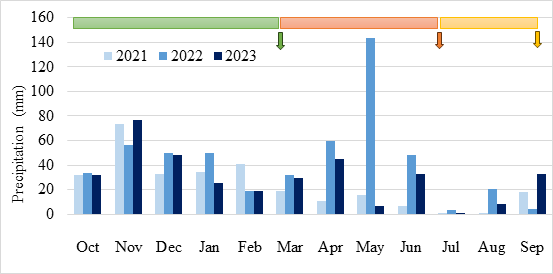
Figure 2 Annual precipitation received at CBARC in 2021, 2022, and 2023. Horizontal colored bars indicate different periods of the year (green: fall and winter, orange: spring, and blue: summer). Colored arrows indicate the approximate time of soil sampling in the trials, at seeding time (green arrow), at wheat harvest (orange arrow), and when the plants were about to die (blue arrow).
Russian thistle and kochia had a higher ratio of biomass per water consumed than prickly lettuce. Those species dried the soil less per gram of plant biomass than prickly lettuce (Table 1). Results also indicate different time of water consumption among the species. While the water consumption was similar for all the species and years from seeding to wheat harvest (July) (Figure 3), except for prickly lettuce in 2023 (data not shown) that extracted significantly more water than the other species, it differed from harvest to plant collection. Russian thistle seemed to dry the soil the most at that time of the year, although the difference was not significant with kochia in 2021 or with kochia and prickly lettuce in 2022 and 2023 (data not shown).

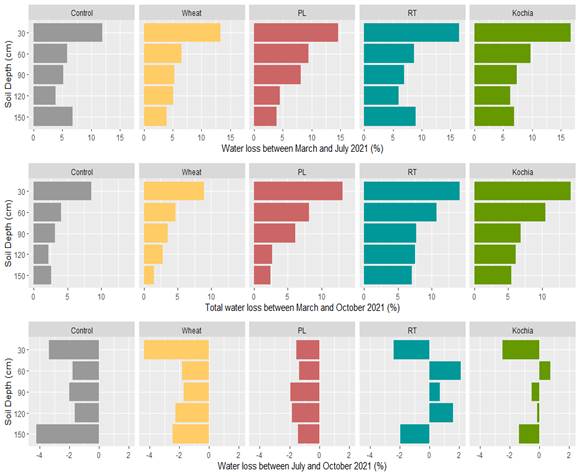
Figure 3 Water loss (kg water/kg dry soil) expressed as percentage (%) under individual plants of spring wheat, prickly lettuce, Russian thistle, and kochia in 2021 in 150 cm of soil, a) from seeding to wheat harvest (March to July), b) from seeding to plant collection (March to October), and c) from wheat harvest to plant collection (July to October). Negative numbers indicate water gain instead of loss. The purple letters to the right of the species name are the results of the Tukey test. Different letters in a row indicate significant differences among the species (p < 0.05).
Our results for Russian thistle are similar to Drs. Schillinger and Young’s (2000) results, where they found that the soil water consumed by single Russian thistle plants growing in spring wheat was 170 L per plant. Results from this work, with single Russian thistle plants growing in fallow and considering a radius of influence of 80 cm around the plant, indicated a water consumption of 176.4 L per plant. This similarity with and without crop, indicates that most of the water is taken once the crop has been harvested. Contrary to Russian thistle’s results, prickly lettuce seems to take most of the water earlier in the season.
CONCLUSIONS
Russian thistle and kochia showed a significant water consumption after July. The amount of 0.04 kg water/kg of soil lost under each individual plant of these species growing in fallow (on an average year), seems high, but the impacts on the following crop yield are still to be determined, and it will probably depend on the precipitation received during the following year.

