




 Inglês (pdf)
 Artigo em XML
 Referências do artigo

 Tradução automática
 Enviar este artigo por email
 Citado por SciELO
 Similares em
SciELO

 Permalink


Processing goals are the specific objectives or purposes individuals have when they engage in information processing. These goals influence how people attend to, interpret (see Aarts, 2012; Higgins, 1996), and remember information (e.g., Craik & Lockhart, 1972; Hamilton et al., 1989). Moreover, they can also shape the way individuals evaluate stimuli (Custers & Aarts, 2003; Moran et al., 2015) and make choices (Klaczynski et al., 1997; Laran, 2010). However, while many instances of information processing are driven by specific goals, not all processing is clearly goal oriented. In fact, there are several types of processing that seem to occur without a clear, deliberate goal, or where goals are less consciously defined, as it seems to be when the target of processing is affective information.
Affective reactions can occur spontaneously and without specific goals directing individuals to attend to the affective nature of the context (Zajonc, 1980). These affective reactions seem to occur independently of, and even prior to, the perceptual and cognitive processes typically thought to underlie stimuli evaluations. Furthermore, it has been suggested that these reactions are the first assessment of a percept, having primacy over its “cognitive processing”, requiring only primitive stimulus analysis (see Peretz et al., 1998; Zajonc, 1980). This primacy of affect suggests that the affective system, which evaluates stimuli in terms of emotional valence (e.g., “Is this word good or bad?”), operates separately and somewhat independently from the cognitive system, which focuses on identifying and categorizing stimuli (e.g., “Is this a word or not?”). This independence hypothesis is supported by neurophysiological and psychological research (see Damasio, 1994; LeDoux, 1996; Murphy & Zajonc, 1993; Zajonc, 2000). The argument that affect is likely primary in the information-processing chain is empirically supported by the fast activation of affective information (LeDoux, 1996; Murphy & Zajonc, 1993). This was corroborated by Murphy and Zajonc (1993) who subliminally exposed participants to either emotional faces or geometric shapes before they evaluated a set of unfamiliar, ambiguous stimuli (Chinese ideographs). In this experiment, only the affective stimuli influenced differently the evaluative judgments at a similar extension as a sub and supraliminal longer exposure. This finding, along with other studies (e.g., Bargh et al., 1989; Edwards, 1990; Hermans et al., 1996; Klauer, 1997), lends support to the hypothesis that the affective aspects of the stimuli are prioritized. Interestingly, these effects seem to extend to the processing of words, even when the goal is not focused on their affective dimension or evaluation. For instance, emotional words more likely to be remembered in recall tasks (Anooshian & Hertel, 1994; Ferré et al., 2009), and when semantic decisions are required affective words are better identified then neutral words (Eviatar & Zaidel, 1991; Kousta et al., 2009). Moreover, affect slows down colour processing latencies relatively to neutral words in affective Stroop task (more clearly for negative words; MacKay et al., 2004; see Bar-Haim et al., 2007; Fernandes et al., 2021). Together, these affective effects corroborate the view that word processing is impacted by the ‘early’ mechanism of attentional capture (e.g., Gaillard et al., 2006; Kousta et al., 2009) or the primacy of affect (Zajonc, 1980) which is assumed to be independent of processing goals.
However, some studies challenge the idea of a primacy of affect. The processing advantage of affect applied only to positive words, not negative ones in a lexical decision task (e.g., Chen et al., 2015; Kissler & Koessler, 2011; MacKay et al., 2004) and this was supported by EEG data (Kanske & Kotz, 2007). Moreover, Crossfield and Damian (2021) used a mouse tracking technique to analyse the development of a lexical decision response and reported a processing advantage for positive words over negative and neutral words, and no evidence of affect modulation on an emotional Stroop effect. These studies suggest that the specific objectives or purposes that individuals have when engaging in information processing, may increase or decrease the relevance of processing the affective features of the stimuli. Furthermore, other evidence suggests that different brain areas are involved in processing valence dependent on processing goals. For instance, Cunningham et al. (2005) identified that the frontal LPP was differently sensitive to the valence of the stimulus being processed, depending on the explicitness of the evaluative judgements. Behavioral data (e.g., Braticco et al., 2005; Mandler & Shebo, 1983) corroborates the dissociation in stimuli processing when the goal is to report liking versus the correctness of stimuli and that the processing goals may moderate the effect of propositional versus associative information on automatic evaluation (Moran et al., 2015). Overall, this research suggests that although we may observe by default the primacy of affect, this could result from the automatic activation of an evaluative processing goal (see Ferguson, 2008), upon which our survival depends (Lang et al., 1990; Mergen & Kuruoglu, 2017).
Here, we propose to contribute to the clarification of the role of the processing goal in processing the affective dimension of the stimuli by relying on the engagement of facial muscle feedback in assessing the affective nature of a stimuli.
Facial muscle feedback
Facial muscle feedback plays an important role in perceiving the emotional, or affective, nature of stimuli (e.g., Damasio, 1994; Decety & Jackson, 2004; Gallese, 2011; Niedenthal, Barsalou, Ric et al., 2005; Niedenthal, Barsalou, Winkielman et al., 2005) and has shown to be causally involved in the perception of others facial expression of emotions (Niedenthal et al., 2001) and emotion words concepts (Niedenthal et al., 2009). These experiments suggest that smiling while observing a positive stimulus can intensify the perception of it being pleasant, while frowning may amplify the sense of negativity when exposed to something aversive. Supposedly this muscle activation occurs because emotional concepts are represented by these body expressions (Barsalou, 1999). Congruent evidence can be found in Havas et al. (2007). In this study, participants judged whether a sentence described a pleasant or unpleasant situation, while holding a pen in their mouth, in a way that mimicked or inhibited smiling. The results suggest that smiling mimicry facilitated the comprehension of pleasant events, while the smile inhibition condition sped up the understanding of unpleasant events.
Critically, none of these studies using facial muscle blocking procedures showed evidence of its interference on a lexical decision task. This makes it relevant to examine the role of processing goals on the processing of valenced stimuli by preventing the use of facial muscles during the task. Different blocking procedures are known to reduce the somatic feedback that supports the construct activation, affecting the participants’ accuracy or reaction time. Importantly, these blocking procedures selectively target different groups of facial muscles and seem to interfere with the responses to different emotions (Oberman et al., 2007). Below, we address these differences.
Hold a pen in the mouth with its tip out - We will refer this as the Strack procedure since it was first referred to in the Strack et al. (1988) paper. Instructions ask participants to hold a pen in the mouth with its tip out of the mouth, pressing with lips and preventing teeth from touching it. This procedure was originally expected to inhibit smiling and lowered the funniness ratings of a set of cartoons. The lips position has been assumed to suppresses the smile by engaging the orbicularis oris muscle, leading to lower EMG activity in the zygomaticus major and potentially increased activity in the orbicularis oris (Ekman et al., 1971; Ekman & Friesen, 1978; Hjortsjö, 1970; Izard, 1971; Soussignan, 2002). However, this is not without controversy since EMG evidence (see Oberman et al., 2007) suggest that this procedure promotes a pattern of facial muscle activation close to relaxation, having no differential activation of any muscle (levator, zygomaticus, orbicularis oris or buccionator).
Hold a pen horizontally in the mouth with the lips (preventing teeth to touch it) - We will refer this as the Niedenthal procedure (see Maringer et al., 2011). EMG evidence (Domingos, 2012) found support for the assumption that it interferes with the activation of lower face muscles, since it activates the zygomaticus usually associated with happy displays (Ekman et al., 1971; Ekman & Friesen, 1978; Hjortsjö, 1970; Izard, 1971). Congruently, Niedenthal et al. (2009; Experiment 3) found the procedure to selective impair the accuracy of judging joy words, as emotional.
Hold a pen horizontally in the mouth exerting an active pressure with teeth (preventing lips to touch it) - We will refer to this as the Oberman procedure (see Oberman et al., 2007). EMG evidence (Domingos, 2012; Oberman et al., 2007) suggests that the procedure exerts blocking through the hyperactivation of the zygomaticus. One possible criticism of this procedure is that it promotes a facial expression highly similar to a smile, as it raises the lip corners. This can be assumed to semantically prime the concept of “happiness”. However, congruently with a blocking assumption, this manipulation has been shown to inhibit, instead of facilitating, the perception of happy faces (decreasing the accuracy of identifying them). In addition, evidence suggests that the blocking procedure is selective and does not impair the recognition accuracy of any other emotion.
The two procedures that promote hyperactivation of the zygomatic are expected to induce difficulties in the detection of positive features of stimuli, but not the negative ones. These procedures should promote different patterns of response than the Strack procedure. Although EMG evidence (Oberman et al., 2007) suggest that the Strack procedure is likely to promote results similar to a free mimicry condition, on the basis of Strack et al. (1988) behavioral data it is also likely that the procedure will lower the preference of positive words. However, and more relevant to our hypothesis, we will only expect these procedures to impact the judgments of valence vs neutral words, and of positive and negative words if muscle activity feedback plays a role in the processing of affective information. Moreover, if processing goals interfere with the primacy of affect, we expect that the pattern of results defined above to be clearer when the processing goal is to report preference compared to when participants must make a lexical decision.
Overview of experiments
The two experiments shared the same protocol and materials, varying only in the type of judgment requested to the participants. In Experiment 1, participants performed a preference task in which they were asked to evaluate how much they liked or not liked each single word or non-word presented on a computer screen. In Experiment 2, participants performed a lexical decision task (word or not a word) with the same material. Words were selected from Garcia Marques’ (2003) valence and familiarity norms (evaluated on a 7-point scale). The materials used in both experiments were 40 positive words, 40 negative words, and 40 neutral words, selected from Garcia Marques’ (2003) valence and familiarity norms (evaluated on a 7 point scale).
An equivalent number of abstract and concrete words were selected, all with low linguistic frequency (between 0 and 48) and low level of familiarity (above the mid-point of the scale M=3.91; SD=.95) ratings. Both lists had 40 evaluated as highly positive (above P75=5.06) and 40 evaluated as highly negative (below P25=3.31), In the remaining central percentiles we chose the 40 most neutral words ranging from 3.50 and 4.50.
A total of forty-five non-words neutral in valence and familiarity and with no relationship with any of the words to be presented were selected from Domingos and Garcia-Marques’ (2008) and mixed in the list (Table 1).

General procedure
In both studies, participants were asked to evaluate different types of verbal stimuli. Upon arrival, participants were given a new pen and informed that they were going to place it in their mouths in different positions during the study. They were also informed that they should carefully read all the instructions given on screen, including the position of the pen. Participants then completed the experimental task in all four mimicry blocking conditions (orders were counterbalanced): Niedenthal et al. (2001), Oberman et al. (2007), Strack et al. (1988), and free mimicry. Each experimental condition was illustrated with a photo (Figure 1) and a written instruction: “hold the pen in the mouth sideways both with your teeth and lips”; “hold the pen in the mouth sideways only with your lips, do not use your teeth”; “hold the pen with its tip out of the mouth, exclusively with the lips, and preventing the teeth to touch it”.
Both experiments followed a within-subjects design defined by the factors Blocking (Niedenthal, Oberman, Strack, Free mimicry) and String of letters (Neutral, Positive, Negative). The nonwords stimuli was used as a filler and therefore not analysed. We have a conducted a power analysis in G*Power 3.0 following the validation article (Faul et al., 2007) instructions for within-subjects designs, which estimated N=13 as the minimum sample size for f=.25 and power=.80. All participants received credits in return for their collaboration.
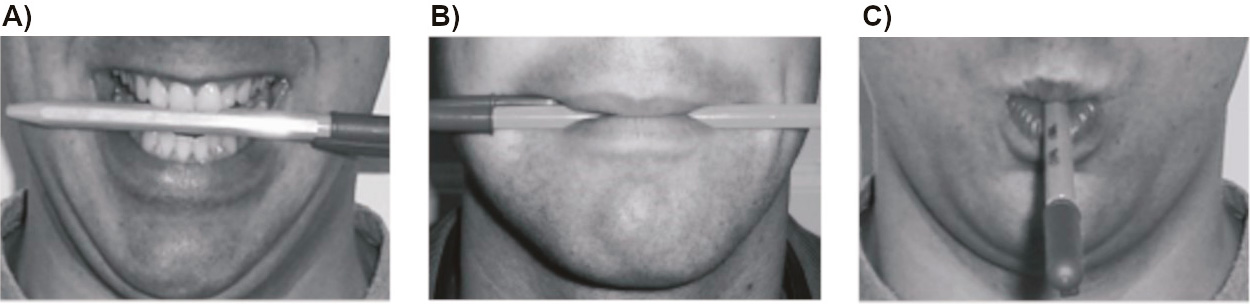
Figure 1 Blocking procedures: A) Oberman et al. (2007); B) Niedenthal et al. (2001); C) Strack et al. (1988)
Experiment 1: Preference judgments
Participants and design
Seventeen (71% women) undergraduate students from the researchers’ institution with ages ranging from 18 to 42 years (M=22.65; SD=7.71), were randomly assigned to the experimental within-subjects design defined above.
Procedure
In this experiment, participants were informed that they should attend to a string of letters that could either be a word or non-word and express their preference for each of stimulus. In this task, participants were instructed to press as quickly as possible, the “L” key if they “like” the string or “S” if they “don’t like” the string (keys were reversed for half of the participants). Reaction times were recorded for all the responses.
Before debriefing, participants were asked about their perceived association between each facial posture and a particular emotion (a list of emotions were provided with “no association” as a possible response).
Results and discussion
Preference
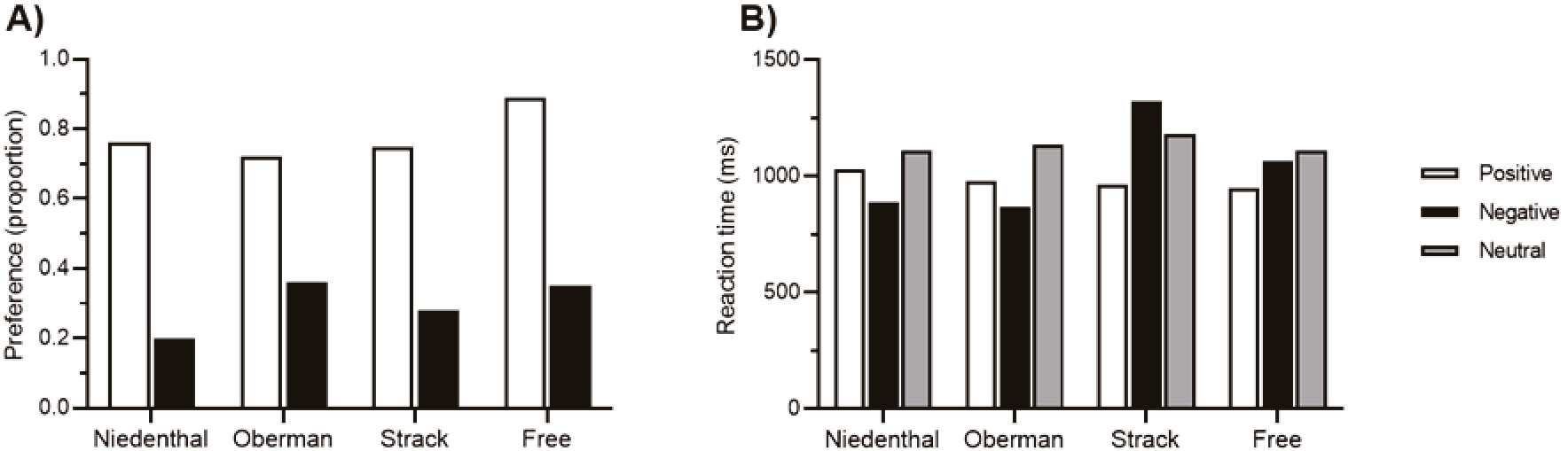
To check if the blocking procedures interfered with the perception of stimulus valence, we calculated the proportion of responses matching preference with positive words and no-preference with negative words. Proportions were arcsine transformed to meet the normality assumptions of the ANOVA. Data is reported in the original scale to facilitate its’ interpretation. Matching judgments were lower for negative words (M=.30; SD=.05) compared to positive words [M=.78; SD=.04; F(1,16)=41.33; p<.001; η p 2 =0.72], suggesting that participants were more likely to express preference for negative words than a no-preference for a positive word (see Figure 2).
We have also found a blocking main effect, F(3,48)=6.19; p=.001; η p 2 =0.28, suggesting that blocking interfered with the preference judgments. All blocking procedures (M Niedenthal=.52; SD=.04; M Strack=.48; SD=.04; M Oberman=.54; SD=.05) promoted less matching judgments, than the free mimicry condition [M=.62; SD=.04; t(16)=3.75; p=.002; d=.94]. No significant difference was detected between the blocking procedures, t(16)<1.
A marginal blocking x valence interaction, F(3,48)=2.23; p=.096; ηp2=.12, seemed to occur because all blocking procedures reduced the preference for positive words (M+=.75; SD=.04; M+Niedenthal=.76; SD=.04; M+Oberman=.72; SD=.07; M Strack+=.75; SD=.04) compared to the free mimicry condition (M+=0.89; SD=.03; M-=0.35; SD=0.08; all ps<.05). But only Niedenthal (M-Niedenthal=.20; SD=.06; M-Oberman=.36; SD=.07; M-Strack=-.28; SD=.07) reduced the proportion of no-preference for negative words, t(16)=2.09; p=.05; d=.52.
Reaction times
To test the effect of the blocking procedures on preference judgment RT, we performed a mixed ANOVA 4 (blocking manipulations) x 3 (Neutral words vs. Positive words vs. Negative words) on the log-transformed RT’s means (three missing data were substituted by means of their conditions, to not lose power in the analysis. Means will be presented in the original scale for interpretability). The main effect of the valence, F(2,32)=6.79; p=.003; η p 2 =.30) suggested that the two sets of valenced words were evaluated faster than the neutral [M+=939; SD=25; M- e =1037; SD=54; M n =1134; SD=59; t(16)=3.18; p=.006; d=.80]. No significant main effect of blocking procedures were found, F(3,48)=1.49; p=.226; η p 2 =.09.
The blocking procedures qualified the valence effect, F(6,96)=7.64; p<.000; η p 2 =.32. The free mimicry condition was used as a baseline to understand the effects. In this condition, we have found RT differences between neutral (M n =1109; SD=75) and positive words [M+=783; SD=22; t(16)=6.73; p<.001; d=1.69], but no with negative words (M-=1067; SD=51; t<1). However, no such difference occurred for the conditions where the zygomatic was blocked; participants were slower on positive words compared to negative [M Niedenthal+=1031; SD=45; M Niedenthal-=890; SD=40; M Oberman+=980; SD=39; M Oberman-=869; SD=40; t(16)=3.27; p<.004; d=.82] and the specific blocking procedures did not qualified the effect (t<1). Only the Strack’s procedure condition, where the zygomatic was not blocked, we find that the evaluation of negative words (M Strack-=1324; SD=168) was slower than the positive words [M Strack+=962; SD=54; t(16)=2.50; p<.023; d=.63]. This specific blocking procedure show the same pattern and not significantly differences from the free condition, t<1. No significant differences between blocking conditions were found for neutral words (M Strack=1180; SD=125; SD=.01; M Niedenthal=1112; SD=55; M Oberman=1136; SD=89; M Free=1109; SD=75; all contrasts show ts<1).
Testing for semantic interfere of procedures: Perceived association to an emotion
Because blocking procedures could be argued to induce semantic priming effects themselves by differently activate the concept of a positive or a negative emotion, we further analysed the perceived association of the three blocking procedures with an emotion.
The Niedenthal’s procedure was not perceived to be associated with any emotion by 82% of the participants (the remaining 18% associated to a negative emotion), Oberman’s procedure was associated by 76% of participants to a positive emotion (18% associated it with a negative emotions and 6% didn’t associate to any emotion) and Stracks’ procedure promoted an ambiguous display (41% of participants report no association, 35% an association with negative emotions and 24% to a positive emotions). These results suggest that only the Oberman’s procedure effects would be able to be confounded with a semantic priming, turning the alternative semantic priming explanations unreliable.
Experiment 2: Lexical decision task
Results and discussion
Accuracy
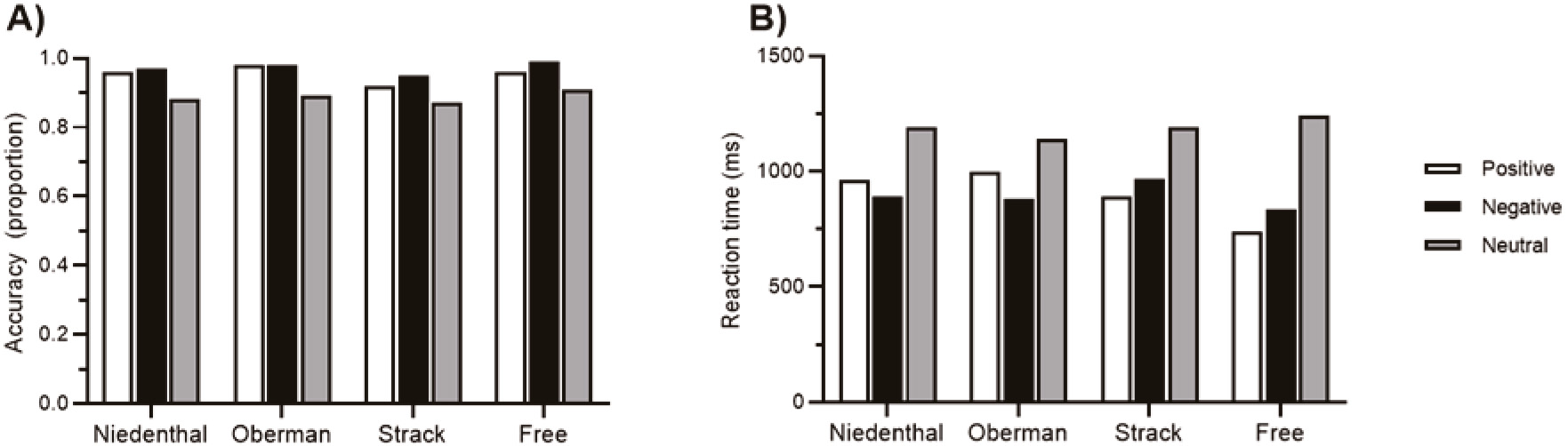
To understand if the blocking procedures interfered with lexical decisions of different stimulus valence, we calculated the proportion of correct lexical identifications of positive and negative words in each experimental condition. Although the two sets of valenced words did not differ significantly between themselves (t<1), both of them (M+=.95; SD=0.01; M-=.96; SD=0.01) were better identified than neutral words [M=.92; SD=0.012; F(2,34)=4.42; p=.019; η p 2 =.21]. A main effect for the blocking conditions occurred, because the Strack procedure promoted lower accuracy [M Strack=.92; SD=.01; M Niedenthal=.94; SD=.01; M Oberman=.95; SD=.009; M Free=.96; SD=.009; F(3,51)=3.23; p=.029; η p 2 =.16].
The valence effect was qualified by the blocking procedures, F(6,102)=4.50; p<.001; η p 2 =.21. As illustrated in Figure 3, only the Niedenthal procedure followed the same pattern of the free condition. The Oberman’s procedure results turn the identification of negative words worse than neutral and positive words and the Strack procedure eliminate differences based on valence.
Reaction times
A within-subjects ANOVA 4 (Blocking conditions) x 3 (Neutral words vs. Positive words vs. Negative words) was performed on log-transformed RT of correct responses (raw data are presented for interpretation). Valence impacted RTs, F(2,34)=34.27; p<.001; η p 2 =.67, only because decisions on positive words (M+=899; SD=42); and negative words (M-=894; SD=42) were faster than on neutral words [M n =1252; SD=84; t(14)=6.28; p<.001; d=1.68].
Blocking conditions in general did not produce different RTs [M Niedenthal=1038; SD=645; M Oberman=1023; SD=57; M Strack=1040; SD=58; M free=958; SD=56; F(3,51)=1.97; p=.130; η p 2 =.10]. However, conditions qualified the valence effect, F(6,102)=5.16; p=.001; η p 2 =.23. Although neutral words were classified at the same speed in all experimental conditions (all ts<1) the same did not occurred for valenced words. Figure 3 shows that valence effects were equally for the Strack and the free mimic condition, and equal for the Niedenthal and Oberman’s conditions, although the two set differ between them. Whereas in the first two conditions participants were faster responding to positive words, in the second two conditions, where the zygomatic is blocked, they were faster I identified as a word a negative word.
General discussion
In these experiments, we have tested if different facial muscle blocking procedures interfered with the primacy of affect in word processing when the affective dimension of the stimuli was necessary to meet the task goals (Experiment 1) and when it was irrelevant to the task (Experiment 2). Our results suggest that the primacy of processing affective information can be disrupted in both situations. This effect is likely to result from our blocking procedures interference with the facial muscle feedback associated with emotional expressions, thereby altering the access and relevance of the affective dimension of the stimuli.
The evidence suggests that participants were less influenced by the affective nature of the stimuli when the facial muscle activity that supports its apprehension was blocked. Importantly, this effect occurred when the affective information was relevant for task performance (Experiment 1) and when it was not relevant (Experiment 2). More efficient responses were found for affective stimuli compared to neutral, and valence impacted accuracy and response latencies on preference judgments and lexical decisions. The results on Experiment 1 supports the hypothesis that blocking facial muscles interferes with preference judgments, as previously shown (Havas et al., 2007; Niedenthal et al., 2001, 2009). However, on Experiment 2, we provide the first data suggesting that this type of interference also occurs on a lexical decision task. This evidence implies that the blocking effect previously identified in the literature does not seem to depend on the processing goals of the task.
Together, these experiments indicate that the affective experiencing in processing the information interferes with access to affective information and that the role of affect in facilitating information processing is independent upon processing goals. These effects likely to result from the influence of the affective dimension of the stimuli that occurs at the early stages of information processing, as proposed by the affect primacy hypothesis. Moreover, it is possible that this occurs before participants have access to the semantic nature of the stimuli, which could in fact be facilitated by the affective dimension of the stimuli. This interpretation of the results match ERP evidence suggesting that there are two phases of information processing eliciting two different emotion-related ERP components: an early posterior negativity (EPN) that typically starts 150-200 after stimulus onset and a late positive complex (LPC) system that occurs at a later stage of information processing (around 300ms). The first component refers to a reflect a reflex-like allocation of visual attention, enhancing the sensory encoding of the stimuli and the selection of relevant information for further processing (Potts & Tucker, 2001; Rellecke et al., 2011). The later provide access to the significance of the stimuli (Schacht & Sommer, 2009; Schupp et al., 2000). Interestingly, both ERPs have been found in tasks that do not require overt decisions based on the emotional valence of the words, suggesting that valence is automatically processed independent of task demands (Herbert et al., 2006; Kissler et al., 2009), which further supports our claims. Although some research suggest that the effect of emotional valence occurs only after the onset of the lexicality effect (Kissler et al., 2007, 2009; Schacht & Sommer, 2009), the data of our experiments by suggesting the independence of processing goal, is likely more akin to research showing as likely a pre-semantic detection of the emotional properties of the stimuli (ex., Rellecke et al., 2011; Scott et al., 2009).
Across the two experiments, we have also found consistent differences between the blocking procedures, suggesting that they could be mapping distinct valence effects (differences between processing positive and negative words relative to each other). The two procedures known to block the zygomatic, Oberman’s and Niedenthal’s, contrasted with how the Strack and the free mimic condition, impacted the valence effect. When the zygomatic is blocked, participants were faster both when evaluating and identifying a negative word as a word, compared to positive words. When the facial muscles were generally more relaxed (Strack procedure) or free, the opposite effect occurred and participants were faster responding to positive words than to negative words. On this matter, the results associated with response accuracy were less informative. While in Experiment 1 all blocking procedures elicited a general reduction of accuracy (matching), in Experiment 2 the effects on accuracy were highly dependent of the blocking procedure being used. The Niedenthal procedure followed the same pattern of the free condition, while Oberman’s procedure impaired the identification of negative words compared to neutral and positive words and the Strack procedure eliminated the differences based on valence. The disparity of these results should be further investigated as they illustrate that there could be other underlying differences in the blocking procedures and their effects.
In conclusion, in these experiments we report that interfering with facial muscle feedback during the processing of valenced words impacts information processing independently of the task goals and adds corroborating evidence to the primacy of effect hypothesis and to the causal role of facial embodiments in valence processing. This finding nicely extends the previous evidence for the involvement of facial expressions in emotion processing (Niedenthal et al., 2001; Oberman et al., 2007) to a context where valence is not a relevant dimension of the stimuli to attend to.

