<?xml version="1.0" encoding="ISO-8859-1"?><article xmlns:mml="http://www.w3.org/1998/Math/MathML" xmlns:xlink="http://www.w3.org/1999/xlink" xmlns:xsi="http://www.w3.org/2001/XMLSchema-instance">
<front>
<journal-meta>
<journal-id>1646-107X</journal-id>
<journal-title><![CDATA[Motricidade]]></journal-title>
<abbrev-journal-title><![CDATA[Motri.]]></abbrev-journal-title>
<issn>1646-107X</issn>
<publisher>
<publisher-name><![CDATA[Edições Desafio Singular]]></publisher-name>
</publisher>
</journal-meta>
<article-meta>
<article-id>S1646-107X2019000100008</article-id>
<article-id pub-id-type="doi">10.6063/motricidade.14160</article-id>
<title-group>
<article-title xml:lang="en"><![CDATA[Dynamic Evaluation Method of Lower Limb Joint Alignment with Parallel Feet (MADAAMI-P): Content validation and Reproducibility]]></article-title>
</title-group>
<contrib-group>
<contrib contrib-type="author">
<name>
<surname><![CDATA[Amaral]]></surname>
<given-names><![CDATA[Maiane A.]]></given-names>
</name>
<xref ref-type="aff" rid="A1"/>
</contrib>
<contrib contrib-type="author">
<name>
<surname><![CDATA[Candotti]]></surname>
<given-names><![CDATA[Cláudia T]]></given-names>
</name>
<xref ref-type="aff" rid="A1"/>
</contrib>
<contrib contrib-type="author">
<name>
<surname><![CDATA[Navarro]]></surname>
<given-names><![CDATA[Isis J. R L]]></given-names>
</name>
<xref ref-type="aff" rid="A1"/>
</contrib>
<contrib contrib-type="author">
<name>
<surname><![CDATA[Gontijo]]></surname>
<given-names><![CDATA[Kaanda N. S]]></given-names>
</name>
<xref ref-type="aff" rid="A1"/>
</contrib>
<contrib contrib-type="author">
<name>
<surname><![CDATA[Fiegenbaum]]></surname>
<given-names><![CDATA[Taís R.]]></given-names>
</name>
<xref ref-type="aff" rid="A1"/>
</contrib>
<contrib contrib-type="author">
<name>
<surname><![CDATA[Santos]]></surname>
<given-names><![CDATA[Gabriela C.]]></given-names>
</name>
<xref ref-type="aff" rid="A1"/>
</contrib>
<contrib contrib-type="author">
<name>
<surname><![CDATA[Loss]]></surname>
<given-names><![CDATA[Jefferson F.]]></given-names>
</name>
<xref ref-type="aff" rid="A1"/>
</contrib>
</contrib-group>
<aff id="AA1">
<institution><![CDATA[,Universidade Federal do Rio Grande do Sul  ]]></institution>
<addr-line><![CDATA[Porto Alegre ]]></addr-line>
<country>Brasil</country>
</aff>
<pub-date pub-type="pub">
<day>00</day>
<month>03</month>
<year>2019</year>
</pub-date>
<pub-date pub-type="epub">
<day>00</day>
<month>03</month>
<year>2019</year>
</pub-date>
<volume>15</volume>
<numero>1</numero>
<fpage>68</fpage>
<lpage>78</lpage>
<copyright-statement/>
<copyright-year/>
<self-uri xlink:href="http://www.scielo.pt/scielo.php?script=sci_arttext&amp;pid=S1646-107X2019000100008&amp;lng=en&amp;nrm=iso"></self-uri><self-uri xlink:href="http://www.scielo.pt/scielo.php?script=sci_abstract&amp;pid=S1646-107X2019000100008&amp;lng=en&amp;nrm=iso"></self-uri><self-uri xlink:href="http://www.scielo.pt/scielo.php?script=sci_pdf&amp;pid=S1646-107X2019000100008&amp;lng=en&amp;nrm=iso"></self-uri><abstract abstract-type="short" xml:lang="en"><p><![CDATA[Neutral static alignment, normal movement and a satisfactory segmental interrelationship are described as significant factors in normal asymptomatic function and, when altered, increase the risk of lesions in the lower limbs. It is important to focus on the early identification of joint misalignments. Thus, the present study aims at developing, validating the content developed and confirming the reproducibility of the Dynamic Evaluation Method of Lower Limb Joint Alignment with Parallel Feet (MADAAMI-P), a simple video-based evaluation method using surface markers and a score sheet. The study was carried out in three stages: (1) the Dynamic Evaluation Method of Lower Limb Joint Alignment for dancers (MADAAMI) was adapted; (2) the content validity of the score sheet used in MADAAMI-P was checked; and (3) the intra- and inter-rater reproducibility were evaluated. Cohen's Kappa coefficient and the Intraclass Correlation Coefficient (ICC) were used in the statistical analysis to analyze the categories of the score sheet criteria and sum of the scores (a <0.05). The results showed that MADAAMI-P presents content validity satisfactory.]]></p></abstract>
<kwd-group>
<kwd lng="en"><![CDATA[evaluation]]></kwd>
<kwd lng="en"><![CDATA[validation studies]]></kwd>
<kwd lng="en"><![CDATA[joint instability]]></kwd>
</kwd-group>
</article-meta>
</front><body><![CDATA[ <p align="right"><font size="2"><b>ARTIGOS ORIGINAIS</b></font></p>     <p><font size="4"><b>Dynamic Evaluation Method of Lower Limb Joint Alignment with    Parallel Feet (MADAAMI-P): Content validation and Reproducibility</b></font></p>     <p><b>Maiane A. Amaral<sup>1</sup>, Cláudia T Candotti<sup>1</sup>, Isis J. R    L Navarro<sup>1</sup><a href="#*"><sup>[*]</sup></a><a name="top*"></a>, Kaanda    N. S Gontijo<sup>1</sup>, Taís R. Fiegenbaum<sup>1</sup>, Gabriela C. Santos<sup>1</sup>,    Jefferson F. Loss<sup>1</sup></b></p>     <p><sup>1</sup>Universidade Federal do Rio Grande do Sul, Porto Alegre - Brasil</p> <hr/>     <p>&nbsp;</p>     <p><b>ABSTRACT</b></p>     <p>Neutral static alignment, normal movement and a satisfactory segmental interrelationship    are described as significant factors in normal asymptomatic function and, when    altered, increase the risk of lesions in the lower limbs. It is important to    focus on the early identification of joint misalignments. Thus, the present    study aims at developing, validating the content developed and confirming the    reproducibility of the Dynamic Evaluation Method of Lower Limb Joint Alignment    with Parallel Feet (MADAAMI-P), a simple video-based evaluation method using    surface markers and a score sheet. The study was carried out in three stages:    (1) the Dynamic Evaluation Method of Lower Limb Joint Alignment for dancers    (MADAAMI) was adapted; (2) the content validity of the score sheet used in MADAAMI-P    was checked; and (3) the intra- and inter-rater reproducibility were evaluated.    Cohen&rsquo;s Kappa coefficient and the Intraclass Correlation Coefficient (ICC) were    used in the statistical analysis to analyze the categories of the score sheet    criteria and sum of the scores (&#945; &lt;0.05). The results showed that MADAAMI-P    presents content validity satisfactory.</p>     <p><b>Keywords: </b>evaluation; validation studies; joint instability.</p> <hr/>     <p>&nbsp;</p>     <p>INTRODUCTION</p>     ]]></body>
<body><![CDATA[<p>Alignment of the lower limb is considered neutral if the center of the hip-knee-ankle    joints, coincides in the same vertical imaginary line, in the frontal plane    (Saavedra &amp; Espregueira- Mendes, 2014). In addition, to a good static alignment    of the lower limb, a normal movement, i.e. a satisfactory segmental interrelationship,    has been determined as one of the significant factors under normal asymptomatic    function. Therefore, it has been suggested that abnormal movements and segmental    interactions increase the risk of lower limb injury (Khamis, Dar, Peretz, &amp;    Yizhar, 2015), as well as increasing the risk of patellofemoral symptoms or    instability (MAGEE, 2005). Thus, prevention is important and we highlight that    the early identification of static and dynamic joint misalignments may help    to diagnose these injuries.</p>     <p>In order to identify such misalignments, it is important that specific assessment    tools are available for this purpose. Regarding dynamic joint alignment assessment,    some studies use 3D camera systems or accelerometers (Khamis et al., 2015; Pohjola,    Sayers, Mellifont, Mellifont, &amp; Venojärvi, 2014; Shippen, 2011). However,    they are unsuitable for use in clinical practice, because they require considerable    space and personnel trained in the use of such systems, besides their high costs.    Gontijo, Candotti, Feijó, Ribeiro and Loss (2017) suggested an evaluation method    based on simple recording, with the aid of surface markers and a score sheet    which allows the evaluation of the dynamic articular alignment in the lower    limbs of dancers, considering the high prevalence of injuries in this population    and the relationship of those injuries with joint misalignment.</p>     <p>This method, named MADAAMI (Gontijo et al., 2017) and later MADAAMI-II (Gontijo    et al., 2018), allows quick and easy access and handling using basic equipment    (camera, tripod and markers) and a score sheet. However, the method considers    the characteristic positions and movements of classical ballet which makes it    difficult to extrapolate to other populations.</p>     <p>Considering the importance of assessing joint alignment, not only as a means    of providing basic information before some treatment or training, but also as    a way of acting in the prevention of injuries that affect the activities of    daily living (ADLs) of the general population, it was deemed necessary to adapt    the MADAAMI. The sequence of movements performed during the test and the positioning    of the feet of the individuals evaluated underwent adaptations. Therefore, the    objective of the present study was to develop, validate the content developed    and evaluate the reproducibility of the Dynamic Evaluation Method of Lower Limb    Joint Alignment with Parallel Feet, then nominated by <i>MADAAMI-P.</i></p>     <p>METHOD</p>     <p>This is a correlational ex-post-facto type study, characterized as a reliability    study.</p>     <p>Participants</p>     <p>The sample size was calculated according to Sim and Wright (2005), assuming    a null hypothesis of Kappa = 0.40; power of 80%; and the worse scenario of the    proportion of positive ratings equivalent to 30%, to detect a Kappa = 0.70.    Thus, a consecutive sample of fifty-two asymptomatic individuals aged between    19 and 33 years (25.2 ± 2.7), 65% women and 35% men, average weight (65.0 ±    7.5) kg, height (1.65 ± 0.06) m and body mass index (24.1 ±1.3) kg/m2 participated    in the present study.</p>     <p>Individuals who presented pain in the lower limbs at the time of the evaluation,    as well as those who reported pain in the lower limbs during the evaluation    week, were excluded. The study was approved by the Research Ethics Committee    of the <i>Federal University of Rio Grande do Sul </i>(UFRGS) (CAAE: 58157016.0.0000.5347)    and the individuals read and signed the Informed Consent Term (ICT).</p>     <p>Measures</p>     ]]></body>
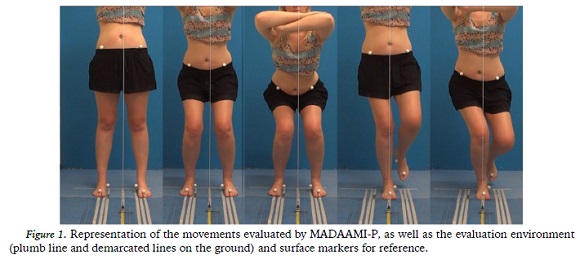
<body><![CDATA[<p>Evaluation with MADAAMI-P requires a pre- prepared environment. This preparation    consists of: (a) a plumb line hanging over a marked centerline on the floor;    (b) three parallel reference lines marked on the ground at 10, 12 and 15 cm    from the center line of the plumb line;</p>     <p>(c) a digital Sony camera HDR-CX19 (Tokyo, Japan) positioned on a tripod at    1.75 m from the reference lines, with the center of its lens aligned with the    plumb line. A metal measuring tape was used to align the center of the lens    with the plumb line. The height of the tripod supporting the camera may initially    be 0.5 m, varying according to the height of the individual to be evaluated,    provided that the video clearly shows the lower limbs of the individual and    the reference lines marked on the floor (<a href="#f1">Figure 1</a>).</p>     <p>&nbsp;</p>     <p align="center"><a name="f1"></a><img src="/img/revistas/mot/v15n1/15n1a08f1.jpg"/></p>     
<p>&nbsp;</p>     <p>Participants completed a form with the following information: Age; Sex (F /    M); Weight (kg); Height (cm). They also answered the questions: Do you have    any injuries to lower limbs? If so, which one? Have you had regular physical    activity for at least three months without interruption? If so, which one? How    many times a week?</p>     <p>Procedures</p>     <p>The study consisted of three stages: (a) MADAAMI-P development, adapted from    MADAAMI for ballet dancers; (b) content validation of the score sheet, based    on analysis from six experts; and (c) evaluation of intra- and inter-rater reproducibility,    from a consecutive sample.</p>     <p><i>(a) MADAAMI-P Development</i></p>     <p>As the name suggests, MADAAMI-P is designed to dynamically evaluate joint alignment    and stability in the lower limbs from the video recordings. Its development    consisted of the adaptation of MADAAMI-I and MADAAMI-II both developed to evaluate    the dynamic joint alignment of the lower limbs of ballet dancers (Gontijo et    al., 2017).</p>     ]]></body>
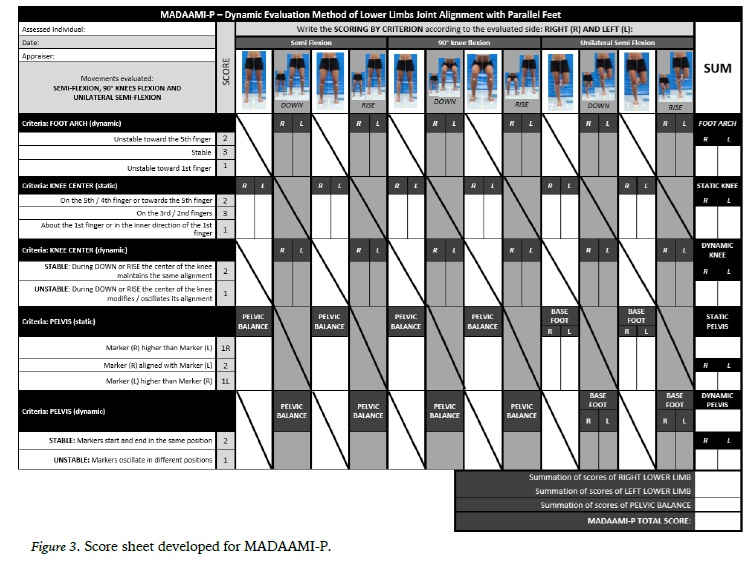
<body><![CDATA[<p>The adaptation process of the instrument consisted of adjustments of the environment,    the protocol of evaluation of individuals and shooting plan; adaptation of the    movements evaluated; and change in the scoring score sheet. Regarding the adaptations    of the environment and protocol of evaluation of the individuals, the position    of the plumb line was modified, being placed in the center of the video, so    that it is between the lower limbs of the individual to be evaluated. Regarding    the protocol of evaluation, there was modification referring to the anatomical    points of reference for the evaluation. In MADAAMI-P the palpated and marked    points with the surface markers (white polystyrene pellets) in the subject to    be evaluated are: anterior superior iliac spine (ASIS), navicular bone, and    second metatarsal-phalangeal joint, all bilaterally. As for the alteration of    the shooting plan of the sequence of movements, in MADAAMI-P the filming must    be performed in the frontal plane, with the individual positioned with the feet    parallel on the lines previously marked on the ground.</p>     <p>The sequence of MADAAMI-P movements was also adapted, being defined as: (1)    a semi- flexion repetition of knees (semi-squatting) with parallel feet, in    bipodal support; (2) a 90 ° repetition of kneeling (squatting) with parallel    feet, in bipodal support; (3) a repetition of knee semi-flexion (semi-squatting)    in right unipodal support; and (4) a repetition of knee semi-flexion (semi-squatting)    in left unipodal support (<a href="#f1">Figure 1</a>). When choosing the movements    to be assessed, functionality, simplicity and ease of execution were guiding    factors.</p>     <p>The analysis of the video containing the sequence of movements of MADAAMI-P    is performed by filling out a scoring score sheet. In this sense, the last adaptation    was the score sheet developed for MADAAMI-P, elaborated to score three basic    criteria: (1) stabilization of the arch of the foot, (2) alignment and stabilization    of the center of the knee with the ipsilateral foot and 3) pelvic alignment    and stabilization. For each criterion a series of categories scored from 1 to    3 are presented, where 1 represents the worst aligned or stable execution, and    3 (or 2 in some criteria) the best alignment or stability. There is, therefore,    a summation of points for each criterion evaluated and for each lower limb,    as well as a final score, which the higher indicates a better joint alignment.    Also, in the scoring chart, the movements evaluated in the MADAAMI-P sequence    (knee flexion, knee flexion at 90 ° and knee flexion in unipodal support) were    identified, divided into static and dynamic phases (<a href="/img/revistas/mot/v15n1/15n1a08f3.jpg" target="_blank">Figure    3</a>).</p>     
<p>&nbsp;</p>     <p align="center"><a name="f2"></a><img src="/img/revistas/mot/v15n1/15n1a08f2.jpg"/></p>     
<p>&nbsp;</p>     <p align="center"><a href="/img/revistas/mot/v15n1/15n1a08f3.jpg" target="_blank"><img src="/img/revistas/mot/v15n1/15n1a08f3.jpg" width="300" height="167"/><br />   (clique para ampliar ! click to enlarge)</a></p>     
<p>&nbsp;</p>     <p>In order to facilitate the use of MADAAMI-P, a collection of video examples    and their corresponding analysis have been included in the User&rsquo;s Manual, which    can be requested from the authors.</p>     <p><i>(b) Content validation</i></p>     ]]></body>
<body><![CDATA[<p>Once the first version of MADAAMI-P was developed, we proceeded with the second    stage of the study, the content validation. In this stage, six experts, four    Physiotherapists and two Physical Education Teachers, were invited. All the    experts have at least 15 years of experience in postural evaluation in their    respective areas and specialize in Human Movement Sciences and / or Kinesiology.    These experts were responsible for evaluating the clarity and suitability of    the score sheet of MADAAMI-P. For this purpose, the following items were sent    to the experts: (a) a video in which an individual is performing the MADAAMI-P    sequence of movements; (b) the initial version of the scoring score sheet; (c)    the User Manual; and (d) a MADAAMI-P evaluation questionnaire.</p>     <p>After Reading the User’s Manual, the experts watched the video, analyzed the    subject’s execution, and completed the score sheet. Also, after this process,    the experts should answer the evaluation questionnaire, which contained the    following questions: (1) As to the clarity and ease of understanding and use    of the proposed score sheet to evaluate the video, in general, you consider    it : very adequate, adequate or not adequate? and (2) Would you have general    suggestions, comments or modifications to make about the language used in the    score sheet or other features related to the MADAAMI-P instrument? The first    question was assessed using the Content Validity Index (CVI), which measures    the proportion of the experts that concord regarding an instrument as a whole    (Alexandre &amp; Coluci, 2011). The CVI was calculated as the ratio between    positive answers (very adequate and adequate) and the totality of the answers    (6 answers), varying from zero (worst case) to one (best index).</p>     <p>The entire content validation process was carried out individually and independently    by the experts. Based on the suggestions and comments, the initial version of    the score sheet was modified, and then sent to the experts for approval or further    suggestions. After this process, the final version of the MADAAMI-P evaluation    score sheet (<a href="/img/revistas/mot/v15n1/15n1a08f3.jpg" target="_blank">Figure    3</a><a href="#f3"></a>) was obtained, and the appropriate adjustments were    made in the User Manual.</p>     
<p><i>(c) Intra- and inter-rater reproducibility</i></p>     <p>In this third stage of the study, the same researcher made a digital video    recording of each subject executing the sequence of three movements that constitute    the MADAAMI-P. Initially palpation and marking of the following anatomical points    in each individual were performed bilaterally: ASIS, navicular bone and second    metatarsal-phalangeal joint. After marking the points, the individual was positioned    at the evaluation site, that is, behind the plumb line, with the second toe    of each foot and the heels aligned on the parallel lines. The choice of positioning    of the feet in one of the three lines marked on the floor was at the discretion    of each individual. However, this choice should be symmetrical for both feet.</p>     <p>Once positioned, the subjects were oriented as to the sequence of movements    to be performed: knee semi-flexion, knee flexion at 90° and knee semi-flexion    in unipodal support. Before the recording began, individuals were asked to perform    the sequence of movements once or twice for familiarization purposes.</p>     <p>After the data collection, the videos were analyzed using the final version    of the score sheet. For the inter-rater reproducibility, three distinct raters    (R1, R2, R3) analyzed the videos only once, independently and without conferring.    Undergraduate students, two physiotherapists and one physical education teacher,    all in the last year of their courses, with little experience in postural evaluation,    where invited to participate in this stage. The raters read the User’s Manual,    having previously received training in the analytical process from an experienced    physiotherapist (2 meetings with 3 hours each). The reliability of the three    raters’ answers determined the inter-rater reproducibility (Bartlett &amp; Frost,    2008). For intra-rater reproducibility, only one of the raters (R1) repeated    the analysis of each video with an interval of seven days. The reliability of    the responses of the first and second day of R1’s analyses determined intra-rater    reproducibility (Bartlett &amp; Frost, 2008).</p>     <p>Statistical analysis</p>     <p>The MAADAMI-P scores for each subject were tabulated to enable subsequent statistical    analysis. To check reproducibility, the following scores were then extracted    from the evaluation score sheet: (1) summation of right lower limb scores, (2)    summation of left lower limb scores,</p>     <p>(3) summation of knee semiflexion movement in bipodal support, (4) summation    of bending movement at 90 ° of knees, (5) summation of knee semi-flexion movement    in unipodal support for right lower limb, (6) summation of knee semi-flexion    movement in unipodal support for the left lower limb, (7) the sum of the knee    semiflexion movement in total unipodal support,</p>     ]]></body>
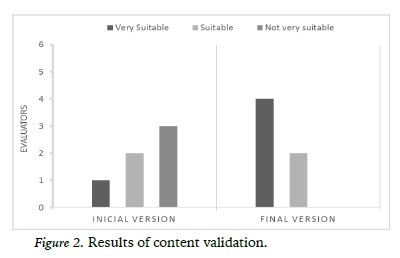
<body><![CDATA[<p>(8) MADAAMI-P total score, and (9) individual scores for each criterion in    each assessed movement phase, for right lower limbs and left separately.</p>     <p>The data were analyzed in IBM SPSS version 22 (IBM Inc., Chigaco, USA), adopting    the level of significance of 0.05 in all the inferential analyzes. Initially    the data were confirmed by the Kolmoronov-Smirnov test. Cohen&rsquo;s Kappa coefficient    was used for analysis by categories, performed in the reproducibility verification    phase, considering the following classification:</p>     <p>&#8804;0 = poor; between 0.01-0.20 = weak; between 0.21-0.40 = reasonable;    between 0.41-0.60 = moderate; between 0.61-0.80 = significant; and between 0,81-1,0    = almost perfect (Landis &amp; Koch, 1977). For the analysis of MADAAMI-P final    scores, the Intraclass Correlation Coefficient (ICC) was used. ICC1,2 was used    for intra-rater reproducibility, and ICC1,3 was used for the inter-rater reproducibility    (Krebs, 1986; Weir, 2005). The ICC was classified as excellent (ICC&gt; 0.75),    satisfactory (ICC 0.4 - 0.75), and poor (ICC &lt; 0.40) (Fleiss, Levin, &amp;    Paik, 2004).</p>     <p>RESULTS</p>     <p>The content validation results show that 50% of the invited experts considered    the score sheet to be inappropriate in the first evaluation, 33.3% suitable,    and 16.6% very suitable, which correspond a CVI equal to 0.5. After its reconstruction    based on suggestions and comments, 66.6% of the experts considered it very suitable,    33.3% suitable, and none of the experts considered it to be unsuitable (<a href="#f2">Figure    2</a>), with a CVI of 1.0. Based on this result, the final version of the MADAAMI-P    score sheet was obtained (<a href="/img/revistas/mot/v15n1/15n1a08f3.jpg" target="_blank">Figure    3</a><a href="#f3"></a>).</p>     
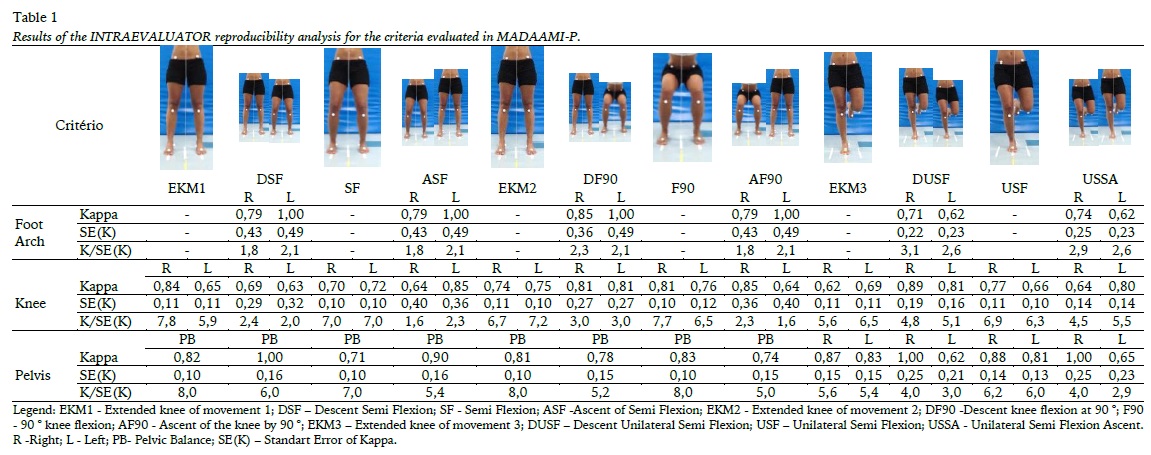
<p>Intra-evaluative analysis, for each criterion alone, showed, in general, that    MADAAMI-P presents reproducibility, with Kappa values varying from 0.62 to 1.00,    indicating a reproducibility of important to near-perfect. In this analysis,    both arch criteria of the foot and pelvis were the ones that obtained the highest    reproducibility indexes (<a href="/img/revistas/mot/v15n1/15n1a08t1.jpg" target="_blank">Table    1</a>).</p>     
<p>&nbsp;</p>     <p align="center"><a href="/img/revistas/mot/v15n1/15n1a08t1.jpg" target="_blank"><img src="/img/revistas/mot/v15n1/15n1a08t1.jpg" width="300" height="167"/><br />   (clique para ampliar ! click to enlarge)</a></p>     
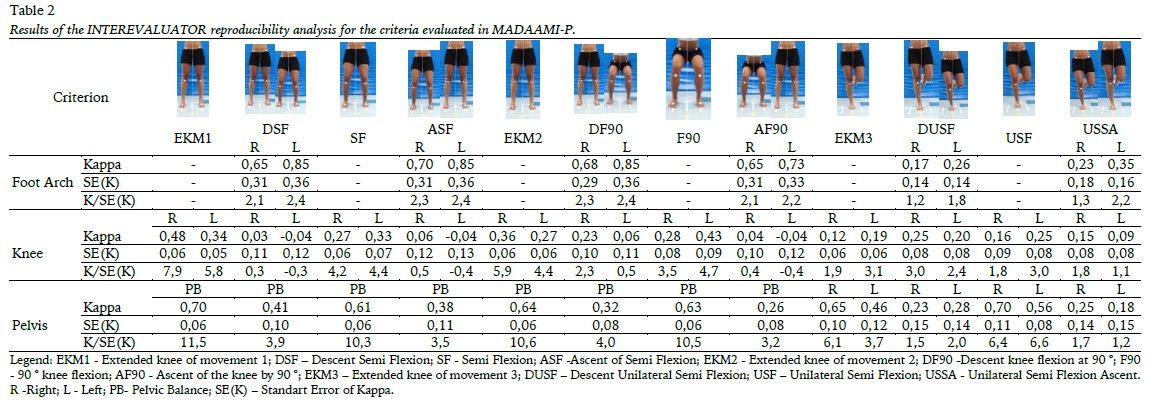
<p>&nbsp;</p>     <p>The inter-analyzer analysis, referring to the criterion of arch of the foot    in bipodal support, indicated reproducibility from important to almost perfect    in (Kappa ranging from 0.65 to 0.85). In the knee criterion, in both unipolar    and bipodal support, Kappa values indicated a reproducibility from poor to reasonable    (-0.04 to 0.48). And, for the pelvic criterion the values of K indicated reproducibility    from weak to important (0.18 to 0.70) (<a href="/img/revistas/mot/v15n1/15n1a08t2.jpg" target="_blank">Table    2</a>).</p>     
]]></body>
<body><![CDATA[<p>&nbsp;</p>     <p align="center"><a href="/img/revistas/mot/v15n1/15n1a08t2.jpg" target="_blank"><img src="/img/revistas/mot/v15n1/15n1a08t2.jpg" width="300" height="167"/><br />   (clique para ampliar ! click to enlarge)</a></p>     
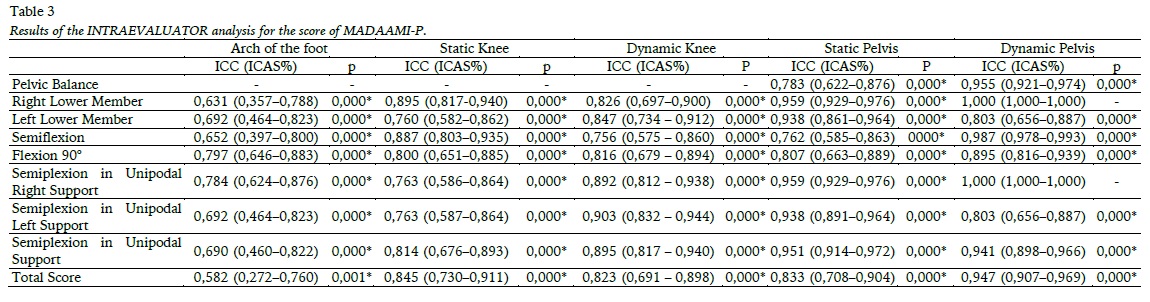
<p>&nbsp;</p>     <p>The MADAAMI-P intra-evaluative analysis, given by the sum of the points obtained    in each phase of the movement, for each criterion, showed ICCs ranging from    0.582 to 1.00, indicating a reproducibility from satisfactory to excellent.    The pelvic criterion, both static and dynamic, was the one with the highest    values of CHF (<a href="/img/revistas/mot/v15n1/15n1a08t3.jpg" target="_blank">Table    3</a>).</p>     
<p>&nbsp;</p>     <p align="center"><a href="/img/revistas/mot/v15n1/15n1a08t3.jpg" target="_blank"><img src="/img/revistas/mot/v15n1/15n1a08t3.jpg" width="300" height="167"/><br />   (clique para ampliar ! click to enlarge)</a></p>     
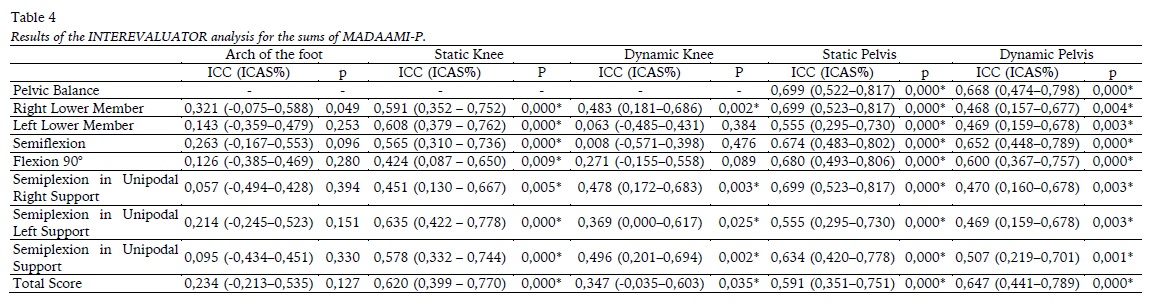
<p>&nbsp;</p>     <p>The inter-analyzer analysis of MADAAMI-P, given the sum of the points obtained    in each phase of the movement, for each criterion, showed ICCs varying from    0.008 to 0.669, and some of the partial scores did not present significant correlations.    The pelvis criterion, both static and dynamic, was the one that presented the    highest values of CHF, indicating a satisfactory reproducibility of this criterion,    whereas the criterion of arch of the foot was not reproducible, having ICC values    ranging from 0.057 to 0.321 (<a href="/img/revistas/mot/v15n1/15n1a08t4.jpg" target="_blank">Table    4</a>).</p>     
<p>&nbsp;</p>     <p align="center"><a href="/img/revistas/mot/v15n1/15n1a08t4.jpg" target="_blank"><img src="/img/revistas/mot/v15n1/15n1a08t4.jpg" width="300" height="167"/><br />   (clique para ampliar ! click to enlarge)</a></p>     
]]></body>
<body><![CDATA[<p>&nbsp;</p>     <p>DISCUSSION</p>     <p>Regarding the evaluation of lower limb articular alignment, different methods    are described for static evaluation. We can cite subjective visual assessment    (J. Lee &amp; Park, 2016), radiological examinations (Cho, Ko, &amp; Lee, 2015;    Gao et al., 2016; Moyer, Wirth, Duryea, &amp; Eckstein, 2016; Zampogna et al.,    2015) or angular measurements by goniometry (Karukunchit, Puntumetakul, Swangnetr,    &amp; Boucaut, 2015; Lee, Choi, &amp; Chang, 2015). For the dynamic assessment    of the lower limb articular alignment, some studies have been conducting using    3D camera systems in combination with retro-reflexive markers (Khamis et al.,    2015; Pohjola et al., 2014; Shippen, 2011). It is a laboratory-based evaluation    system requiring adequate space and specific costly equipment, as well as trained    personnel, hich makes access difficult for the general population. Considering    this, the intention of the present study was to offer an alternative evaluation    tool to such systems.</p>     <p>The MADAAMI-P instrument is valid, with respect to content, and reproducible,    for use by the same rater. In this case, we highlight its usefulness as an evaluation    tool in the therapeutic environment, as long as the follow- up of an individual    being treated, for example, is performed by the same professional. Regarding    inter-rater reproducibility, the findings of the present study corroborate with    the results of the study by Gontijo, Candotti, Amaral, Santos, and Loss (2018).    The data highlight the subjective nature of the evaluation, revealing the sensitivity    of the tool in relation to the clinical view and the experience of each rater,    hampering good reliability between raters.</p>     <p>Regarding the criteria evaluated by the instrument, the arch of the foot and    the pelvis showed better inter-rater reproducibility results than the knee.    This can be explained by the anatomical differences of the structures involved    in each criterion, since the knee is a more unstable joint, especially when    flexed (Kapandji &amp; Articular, 1990), a position performed during MADAAMI-P    evaluation movements. Moreover, the knee is difficult to evaluate compared to    other joints because it is located at the extremity of two noncongruous structures,    the femur and the tibia, allowing it to move more freely, guided by muscles    and ligaments (Magee, 2005). Thus, identifying the center of the knee, in movement,    without technological resources, such as movement tracking systems, is not an    easy task. While developing the MADAAMI-P, we conducted tests using markers    on the patella and anterior tibial tuberosity, which proved unsuitable for representing    the center of the knee, inducing the raters to error. Hence, we opted for a    more subjective analysis (i.e. without markers on the knee), which could explain    the poor results for inter-rater reproducibility.</p>     <p>Among the results found, in the inter-rater analysis, we can emphasize the    divergences related to evaluation in bi or unipodal support. This finding may    be related to increased instability in unipodal support (Assaiante, 1998; Oliveira,    Santos, Andrade, &amp; Avila, 2008), which causes a greater oscillation in the    joints, hampering the inter-rater reproducibility. As with the evaluation of    the knee, the subjectivity of the analysis allied to the clinical experience    of each rater appears to be a factor limiting inter- rater reproducibility.</p>     <p>Likewise, the pelvis tends to be more stable than the knee or ankle, due to    anatomical/kinesiological characteristics which ensure less oscillation. This    makes the analysis simpler, with less variation between the markers on ASIS    left and right, leading to better inter- rater reproducibility results in this    criterion (Germain, 1992; Kapandji &amp; Articular, 1990; Magee, 2005).</p>     <p>The study presents clinical relevance, mainly in the area of physiotherapy.    When considering the achievement of good intra-evaluative results in a therapeutic    environment, it is possible to extrapolate the use of the tool, since the possible    follow-up of an individual is done by the same professional. In addition, the    record of the execution of the movements as well as the scoring score are very    attractive visuals in clinical practice, serving as feedback and encouragement    to the individual in treatment/training.</p>     <p>Limitations of the study</p>     <p>We observed in the present study as limitations the dependence on the subjective    clinical view of the examiner in the evaluation, leading to heterogeneous evaluations    from the different raters. Another limitation refers to the analysis of a 3D-movement    based on a view from a single plane. Furthermore, the absence of the concurrent    validation procedure, from the comparison of MADAAMI-P results with the cinemetry    can also be considered a limitation of the study.</p>     ]]></body>
<body><![CDATA[<p>CONCLUSION</p>     <p>Dynamic Evaluation Method of Lower Limb Joint Alignment with Parallel Feet    (MADAAMI-P) is valid in terms of content (score sheet), and presents intra-rater    reproducibility, being safely indicated for use by the same rater. However,    the inter-assay reproducibility of the instrument is limited to some parameters,    suggesting caution when used by more than one examiner. In addition, it is emphasized    once again the clinical importance of the instrument, especially in physiotherapy,    serving as an effective quantitative method to obtain the record of movement    execution, which together with the scoring score, are attractive visual resources    in clinical practice, serving as feedback and encouragement to the individual    in treatment / training.</p>     <p>&nbsp;</p>     <p><b>REFERENCES</b></p>     <!-- ref --><p>Alexandre, N. M. C., &amp; Coluci, M. Z. O. (2011). Validade de conteúdo nos    processos de construção e adaptação de instrumentos de medidas. Ciência &amp;    Saúde Coletiva, <i>16</i>,3061- 3068.    &nbsp;&nbsp;&nbsp;&nbsp;&nbsp;&nbsp;&nbsp;&nbsp;[&#160;<a href="javascript:void(0);" onclick="javascript: window.open('/scielo.php?script=sci_nlinks&ref=389821&pid=S1646-107X201900010000800001&lng=','','width=640,height=500,resizable=yes,scrollbars=1,menubar=yes,');">Links</a>&#160;]<!-- end-ref --></p>     <!-- ref --><p>Assaiante, C. (1998). Development of locomotor balance control in healthy children.    <i>Neuroscience &amp; Biobehavioral Reviews</i>, <i>22</i>(4), 527-532. <a href="https://doi.org/10.1016/S0149-7634(97)00040-7" target="_blank">https://doi.org/10.1016/S0149-7634(97)00040-7</a>  &nbsp;&nbsp;&nbsp;&nbsp;&nbsp;&nbsp;&nbsp;&nbsp;[&#160;<a href="javascript:void(0);" onclick="javascript: window.open('/scielo.php?script=sci_nlinks&ref=389823&pid=S1646-107X201900010000800002&lng=','','width=640,height=500,resizable=yes,scrollbars=1,menubar=yes,');">Links</a>&#160;]<!-- end-ref --><!-- ref --><p>Bartlett, J. W., &amp; Frost, C. (2008). Reliability, repeatability and reproducibility:    analysis of measurement errors in continuous variables. <i>Ultrasound in Obstetrics    and Gynecology: The Official Journal of the International Society of Ultrasound    in Obstetrics and Gynecology</i>, <i>31</i>(4), 466-475. <a href="https://doi.org/10.1002/uog.5256" target="_blank">https://doi.org/10.1002/uog.5256</a>  &nbsp;&nbsp;&nbsp;&nbsp;&nbsp;&nbsp;&nbsp;&nbsp;[&#160;<a href="javascript:void(0);" onclick="javascript: window.open('/scielo.php?script=sci_nlinks&ref=389824&pid=S1646-107X201900010000800003&lng=','','width=640,height=500,resizable=yes,scrollbars=1,menubar=yes,');">Links</a>&#160;]<!-- end-ref --><!-- ref --><p>Cho, Y., Ko, Y., &amp; Lee, W. (2015). Relationships among foot position, lower    limb alignment, and knee adduction moment in patients with degenerative knee    osteoarthritis. <i>Journal of Physical Therapy Science</i>, <i>27</i>(1), 265-268.    <a href="https://doi.org/10.1589/jpts.27.265" target="_blank">https://doi.org/10.1589/jpts.27.265</a>  &nbsp;&nbsp;&nbsp;&nbsp;&nbsp;&nbsp;&nbsp;&nbsp;[&#160;<a href="javascript:void(0);" onclick="javascript: window.open('/scielo.php?script=sci_nlinks&ref=389825&pid=S1646-107X201900010000800004&lng=','','width=640,height=500,resizable=yes,scrollbars=1,menubar=yes,');">Links</a>&#160;]<!-- end-ref --><p>Fleiss, J. L., Levin, B., &amp; Paik, M. C. (2004). Statistical methods for    rates and proportions (Third Addition). In <i>Wiley Series in Probability and    statistics</i>.</p>     ]]></body>
<body><![CDATA[<!-- ref --><p>Gao, F., Ma, J., Sun, W., Guo, W., Li, Z., &amp; Wang, W. (2016). The influence    of knee malalignment on the ankle alignment in varus and valgus gonarthrosis    based on radiographic measurement. <i>European Journal of Radiology</i>, <i>85</i>(1),    228-232. <a href="https://doi.org/10.1016/j.ejrad.2015.11.021" target="_blank">https://doi.org/10.1016/j.ejrad.2015.11.021</a>  &nbsp;&nbsp;&nbsp;&nbsp;&nbsp;&nbsp;&nbsp;&nbsp;[&#160;<a href="javascript:void(0);" onclick="javascript: window.open('/scielo.php?script=sci_nlinks&ref=389827&pid=S1646-107X201900010000800006&lng=','','width=640,height=500,resizable=yes,scrollbars=1,menubar=yes,');">Links</a>&#160;]<!-- end-ref --><!-- ref --><p>Germain, B. C. (1992). <i>Anatomia para o movimento:</i><i>Introdução à análise    das técnicas corporais</i>. São Paulo: Manole.    &nbsp;&nbsp;&nbsp;&nbsp;&nbsp;&nbsp;&nbsp;&nbsp;[&#160;<a href="javascript:void(0);" onclick="javascript: window.open('/scielo.php?script=sci_nlinks&ref=389828&pid=S1646-107X201900010000800007&lng=','','width=640,height=500,resizable=yes,scrollbars=1,menubar=yes,');">Links</a>&#160;]<!-- end-ref --></p>     <!-- ref --><p>Gontijo, K. N. S., Candotti, C. T., Amaral, M. A. do, Santos, G. C. dos, Williams,    V., &amp; Loss, J. F. (2018). A New Version of the MADAAMI Method for Assessing    Lower Limb Alignment During Demi-Plié, Grand Plié, and Fondu. <i>Journal of    Dance Medicine &amp; Science</i>, <i>22</i>(3), 123-131. <a href="https://doi.org/10.12678/1089-313X.22.3.123" target="_blank">https://doi.org/10.12678/1089-313X.22.3.123</a>  &nbsp;&nbsp;&nbsp;&nbsp;&nbsp;&nbsp;&nbsp;&nbsp;[&#160;<a href="javascript:void(0);" onclick="javascript: window.open('/scielo.php?script=sci_nlinks&ref=389830&pid=S1646-107X201900010000800008&lng=','','width=640,height=500,resizable=yes,scrollbars=1,menubar=yes,');">Links</a>&#160;]<!-- end-ref --><!-- ref --><p>Gontijo, K. N. S., Candotti, C. T., Feijó, G. dos S.,Ribeiro, L. P., &amp;    Loss, J. F. (2017). Dynamic evaluation method of lower limbs joint alignment    (MADAAMI) for dancers during the plié. <i>Revista Brasileira de Ciências Do    Esporte</i>, <i>39</i>(2), 148-159. <a href="http://dx.doi.org/10.1016/j.rbce.2016.02.016" target="_blank">http://dx.doi.org/10.1016/j.rbce.2016.02.016</a>    .    &nbsp;&nbsp;&nbsp;&nbsp;&nbsp;&nbsp;&nbsp;&nbsp;[&#160;<a href="javascript:void(0);" onclick="javascript: window.open('/scielo.php?script=sci_nlinks&ref=389831&pid=S1646-107X201900010000800009&lng=','','width=640,height=500,resizable=yes,scrollbars=1,menubar=yes,');">Links</a>&#160;]<!-- end-ref --></p>     <p>KAPANDJI, I. F. A., &amp; Articular, A. F. (1990). <i>esquemas comentados de    mecânica humana</i>. MANOLE.</p>     <!-- ref --><p>Karukunchit, U., Puntumetakul, R., Swangnetr, M., &amp; Boucaut, R. (2015).    Prevalence and risk factor analysis of lower extremity abnormal alignment characteristics    among rice farmers. <i>Patient Preference and Adherence</i>, <i>9</i>, 785.    doi: <a href="http://dx.doi.org/10.2147/PPA.S81898" target="_blank">10.2147/PPA.S81898</a>&nbsp;&nbsp;&nbsp;&nbsp;&nbsp;&nbsp;&nbsp;&nbsp;[&#160;<a href="javascript:void(0);" onclick="javascript: window.open('/scielo.php?script=sci_nlinks&ref=389834&pid=S1646-107X201900010000800011&lng=','','width=640,height=500,resizable=yes,scrollbars=1,menubar=yes,');">Links</a>&#160;]<!-- end-ref --><!-- ref --><p>Khamis, S., Dar, G., Peretz, C., &amp; Yizhar, Z. (2015). The relationship    between foot and pelvic alignment while standing. <i>Journal of Human Kinetics</i>,    <i>46</i>(1), 85-97. doi: <a href="http://dx.doi.org/10.1515/hukin-2015-0037" target="_blank">10.1515/hukin-2015-0037</a>&nbsp;&nbsp;&nbsp;&nbsp;&nbsp;&nbsp;&nbsp;&nbsp;[&#160;<a href="javascript:void(0);" onclick="javascript: window.open('/scielo.php?script=sci_nlinks&ref=389835&pid=S1646-107X201900010000800012&lng=','','width=640,height=500,resizable=yes,scrollbars=1,menubar=yes,');">Links</a>&#160;]<!-- end-ref --><!-- ref --><p>Krebs, D. E. (1986). Declare your ICC type. <i>Physical Therapy</i>, <i>66</i>(9),    1431.    &nbsp;&nbsp;&nbsp;&nbsp;&nbsp;&nbsp;&nbsp;&nbsp;[&#160;<a href="javascript:void(0);" onclick="javascript: window.open('/scielo.php?script=sci_nlinks&ref=389836&pid=S1646-107X201900010000800013&lng=','','width=640,height=500,resizable=yes,scrollbars=1,menubar=yes,');">Links</a>&#160;]<!-- end-ref --></p>     <p>Landis, J. R., &amp; Koch, G. G. (1977). The measurement of observer agreement    for categorical data. <i>Biometrics</i>, 159-174. doi: <a href="http://dx.doi.org/10.2307/2529310" target="_blank">10.2307/2529310</a></p>     <!-- ref --><p>Lee, J., &amp; Park, H.-S. (2016). Effects of physical characteristics and    residence style on alignment of lower extremity. <i>Journal of Exercise Rehabilitation</i>,    <i>12</i>(2), 109. doi: <a href="http://dx.doi.org/10.12965/jer.1632596.298" target="_blank">10.12965/jer.1632596.298</a>&nbsp;&nbsp;&nbsp;&nbsp;&nbsp;&nbsp;&nbsp;&nbsp;[&#160;<a href="javascript:void(0);" onclick="javascript: window.open('/scielo.php?script=sci_nlinks&ref=389839&pid=S1646-107X201900010000800015&lng=','','width=640,height=500,resizable=yes,scrollbars=1,menubar=yes,');">Links</a>&#160;]<!-- end-ref --><!-- ref --><p>Lee, S. A., Choi, S.-H., &amp; Chang, M. J. (2015). How accurate is anatomic    limb alignment in predicting mechanical limb alignment after total knee arthroplasty?    <i>BMC Musculoskeletal Disorders</i>, <i>16</i>(1), 323. <a href="https://doi.org/10.1186/s12891-015-0756-2" target="_blank">https://doi.org/10.1186/s12891-015-0756-2</a>  &nbsp;&nbsp;&nbsp;&nbsp;&nbsp;&nbsp;&nbsp;&nbsp;[&#160;<a href="javascript:void(0);" onclick="javascript: window.open('/scielo.php?script=sci_nlinks&ref=389840&pid=S1646-107X201900010000800016&lng=','','width=640,height=500,resizable=yes,scrollbars=1,menubar=yes,');">Links</a>&#160;]<!-- end-ref --><p>MAGEE, D. J. (2005). <i>Avaliação musculoesquelética</i>. Editora Manole.</p>     <!-- ref --><p>Moyer, R., Wirth, W., Duryea, J., &amp; Eckstein, F. (2016). Anatomical alignment,    but not goniometry, predicts femorotibial cartilage loss as well as mechanical    alignment: data from the Osteoarthritis Initiative. <i>Osteoarthritis and Cartilage</i>,    <i>24</i>(2), 254-261. doi: <a href="https://doi.org/10.1016/j.joca.2015.08.016" target="_blank">https://doi.org/10.1016/j.joca.2015.08.016</a>  &nbsp;&nbsp;&nbsp;&nbsp;&nbsp;&nbsp;&nbsp;&nbsp;[&#160;<a href="javascript:void(0);" onclick="javascript: window.open('/scielo.php?script=sci_nlinks&ref=389842&pid=S1646-107X201900010000800018&lng=','','width=640,height=500,resizable=yes,scrollbars=1,menubar=yes,');">Links</a>&#160;]<!-- end-ref --><!-- ref --><p>Oliveira, T. P. de, Santos, A. M. de C., Andrade, M. C. de, &amp; Avila, A.    O. V. (2008). Controle postural de crianças praticantes e não praticantes de    atividade física regular. <i>Brazilian Journal of Biomechanics Revista Brasileira    de Biomecânica</i>, <i>9</i>(16), 41-46.    &nbsp;&nbsp;&nbsp;&nbsp;&nbsp;&nbsp;&nbsp;&nbsp;[&#160;<a href="javascript:void(0);" onclick="javascript: window.open('/scielo.php?script=sci_nlinks&ref=389843&pid=S1646-107X201900010000800019&lng=','','width=640,height=500,resizable=yes,scrollbars=1,menubar=yes,');">Links</a>&#160;]<!-- end-ref --></p>     <!-- ref --><p>Pohjola, H., Sayers, M., Mellifont, R., Mellifont, D., &amp; Venojärvi, M.    (2014). Three-dimensional analysis of a ballet dancer with ischial tuberosity    apophysitis. A case study. <i>Journal of Sports Science &amp; Medicine</i>,    <i>13</i>(4), 874.    &nbsp;&nbsp;&nbsp;&nbsp;&nbsp;&nbsp;&nbsp;&nbsp;[&#160;<a href="javascript:void(0);" onclick="javascript: window.open('/scielo.php?script=sci_nlinks&ref=389845&pid=S1646-107X201900010000800020&lng=','','width=640,height=500,resizable=yes,scrollbars=1,menubar=yes,');">Links</a>&#160;]<!-- end-ref --></p>     ]]></body>
<body><![CDATA[<!-- ref --><p>Saavedra, C., &amp; Espregueira-Mendes, J. (2014). Alinhamento dos membros    inferiores. <i>Medicina Desportiva Informa</i>, <i>5</i>(4), 30-31.    &nbsp;&nbsp;&nbsp;&nbsp;&nbsp;&nbsp;&nbsp;&nbsp;[&#160;<a href="javascript:void(0);" onclick="javascript: window.open('/scielo.php?script=sci_nlinks&ref=389847&pid=S1646-107X201900010000800021&lng=','','width=640,height=500,resizable=yes,scrollbars=1,menubar=yes,');">Links</a>&#160;]<!-- end-ref --></p>     <!-- ref --><p>Shippen, J. (2011). Turnout is an Euler angle. <i>Arts Biomechanics</i>, <i>1</i>(1),    33.    &nbsp;&nbsp;&nbsp;&nbsp;&nbsp;&nbsp;&nbsp;&nbsp;[&#160;<a href="javascript:void(0);" onclick="javascript: window.open('/scielo.php?script=sci_nlinks&ref=389849&pid=S1646-107X201900010000800022&lng=','','width=640,height=500,resizable=yes,scrollbars=1,menubar=yes,');">Links</a>&#160;]<!-- end-ref --> ISSN: 2156-5724</p>     <!-- ref --><p>Sim, J., &amp; Wright, C. C. (2005). The kappa statistic in reliability studies:    use, interpretation, and sample size requirements. <i>Physical Therapy</i>,    <i>85</i>(3), 257-268. <a href="https://doi.org/10.1093/ptj/85.3.257" target="_blank">https://doi.org/10.1093/ptj/85.3.257</a>  &nbsp;&nbsp;&nbsp;&nbsp;&nbsp;&nbsp;&nbsp;&nbsp;[&#160;<a href="javascript:void(0);" onclick="javascript: window.open('/scielo.php?script=sci_nlinks&ref=389851&pid=S1646-107X201900010000800023&lng=','','width=640,height=500,resizable=yes,scrollbars=1,menubar=yes,');">Links</a>&#160;]<!-- end-ref --><!-- ref --><p>Weir, J. P. (2005). Quantifying test-retest reliability using the intraclass    correlation coefficient and the SEM. <i>The Journal of Strength &amp; Conditioning    Research</i>, <i>19</i>(1), 231-240.    &nbsp;&nbsp;&nbsp;&nbsp;&nbsp;&nbsp;&nbsp;&nbsp;[&#160;<a href="javascript:void(0);" onclick="javascript: window.open('/scielo.php?script=sci_nlinks&ref=389852&pid=S1646-107X201900010000800024&lng=','','width=640,height=500,resizable=yes,scrollbars=1,menubar=yes,');">Links</a>&#160;]<!-- end-ref --></p>     <!-- ref --><p>Zampogna, B., Vasta, S., Amendola, A., Marbach, B. U.-E., Gao, Y., Papalia,    R., &amp; Denaro, V. (2015). Assessing lower limb alignment: comparison of standard    knee xray vs long leg view. <i>The Iowa Orthopaedic Journal</i>, <i>35</i>,    49.    &nbsp;&nbsp;&nbsp;&nbsp;&nbsp;&nbsp;&nbsp;&nbsp;[&#160;<a href="javascript:void(0);" onclick="javascript: window.open('/scielo.php?script=sci_nlinks&ref=389854&pid=S1646-107X201900010000800025&lng=','','width=640,height=500,resizable=yes,scrollbars=1,menubar=yes,');">Links</a>&#160;]<!-- end-ref --></p>     <p>&nbsp;</p>     ]]></body>
<body><![CDATA[<p>Acknowledgments: Nothing to declare.</p>     <p>Conflict of interests: Nothing to declare.</p>     <p>Funding: Scientific initiation grant and CNPq Masters Grant. </p>     <p>&nbsp;</p>     <p>Manuscript received at April 11th 2018; Accepted at March 11th 2019</p>     <p>&nbsp;</p>     <p><a href="#top*"><sup>[*]</sup></a><a name="*"></a>Corresponding author: Rua    Felizardo, 750 - Jardim Botânico, Porto Alegre - RS- Brasil</p>     <p><i>Email: </i><a href="mailto:isisjlnavarro@gmail.com">isisjlnavarro@gmail.com</a></p>      ]]></body>
<back>
<ref-list>
<ref id="B1">
<nlm-citation citation-type="journal">
<person-group person-group-type="author">
<name>
<surname><![CDATA[Alexandre]]></surname>
<given-names><![CDATA[N. M. C.]]></given-names>
</name>
<name>
<surname><![CDATA[Coluci]]></surname>
<given-names><![CDATA[M. Z. O.]]></given-names>
</name>
</person-group>
<article-title xml:lang="pt"><![CDATA[Validade de conteúdo nos processos de construção e adaptação de instrumentos de medidas]]></article-title>
<source><![CDATA[Ciência & Saúde Coletiva]]></source>
<year>2011</year>
<volume>16</volume>
<page-range>3061- 3068</page-range></nlm-citation>
</ref>
<ref id="B2">
<nlm-citation citation-type="journal">
<person-group person-group-type="author">
<name>
<surname><![CDATA[Assaiante]]></surname>
<given-names><![CDATA[C.]]></given-names>
</name>
</person-group>
<article-title xml:lang="en"><![CDATA[Development of locomotor balance control in healthy children]]></article-title>
<source><![CDATA[Neuroscience & Biobehavioral Reviews]]></source>
<year>1998</year>
<volume>22</volume>
<numero>4</numero>
<issue>4</issue>
<page-range>527-532</page-range></nlm-citation>
</ref>
<ref id="B3">
<nlm-citation citation-type="journal">
<person-group person-group-type="author">
<name>
<surname><![CDATA[Bartlett]]></surname>
<given-names><![CDATA[J. W.]]></given-names>
</name>
<name>
<surname><![CDATA[Frost]]></surname>
<given-names><![CDATA[C.]]></given-names>
</name>
</person-group>
<article-title xml:lang="en"><![CDATA[Reliability, repeatability and reproducibility: analysis of measurement errors in continuous variables]]></article-title>
<source><![CDATA[Ultrasound in Obstetrics and Gynecology: The Official Journal of the International Society of Ultrasound in Obstetrics and Gynecology]]></source>
<year>2008</year>
<volume>31</volume>
<numero>4</numero>
<issue>4</issue>
<page-range>466-475</page-range></nlm-citation>
</ref>
<ref id="B4">
<nlm-citation citation-type="journal">
<person-group person-group-type="author">
<name>
<surname><![CDATA[Cho]]></surname>
<given-names><![CDATA[Y.]]></given-names>
</name>
<name>
<surname><![CDATA[Ko]]></surname>
<given-names><![CDATA[Y.]]></given-names>
</name>
<name>
<surname><![CDATA[Lee]]></surname>
<given-names><![CDATA[W.]]></given-names>
</name>
</person-group>
<article-title xml:lang="en"><![CDATA[Relationships among foot position, lower limb alignment, and knee adduction moment in patients with degenerative knee osteoarthritis]]></article-title>
<source><![CDATA[Journal of Physical Therapy Science]]></source>
<year>2015</year>
<volume>27</volume>
<numero>1</numero>
<issue>1</issue>
<page-range>265-268</page-range></nlm-citation>
</ref>
<ref id="B5">
<nlm-citation citation-type="book">
<person-group person-group-type="author">
<name>
<surname><![CDATA[Fleiss]]></surname>
<given-names><![CDATA[J. L.]]></given-names>
</name>
<name>
<surname><![CDATA[Levin]]></surname>
<given-names><![CDATA[B.]]></given-names>
</name>
<name>
<surname><![CDATA[Paik]]></surname>
<given-names><![CDATA[M. C.]]></given-names>
</name>
</person-group>
<source><![CDATA[Statistical methods for rates and proportions]]></source>
<year>2004</year>
<edition>Third</edition>
<publisher-name><![CDATA[Wiley]]></publisher-name>
</nlm-citation>
</ref>
<ref id="B6">
<nlm-citation citation-type="journal">
<person-group person-group-type="author">
<name>
<surname><![CDATA[Gao]]></surname>
<given-names><![CDATA[F.]]></given-names>
</name>
<name>
<surname><![CDATA[Ma]]></surname>
<given-names><![CDATA[J.]]></given-names>
</name>
<name>
<surname><![CDATA[Sun]]></surname>
<given-names><![CDATA[W.]]></given-names>
</name>
<name>
<surname><![CDATA[Guo]]></surname>
<given-names><![CDATA[W.]]></given-names>
</name>
<name>
<surname><![CDATA[Li]]></surname>
<given-names><![CDATA[Z.]]></given-names>
</name>
<name>
<surname><![CDATA[Wang]]></surname>
<given-names><![CDATA[W.]]></given-names>
</name>
</person-group>
<article-title xml:lang="en"><![CDATA[The influence of knee malalignment on the ankle alignment in varus and valgus gonarthrosis based on radiographic measurement]]></article-title>
<source><![CDATA[European Journal of Radiology]]></source>
<year>2016</year>
<volume>85</volume>
<numero>1</numero>
<issue>1</issue>
<page-range>228-232</page-range></nlm-citation>
</ref>
<ref id="B7">
<nlm-citation citation-type="book">
<person-group person-group-type="author">
<name>
<surname><![CDATA[Germain]]></surname>
<given-names><![CDATA[B. C.]]></given-names>
</name>
</person-group>
<source><![CDATA[Anatomia para o movimento: Introdução à análise das técnicas corporais]]></source>
<year>1992</year>
<publisher-loc><![CDATA[São Paulo ]]></publisher-loc>
<publisher-name><![CDATA[Manole]]></publisher-name>
</nlm-citation>
</ref>
<ref id="B8">
<nlm-citation citation-type="journal">
<person-group person-group-type="author">
<name>
<surname><![CDATA[Gontijo]]></surname>
<given-names><![CDATA[K. N. S.]]></given-names>
</name>
<name>
<surname><![CDATA[Candotti]]></surname>
<given-names><![CDATA[C. T.]]></given-names>
</name>
<name>
<surname><![CDATA[Amaral]]></surname>
<given-names><![CDATA[M. A. do]]></given-names>
</name>
<name>
<surname><![CDATA[Santos]]></surname>
<given-names><![CDATA[G. C. dos]]></given-names>
</name>
<name>
<surname><![CDATA[Williams]]></surname>
<given-names><![CDATA[V.]]></given-names>
</name>
<name>
<surname><![CDATA[Loss]]></surname>
<given-names><![CDATA[J. F.]]></given-names>
</name>
</person-group>
<article-title xml:lang="en"><![CDATA[A New Version of the MADAAMI Method for Assessing Lower Limb Alignment During Demi-Plié, Grand Plié, and Fondu]]></article-title>
<source><![CDATA[Journal of Dance Medicine & Science]]></source>
<year>2018</year>
<volume>22</volume>
<numero>3</numero>
<issue>3</issue>
<page-range>123-131</page-range></nlm-citation>
</ref>
<ref id="B9">
<nlm-citation citation-type="journal">
<person-group person-group-type="author">
<name>
<surname><![CDATA[Gontijo]]></surname>
<given-names><![CDATA[K. N. S.]]></given-names>
</name>
<name>
<surname><![CDATA[Candotti]]></surname>
<given-names><![CDATA[C. T.]]></given-names>
</name>
<name>
<surname><![CDATA[Feijó]]></surname>
<given-names><![CDATA[G. dos S.]]></given-names>
</name>
<name>
<surname><![CDATA[Ribeiro]]></surname>
<given-names><![CDATA[L. P.]]></given-names>
</name>
<name>
<surname><![CDATA[Loss]]></surname>
<given-names><![CDATA[J. F.]]></given-names>
</name>
</person-group>
<article-title xml:lang="en"><![CDATA[Dynamic evaluation method of lower limbs joint alignment (MADAAMI) for dancers during the plié]]></article-title>
<source><![CDATA[Revista Brasileira de Ciências Do Esporte]]></source>
<year>2017</year>
<volume>39</volume>
<numero>2</numero>
<issue>2</issue>
<page-range>148-159</page-range></nlm-citation>
</ref>
<ref id="B10">
<nlm-citation citation-type="book">
<person-group person-group-type="author">
<name>
<surname><![CDATA[KAPANDJI]]></surname>
<given-names><![CDATA[I. F. A.]]></given-names>
</name>
<name>
<surname><![CDATA[Articular]]></surname>
<given-names><![CDATA[A. F.]]></given-names>
</name>
</person-group>
<source><![CDATA[Esquemas comentados de mecânica humana]]></source>
<year>1990</year>
<publisher-loc><![CDATA[São Paulo ]]></publisher-loc>
<publisher-name><![CDATA[MANOLE]]></publisher-name>
</nlm-citation>
</ref>
<ref id="B11">
<nlm-citation citation-type="journal">
<person-group person-group-type="author">
<name>
<surname><![CDATA[Karukunchit]]></surname>
<given-names><![CDATA[U.]]></given-names>
</name>
<name>
<surname><![CDATA[Puntumetakul]]></surname>
<given-names><![CDATA[R.]]></given-names>
</name>
<name>
<surname><![CDATA[Swangnetr]]></surname>
<given-names><![CDATA[M.]]></given-names>
</name>
<name>
<surname><![CDATA[Boucaut]]></surname>
<given-names><![CDATA[R.]]></given-names>
</name>
</person-group>
<article-title xml:lang="en"><![CDATA[Prevalence and risk factor analysis of lower extremity abnormal alignment characteristics among rice farmers]]></article-title>
<source><![CDATA[Patient Preference and Adherence]]></source>
<year>2015</year>
<volume>9</volume>
<page-range>785</page-range></nlm-citation>
</ref>
<ref id="B12">
<nlm-citation citation-type="journal">
<person-group person-group-type="author">
<name>
<surname><![CDATA[Khamis]]></surname>
<given-names><![CDATA[S.]]></given-names>
</name>
<name>
<surname><![CDATA[Dar]]></surname>
<given-names><![CDATA[G.]]></given-names>
</name>
<name>
<surname><![CDATA[Peretz]]></surname>
<given-names><![CDATA[C.]]></given-names>
</name>
<name>
<surname><![CDATA[Yizhar]]></surname>
<given-names><![CDATA[Z.]]></given-names>
</name>
</person-group>
<article-title xml:lang="en"><![CDATA[The relationship between foot and pelvic alignment while standing]]></article-title>
<source><![CDATA[Journal of Human Kinetics]]></source>
<year>2015</year>
<volume>46</volume>
<numero>1</numero>
<issue>1</issue>
<page-range>85-97</page-range></nlm-citation>
</ref>
<ref id="B13">
<nlm-citation citation-type="journal">
<person-group person-group-type="author">
<name>
<surname><![CDATA[Krebs]]></surname>
<given-names><![CDATA[D. E.]]></given-names>
</name>
</person-group>
<article-title xml:lang="en"><![CDATA[Declare your ICC type]]></article-title>
<source><![CDATA[Physical Therapy]]></source>
<year>1986</year>
<volume>66</volume>
<numero>9</numero>
<issue>9</issue>
<page-range>1431</page-range></nlm-citation>
</ref>
<ref id="B14">
<nlm-citation citation-type="journal">
<person-group person-group-type="author">
<name>
<surname><![CDATA[Landis]]></surname>
<given-names><![CDATA[J. R.]]></given-names>
</name>
<name>
<surname><![CDATA[Koch]]></surname>
<given-names><![CDATA[G. G.]]></given-names>
</name>
</person-group>
<article-title xml:lang="en"><![CDATA[The measurement of observer agreement for categorical data]]></article-title>
<source><![CDATA[Biometrics]]></source>
<year>1977</year>
<volume>0</volume>
<page-range>159-174</page-range></nlm-citation>
</ref>
<ref id="B15">
<nlm-citation citation-type="journal">
<person-group person-group-type="author">
<name>
<surname><![CDATA[Lee]]></surname>
<given-names><![CDATA[J.]]></given-names>
</name>
<name>
<surname><![CDATA[Park]]></surname>
<given-names><![CDATA[H.-S.]]></given-names>
</name>
</person-group>
<article-title xml:lang="en"><![CDATA[Effects of physical characteristics and residence style on alignment of lower extremity]]></article-title>
<source><![CDATA[Journal of Exercise Rehabilitation]]></source>
<year>2016</year>
<volume>12</volume>
<numero>2</numero>
<issue>2</issue>
<page-range>109</page-range></nlm-citation>
</ref>
<ref id="B16">
<nlm-citation citation-type="journal">
<person-group person-group-type="author">
<name>
<surname><![CDATA[Lee]]></surname>
<given-names><![CDATA[S. A.]]></given-names>
</name>
<name>
<surname><![CDATA[Choi]]></surname>
<given-names><![CDATA[S.-H.]]></given-names>
</name>
<name>
<surname><![CDATA[Chang]]></surname>
<given-names><![CDATA[M. J.]]></given-names>
</name>
</person-group>
<article-title xml:lang="en"><![CDATA[How accurate is anatomic limb alignment in predicting mechanical limb alignment after total knee arthroplasty?]]></article-title>
<source><![CDATA[BMC Musculoskeletal Disorders]]></source>
<year>2015</year>
<volume>16</volume>
<numero>1</numero>
<issue>1</issue>
<page-range>323</page-range></nlm-citation>
</ref>
<ref id="B17">
<nlm-citation citation-type="book">
<person-group person-group-type="author">
<name>
<surname><![CDATA[MAGEE]]></surname>
<given-names><![CDATA[D. J.]]></given-names>
</name>
</person-group>
<source><![CDATA[Avaliação musculoesquelética]]></source>
<year>2005</year>
<publisher-loc><![CDATA[São Paulo ]]></publisher-loc>
<publisher-name><![CDATA[Editora Manole]]></publisher-name>
</nlm-citation>
</ref>
<ref id="B18">
<nlm-citation citation-type="journal">
<person-group person-group-type="author">
<name>
<surname><![CDATA[Moyer]]></surname>
<given-names><![CDATA[R.]]></given-names>
</name>
<name>
<surname><![CDATA[Wirth]]></surname>
<given-names><![CDATA[W.]]></given-names>
</name>
<name>
<surname><![CDATA[Duryea]]></surname>
<given-names><![CDATA[J.]]></given-names>
</name>
<name>
<surname><![CDATA[Eckstein]]></surname>
<given-names><![CDATA[F.]]></given-names>
</name>
</person-group>
<article-title xml:lang="en"><![CDATA[Anatomical alignment, but not goniometry, predicts femorotibial cartilage loss as well as mechanical alignment: data from the Osteoarthritis Initiative]]></article-title>
<source><![CDATA[Osteoarthritis and Cartilage]]></source>
<year>2016</year>
<volume>24</volume>
<numero>2</numero>
<issue>2</issue>
<page-range>254-261</page-range></nlm-citation>
</ref>
<ref id="B19">
<nlm-citation citation-type="journal">
<person-group person-group-type="author">
<name>
<surname><![CDATA[Oliveira]]></surname>
<given-names><![CDATA[T. P. de]]></given-names>
</name>
<name>
<surname><![CDATA[Santos]]></surname>
<given-names><![CDATA[A. M. de C.]]></given-names>
</name>
<name>
<surname><![CDATA[Andrade]]></surname>
<given-names><![CDATA[M. C. de]]></given-names>
</name>
<name>
<surname><![CDATA[Avila]]></surname>
<given-names><![CDATA[A. O. V.]]></given-names>
</name>
</person-group>
<article-title xml:lang="pt"><![CDATA[Controle postural de crianças praticantes e não praticantes de atividade física regular]]></article-title>
<source><![CDATA[Brazilian Journal of Biomechanics Revista Brasileira de Biomecânica]]></source>
<year>2008</year>
<volume>9</volume>
<numero>16</numero>
<issue>16</issue>
<page-range>41-46</page-range></nlm-citation>
</ref>
<ref id="B20">
<nlm-citation citation-type="journal">
<person-group person-group-type="author">
<name>
<surname><![CDATA[Pohjola]]></surname>
<given-names><![CDATA[H.]]></given-names>
</name>
<name>
<surname><![CDATA[Sayers]]></surname>
<given-names><![CDATA[M.]]></given-names>
</name>
<name>
<surname><![CDATA[Mellifont]]></surname>
<given-names><![CDATA[R.]]></given-names>
</name>
<name>
<surname><![CDATA[Mellifont]]></surname>
<given-names><![CDATA[D.]]></given-names>
</name>
<name>
<surname><![CDATA[Venojärvi]]></surname>
<given-names><![CDATA[M.]]></given-names>
</name>
</person-group>
<article-title xml:lang="en"><![CDATA[Three-dimensional analysis of a ballet dancer with ischial tuberosity apophysitis]]></article-title>
<source><![CDATA[A case study. Journal of Sports Science & Medicine]]></source>
<year>2014</year>
<volume>13</volume>
<numero>4</numero>
<issue>4</issue>
<page-range>874</page-range></nlm-citation>
</ref>
<ref id="B21">
<nlm-citation citation-type="journal">
<person-group person-group-type="author">
<name>
<surname><![CDATA[Saavedra]]></surname>
<given-names><![CDATA[C.]]></given-names>
</name>
<name>
<surname><![CDATA[Espregueira-Mendes]]></surname>
<given-names><![CDATA[J.]]></given-names>
</name>
</person-group>
<article-title xml:lang="pt"><![CDATA[Alinhamento dos membros inferiores]]></article-title>
<source><![CDATA[Medicina Desportiva Informa]]></source>
<year>2014</year>
<volume>5</volume>
<numero>4</numero>
<issue>4</issue>
<page-range>30-31</page-range></nlm-citation>
</ref>
<ref id="B22">
<nlm-citation citation-type="journal">
<person-group person-group-type="author">
<name>
<surname><![CDATA[Shippen]]></surname>
<given-names><![CDATA[J.]]></given-names>
</name>
</person-group>
<article-title xml:lang="en"><![CDATA[Turnout is an Euler angle]]></article-title>
<source><![CDATA[Arts Biomechanics]]></source>
<year>2011</year>
<volume>1</volume>
<numero>1</numero>
<issue>1</issue>
<page-range>33</page-range></nlm-citation>
</ref>
<ref id="B23">
<nlm-citation citation-type="journal">
<person-group person-group-type="author">
<name>
<surname><![CDATA[Sim]]></surname>
<given-names><![CDATA[J.]]></given-names>
</name>
<name>
<surname><![CDATA[Wright]]></surname>
<given-names><![CDATA[C. C.]]></given-names>
</name>
</person-group>
<article-title xml:lang="en"><![CDATA[The kappa statistic in reliability studies: use, interpretation, and sample size requirements]]></article-title>
<source><![CDATA[Physical Therapy]]></source>
<year>2005</year>
<volume>85</volume>
<numero>3</numero>
<issue>3</issue>
<page-range>257-268</page-range></nlm-citation>
</ref>
<ref id="B24">
<nlm-citation citation-type="journal">
<person-group person-group-type="author">
<name>
<surname><![CDATA[Weir]]></surname>
<given-names><![CDATA[J. P.]]></given-names>
</name>
</person-group>
<article-title xml:lang="en"><![CDATA[Quantifying test-retest reliability using the intraclass correlation coefficient and the SEM]]></article-title>
<source><![CDATA[The Journal of Strength & Conditioning Research]]></source>
<year>2005</year>
<volume>19</volume>
<numero>1</numero>
<issue>1</issue>
<page-range>231-240</page-range></nlm-citation>
</ref>
<ref id="B25">
<nlm-citation citation-type="journal">
<person-group person-group-type="author">
<name>
<surname><![CDATA[Zampogna]]></surname>
<given-names><![CDATA[B.]]></given-names>
</name>
<name>
<surname><![CDATA[Vasta]]></surname>
<given-names><![CDATA[S.]]></given-names>
</name>
<name>
<surname><![CDATA[Amendola]]></surname>
<given-names><![CDATA[A.]]></given-names>
</name>
<name>
<surname><![CDATA[Marbach]]></surname>
<given-names><![CDATA[B. U.-E.]]></given-names>
</name>
<name>
<surname><![CDATA[Gao]]></surname>
<given-names><![CDATA[Y.]]></given-names>
</name>
<name>
<surname><![CDATA[Papalia]]></surname>
<given-names><![CDATA[R.]]></given-names>
</name>
<name>
<surname><![CDATA[Denaro]]></surname>
<given-names><![CDATA[V.]]></given-names>
</name>
</person-group>
<article-title xml:lang="en"><![CDATA[Assessing lower limb alignment: comparison of standard knee xray vs long leg view]]></article-title>
<source><![CDATA[The Iowa Orthopaedic Journal]]></source>
<year>2015</year>
<volume>35</volume>
<page-range>49</page-range></nlm-citation>
</ref>
</ref-list>
</back>
</article>