<?xml version="1.0" encoding="ISO-8859-1"?><article xmlns:mml="http://www.w3.org/1998/Math/MathML" xmlns:xlink="http://www.w3.org/1999/xlink" xmlns:xsi="http://www.w3.org/2001/XMLSchema-instance">
<front>
<journal-meta>
<journal-id>0872-1904</journal-id>
<journal-title><![CDATA[Portugaliae Electrochimica Acta]]></journal-title>
<abbrev-journal-title><![CDATA[Port. Electrochim. Acta]]></abbrev-journal-title>
<issn>0872-1904</issn>
<publisher>
<publisher-name><![CDATA[Sociedade Portuguesa de Electroquímica]]></publisher-name>
</publisher>
</journal-meta>
<article-meta>
<article-id>S0872-19042014000500003</article-id>
<article-id pub-id-type="doi">10.4152/pea.201405325</article-id>
<title-group>
<article-title xml:lang="en"><![CDATA[New Approach for Measuring Antioxidant Activity Via a Graphite Sensor]]></article-title>
</title-group>
<contrib-group>
<contrib contrib-type="author">
<name>
<surname><![CDATA[El-Kosasy]]></surname>
<given-names><![CDATA[A. M.]]></given-names>
</name>
<xref ref-type="aff" rid="A01"/>
</contrib>
<contrib contrib-type="author">
<name>
<surname><![CDATA[Hussien]]></surname>
<given-names><![CDATA[L. A.]]></given-names>
</name>
<xref ref-type="aff" rid="A01"/>
</contrib>
<contrib contrib-type="author">
<name>
<surname><![CDATA[Abdel-Rahman]]></surname>
<given-names><![CDATA[M. H.]]></given-names>
</name>
<xref ref-type="aff" rid="A01"/>
</contrib>
</contrib-group>
<aff id="A01">
<institution><![CDATA[,Ain Shams University Faculty of Pharmacy Pharmaceutical Analytical Chemistry Department]]></institution>
<addr-line><![CDATA[Cairo ]]></addr-line>
<country>Egypt</country>
</aff>
<pub-date pub-type="pub">
<day>00</day>
<month>09</month>
<year>2014</year>
</pub-date>
<pub-date pub-type="epub">
<day>00</day>
<month>09</month>
<year>2014</year>
</pub-date>
<volume>32</volume>
<numero>5</numero>
<fpage>395</fpage>
<lpage>403</lpage>
<copyright-statement/>
<copyright-year/>
<self-uri xlink:href="http://www.scielo.pt/scielo.php?script=sci_arttext&amp;pid=S0872-19042014000500003&amp;lng=en&amp;nrm=iso"></self-uri><self-uri xlink:href="http://www.scielo.pt/scielo.php?script=sci_abstract&amp;pid=S0872-19042014000500003&amp;lng=en&amp;nrm=iso"></self-uri><self-uri xlink:href="http://www.scielo.pt/scielo.php?script=sci_pdf&amp;pid=S0872-19042014000500003&amp;lng=en&amp;nrm=iso"></self-uri><abstract abstract-type="short" xml:lang="en"><p><![CDATA[An ion selective membrane sensor from dioctyl phthalate as a plasticizer in a polymeric matrix of polyvinyl chloride (PVC) and &#946;-cyclodextrin as an ionophore was constructed and evaluated according to IUPAC recommendations. Linear Nernstian response of DPPH&#8226; within the concentration ranges of 10-6 to 10-2 mol L-1 was obtained with average recovery 99.87 &#177; 0.617. Nernstian slope of 58.5 mV/decade with excellent selectivity over the pH range of 3-8 was observed. The suggested method was standardized using butylated hydroxyl anisole (BHA). The 50% radical scavenging activity (IC50) determined by the proposed sensor correlated well with that of the common spectrophotometric method based on scavenging of 2,2-diphenyl-1picrylhydrazyl (DPPH&#8226;). An algorithm implemented in Microsoft Visual Basic® 6.0 was used for calculating (IC50) values which are 7.38 &#956;g/mL &#177; 0.35, 89.98 &#956;g/ mL &#177; 0.45 and 1.45 mg/ mL &#177; 1.50 for BHA, Paracetamol and Dipyridamole, respectively. The proposed sensor represents a simple and reproducible tool for measuring DPPH&#8226; scavenging activity of Paracetamol and Dipyridamole in bulk powder, pharmaceutical formulations and simulated intestinal fluid (SIF) without sophisticated separation techniques.]]></p></abstract>
<kwd-group>
<kwd lng="en"><![CDATA[Sensor]]></kwd>
<kwd lng="en"><![CDATA[antioxidant]]></kwd>
<kwd lng="en"><![CDATA[Paracetamol]]></kwd>
<kwd lng="en"><![CDATA[Dipyridamole]]></kwd>
</kwd-group>
</article-meta>
</front><body><![CDATA[   <!--     <p>&nbsp;</p>     <p>doi: 10.4152/pea.201405325</p> -->      <p><b>New Approach for Measuring Antioxidant Activity Via a Graphite Sensor</b></p>      <p> <b>A. M. El-Kosasy</b>, <b>L. A. Hussien</b> and <b>M. H. Abdel-Rahman</b><sup><a href="#0">*</a></sup> </p>      <p><i> Pharmaceutical Analytical Chemistry Department, Faculty of Pharmacy, Ain Shams University, Abbassia, 11566 Cairo, Egypt</i></p>       <p>&nbsp;</p>     <p><b>Abstract</b></p>      <p>An ion selective membrane sensor from dioctyl phthalate as a plasticizer in    a polymeric matrix of polyvinyl chloride (PVC) and &beta;-cyclodextrin as an    ionophore was constructed and evaluated according to IUPAC recommendations.    Linear Nernstian response of DPPH<sup>&bull;</sup> within the concentration    ranges of 10<sup>-6</sup> to 10<sup>-2</sup> mol L<sup>-1</sup> was obtained    with average recovery 99.87 &#177; 0.617. Nernstian slope of 58.5 mV/decade    with excellent selectivity over the pH range of 3-8 was observed. The suggested    method was standardized using butylated hydroxyl anisole (BHA). The 50% radical    scavenging activity (IC50) determined by the proposed sensor correlated well    with that of the common spectrophotometric method based on scavenging of 2,2-diphenyl-1picrylhydrazyl    (DPPH<sup>&bull;</sup>). An algorithm implemented in Microsoft Visual Basic&reg;    6.0 was used for calculating (IC50) values which are 7.38 &mu;g/mL &#177; 0.35,    89.98 &mu;g/ mL&#177;0.45 and 1.45 mg/ mL &#177; 1.50 for BHA, Paracetamol and    Dipyridamole, respectively. The proposed sensor represents a simple and reproducible    tool for measuring DPPH<sup>&bull;</sup> scavenging activity of Paracetamol    and Dipyridamole in bulk powder, pharmaceutical formulations and simulated intestinal    fluid (SIF) without sophisticated separation techniques.</p>      <p><b><i>Keywords:</i></b> Sensor, antioxidant, Paracetamol, Dipyridamole.</p>       ]]></body>
<body><![CDATA[<p>&nbsp;</p>     <p><b>Introduction</b></p>      <p>The chemistry of free radicals and antioxidants is of great importance,  particularly in the areas of clinical medicine and nutritional science [1].  Antioxidants act as free radical scavengers and can prevent the damage caused by  oxidative reactions, including cancer, Alzheimer's and Parkinson's diseases [2, 3-6].  Hence, the evaluation of the antioxidative activity of medical, cosmetic  and food samples provides useful clinical information [7].</p>      <p>One of the most commonly used methods for in vitro evaluation of antioxidant  capacity is DPPH<sup>&bull;</sup> scavenging method [8-13]. Recently, a number  of DPPH<sup>&bull;</sup> -based tests for the assessment of antioxidant activity have been  developed. The evaluation of antioxidant capacity based on the amperometric  reduction of DPPH<sup>&bull;</sup> at the glassy carbon electrode was reported [14, 15], TLC  [16], HPLC techniques [17-20] and flow injection based methods for  determination of scavenging capacity against DPPH<sup>&bull;</sup> were also reported [21-25].  A DPPH<sup>&bull;</sup> based optical sensor for screening of antioxidant activity  was introduced by Steinberg et al. [26].</p>      <p>In the present work, we have studied the feasibility of using a graphite ion- selective membrane sensor for evaluation of DPPH<sup>&bull;</sup> scavenging activity of  certain antioxidants and using BHA, a standard antioxidant, to study its response.  The proposed sensor can be considered superior to the common colorimetric  method since it can be used for evaluation of antioxidant activity of colored or  turbid solutions and it applies neither sophisticated instruments nor any  separation step; also, the proposed method is more simple, faster and cheaper  than the amperometric and chromatographic methods.</p>       <p>&nbsp;</p>     <p><b>Experimental</b></p>      <p><b><i>Apparatus</i></b></p>      <p>Mettler Toledo compact titrator model G20 with Labx software version 3.1  accompanied with Ag/AgCl double junction reference electrode was used for  potential measurements. A Jenway pH meter 3310 pH / mV / &deg;C meter with a  Jenway pH glass electrode (UK) was used for pH adjustments. Thermostatic  multiple water bath, model BT-15 (Spain). Thermometer. Double beam  Shimadzu (Japan) 1601Pc UV-VIS spectrophotometer connected to a computer  fitted with UVPC personal spectroscopy software version 3.7.</p>       <p><b><i>Chemicals and reagents</i></b></p>      ]]></body>
<body><![CDATA[<p>2,2-diphenyl-1-picrylhydrazyl radical (DPPH<sup>&bull;</sup>), 99.98%, was obtained from  Sigma Aldrich, Cairo, Egypt. Hepamol&reg; tablets (500 mg paracetamol/tablet,  Hikma Pharmaceutical Company, Egypt) and Persantin tablets (75 mg  dipyridamole/ tablet, Sideco Pharmaceutical Company, Egypt).</p>      <p>All reagents and chemicals used throughout this work were of analytical grade  and the water used was bi-distilled. Poly (vinyl chloride) carboxylate (PVC  carboxylate) and &beta;-cyclodextrin (&beta;-CD) were obtained from Fluka (Chemie  Gmbh, Germany), dioctyl phthalate (DOP) was obtained from Aldrich  (Germany). Tetrahydrofuran (THF) was obtained from Merck (Darmstadt,  Germany). Sodium hydroxide, hydrochloric acid, potassium chloride, citric acid,  sodium bicarbonate, nickel chloride hexahydrate and magnesium chloride were  obtained from Prolabo (Pennsylvania, USA). Simulated intestinal fluid (SIF) was  prepared from 6.8 g monobasic potassium phosphate, 0.2 M sodium hydroxide  (NaOH) (to adjust pH to 6.8) and water to 1000 mL and the temperature was  adjusted to 37 &pm; 0.2 &deg;C.</p>       <p><b><i>Procedures</i></b></p>      <p><i>Fabrication of the membrane sensor</i></p>      <p>0.04 g of (&beta;-cd) was mixed with 0.19 g PVC carboxylate and dissolved in 0.4 mL  (DOP) and then mixed thoroughly with 5 mL (THF) till complete homogeneity  in a Petri dish (5 cm diameter), the solvent was slowly evaporated at room  temperature until an oily concentrated mixture was obtained.  The coated graphite electrode was constructed using a graphite bar 3 cm length, 3  mm diameter). One end of the bar was used for connection, while the other,  about 1 cm length, was dipped in the electro-active membrane mixture. The  process was repeated several times until a layer of proper thickness was formed  covering the terminal of the graphite bar. The electrode was left standing at room  temperature to dry. The uncoated end of the graphite rod was sealed in a poly  tetra ethylene tube; the tube was filled with metallic mercury into which a copper  wire was dipped.</p>       <p><i>Sensor calibration</i></p>      <p>The sensor was conditioned by soaking in 10<sup>-2</sup> mol L<sup>-1</sup> DPPH<sup>&bull;</sup> solution for only  2 hours before measurement, storage was in distilled water when not in use, the  conditioned sensor was calibrated by separately transferring 50 mL aliquots of  solutions covering the concentration range of (10<sup>-7</sup> to 10<sup>-2</sup> mol L<sup>-1</sup>) DPPH<sup>&bull;</sup>, into a  series of 100 mL beakers. The electrode system was immersed in each solution  with constant stirring at speed 20% in conjunction with a Mettler Toledo  reference electrode. The sensor was washed in distilled water between  measurements. The sensor potential was plotted versus each negative logarithmic  concentration of DPPH<sup>&bull;</sup>, the calibration plot obtained was used for subsequent  measurements of unknown samples.</p>       <p><i>Effect of pH and temperature</i></p>      <p>The influence of pH on the response of the membrane sensor was checked at  various pH values over a pH range of (1-9). 1&times;10<sup>-3</sup> and  1&times;10<sup>-4</sup> mol L<sup>-1</sup> DPPH<sup>&bull;</sup> solutions were prepared.  Effect of temperature also was checked by applying the  same procedures at all concentrations at different temperatures using a water bath  and a thermometer to adjust the temperature of each concentration.</p>       <p><i>Sensor selectivity</i></p>      ]]></body>
<body><![CDATA[<p>The potentiometric selectivity coefficients (K<sup>pot</sup><sub>A.B</sub>)  of the proposed sensor towards different substances were determined by a separate solution method  using the following equation [27]:</p>       <p>&nbsp;</p> <a name="e1"> <img src="/img/revistas/pea/v32n5/32n5a03e1.jpg">     
<p>&nbsp;</p>       <p>where K<sup>pot</sup><sub>A.B</sub> is the potentiometric selectivity coefficient, E<sub>1</sub> is the potential  measured in 10<sup>-3</sup> mol L<sup>-1</sup> DPPH<sup>&bull;</sup> solution, E<sub>2</sub> is the potential measured in  10<sup>-3</sup> mol L<sup>-1</sup> of the interfering solution, Z<sub>A</sub> and Z<sub>B</sub> are the charges of DPPH<sup>&bull;</sup> and  interfering ion, respectively, a<sub>A</sub> is the activity of DPPH<sup>&bull;</sup> and 2.303RT/<sub>A</sub>F  represents the slope of the investigated sensor (mV/concentration decade).</p>       <p><i>Potentiometric determination of % DPPH<sup>&bull;</sup> scavenging of pure paracetamol and dipyridamole</i></p>      <p>0.5 mL of BHA, paracetamol and dipyridamole standard solutions (1.01-15.15    mg mL<sup>-1</sup>) were taken separately to obtain concentrations (10-150 &mu;g/mL),    50 mL DPPH<sup>&bull;</sup> working standard solution (1&times;10<sup>-4</sup>    mol L<sup>-1</sup>) were added, BHA prepared in methanol but paracetamol and    dipyridamole prepared in water: methanol (1:1) then incubated at room temperature    for 15 min after good shaking. Control solutions were prepared, in which no    drug was added and the same procedure was carried out. The reagent solutions    were prepared daily. Percentages scavenging and IC<sub>50</sub> values were    calculated using an algorithm [28] implemented in Microsoft Visual Basic&reg;    6.0 (Microsoft Corporation, Redmond, WA, USA).The software can be freely downloaded    at <a href="http://www.pharm.unipmn.it/rinaldi/software/blesq/BLeSq.html" target="_blank">http://www.pharm.unipmn.it/rinaldi/software/blesq/BLeSq.html</a>.    Results were compared with those obtained from the colorimetric method.</p>       <p><i>Potentiometric determination of % DPPH<sup>&bull;</sup> scavenging of paracetamol and  dipyridamole in dosage forms</i></p>      <p>The suggested procedure was applied for the evaluation of DPPH<sup>&bull;</sup> scavenging  activities of dipyridamole in Persantin&reg; tablets and paracetamol in hepamol&reg;  tablets in which ten tablets were weighed and their mean weight was determined.  The tablets were finely powdered and accurately weighed portions of powders  equivalent to (101.00-1515.00 mg) were transferred to 100-mL volumetric flasks,  then the volume was completed with water: methanol (1:1) then filtered. The  same previous procedure was then repeated. Percentages scavenging of  paracetamol and dipyridamole in dosage forms, separately, were calculated.</p>       <p><i>Potentiometric determination of % DPPH<sup>&bull;</sup> scavenging of paracetamol and  dipyridamole in dosage forms in (SIF)</i></p>      <p>The same procedure was applied but the volume was completed with simulated  intestinal fluid (SIF): methanol (1:1) then filtered. Percentages scavenging of  paracetamol and dipyridamole in tablet dosage forms, separately, were  calculated.</p>       ]]></body>
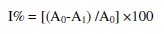
<body><![CDATA[<p><i>Colorimetric analysis</i></p>      <p>The DPPH<sup>&bull;</sup> scavenging activity was measured by following the methodology  described by Sharififar [29] where 50 &mu;L of BHA, paracetamol and dipyridamole  standard solutions (1.01-15.15 mg mL<sup>-1</sup>) were taken separately to obtain  concentrations (10-150 &mu;g/mL), 5 mL DPPH<sup>&bull;</sup> working standard solution (1&times;10<sup>-4</sup>  mol L<sup>-1</sup>) were added, BHA prepared in methanol but paracetamol and  dipyridamole prepared in water: methanol (1:1), then incubated at room  temperature for 15 min after good shaking. Absorbances were measured at 517  nm. Control solutions were prepared, in which no sample was added and the  same procedure was carried out. The assays were carried out in triplicate. The  percent radical scavenging activity is determined from the difference in  absorbance of DPPH<sup>&bull;</sup> between the control and samples by the following  equation:</p>       <p>&nbsp;</p> <a name="e2"> <img src="/img/revistas/pea/v32n5/32n5a03e2.jpg">     
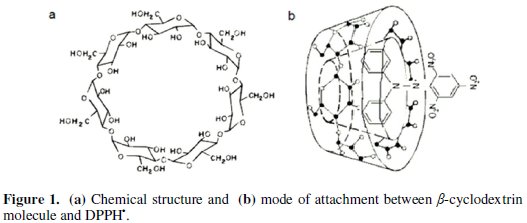
<p>&nbsp;</p>       <p>where A<sub>0</sub> is the absorbance of the control reaction and A<sub>1</sub> is the absorbance in the  presence of the antioxidant [30]. The same procedure was applied on  pharmaceutical formulations and in SIF.</p>       <p>&nbsp;</p>     <p><b>Results and discussion</b></p>      <p><b><i>Sensor fabrication</i></b></p>      <p>The central cavity of the cyclodextrin molecule is lined with skeletal carbons and  ethereal oxygens of the glucose residues (<a href="#f1">Fig. 1a</a>).</p>       <p>&nbsp;</p> <a name="f1"> <img src="/img/revistas/pea/v32n5/32n5a03f1.jpg">     
]]></body>
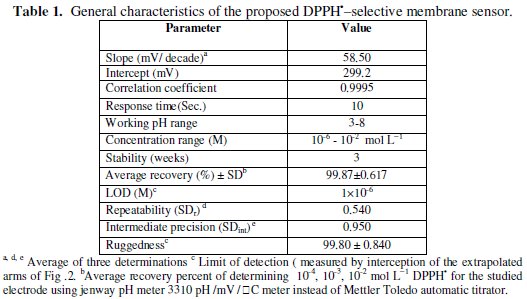
<body><![CDATA[<p>&nbsp;</p>       <p>It has therefore lipophilic  cavity into which suitably sized drug molecules are included. No covalent bonds  are formed or broken during drug-cyclodextrin complex formation [31]. We  proposed that the two benzene rings of DPPH<sup>&bull;</sup> are located well inside the cavity  with the tri nitro benzene group protruding from &beta;-cd cavity with the formation  of hydrogen bonds between hydroxyl groups of &beta;-cd and nitro groups of DPPH<sup>&bull;</sup>  (<a href="#f1">Fig. 1b</a>).</p>      <p>It has been reported that PVC matrix is a regular support and reproducible trap  for ion association complex in ion selective electrodes [32]. Nevertheless, its use  creates a need for plasticization and places a constraint on the choice of the  mediator [33].</p>      <p>In the present study, DOP was used in the sensor fabrication, which plasticized  the membrane and adjusted permittivity of the final organic membrane [34].  The electrochemical cell of the suggested membrane electrode for the  determination of DPPH<sup>&bull;</sup> can be illustrated diagrammatically as follows:</p>      <p>Double junction Ag/AgCl reference electrode &#8739; &#8739; Test solution (DPPH<sup>&bull;</sup>) &#8739; Membrane (PVC,&beta;-CD, DOP) &#8739; Graphite rod &#8739;&#8739; Metallic mercury.</p>       <p><b><i>Choice of solvent</i></b></p>      <p>The reaction mechanism between DPPH<sup>&bull;</sup> and antioxidant molecule is based on an  electron transfer reaction [35]; as a result, the scavenging capacity against DPPH<sup>&bull;</sup>  radical is strongly influenced by the solvent and the pH of the reaction [36]. It  was concluded that 50% (v/v) aqueous/methanol solutions are a suitable choice  for lipophilic and hydrophilic antioxidants and the reaction rate between DPPH<sup>&bull;</sup>  and the antioxidant may increase considerably with increasing water ratios.  However, at water content over 60% (v/v) the measured antioxidant capacity  decreased, since a part of the DPPH<sup>&bull;</sup> coagulates and it is not easily accessible to  the reaction with the antioxidant [37].</p>       <p><b><i>Sensor calibration and response time</i></b></p>      <p>The electrochemical performance characteristics of the investigated DPPH<sup>&bull;</sup>selective  membrane sensor were evaluated according to IUPAC recommendation  data [27] and summarized in <a href="#t1">Table 1</a>.</p>       <p>&nbsp;</p> <a name="t1"> <img src="/img/revistas/pea/v32n5/32n5a03t1.jpg">     
]]></body>
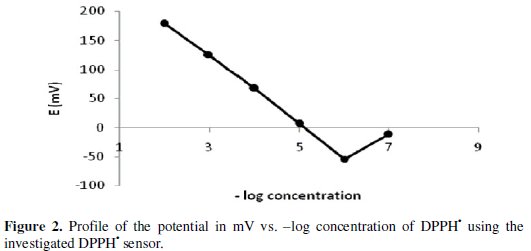
<body><![CDATA[<p>&nbsp;</p>       <p>The potential displayed by the proposed electrode for the measurements of the  standard drug solution in the same day and linearity range from day-to-day does  not vary by more than &pm; 1 mV. Calibration slopes didn't change by more than &pm; 1  mV/decade concentration over a period of 3 weeks. The required time for the  sensor to reach values within &pm; 1 mV of the final equilibrium potential after  increasing the drug concentration 10-folds was found to be 10 seconds. Typical  calibration plot is shown in <a href="#f2">Fig. 2</a>.</p>       <p>&nbsp;</p> <a name="f2"> <img src="/img/revistas/pea/v32n5/32n5a03f2.jpg">     
<p>&nbsp;</p>       <p>The slope of the calibration plot was 58.5 mV/concentration decades.  The slight deviation from the ideal Nernstian slope  (60 mV) stems from the fact that the electrode responds to the activities of drug  anion and cation rather than to their concentration. Nernstian relation of the  sensor is:</p>       <p>&nbsp;</p> <a name="e3"> <img src="/img/revistas/pea/v32n5/32n5a03e3.jpg">     
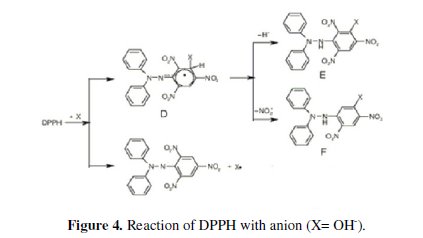
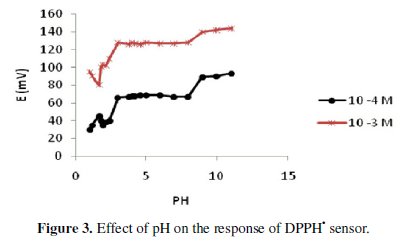
<p>&nbsp;</p>       <p>where [C] is the molar concentration. The detection limit of the proposed sensor  was estimated according to the IUPAC definition [27]. LOD value was found to  be 10<sup>-6</sup> mol L<sup>-1</sup>.</p>       <p><b><i>The effect of pH and temperature</i></b></p>      <p>The influence of pH on the potential response of the sensor was studied at  different concentrations, 10<sup>-3</sup> and 10<sup>-4</sup> mol L<sup>-1</sup> over the pH range 1-9; the  potential pH profile (<a href="#f3">Fig. 3</a>) indicated that the sensor potential is fairly constant  over the pH range of 3-8, therefore, this range can be chosen as the working pH  range for the sensor assembly; above pH 8, the hydroxide anion reacts with  DPPH<sup>&bull;</sup>, in two ways, the first one in which the anion acts as a nucleophile and  makes a complex , which decomposes after that by losing a hydride anion or a  nitrite anion, leading to different compounds, or the DPPH<sup>&bull;</sup> is strong enough to  abstract one electron from the anion and to oxidize it to the short-lived radical X,  which reacts with DPPH<sup>&bull;</sup> , yielding also finally the nitro derivative of DPPH<sup>&bull;</sup>  [38], as shown in <a href="#f4">Fig. 4</a>.</p>       ]]></body>
<body><![CDATA[<p>&nbsp;</p> <a name="f3"> <img src="/img/revistas/pea/v32n5/32n5a03f3.jpg">     
<p>&nbsp;</p> <a name="f4"> <img src="/img/revistas/pea/v32n5/32n5a03f4.jpg">     
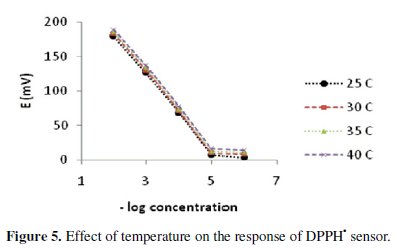
<p>&nbsp;</p>       <p>Upon studying the effect of temperature, the proposed sensor exhibits slight  increase in its potentials as the temperature rises in the range of 25-40 &deg;C;  however, the calibration graphs obtained at different temperatures were parallel,  as shown in <a href="#f5">Fig. 5</a>.</p>       <p>&nbsp;</p> <a name="f5"> <img src="/img/revistas/pea/v32n5/32n5a03f5.jpg">     
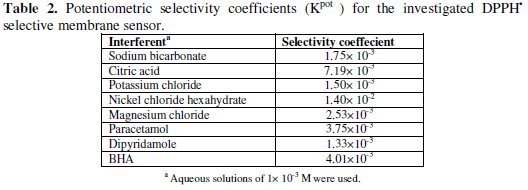
<p>&nbsp;</p>       <p>The limit of detection, slope and response time didn't significantly vary with  variation of temperature, indicating reasonable thermal stability up to 40 &deg;C.</p>       <p><b><i>Sensor selectivity</i></b></p>      <p><a href="#t2">Table 2</a> shows the potentiometric selectivity coefficients of the proposed sensor  in the presence of other interfering substances.</p>       <p>&nbsp;</p> <a name="t2"> <img src="/img/revistas/pea/v32n5/32n5a03t2.jpg">     
]]></body>
<body><![CDATA[<p>&nbsp;</p>       <p>The results reveal that the  proposed membrane sensor displays high selectivity.</p>       <p><b><i>Assessment of the antioxidant activity of paracetamol and dipyridamole in pure  form, dosage forms and SIF</i></b></p>      <p>The radical scavenging activity was calculated as follows:</p>       <p>&nbsp;</p> <a name="e4"> <img src="/img/revistas/pea/v32n5/32n5a03e4.jpg">     
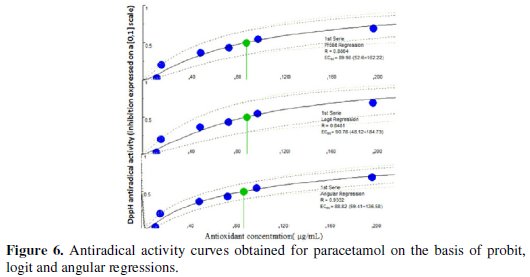
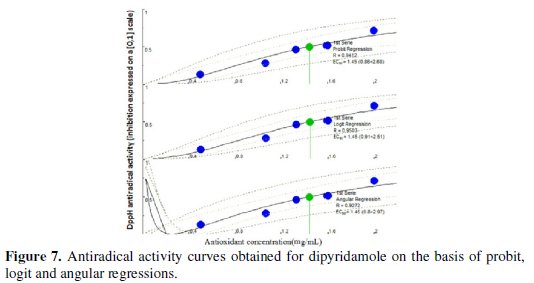
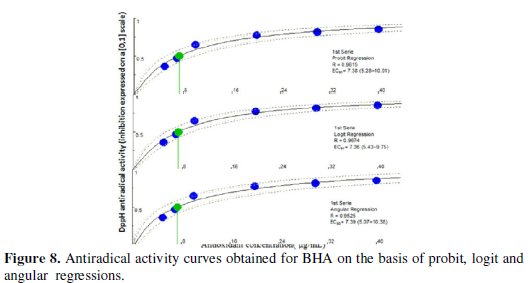
<p>&nbsp;</p>       <p>where E<sub>0</sub> is the potential of the control and E<sub>1</sub> is the potential in the presence of  the test compound at different concentrations.</p>      <p>The IC50 values were calculated graphically by plotting the antioxidant drug  concentration vs. the corresponding scavenging effect using the algorithm  implemented in Microsoft Visual Basic&reg; 6.0 (Microsoft Corporation, Redmond,  WA, USA) (on the basis of probit, logit and angular regressions) as presented in  Figs. <a href="#f6">6</a>, <a href="#f7">7</a> and <a href="#f8">8</a>.</p>       <p>&nbsp;</p> <a name="f6"> <img src="/img/revistas/pea/v32n5/32n5a03f6.jpg">     
<p>&nbsp;</p> <a name="f7"> <img src="/img/revistas/pea/v32n5/32n5a03f7.jpg">     
]]></body>
<body><![CDATA[<p>&nbsp;</p> <a name="f8"> <img src="/img/revistas/pea/v32n5/32n5a03f8.jpg">     
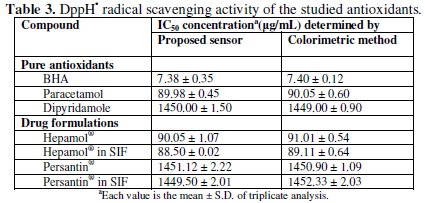
<p>&nbsp;</p>       <p>The proposed sensor was successfully used for evaluating the antioxidant  activities. The percentage scavenging of BHA(IC<sub>50</sub>) = 7.38 &mu;g/mL, paracetamol  (IC<sub>50</sub>) = 89.98 &mu;g/mL and dipyridamole (IC<sub>50</sub>) = 1.45 mg/mL. Probit model had  been chosen as it is well adapting to the data obtained from the DPPH<sup>&bull;</sup> assay and  it generally gives the intermediate IC<sub>50</sub> amongst the three regression models  considered. Results arranged scavenging activity in the following order: BHA &gt;  paracetamol &gt; dipyridamole. The AAI value [final concentration of DPPH<sup>&bull;</sup> in  &mu;g mL<sup>-1</sup> / IC50 (&mu;g/mL)] of the standard antioxidant BHA is correlated well with  that obtained from the application of the colorimetric method established by  Gourine et al. [39] (<a href="#t3">Table 3</a>).</p>       <p>&nbsp;</p> <a name="t3"> <img src="/img/revistas/pea/v32n5/32n5a03t3.jpg">     
<p>&nbsp;</p>       <p>The results proved the applicability of the proposed sensor for the evaluation of  DPPH<sup>&bull;</sup> scavenging activity of the studied drugs in their pharmaceutical  formulations and in SIF.</p>       <p>&nbsp;</p>     <p><b>Conclusions</b></p>      <p>The proposed membrane sensor was successfully used for assessment of DPPH<sup>&bull;</sup>  scavenging of paracetamol and dipyridamole in pure form and in dosage form in  (SIF). It also offers moderate stability time, elimination of drug pretreatment or  separation steps, wide pH range, low detection limit and direct determination of  drugs scavenging effects in turbid and colored solutions without interference by  pigments or excipients. In addition, DPPH<sup>&bull;</sup> radical is stable, commercially  available, and does not have to be generated before assay.</p>      <p>The use of the proposed sensor is particularly suited to fast response and low-cost  screening of the antioxidant activity.</p>       ]]></body>
<body><![CDATA[<p>&nbsp;</p>     <p><b>References</b></p>      <!-- ref --><p>1. Halliwell B, Gutteridge J M C, Free Radicals in Biology and Medicine, third ed., Oxford University Press, New York, 1999.    &nbsp;&nbsp;&nbsp;&nbsp;&nbsp;&nbsp;&nbsp;&nbsp;[&#160;<a href="javascript:void(0);" onclick="javascript: window.open('/scielo.php?script=sci_nlinks&ref=000105&pid=S0872-1904201400050000300001&lng=','','width=640,height=500,resizable=yes,scrollbars=1,menubar=yes,');">Links</a>&#160;]<!-- end-ref --></p>      <!-- ref --><p>2. Balazs L, Leon M. Neurochem Res. 1994;19:1131.    &nbsp;&nbsp;&nbsp;&nbsp;&nbsp;&nbsp;&nbsp;&nbsp;[&#160;<a href="javascript:void(0);" onclick="javascript: window.open('/scielo.php?script=sci_nlinks&ref=000107&pid=S0872-1904201400050000300002&lng=','','width=640,height=500,resizable=yes,scrollbars=1,menubar=yes,');">Links</a>&#160;]<!-- end-ref --></p>      <!-- ref --><p>3. Lewen A, Matz P, Chan PH. Neurotauma. 2000;17:871.    &nbsp;&nbsp;&nbsp;&nbsp;&nbsp;&nbsp;&nbsp;&nbsp;[&#160;<a href="javascript:void(0);" onclick="javascript: window.open('/scielo.php?script=sci_nlinks&ref=000109&pid=S0872-1904201400050000300003&lng=','','width=640,height=500,resizable=yes,scrollbars=1,menubar=yes,');">Links</a>&#160;]<!-- end-ref --></p>      <!-- ref --><p>4. Duh P D, Tu Y Y, Yen G C. Lebensmittel Wissenchaft und-Technologie. 1999;32:269.    &nbsp;&nbsp;&nbsp;&nbsp;&nbsp;&nbsp;&nbsp;&nbsp;[&#160;<a href="javascript:void(0);" onclick="javascript: window.open('/scielo.php?script=sci_nlinks&ref=000111&pid=S0872-1904201400050000300004&lng=','','width=640,height=500,resizable=yes,scrollbars=1,menubar=yes,');">Links</a>&#160;]<!-- end-ref --></p>      ]]></body>
<body><![CDATA[<!-- ref --><p>5. Bautista A P, Meszaros K, Bojta J, et al. Leukocyte Biol. 1990;48:123.    &nbsp;&nbsp;&nbsp;&nbsp;&nbsp;&nbsp;&nbsp;&nbsp;[&#160;<a href="javascript:void(0);" onclick="javascript: window.open('/scielo.php?script=sci_nlinks&ref=000113&pid=S0872-1904201400050000300005&lng=','','width=640,height=500,resizable=yes,scrollbars=1,menubar=yes,');">Links</a>&#160;]<!-- end-ref --></p>      <!-- ref --><p>6. Bautista A P, Spitzer J J. Am J Physiol. 1990;259:907.    &nbsp;&nbsp;&nbsp;&nbsp;&nbsp;&nbsp;&nbsp;&nbsp;[&#160;<a href="javascript:void(0);" onclick="javascript: window.open('/scielo.php?script=sci_nlinks&ref=000115&pid=S0872-1904201400050000300006&lng=','','width=640,height=500,resizable=yes,scrollbars=1,menubar=yes,');">Links</a>&#160;]<!-- end-ref --></p>      <!-- ref --><p>7. CRC press, Taylor and Francis group, oxidative stress and inflammatory  mechanisms in obesity, diabetes and metabolic syndrome, Lester Packer, Helmut Sies, 2007.    &nbsp;&nbsp;&nbsp;&nbsp;&nbsp;&nbsp;&nbsp;&nbsp;[&#160;<a href="javascript:void(0);" onclick="javascript: window.open('/scielo.php?script=sci_nlinks&ref=000117&pid=S0872-1904201400050000300007&lng=','','width=640,height=500,resizable=yes,scrollbars=1,menubar=yes,');">Links</a>&#160;]<!-- end-ref --></p>      <!-- ref --><p>8. Magalhaes L M, Segundo M A, Reis S, et al. Anal Chim Acta. 2008;613:119.    &nbsp;&nbsp;&nbsp;&nbsp;&nbsp;&nbsp;&nbsp;&nbsp;[&#160;<a href="javascript:void(0);" onclick="javascript: window.open('/scielo.php?script=sci_nlinks&ref=000119&pid=S0872-1904201400050000300008&lng=','','width=640,height=500,resizable=yes,scrollbars=1,menubar=yes,');">Links</a>&#160;]<!-- end-ref --></p>      <!-- ref --><p>9. Gulcin I. Life Sci. 2006;78:803.    &nbsp;&nbsp;&nbsp;&nbsp;&nbsp;&nbsp;&nbsp;&nbsp;[&#160;<a href="javascript:void(0);" onclick="javascript: window.open('/scielo.php?script=sci_nlinks&ref=000121&pid=S0872-1904201400050000300009&lng=','','width=640,height=500,resizable=yes,scrollbars=1,menubar=yes,');">Links</a>&#160;]<!-- end-ref --></p>      ]]></body>
<body><![CDATA[<!-- ref --><p>10. Gourine N, Yousfi M, Bombarda I, et al. Ind Crops Products. 2010;31:203.    &nbsp;&nbsp;&nbsp;&nbsp;&nbsp;&nbsp;&nbsp;&nbsp;[&#160;<a href="javascript:void(0);" onclick="javascript: window.open('/scielo.php?script=sci_nlinks&ref=000123&pid=S0872-1904201400050000300010&lng=','','width=640,height=500,resizable=yes,scrollbars=1,menubar=yes,');">Links</a>&#160;]<!-- end-ref --></p>      <!-- ref --><p>11. Beara IN, Lesjak MM, Cetojevic-Simin DD, et al. Food Res Int. 2012;49:501.    &nbsp;&nbsp;&nbsp;&nbsp;&nbsp;&nbsp;&nbsp;&nbsp;[&#160;<a href="javascript:void(0);" onclick="javascript: window.open('/scielo.php?script=sci_nlinks&ref=000125&pid=S0872-1904201400050000300011&lng=','','width=640,height=500,resizable=yes,scrollbars=1,menubar=yes,');">Links</a>&#160;]<!-- end-ref --></p>      <!-- ref --><p>12. Tadhani MB, Patel VH, Subhash R. Food Compos Analysis. 2007;20:323.    &nbsp;&nbsp;&nbsp;&nbsp;&nbsp;&nbsp;&nbsp;&nbsp;[&#160;<a href="javascript:void(0);" onclick="javascript: window.open('/scielo.php?script=sci_nlinks&ref=000127&pid=S0872-1904201400050000300012&lng=','','width=640,height=500,resizable=yes,scrollbars=1,menubar=yes,');">Links</a>&#160;]<!-- end-ref --></p>      <!-- ref --><p>13. Blois MS. Nature. 1958;181:199.    &nbsp;&nbsp;&nbsp;&nbsp;&nbsp;&nbsp;&nbsp;&nbsp;[&#160;<a href="javascript:void(0);" onclick="javascript: window.open('/scielo.php?script=sci_nlinks&ref=000129&pid=S0872-1904201400050000300013&lng=','','width=640,height=500,resizable=yes,scrollbars=1,menubar=yes,');">Links</a>&#160;]<!-- end-ref --></p>      <!-- ref --><p>14. Milardovic S, Ivekovic D, Grabaric BS. Bioelectrochem. 2006;68:175.    &nbsp;&nbsp;&nbsp;&nbsp;&nbsp;&nbsp;&nbsp;&nbsp;[&#160;<a href="javascript:void(0);" onclick="javascript: window.open('/scielo.php?script=sci_nlinks&ref=000131&pid=S0872-1904201400050000300014&lng=','','width=640,height=500,resizable=yes,scrollbars=1,menubar=yes,');">Links</a>&#160;]<!-- end-ref --></p>      ]]></body>
<body><![CDATA[<!-- ref --><p>15. Milardovic S, Ivekovic D, Ruwenjak V, et al. Electroanalysis. 2005;17:1847.    &nbsp;&nbsp;&nbsp;&nbsp;&nbsp;&nbsp;&nbsp;&nbsp;[&#160;<a href="javascript:void(0);" onclick="javascript: window.open('/scielo.php?script=sci_nlinks&ref=000133&pid=S0872-1904201400050000300015&lng=','','width=640,height=500,resizable=yes,scrollbars=1,menubar=yes,');">Links</a>&#160;]<!-- end-ref --></p>      <!-- ref --><p>16. Ciesla L, Kryszen J, Stochmal A, et al. Pharm Biomed Anal. 2012;70:126.    &nbsp;&nbsp;&nbsp;&nbsp;&nbsp;&nbsp;&nbsp;&nbsp;[&#160;<a href="javascript:void(0);" onclick="javascript: window.open('/scielo.php?script=sci_nlinks&ref=000135&pid=S0872-1904201400050000300016&lng=','','width=640,height=500,resizable=yes,scrollbars=1,menubar=yes,');">Links</a>&#160;]<!-- end-ref --></p>      <!-- ref --><p>17. Chandrasekar D, Madhusudhana K, Ramakrishna S, et al. Pharm Biom Anal. 2006;40:460.    &nbsp;&nbsp;&nbsp;&nbsp;&nbsp;&nbsp;&nbsp;&nbsp;[&#160;<a href="javascript:void(0);" onclick="javascript: window.open('/scielo.php?script=sci_nlinks&ref=000137&pid=S0872-1904201400050000300017&lng=','','width=640,height=500,resizable=yes,scrollbars=1,menubar=yes,');">Links</a>&#160;]<!-- end-ref --></p>      <!-- ref --><p>18. Shi S, Ma Y, Zhang Y, et al. Sep Purif Tech. 2012;89:225.    &nbsp;&nbsp;&nbsp;&nbsp;&nbsp;&nbsp;&nbsp;&nbsp;[&#160;<a href="javascript:void(0);" onclick="javascript: window.open('/scielo.php?script=sci_nlinks&ref=000139&pid=S0872-1904201400050000300018&lng=','','width=640,height=500,resizable=yes,scrollbars=1,menubar=yes,');">Links</a>&#160;]<!-- end-ref --></p>      <!-- ref --><p>19. Qiu J, Chen L, Zhu Q, et al. Food Chem. 2012;135:2366.    &nbsp;&nbsp;&nbsp;&nbsp;&nbsp;&nbsp;&nbsp;&nbsp;[&#160;<a href="javascript:void(0);" onclick="javascript: window.open('/scielo.php?script=sci_nlinks&ref=000141&pid=S0872-1904201400050000300019&lng=','','width=640,height=500,resizable=yes,scrollbars=1,menubar=yes,');">Links</a>&#160;]<!-- end-ref --></p>      ]]></body>
<body><![CDATA[<!-- ref --><p>20. Yamaguchi T, Takamura H, Matoba T, et al. Biosci Biotech Biochem. 1998;62:1201.    &nbsp;&nbsp;&nbsp;&nbsp;&nbsp;&nbsp;&nbsp;&nbsp;[&#160;<a href="javascript:void(0);" onclick="javascript: window.open('/scielo.php?script=sci_nlinks&ref=000143&pid=S0872-1904201400050000300020&lng=','','width=640,height=500,resizable=yes,scrollbars=1,menubar=yes,');">Links</a>&#160;]<!-- end-ref --></p>      <!-- ref --><p>21. Magalhaes L M, Santos M, Segundo MA, et al. Talanta. 2009;77:1559.    &nbsp;&nbsp;&nbsp;&nbsp;&nbsp;&nbsp;&nbsp;&nbsp;[&#160;<a href="javascript:void(0);" onclick="javascript: window.open('/scielo.php?script=sci_nlinks&ref=000145&pid=S0872-1904201400050000300021&lng=','','width=640,height=500,resizable=yes,scrollbars=1,menubar=yes,');">Links</a>&#160;]<!-- end-ref --></p>      <!-- ref --><p>22. Ukeda H, Adachi Y, Sawamura M, Talanta. 2002;58:1279.    &nbsp;&nbsp;&nbsp;&nbsp;&nbsp;&nbsp;&nbsp;&nbsp;[&#160;<a href="javascript:void(0);" onclick="javascript: window.open('/scielo.php?script=sci_nlinks&ref=000147&pid=S0872-1904201400050000300022&lng=','','width=640,height=500,resizable=yes,scrollbars=1,menubar=yes,');">Links</a>&#160;]<!-- end-ref --></p>      <!-- ref --><p>23. Polasek M, Skala P, Opletal L, et al. Anal Bioanal Chem. 2004;379:754.    &nbsp;&nbsp;&nbsp;&nbsp;&nbsp;&nbsp;&nbsp;&nbsp;[&#160;<a href="javascript:void(0);" onclick="javascript: window.open('/scielo.php?script=sci_nlinks&ref=000149&pid=S0872-1904201400050000300023&lng=','','width=640,height=500,resizable=yes,scrollbars=1,menubar=yes,');">Links</a>&#160;]<!-- end-ref --></p>      <!-- ref --><p>24. Koleckar V, Opletal L, Brojerova E, et al. J Enzym Inhib Med Chem. 2008;23:218.    &nbsp;&nbsp;&nbsp;&nbsp;&nbsp;&nbsp;&nbsp;&nbsp;[&#160;<a href="javascript:void(0);" onclick="javascript: window.open('/scielo.php?script=sci_nlinks&ref=000151&pid=S0872-1904201400050000300024&lng=','','width=640,height=500,resizable=yes,scrollbars=1,menubar=yes,');">Links</a>&#160;]<!-- end-ref --></p>      ]]></body>
<body><![CDATA[<!-- ref --><p>25. Magalhaes L M, Segundo M A, Reis S, et al. Anal Chim Acta. 2006;558:310.    &nbsp;&nbsp;&nbsp;&nbsp;&nbsp;&nbsp;&nbsp;&nbsp;[&#160;<a href="javascript:void(0);" onclick="javascript: window.open('/scielo.php?script=sci_nlinks&ref=000153&pid=S0872-1904201400050000300025&lng=','','width=640,height=500,resizable=yes,scrollbars=1,menubar=yes,');">Links</a>&#160;]<!-- end-ref --></p>      <!-- ref --><p>26. Steinberg IM, Milardovic S. Talanta. 2007;71:1782.    &nbsp;&nbsp;&nbsp;&nbsp;&nbsp;&nbsp;&nbsp;&nbsp;[&#160;<a href="javascript:void(0);" onclick="javascript: window.open('/scielo.php?script=sci_nlinks&ref=000155&pid=S0872-1904201400050000300026&lng=','','width=640,height=500,resizable=yes,scrollbars=1,menubar=yes,');">Links</a>&#160;]<!-- end-ref --></p>      <!-- ref --><p>27. Umezawa Y, Buhlmann P, Umezawa K, et al. Pure Appl Chem. 2000;72:1851.    &nbsp;&nbsp;&nbsp;&nbsp;&nbsp;&nbsp;&nbsp;&nbsp;[&#160;<a href="javascript:void(0);" onclick="javascript: window.open('/scielo.php?script=sci_nlinks&ref=000157&pid=S0872-1904201400050000300027&lng=','','width=640,height=500,resizable=yes,scrollbars=1,menubar=yes,');">Links</a>&#160;]<!-- end-ref --></p>      <!-- ref --><p>28. Locatelli M, Gindro R, Travaglia F, et al. Food Chem. 2009;114:889.    &nbsp;&nbsp;&nbsp;&nbsp;&nbsp;&nbsp;&nbsp;&nbsp;[&#160;<a href="javascript:void(0);" onclick="javascript: window.open('/scielo.php?script=sci_nlinks&ref=000159&pid=S0872-1904201400050000300028&lng=','','width=640,height=500,resizable=yes,scrollbars=1,menubar=yes,');">Links</a>&#160;]<!-- end-ref --></p>      <!-- ref --><p>29. Sharififar F, Moshafi M H, Mansouri S H, et al. Food Control. 2007;18:800.    &nbsp;&nbsp;&nbsp;&nbsp;&nbsp;&nbsp;&nbsp;&nbsp;[&#160;<a href="javascript:void(0);" onclick="javascript: window.open('/scielo.php?script=sci_nlinks&ref=000161&pid=S0872-1904201400050000300029&lng=','','width=640,height=500,resizable=yes,scrollbars=1,menubar=yes,');">Links</a>&#160;]<!-- end-ref --></p>      ]]></body>
<body><![CDATA[<!-- ref --><p>30. Gulcin I, Beydemir S, Lici H A, et al. Pharm Res. 2004;49:59.    &nbsp;&nbsp;&nbsp;&nbsp;&nbsp;&nbsp;&nbsp;&nbsp;[&#160;<a href="javascript:void(0);" onclick="javascript: window.open('/scielo.php?script=sci_nlinks&ref=000163&pid=S0872-1904201400050000300030&lng=','','width=640,height=500,resizable=yes,scrollbars=1,menubar=yes,');">Links</a>&#160;]<!-- end-ref --></p>      <!-- ref --><p>31. Loftsson T, Brewster M E. Pharm Sci. 1996;85:1017.    &nbsp;&nbsp;&nbsp;&nbsp;&nbsp;&nbsp;&nbsp;&nbsp;[&#160;<a href="javascript:void(0);" onclick="javascript: window.open('/scielo.php?script=sci_nlinks&ref=000165&pid=S0872-1904201400050000300031&lng=','','width=640,height=500,resizable=yes,scrollbars=1,menubar=yes,');">Links</a>&#160;]<!-- end-ref --></p>      <!-- ref --><p>32. Adhikari B, Majumdar S. Prog Polym Sci. 2004;29:699.    &nbsp;&nbsp;&nbsp;&nbsp;&nbsp;&nbsp;&nbsp;&nbsp;[&#160;<a href="javascript:void(0);" onclick="javascript: window.open('/scielo.php?script=sci_nlinks&ref=000167&pid=S0872-1904201400050000300032&lng=','','width=640,height=500,resizable=yes,scrollbars=1,menubar=yes,');">Links</a>&#160;]<!-- end-ref --></p>      <!-- ref --><p>33. Cunningham A J. Introduction to bioanalytical sensors. New York:Wiley;1998. p. 113.    &nbsp;&nbsp;&nbsp;&nbsp;&nbsp;&nbsp;&nbsp;&nbsp;[&#160;<a href="javascript:void(0);" onclick="javascript: window.open('/scielo.php?script=sci_nlinks&ref=000169&pid=S0872-1904201400050000300033&lng=','','width=640,height=500,resizable=yes,scrollbars=1,menubar=yes,');">Links</a>&#160;]<!-- end-ref --></p>      <!-- ref --><p>34. Stefan R, Staden J V, Aboul-Enein H. Talanta. 1999;48:1139.    &nbsp;&nbsp;&nbsp;&nbsp;&nbsp;&nbsp;&nbsp;&nbsp;[&#160;<a href="javascript:void(0);" onclick="javascript: window.open('/scielo.php?script=sci_nlinks&ref=000171&pid=S0872-1904201400050000300034&lng=','','width=640,height=500,resizable=yes,scrollbars=1,menubar=yes,');">Links</a>&#160;]<!-- end-ref --></p>      ]]></body>
<body><![CDATA[<!-- ref --><p>35. Foti M C, Daquino C, Geraci C. J Org Chem. 2004;69:2309.    &nbsp;&nbsp;&nbsp;&nbsp;&nbsp;&nbsp;&nbsp;&nbsp;[&#160;<a href="javascript:void(0);" onclick="javascript: window.open('/scielo.php?script=sci_nlinks&ref=000173&pid=S0872-1904201400050000300035&lng=','','width=640,height=500,resizable=yes,scrollbars=1,menubar=yes,');">Links</a>&#160;]<!-- end-ref --></p>      <!-- ref --><p>36. Magalhaes L M, Segundo M A, Siquet C, et al. Microchim Acta. 2007;157:113.    &nbsp;&nbsp;&nbsp;&nbsp;&nbsp;&nbsp;&nbsp;&nbsp;[&#160;<a href="javascript:void(0);" onclick="javascript: window.open('/scielo.php?script=sci_nlinks&ref=000175&pid=S0872-1904201400050000300036&lng=','','width=640,height=500,resizable=yes,scrollbars=1,menubar=yes,');">Links</a>&#160;]<!-- end-ref --></p>      <!-- ref --><p>37. Stasko A, Brezova V, Biskupic S, et al. Free Rad Res. 2007;41:379.    &nbsp;&nbsp;&nbsp;&nbsp;&nbsp;&nbsp;&nbsp;&nbsp;[&#160;<a href="javascript:void(0);" onclick="javascript: window.open('/scielo.php?script=sci_nlinks&ref=000177&pid=S0872-1904201400050000300037&lng=','','width=640,height=500,resizable=yes,scrollbars=1,menubar=yes,');">Links</a>&#160;]<!-- end-ref --></p>      <!-- ref --><p>38. Ionita P. Chem Pap. 2005;59:11.    &nbsp;&nbsp;&nbsp;&nbsp;&nbsp;&nbsp;&nbsp;&nbsp;[&#160;<a href="javascript:void(0);" onclick="javascript: window.open('/scielo.php?script=sci_nlinks&ref=000179&pid=S0872-1904201400050000300038&lng=','','width=640,height=500,resizable=yes,scrollbars=1,menubar=yes,');">Links</a>&#160;]<!-- end-ref --></p>      <!-- ref --><p>39. Gourine N, Yousfi M, Bombarda I, et al. Ind Crops Prod. 2010;31:203.    &nbsp;&nbsp;&nbsp;&nbsp;&nbsp;&nbsp;&nbsp;&nbsp;[&#160;<a href="javascript:void(0);" onclick="javascript: window.open('/scielo.php?script=sci_nlinks&ref=000181&pid=S0872-1904201400050000300039&lng=','','width=640,height=500,resizable=yes,scrollbars=1,menubar=yes,');">Links</a>&#160;]<!-- end-ref --></p>       ]]></body>
<body><![CDATA[<p>&nbsp;</p>     <p><a name=0></a><sup><a href="#top">*</a></sup>Corresponding author. E-mail address: <a href="mailto:monahamdyph@yahoo.com">monahamdyph@yahoo.com</a></p>      <p>Received 16 May 2013; accepted 3 August 2014</p>      <p><a href="http://www.peacta.org" target="_blank">www.peacta.org</a> </p>        ]]></body>
<back>
<ref-list>
<ref id="B1">
<label>1</label><nlm-citation citation-type="book">
<person-group person-group-type="author">
<name>
<surname><![CDATA[Halliwell]]></surname>
<given-names><![CDATA[B]]></given-names>
</name>
<name>
<surname><![CDATA[Gutteridge]]></surname>
<given-names><![CDATA[J M C]]></given-names>
</name>
</person-group>
<source><![CDATA[Free Radicals in Biology and Medicine]]></source>
<year>1999</year>
<edition>third ed</edition>
<publisher-loc><![CDATA[New York ]]></publisher-loc>
<publisher-name><![CDATA[Oxford University Press]]></publisher-name>
</nlm-citation>
</ref>
<ref id="B2">
<label>2</label><nlm-citation citation-type="journal">
<person-group person-group-type="author">
<name>
<surname><![CDATA[Balazs]]></surname>
<given-names><![CDATA[L]]></given-names>
</name>
<name>
<surname><![CDATA[Leon]]></surname>
<given-names><![CDATA[M]]></given-names>
</name>
</person-group>
<source><![CDATA[Neurochem Res]]></source>
<year>1994</year>
<volume>19</volume>
<page-range>1131</page-range></nlm-citation>
</ref>
<ref id="B3">
<label>3</label><nlm-citation citation-type="journal">
<person-group person-group-type="author">
<name>
<surname><![CDATA[Lewen]]></surname>
<given-names><![CDATA[A]]></given-names>
</name>
<name>
<surname><![CDATA[Matz]]></surname>
<given-names><![CDATA[P]]></given-names>
</name>
<name>
<surname><![CDATA[Chan]]></surname>
<given-names><![CDATA[P H]]></given-names>
</name>
</person-group>
<source><![CDATA[Neurotauma]]></source>
<year>2000</year>
<volume>17</volume>
<page-range>871</page-range></nlm-citation>
</ref>
<ref id="B4">
<label>4</label><nlm-citation citation-type="journal">
<person-group person-group-type="author">
<name>
<surname><![CDATA[Duh]]></surname>
<given-names><![CDATA[P D]]></given-names>
</name>
<name>
<surname><![CDATA[Tu]]></surname>
<given-names><![CDATA[Y Y]]></given-names>
</name>
<name>
<surname><![CDATA[Yen]]></surname>
<given-names><![CDATA[G C]]></given-names>
</name>
</person-group>
<source><![CDATA[Lebensmittel Wissenchaft und-Technologie]]></source>
<year>1999</year>
<volume>32</volume>
<page-range>269</page-range></nlm-citation>
</ref>
<ref id="B5">
<label>5</label><nlm-citation citation-type="journal">
<person-group person-group-type="author">
<name>
<surname><![CDATA[Bautista]]></surname>
<given-names><![CDATA[A P]]></given-names>
</name>
<name>
<surname><![CDATA[Meszaros]]></surname>
<given-names><![CDATA[K]]></given-names>
</name>
<name>
<surname><![CDATA[Bojta]]></surname>
<given-names><![CDATA[J]]></given-names>
</name>
</person-group>
<source><![CDATA[Leukocyte Biol]]></source>
<year>1990</year>
<volume>48</volume>
<page-range>123</page-range></nlm-citation>
</ref>
<ref id="B6">
<label>6</label><nlm-citation citation-type="journal">
<person-group person-group-type="author">
<name>
<surname><![CDATA[Bautista]]></surname>
<given-names><![CDATA[A P]]></given-names>
</name>
<name>
<surname><![CDATA[Spitzer]]></surname>
<given-names><![CDATA[J J]]></given-names>
</name>
</person-group>
<source><![CDATA[Am J Physiol]]></source>
<year>1990</year>
<volume>259</volume>
<page-range>907</page-range></nlm-citation>
</ref>
<ref id="B7">
<label>7</label><nlm-citation citation-type="book">
<collab>CRC press</collab>
<source><![CDATA[Taylor and Francis group, oxidative stress and inflammatory mechanisms in obesity, diabetes and metabolic syndrome]]></source>
<year>2007</year>
<publisher-name><![CDATA[Lester Packer, Helmut Sies]]></publisher-name>
</nlm-citation>
</ref>
<ref id="B8">
<label>8</label><nlm-citation citation-type="journal">
<person-group person-group-type="author">
<name>
<surname><![CDATA[Magalhaes]]></surname>
<given-names><![CDATA[L M]]></given-names>
</name>
<name>
<surname><![CDATA[Segundo]]></surname>
<given-names><![CDATA[M A]]></given-names>
</name>
<name>
<surname><![CDATA[Reis]]></surname>
<given-names><![CDATA[S]]></given-names>
</name>
</person-group>
<source><![CDATA[Anal Chim Acta]]></source>
<year>2008</year>
<volume>613</volume>
<page-range>119</page-range></nlm-citation>
</ref>
<ref id="B9">
<label>9</label><nlm-citation citation-type="journal">
<person-group person-group-type="author">
<name>
<surname><![CDATA[Gulcin]]></surname>
<given-names><![CDATA[I]]></given-names>
</name>
</person-group>
<source><![CDATA[Life Sci]]></source>
<year>2006</year>
<volume>78</volume>
<page-range>803</page-range></nlm-citation>
</ref>
<ref id="B10">
<label>10</label><nlm-citation citation-type="journal">
<person-group person-group-type="author">
<name>
<surname><![CDATA[Gourine]]></surname>
<given-names><![CDATA[N]]></given-names>
</name>
<name>
<surname><![CDATA[Yousfi]]></surname>
<given-names><![CDATA[M]]></given-names>
</name>
<name>
<surname><![CDATA[Bombarda]]></surname>
<given-names><![CDATA[I]]></given-names>
</name>
</person-group>
<source><![CDATA[Ind Crops Products]]></source>
<year>2010</year>
<volume>31</volume>
<page-range>203</page-range></nlm-citation>
</ref>
<ref id="B11">
<label>11</label><nlm-citation citation-type="journal">
<person-group person-group-type="author">
<name>
<surname><![CDATA[Beara]]></surname>
<given-names><![CDATA[I N]]></given-names>
</name>
<name>
<surname><![CDATA[Lesjak]]></surname>
<given-names><![CDATA[M M]]></given-names>
</name>
<name>
<surname><![CDATA[Cetojevic-Simin]]></surname>
<given-names><![CDATA[D D]]></given-names>
</name>
</person-group>
<source><![CDATA[Food Res Int]]></source>
<year>2012</year>
<volume>49</volume>
<page-range>501</page-range></nlm-citation>
</ref>
<ref id="B12">
<label>12</label><nlm-citation citation-type="journal">
<person-group person-group-type="author">
<name>
<surname><![CDATA[Tadhani]]></surname>
<given-names><![CDATA[M B]]></given-names>
</name>
<name>
<surname><![CDATA[Patel]]></surname>
<given-names><![CDATA[V H]]></given-names>
</name>
<name>
<surname><![CDATA[Subhash]]></surname>
<given-names><![CDATA[R]]></given-names>
</name>
</person-group>
<source><![CDATA[Food Compos Analysis]]></source>
<year>2007</year>
<volume>20</volume>
<page-range>323</page-range></nlm-citation>
</ref>
<ref id="B13">
<label>13</label><nlm-citation citation-type="journal">
<person-group person-group-type="author">
<name>
<surname><![CDATA[Blois]]></surname>
<given-names><![CDATA[M S]]></given-names>
</name>
</person-group>
<source><![CDATA[Nature]]></source>
<year>1958</year>
<volume>181</volume>
<page-range>199</page-range></nlm-citation>
</ref>
<ref id="B14">
<label>14</label><nlm-citation citation-type="journal">
<person-group person-group-type="author">
<name>
<surname><![CDATA[Milardovic]]></surname>
<given-names><![CDATA[S]]></given-names>
</name>
<name>
<surname><![CDATA[Ivekovic]]></surname>
<given-names><![CDATA[D]]></given-names>
</name>
<name>
<surname><![CDATA[Grabaric]]></surname>
<given-names><![CDATA[B S]]></given-names>
</name>
</person-group>
<source><![CDATA[Bioelectrochem]]></source>
<year>2006</year>
<volume>68</volume>
<page-range>175</page-range></nlm-citation>
</ref>
<ref id="B15">
<label>15</label><nlm-citation citation-type="journal">
<person-group person-group-type="author">
<name>
<surname><![CDATA[Milardovic]]></surname>
<given-names><![CDATA[S]]></given-names>
</name>
<name>
<surname><![CDATA[Ivekovic]]></surname>
<given-names><![CDATA[D]]></given-names>
</name>
<name>
<surname><![CDATA[Ruwenjak]]></surname>
<given-names><![CDATA[V]]></given-names>
</name>
</person-group>
<source><![CDATA[Electroanalysis]]></source>
<year>2005</year>
<volume>17</volume>
<page-range>1847</page-range></nlm-citation>
</ref>
<ref id="B16">
<label>16</label><nlm-citation citation-type="journal">
<person-group person-group-type="author">
<name>
<surname><![CDATA[Ciesla]]></surname>
<given-names><![CDATA[L]]></given-names>
</name>
<name>
<surname><![CDATA[Kryszen]]></surname>
<given-names><![CDATA[J]]></given-names>
</name>
<name>
<surname><![CDATA[Stochmal]]></surname>
<given-names><![CDATA[A]]></given-names>
</name>
</person-group>
<source><![CDATA[Pharm Biomed Anal]]></source>
<year>2012</year>
<volume>70</volume>
<page-range>126</page-range></nlm-citation>
</ref>
<ref id="B17">
<label>17</label><nlm-citation citation-type="journal">
<person-group person-group-type="author">
<name>
<surname><![CDATA[Chandrasekar]]></surname>
<given-names><![CDATA[D]]></given-names>
</name>
<name>
<surname><![CDATA[Madhusudhana]]></surname>
<given-names><![CDATA[K]]></given-names>
</name>
<name>
<surname><![CDATA[Ramakrishna]]></surname>
<given-names><![CDATA[S]]></given-names>
</name>
</person-group>
<source><![CDATA[Pharm Biom Anal]]></source>
<year>2006</year>
<volume>40</volume>
<page-range>460</page-range></nlm-citation>
</ref>
<ref id="B18">
<label>18</label><nlm-citation citation-type="journal">
<person-group person-group-type="author">
<name>
<surname><![CDATA[Shi]]></surname>
<given-names><![CDATA[S]]></given-names>
</name>
<name>
<surname><![CDATA[Ma]]></surname>
<given-names><![CDATA[Y]]></given-names>
</name>
<name>
<surname><![CDATA[Zhang]]></surname>
<given-names><![CDATA[Y]]></given-names>
</name>
</person-group>
<source><![CDATA[Sep Purif Tech]]></source>
<year>2012</year>
<volume>89</volume>
<page-range>225</page-range></nlm-citation>
</ref>
<ref id="B19">
<label>19</label><nlm-citation citation-type="journal">
<person-group person-group-type="author">
<name>
<surname><![CDATA[Qiu]]></surname>
<given-names><![CDATA[J]]></given-names>
</name>
<name>
<surname><![CDATA[Chen]]></surname>
<given-names><![CDATA[L]]></given-names>
</name>
<name>
<surname><![CDATA[Zhu]]></surname>
<given-names><![CDATA[Q]]></given-names>
</name>
</person-group>
<source><![CDATA[Food Chem]]></source>
<year>2012</year>
<volume>135</volume>
<page-range>2366</page-range></nlm-citation>
</ref>
<ref id="B20">
<label>20</label><nlm-citation citation-type="journal">
<person-group person-group-type="author">
<name>
<surname><![CDATA[Yamaguchi]]></surname>
<given-names><![CDATA[T]]></given-names>
</name>
<name>
<surname><![CDATA[Takamura]]></surname>
<given-names><![CDATA[H]]></given-names>
</name>
<name>
<surname><![CDATA[Matoba]]></surname>
<given-names><![CDATA[T]]></given-names>
</name>
</person-group>
<source><![CDATA[Biosci Biotech Biochem]]></source>
<year>1998</year>
<volume>62</volume>
<page-range>1201</page-range></nlm-citation>
</ref>
<ref id="B21">
<label>21</label><nlm-citation citation-type="journal">
<person-group person-group-type="author">
<name>
<surname><![CDATA[Magalhaes]]></surname>
<given-names><![CDATA[L M]]></given-names>
</name>
<name>
<surname><![CDATA[Santos]]></surname>
<given-names><![CDATA[M]]></given-names>
</name>
<name>
<surname><![CDATA[Segundo]]></surname>
<given-names><![CDATA[M A]]></given-names>
</name>
</person-group>
<source><![CDATA[Talanta]]></source>
<year>2009</year>
<volume>77</volume>
<page-range>1559</page-range></nlm-citation>
</ref>
<ref id="B22">
<label>22</label><nlm-citation citation-type="journal">
<person-group person-group-type="author">
<name>
<surname><![CDATA[Ukeda]]></surname>
<given-names><![CDATA[H]]></given-names>
</name>
<name>
<surname><![CDATA[Adachi]]></surname>
<given-names><![CDATA[Y]]></given-names>
</name>
<name>
<surname><![CDATA[Sawamura]]></surname>
<given-names><![CDATA[M]]></given-names>
</name>
</person-group>
<source><![CDATA[Talanta]]></source>
<year>2002</year>
<volume>58</volume>
<page-range>1279</page-range></nlm-citation>
</ref>
<ref id="B23">
<label>23</label><nlm-citation citation-type="journal">
<person-group person-group-type="author">
<name>
<surname><![CDATA[Polasek]]></surname>
<given-names><![CDATA[M]]></given-names>
</name>
<name>
<surname><![CDATA[Skala]]></surname>
<given-names><![CDATA[P]]></given-names>
</name>
<name>
<surname><![CDATA[Opletal]]></surname>
<given-names><![CDATA[L]]></given-names>
</name>
</person-group>
<source><![CDATA[Anal Bioanal Chem]]></source>
<year>2004</year>
<volume>379</volume>
<page-range>754</page-range></nlm-citation>
</ref>
<ref id="B24">
<label>24</label><nlm-citation citation-type="journal">
<person-group person-group-type="author">
<name>
<surname><![CDATA[Koleckar]]></surname>
<given-names><![CDATA[V]]></given-names>
</name>
<name>
<surname><![CDATA[Opletal]]></surname>
<given-names><![CDATA[L]]></given-names>
</name>
<name>
<surname><![CDATA[Brojerova]]></surname>
<given-names><![CDATA[E]]></given-names>
</name>
</person-group>
<source><![CDATA[J Enzym Inhib Med Chem]]></source>
<year>2008</year>
<volume>23</volume>
<page-range>218</page-range></nlm-citation>
</ref>
<ref id="B25">
<label>25</label><nlm-citation citation-type="journal">
<person-group person-group-type="author">
<name>
<surname><![CDATA[Magalhaes]]></surname>
<given-names><![CDATA[L M]]></given-names>
</name>
<name>
<surname><![CDATA[Segundo]]></surname>
<given-names><![CDATA[M A]]></given-names>
</name>
<name>
<surname><![CDATA[Reis]]></surname>
<given-names><![CDATA[S]]></given-names>
</name>
</person-group>
<source><![CDATA[Anal Chim Acta]]></source>
<year>2006</year>
<volume>558</volume>
<page-range>310</page-range></nlm-citation>
</ref>
<ref id="B26">
<label>26</label><nlm-citation citation-type="journal">
<person-group person-group-type="author">
<name>
<surname><![CDATA[Steinberg]]></surname>
<given-names><![CDATA[I M]]></given-names>
</name>
<name>
<surname><![CDATA[Milardovic]]></surname>
<given-names><![CDATA[S]]></given-names>
</name>
</person-group>
<source><![CDATA[Talanta]]></source>
<year>2007</year>
<volume>71</volume>
<page-range>1782</page-range></nlm-citation>
</ref>
<ref id="B27">
<label>27</label><nlm-citation citation-type="journal">
<person-group person-group-type="author">
<name>
<surname><![CDATA[Umezawa]]></surname>
<given-names><![CDATA[Y]]></given-names>
</name>
<name>
<surname><![CDATA[Buhlmann]]></surname>
<given-names><![CDATA[P]]></given-names>
</name>
<name>
<surname><![CDATA[Umezawa]]></surname>
<given-names><![CDATA[K]]></given-names>
</name>
</person-group>
<source><![CDATA[Pure Appl Chem]]></source>
<year>2000</year>
<volume>72</volume>
<page-range>1851</page-range></nlm-citation>
</ref>
<ref id="B28">
<label>28</label><nlm-citation citation-type="journal">
<person-group person-group-type="author">
<name>
<surname><![CDATA[Locatelli]]></surname>
<given-names><![CDATA[M]]></given-names>
</name>
<name>
<surname><![CDATA[Gindro]]></surname>
<given-names><![CDATA[R]]></given-names>
</name>
<name>
<surname><![CDATA[Travaglia]]></surname>
<given-names><![CDATA[F]]></given-names>
</name>
</person-group>
<source><![CDATA[Food Chem]]></source>
<year>2009</year>
<volume>114</volume>
<page-range>889</page-range></nlm-citation>
</ref>
<ref id="B29">
<label>29</label><nlm-citation citation-type="journal">
<person-group person-group-type="author">
<name>
<surname><![CDATA[Sharififar]]></surname>
<given-names><![CDATA[F]]></given-names>
</name>
<name>
<surname><![CDATA[Moshafi]]></surname>
<given-names><![CDATA[M H]]></given-names>
</name>
<name>
<surname><![CDATA[Mansouri]]></surname>
<given-names><![CDATA[S H]]></given-names>
</name>
</person-group>
<source><![CDATA[Food Control]]></source>
<year>2007</year>
<volume>18</volume>
<page-range>800</page-range></nlm-citation>
</ref>
<ref id="B30">
<label>30</label><nlm-citation citation-type="journal">
<person-group person-group-type="author">
<name>
<surname><![CDATA[Gulcin]]></surname>
<given-names><![CDATA[I]]></given-names>
</name>
<name>
<surname><![CDATA[Beydemir]]></surname>
<given-names><![CDATA[S]]></given-names>
</name>
<name>
<surname><![CDATA[Lici]]></surname>
<given-names><![CDATA[H A]]></given-names>
</name>
</person-group>
<source><![CDATA[Pharm Res]]></source>
<year>2004</year>
<volume>49</volume>
<page-range>59</page-range></nlm-citation>
</ref>
<ref id="B31">
<label>31</label><nlm-citation citation-type="journal">
<person-group person-group-type="author">
<name>
<surname><![CDATA[Loftsson]]></surname>
<given-names><![CDATA[T]]></given-names>
</name>
<name>
<surname><![CDATA[Brewster]]></surname>
<given-names><![CDATA[M E]]></given-names>
</name>
</person-group>
<source><![CDATA[Pharm Sci]]></source>
<year>1996</year>
<volume>85</volume>
<page-range>1017</page-range></nlm-citation>
</ref>
<ref id="B32">
<label>32</label><nlm-citation citation-type="journal">
<person-group person-group-type="author">
<name>
<surname><![CDATA[Adhikari]]></surname>
<given-names><![CDATA[B]]></given-names>
</name>
<name>
<surname><![CDATA[Majumdar]]></surname>
<given-names><![CDATA[S]]></given-names>
</name>
</person-group>
<source><![CDATA[Prog Polym Sci]]></source>
<year>2004</year>
<volume>29</volume>
<page-range>699</page-range></nlm-citation>
</ref>
<ref id="B33">
<label>33</label><nlm-citation citation-type="book">
<person-group person-group-type="author">
<name>
<surname><![CDATA[Cunningham]]></surname>
<given-names><![CDATA[A J]]></given-names>
</name>
</person-group>
<source><![CDATA[Introduction to bioanalytical sensors]]></source>
<year>1998</year>
<page-range>113</page-range><publisher-loc><![CDATA[New York ]]></publisher-loc>
<publisher-name><![CDATA[Wiley]]></publisher-name>
</nlm-citation>
</ref>
<ref id="B34">
<label>34</label><nlm-citation citation-type="journal">
<person-group person-group-type="author">
<name>
<surname><![CDATA[Stefan]]></surname>
<given-names><![CDATA[R]]></given-names>
</name>
<name>
<surname><![CDATA[Staden]]></surname>
<given-names><![CDATA[J V]]></given-names>
</name>
<name>
<surname><![CDATA[Aboul-Enein]]></surname>
<given-names><![CDATA[H]]></given-names>
</name>
</person-group>
<source><![CDATA[Talanta]]></source>
<year>1999</year>
<volume>48</volume>
<page-range>1139</page-range></nlm-citation>
</ref>
<ref id="B35">
<label>35</label><nlm-citation citation-type="journal">
<person-group person-group-type="author">
<name>
<surname><![CDATA[Foti]]></surname>
<given-names><![CDATA[M C]]></given-names>
</name>
<name>
<surname><![CDATA[Daquino]]></surname>
<given-names><![CDATA[C]]></given-names>
</name>
<name>
<surname><![CDATA[Geraci]]></surname>
<given-names><![CDATA[C]]></given-names>
</name>
</person-group>
<source><![CDATA[J Org Chem]]></source>
<year>2004</year>
<volume>69</volume>
<page-range>2309</page-range></nlm-citation>
</ref>
<ref id="B36">
<label>36</label><nlm-citation citation-type="journal">
<person-group person-group-type="author">
<name>
<surname><![CDATA[Magalhaes]]></surname>
<given-names><![CDATA[L M]]></given-names>
</name>
<name>
<surname><![CDATA[Segundo]]></surname>
<given-names><![CDATA[M A]]></given-names>
</name>
<name>
<surname><![CDATA[Siquet]]></surname>
<given-names><![CDATA[C]]></given-names>
</name>
</person-group>
<source><![CDATA[Microchim Acta]]></source>
<year>2007</year>
<volume>157</volume>
<page-range>113</page-range></nlm-citation>
</ref>
<ref id="B37">
<label>37</label><nlm-citation citation-type="journal">
<person-group person-group-type="author">
<name>
<surname><![CDATA[Stasko]]></surname>
<given-names><![CDATA[A]]></given-names>
</name>
<name>
<surname><![CDATA[Brezova]]></surname>
<given-names><![CDATA[V]]></given-names>
</name>
<name>
<surname><![CDATA[Biskupic]]></surname>
<given-names><![CDATA[S]]></given-names>
</name>
</person-group>
<source><![CDATA[Free Rad Res]]></source>
<year>2007</year>
<volume>41</volume>
<page-range>379</page-range></nlm-citation>
</ref>
<ref id="B38">
<label>38</label><nlm-citation citation-type="journal">
<person-group person-group-type="author">
<name>
<surname><![CDATA[Ionita]]></surname>
<given-names><![CDATA[P]]></given-names>
</name>
</person-group>
<source><![CDATA[Chem Pap]]></source>
<year>2005</year>
<volume>59</volume>
<page-range>11</page-range></nlm-citation>
</ref>
<ref id="B39">
<label>39</label><nlm-citation citation-type="journal">
<person-group person-group-type="author">
<name>
<surname><![CDATA[Gourine]]></surname>
<given-names><![CDATA[N]]></given-names>
</name>
<name>
<surname><![CDATA[Yousfi]]></surname>
<given-names><![CDATA[M]]></given-names>
</name>
<name>
<surname><![CDATA[Bombarda]]></surname>
<given-names><![CDATA[I]]></given-names>
</name>
</person-group>
<source><![CDATA[Ind Crops Prod]]></source>
<year>2010</year>
<volume>31</volume>
<page-range>203</page-range></nlm-citation>
</ref>
</ref-list>
</back>
</article>