<?xml version="1.0" encoding="ISO-8859-1"?><article xmlns:mml="http://www.w3.org/1998/Math/MathML" xmlns:xlink="http://www.w3.org/1999/xlink" xmlns:xsi="http://www.w3.org/2001/XMLSchema-instance">
<front>
<journal-meta>
<journal-id>0872-1904</journal-id>
<journal-title><![CDATA[Portugaliae Electrochimica Acta]]></journal-title>
<abbrev-journal-title><![CDATA[Port. Electrochim. Acta]]></abbrev-journal-title>
<issn>0872-1904</issn>
<publisher>
<publisher-name><![CDATA[Sociedade Portuguesa de Electroquímica]]></publisher-name>
</publisher>
</journal-meta>
<article-meta>
<article-id>S0872-19042012000400006</article-id>
<article-id pub-id-type="doi">10.4152/pea.201204295</article-id>
<title-group>
<article-title xml:lang="en"><![CDATA[Numerical Modeling on Non-enzymatic, Potentiometric Glucose Sensor]]></article-title>
</title-group>
<contrib-group>
<contrib contrib-type="author">
<name>
<surname><![CDATA[Kanagasabapathy]]></surname>
<given-names><![CDATA[M.]]></given-names>
</name>
<xref ref-type="aff" rid="A01"/>
</contrib>
<contrib contrib-type="author">
<name>
<surname><![CDATA[Ramesh Bapu]]></surname>
<given-names><![CDATA[G.N.K.]]></given-names>
</name>
<xref ref-type="aff" rid="A02"/>
</contrib>
<contrib contrib-type="author">
<name>
<surname><![CDATA[Lingac]]></surname>
<given-names><![CDATA[Praveen]]></given-names>
</name>
<xref ref-type="aff" rid="A03"/>
</contrib>
<contrib contrib-type="author">
<name>
<surname><![CDATA[Gnanamuthud]]></surname>
<given-names><![CDATA[R.M.]]></given-names>
</name>
<xref ref-type="aff" rid="A04"/>
</contrib>
</contrib-group>
<aff id="A01">
<institution><![CDATA[,Madurai Kamaraj University Rajapalayam Rajus' College Department of Chemistry]]></institution>
<addr-line><![CDATA[Rajapalayam ]]></addr-line>
<country>India</country>
</aff>
<aff id="A02">
<institution><![CDATA[,Central Electrochemical Research Institute EMFT Division ]]></institution>
<addr-line><![CDATA[Karaikudi ]]></addr-line>
<country>India</country>
</aff>
<aff id="A03">
<institution><![CDATA[,National University of Singapore Department of Chemical and Biomolecular Engineering ]]></institution>
<addr-line><![CDATA[Singapore ]]></addr-line>
</aff>
<aff id="A04">
<institution><![CDATA[,Central Electrochemical Research Institute Council of Scientific and Industrial Research ]]></institution>
<addr-line><![CDATA[New Delhi ]]></addr-line>
<country>India</country>
</aff>
<pub-date pub-type="pub">
<day>00</day>
<month>07</month>
<year>2012</year>
</pub-date>
<pub-date pub-type="epub">
<day>00</day>
<month>07</month>
<year>2012</year>
</pub-date>
<volume>30</volume>
<numero>4</numero>
<fpage>295</fpage>
<lpage>306</lpage>
<copyright-statement/>
<copyright-year/>
<self-uri xlink:href="http://www.scielo.pt/scielo.php?script=sci_arttext&amp;pid=S0872-19042012000400006&amp;lng=en&amp;nrm=iso"></self-uri><self-uri xlink:href="http://www.scielo.pt/scielo.php?script=sci_abstract&amp;pid=S0872-19042012000400006&amp;lng=en&amp;nrm=iso"></self-uri><self-uri xlink:href="http://www.scielo.pt/scielo.php?script=sci_pdf&amp;pid=S0872-19042012000400006&amp;lng=en&amp;nrm=iso"></self-uri><abstract abstract-type="short" xml:lang="en"><p><![CDATA[A novel, enzymeless electrochemical sensing mechanism for glucose based on potentiometric measurement was proposed using the mediator hexacyanoferrate. In this methodology, EMF of the cell exclusively depends on glucose concentration and independent on reference half-cell electrode potential or mediator concentration or any other interfering factors. Electrochemical as well as mathematical models were proposed. Numerical computations along with boundary conditions were evaluated for the proposed models, to reduce the deviation in the interpolated results. Molar ratio of mediator to glucose was correlated with EMF cell. Numerical simulations, Legendre polynomials and Lagrange coefficients iterations can be executed through computer programs.]]></p></abstract>
<kwd-group>
<kwd lng="en"><![CDATA[potentiometric glucose sensors]]></kwd>
<kwd lng="en"><![CDATA[mathematical modeling]]></kwd>
<kwd lng="en"><![CDATA[non-enzymatic glucose sensors]]></kwd>
</kwd-group>
</article-meta>
</front><body><![CDATA[ 

    <p><b>Numerical Modeling on Non-enzymatic, Potentiometric Glucose Sensor</b></p>

    <p><b>M. Kanagasabapathy<sup>1,<a href="#0">*<a/></sup>, G.N.K. Ramesh Bapu<sup>2</sup> Praveen Lingac<sup>3</sup> and R.M. Gnanamuthud<sup>4</sup></b></p>

    <p><sup>1</sup><i> Department of Chemistry, Rajapalayam Rajus' College, Affiliated to Madurai Kamaraj University, Rajapalayam, India 626117.</i></p>

    <p><sup>2</sup><i> EMFT Division, Central Electrochemical Research Institute, Karaikudi, India 630 006.</i></p>

    <p><sup>3</sup><i> Department of Chemical and Biomolecular Engineering, National University of Singapore, Singapore.</i></p>

    <p><sup>4</sup><i> Central Electrochemical Research Institute, Karaikudi, Council of Scientific and Industrial Research, New Delhi India 630 006.</i></p>


<!--     <p>&nbsp;</p>
    <p>doi: 10.4152/pea.201204295</p> -->


    <p>&nbsp;</p>
    ]]></body>
<body><![CDATA[<p><b>Abstract</b></p>

    <p>A novel, enzymeless electrochemical sensing mechanism for glucose based on 
potentiometric measurement was proposed using the mediator hexacyanoferrate. In this 
methodology, EMF of the cell exclusively depends on glucose concentration and 
independent on reference half-cell electrode potential or mediator concentration or any 
other interfering factors. Electrochemical as well as mathematical models were 
proposed. Numerical computations along with boundary conditions were evaluated for 
the proposed models, to reduce the deviation in the interpolated results. Molar ratio of 
mediator to glucose was correlated with EMF cell. Numerical simulations, Legendre 
polynomials and Lagrange coefficients iterations can be executed through computer 
programs.</p>

    <p><b><i>Keywords:</i></b> potentiometric glucose sensors, mathematical modeling, non-enzymatic glucose sensors.</p>


    <p>&nbsp;</p>
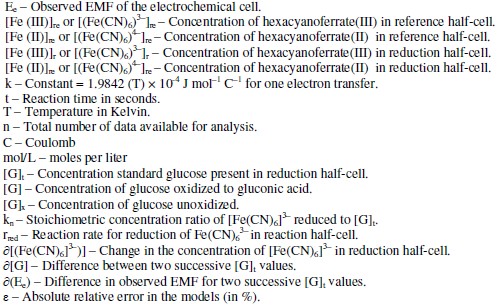
    <p><b>Abbreviations</b></p>

<a name="s1">
<img src="/img/revistas/pea/v30n4/30n4a06s1.jpg">
    
<p>&nbsp;</p>


    <p>&nbsp;</p>
    <p><b>Introduction</b></p>

    <p>Most of the commercially available blood glucose sensors for monitoring 
diabetes are enzyme based and they rely on either amperometric or coulometric 
techniques [1]. Many research works have been reported [2-8] for the designing 
of sensitive, enzymatic, electrochemical glucose sensors using unique materials 
and methods. Present-day, second-generation commercial sensors are converting 
glucose concentration into electrochemical signal indirectly through bio-catalytic 
process followed by electron transfer. The enzymes commonly used are Glucose 
Oxidase (GOx), Glucose Dehydrogenase, etc., and the mediators used are 
ferrocene, ferricyanide, hydroquinone, and certain redox organic compounds [9, 
10]. Development of third generation glucose sensors based on direct wiring of 
electron transfer from enzyme surface to electrode interface using novel 
materials, is still under study towards commercial perspective [4, 9-13]. But it 
should be noted that these enzymes are not only specific to glucose but also to 
other sugars and can be affected by the presence of interferences. And they 
become either partially or completely inactive due to environmental factors such 
as humidity, temperature etc. For instance, Ginsberg [14] pointed out various 
errors associated with these factors. The widely used GOx loses its activity at 
temperatures above 313 K and pH > 8 [15]. On the other hand non-enzymatic 
amperometric or coulometric glucose sensors [16-21] have an advantage that 
direct electron transfer is possible to electrode interface and this enhances the 
sensitivity even in the presence of interferences such as ascorbic acid, dopamine, 
etc. In this regard, very few works on non-enzymatic, potentiometric glucose 
sensors have been studied. From earlier reports [22-24] and references therein, it 
can be known that potentiometric titration method either with or without 
indicators was used for the estimation of sugars. Shoji and Freund [25, 26] have 
suggested a novel methodology using conjugated poly(aniline) and poly(aniline 
boronic acid) for the enzymeless potentiometric detection of saccharides. 
The accuracy of the potentiometric sensor lies on the fact that the observed redox 
potential should absolutely dependent on the glucose concentration and 
independent on oxidant or mediator concentration or reference electrode potential 
or any such factors. So in this study, the cell has been designed in such a way that 
the redox potential is entirely dependent on the glucose concentration and these 
two parameters can be correlated by numerical models to enhance the accuracy. 
It is noted that potassium hexacyanoferrate(III) in mild basic conditions and at 
363 K, acts as an ideal oxidant [23, 27] for glucose to gluconic acid oxidation 
with a standard reduction potential (EÂ°) for the couple [Fe(CN)<sub>6</sub>]<sup>3-</sup>/ [Fe(CN)<sub>6</sub>]<sup>4-</sup>
of 0.3560 V [28]. So this half-cell was chosen to design this potentiometric 
sensor through glucose oxidation. To eliminate errors associated with the redox 
potential of reference half-cell components, a glucose free half-cell ([Fe(CN)<sub>6</sub>]<sup>3-</sup> / 
[Fe(CN)<sub>6</sub>]<sup>4-</sup>) was devised simultaneously during the net EMF measurements. To 
the best of our knowledge, no literature reports are available based on this non-
enzymatic potentiometric approach and the numerical simulations for 
interpolations.</p>


    <p>&nbsp;</p>
    ]]></body>
<body><![CDATA[<p><b>Material and methods</b></p>

    <p>Exactly 5 mL of standard D-glucose solution along with 5 mL of K<sub>3</sub>[Fe(CN)<sub>6</sub>] 
and K<sub>4</sub>[Fe(CN)<sub>6</sub>] (AR grade, Merck) reagent were taken in a 25 mL stoppered 
bottle (Borosilicate glass, Merck, No. 62026500251730). The reagent contains 
K<sub>3</sub>[Fe(CN)<sub>6</sub>] and K<sub>4</sub>[Fe(CN)<sub>6</sub>] at the required concentrations along with 0.5 
mol/L KCl and 0.5 mol/L K<sub>2</sub>CO<sub>3</sub> (AR grade, Merck). Both KCl and K<sub>2</sub>CO<sub>3</sub> 
concentrations were optimized previously. It should be noted from a separate 
study that by the presence of KCl and K<sub>2</sub>CO<sub>3</sub> at these specified concentrations 
(0.5 mol/L) in the reagent (pH about 10.5), the observed EMF was stabilized and 
reproducible. A second reference bottle of same size and shape containing 5 mL 
of demineralized water instead of standard D-glucose solution along with 5 mL 
of the reagent was taken. In all measurements, both reference cell and reaction 
cell have the same reagent solution except that the reaction cell has 5 mL of 
standard D-glucose solution, whereas the reference cell has 5 mL of DM water 
instead of glucose solution. So in the constructed electrochemical cell the 
measured EMF entirely depends on [G] and is independent of other external 
reference half-cell potential or reagent concentration. The solutions in the 
stoppered bottles were mixed thoroughly by mild shaking and both bottles were 
heated simultaneously in a thermostat at about 363 &pm; 1 K for 15 minutes. Then 
the containers were cooled at room temperature for 30 minutes and then kept in a 
thermostat at 303 &pm; 1 K. After attaining thermal equilibrium, the EMF was 
measured at 303 K using the digital potentiometer (Model SYSTRONICS - 318) 
by introducing a platinum electrode in each bottles followed by connecting both 
solutions through salt bridge (agar-agar in 1 M KCl) tube. Concentrations of both 
K<sub>3</sub>Fe(CN)<sub>6</sub> and K<sub>4</sub>Fe(CN)<sub>6</sub> solutions in reference and reduction cells were 
analyzed for the iron content before and after the redox reaction by atomic 
absorption spectra (VARIAN SPECTRAA 220 with graphite tube atomizer). 
Concentration terms are expressed in moles per liter (mol/L) and given in square 
brackets. The cell notation is represented as:</p>

    <p>&nbsp;</p>
<a name="s2">
<img src="/img/revistas/pea/v30n4/30n4a06s2.jpg">
    
<p>&nbsp;</p>

 
    <p>&nbsp;</p>
    <p><b>Results and discussion</b></p>

    <p><b><i>Correlation between glucose concentration and EMF</i></b></p>

    <p>Under ideal reaction conditions, the total amount of glucose [G]<sub>t</sub>, present in the 
reduction half-cell should undergo oxidation into gluconic acid. The completion 
of this reaction depends on many parameters such as concentration of 
[Fe(CN)<sub>6</sub>]<sup>3-</sup> and [Fe(CN)<sub>6</sub>]<sup>4-</sup>, temperature (T), reaction time (t), pH, concentration 
of Cl<sup>-</sup>, CO<sub>3</sub><sup>2-</sup>. Concentration of glucose oxidized, [G] is the only parameter for 
the EMF difference and this should be correlated to [Fe(CN)<sub>6</sub>]<sup>3-</sup> and [Fe(CN)<sub>6</sub>]<sup>4-</sup>. 
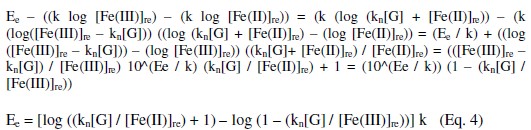
EMF (Ee) of the cell depends on the changes in the concentration of [Fe(CN)<sub>6</sub>]<sup>3-</sup> 
and [Fe(CN)<sub>6</sub>]<sup>4-</sup>,</p>


    <p>&nbsp;</p>
<a name="e1">
<img src="/img/revistas/pea/v30n4/30n4a06e1.jpg">
    
<p>&nbsp;</p>


    ]]></body>
<body><![CDATA[<p>where, 're' and 'r' refer to reference and reduction half-cells, respectively. The 
EMF can be deduced by assuming the following conditions</p>

    <p>&nbsp;</p>
<a name="s3">
<img src="/img/revistas/pea/v30n4/30n4a06s3.jpg">
    
<p>&nbsp;</p>


    <p>The value of the 'k' depends on both temperature as well as number of electrons 
transferred. It is equal to 1.9842 (T) &times; 10<sup>-4</sup> J mol<sup>-1</sup> C<sup>-1</sup> for one electron transfer at 
the given temperature (T).</p>

    <p>Observed EMF (Ec) can also be calculated by treating this as concentration cell 
rather than electrochemical cell at a given temperature.</p>


    <p>&nbsp;</p>
<a name="e2">
<img src="/img/revistas/pea/v30n4/30n4a06e2.jpg">
    
<p>&nbsp;</p>


    <p>And it can be known that Ec should equals to Ee. By treating this as an 
electrochemical cell, it is easier to correlate the reduction potential of the 
reference half-cell to net EMF, rather than treating it as concentration cell, since 
the reference half-cell EMF depends on both [G]<sub>t</sub> and [G] in the latter case. And 
cathodic half-cell emf can be correlated, since anodic half-cell EMF is constant 
and independent of [G]</p>

<img src="/img/revistas/pea/v30n4/30n4a06s4.jpg">

    
<p>The term 'k<sub>re</sub>' is constant and independent of both 't' and [G]<sub>t</sub>, but the value of 
'k<sub>r</sub>' is increased with increased in 't' and [G]<sub>t</sub>.</p>


    <p>&nbsp;</p>
<a name="e3">
<img src="/img/revistas/pea/v30n4/30n4a06e3.jpg">
    
]]></body>
<body><![CDATA[<p>&nbsp;</p>


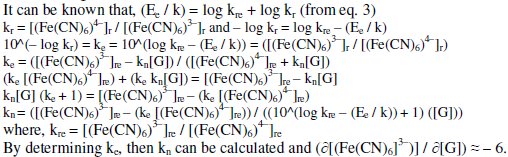
    <p>Stoichiometric ratio between [Fe(CN)<sub>6</sub>]<sup>3-</sup> reduced with respect to [G] is given as 
k<sub>n</sub>.</p>

<img src="/img/revistas/pea/v30n4/30n4a06s5.jpg">

    
<p>Negative sign shows that, the value of [(Fe(CN)<sub>6</sub>]<sup>3-</sup> decreases.</p>

    <p>And [G]<sub>x</sub> = [G]<sub>t</sub> - [G] where [G]<sub>x</sub> is the concentration of glucose not undergoing 
oxidation. The reaction rate for reduction reaction (r<sub>red</sub>) as well as 'k<sub>n</sub>' depends on 
[G]<sub>x</sub>, which in turn depends on initial value of ([Fe(CN)<sub>6</sub>]<sup>3-</sup>)r,when t = 0 or 
([Fe(CN)<sub>6</sub>]<sup>3-</sup>)<sub>re</sub> at any 't' value. 
Thus for higher values of [(Fe(CN)<sub>6</sub>)<sup>3-</sup>]<sub>r</sub> and [G]<sub>x</sub>, 
the reaction rate is also higher, but kn will be increased only for higher 
concentrations of (Fe(CN)<sub>6</sub>]<sup>3-</sup>)<sub>r</sub>.</p>

<img src="/img/revistas/pea/v30n4/30n4a06s6.jpg">

    
<p>From this, <a href="#e3">equation 3</a> can be rewritten as,</p>


    <p>&nbsp;</p>
<a name="e4">
<img src="/img/revistas/pea/v30n4/30n4a06e4.jpg">
    
<p>&nbsp;</p>


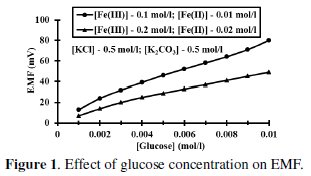
    <p>It can be shown that EMF is directly proportional to [G] as well as 
[Fe(CN)<sub>6</sub>]<sup>4-</sup>]<sub>r</sub>, but inversely proportional to 
[Fe(CN)<sub>6</sub>]<sup>3-</sup>]<sub>r</sub>. The net EMF of the 
cell raises gradually, if [G]<sub>t</sub> is increased due to increase in [Fe(CN)<sub>6</sub><sup>4-</sup>]<sub>r</sub> for a 
given 'k<sub>re</sub>', and under this condition it can be noted that [Fe(CN)<sub>6</sub><sup>4-</sup>]<sub>r</sub> &gt; 
[Fe(CN)<sub>6</sub><sup>4-</sup>]<sub>re</sub> (<a href="#f1">Fig. 1</a>).</p>


    <p>&nbsp;</p>
<a name="f1">
<img src="/img/revistas/pea/v30n4/30n4a06f1.jpg">
    
<p>&nbsp;</p>


    ]]></body>
<body><![CDATA[<p>But the EMF is lowered, if [Fe(CN)<sub>6</sub><sup>3-</sup>] is increased (<a href="#f1">Fig. 1</a>) for the given [G]<sub>t</sub>. If 
[Fe(CN)<sub>6</sub><sup>3-</sup>]<sub>re</sub> is increased, then it leads to raise ([Fe(CN)<sub>6</sub><sup>4-</sup>]<sub>r</sub> / 
[Fe(CN)<sub>6</sub><sup>4-</sup>]r) ratio, 
since the value of [G] is constant but [Fe(CN)<sub>6</sub><sup>3-</sup>]<sub>r</sub> decreases due to increase in 
rred. Hence reduction half-cell EMF can be increased, which in turn lowers 
overall EMF. From theoretical computations and from the ([Fe(CN)<sub>6</sub><sup>3-</sup>]<sub>re</sub> / 
[Fe(CN)<sub>6</sub><sup>4-</sup>]<sub>r</sub>) ratio, the estimated value of kn is about six. If [G]<sub>t</sub> is increased, then 
[Fe(CN)<sub>6</sub><sup>4-</sup>]<sub>r</sub> also gradually increased with 't', due to increase in [G], when 
compared to [Fe(CN)<sub>6</sub><sup>4-</sup>]<sub>re</sub>, and so the term 'kr' is increased in <a href="#e3">equation 3</a>. The Ee 
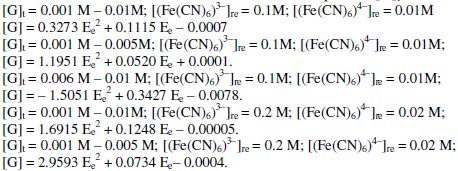
values for the respective [G]<sub>t</sub> values, can be correlated by second degree parabola 
fit, using the following Legendre equations.</p>

<img src="/img/revistas/pea/v30n4/30n4a06s7.jpg">
 
    
<p>where 'i' refers 1, 2, 3&hellip;n values and k1, k2, 
k3 are the corresponding coefficient values, which can be determined through 
iterations.</p>

<img src="/img/revistas/pea/v30n4/30n4a06s8.jpg">

    
<p>By the principle of least squares, the value of 'R' should be minimum.</p>


    <p>&nbsp;</p>
<a name="e5">
<img src="/img/revistas/pea/v30n4/30n4a06e5.jpg">
    
<p>&nbsp;</p>
<a name="e6">
<img src="/img/revistas/pea/v30n4/30n4a06e6.jpg">
    
<p>&nbsp;</p>
<a name="e7">
<img src="/img/revistas/pea/v30n4/30n4a06e7.jpg">
    
<p>&nbsp;</p>


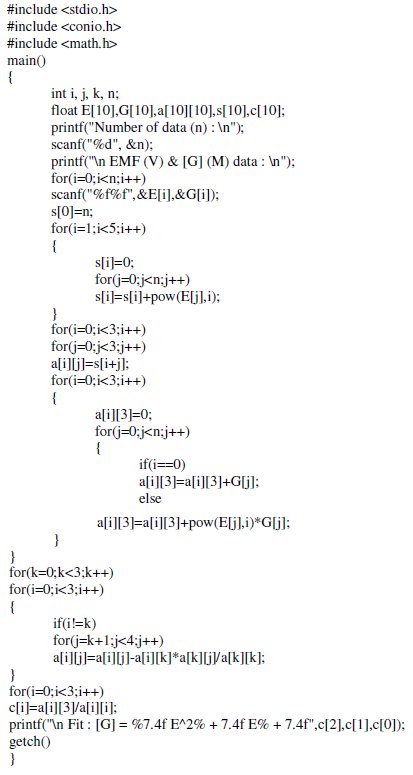
    <p>By solving these normal equations <a href="#e5">5</a>, <a href="#e6">6</a> and <a href="#e7">7</a>, after evaluating the coefficients k1, 
k2 and k3, three individual II order polynomial equations in terms of EMF can be 
obtained. For a given range of Ee and [G]<sub>t</sub> the coefficients can be calculated 
through iteration methods. Values of k1, k2 and k3 depend on both [(Fe(CN)<sub>6</sub>)<sup>3-</sup>]<sub>re</sub> 
as well as [G]<sub>t</sub>. For narrow ranges of 'E' values and within that, for larger values 
of 'n', the deviation can be minimized for the interpolated [G]<sub>t</sub>.</p>

<img src="/img/revistas/pea/v30n4/30n4a06s9.jpg">

    
<p>The coefficients in these II order polynomial equations can be evaluated using 
iteration techniques and it can be executed through the following computer 
programing codes in 'Turbo C v.2.01'(Borland International, Inc.).</p>


    <p>&nbsp;</p>
<a name="p1">
<img src="/img/revistas/pea/v30n4/30n4a06p1.jpg">
    
]]></body>
<body><![CDATA[<p>&nbsp;</p>


    <p>&nbsp;</p>
    <p><b><i>Interpolation of cell EMF to glucose concentration</i></b></p>

    <p>[G] can be interpolated for the measured EMF (E), based on the standard [G]<sub>t</sub> 
values and their corresponding observed 'Ee' values. Lagrange's interpolation 
model was adopted for this, since it has an advantage that it can be applied for 
any unequal intervals of 'Ee' and its respective [G]<sub>t</sub> data. Let ([G])<sub>1</sub>, ([G])<sub>2</sub>, 
([G])<sub>3</sub>, &hellip;([G])<sub>n</sub> are the values of oxidized glucose concentration for the given 
([(Fe(CN)<sub>6</sub>)<sup>3-</sup>]<sub>re</sub> / [(Fe(CN)<sub>6</sub>)<sup>4-</sup>]<sub>re</sub>) ratio, and the pertinent EMF values are E1, E2, 
E3, &hellip; and En. It should be noted that either '[G]<sub>t</sub>' or 'E' values are not 
necessarily at equal intervals. Since 'n' values for f(E) are measured, we can 
assume f(E) to be a polynomial degree (n-1).</p>


    <p>&nbsp;</p>
<a name="e8">
<img src="/img/revistas/pea/v30n4/30n4a06e8.jpg">
    
<p>&nbsp;</p>


    <p>where 'E' is the measured EMF for which '[G]' should be interpolated.</p>

    <p>When E = E1 then</p>
    <p>([G])1 = &Phi;1 (E1-E2) (E1-E3) (E1-E4)&hellip; (E1-En)</p>

    <p>&Phi;1 = ([G])1 / [(E1-E2) (E1-E3) (E1-E4)&hellip; (E1-En)]</p>

    ]]></body>
<body><![CDATA[<p>If E = E2 then</p>
    <p>([G])2 = &Phi;2 (E2-E1) (E2-E3) (E2-E4)&hellip; (E2-En)</p>
    <p>&Phi;2 = ([G])2 / [(E2-E1) (E2-E3) (E2-E4)&hellip; (E2-En)]</p>

    <p>Similarly,</p>
    <p>&Phi;3 = ([G])3 / [(E3-E1) (E3-E2) (E3-E4)&hellip; (E3-En)] </p>
    <p>&hellip; </p>
    <p>&Phi;n = ([G])n / [(En-E1) (En-E2) (En-E3)&hellip; (En-E n-1)]</p>

    <p>Using the values of &Phi;1, &Phi;2, &Phi;3, &hellip; &Phi;n for solving <a href="#e8">equation 8</a> then,</p>


    <p>&nbsp;</p>
<a name="e9">
<img src="/img/revistas/pea/v30n4/30n4a06e9.jpg">
    
<p>&nbsp;</p>


    ]]></body>
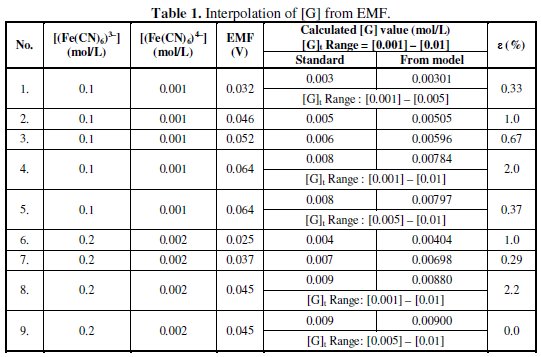
<body><![CDATA[<p><a href="#t1">Table 1</a> summarizes the computed results by using this Lagrange model and the 
absolute relative error in percentage (&epsilon;).</p>


    <p>&nbsp;</p>
<a name="t1">
<img src="/img/revistas/pea/v30n4/30n4a06t1.jpg">
    
<p>&nbsp;</p>


    <p>In these interpolations the EMF data and 
its respective standard [G]<sub>t</sub> value to be calculated is not used in the computation 
and is used to analyze the deviation. For every given set of [G]<sub>t</sub> and EMF data, 
Lagrange coefficients should be calculated through <a href="#e9">eq. 9</a>. The deviation in the 
interpolated results may be due to errors associated with the model and / or 
measured Ee value. The experimental errors may be associated with the degree of 
completion of reaction and auto oxidation of (Fe(CN)<sub>6</sub>)<sup>4-</sup> or auto reduction of 
(Fe(CN)<sub>6</sub>)<sup>3-</sup> or due to the presence of any interferences that can contribute EMF 
for reduction.</p> 

    <p>From the experimental observations it was noted that Ee = 0.0 V, in the absence 
of glucose, ([G]<sub>t</sub> = 0.0 mol/l) in the reduction half-cell, since its potential equals 
to reduction potential of reference half-cell. So the possibility of error due to auto 
oxidation or auto reduction of the reagent in both half-cells under the 
experimental conditions can cancel each other and hence ruled out. It should be 
noted that for larger 'n' values and for narrow ranges of Ee values the observed 
deviation in the interpolated [G] values using the model would be minimum. 
Errors can also be eliminated by selecting the measured EMF for interpolation as, 
E &asymp; {(Ee)max.-(Ee)min) / 2}(<a href="#t1">Table 1</a>). In these studies, [(Fe(CN)<sub>6</sub>)<sup>3-</sup>], [(Fe(CN)<sub>6</sub>)4-], 
[KCl] and [K<sub>2</sub>CO<sub>3</sub>] values can influence the [G] which in turn influences Ee, so 
these parameters should be taken into correlation while designing the 
mathematical models.</p> 

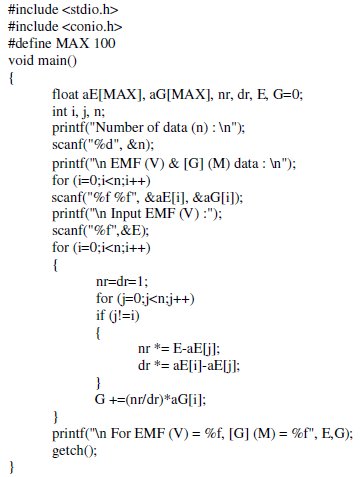
    <p>Following 'Turbo C v.2.01' (Borland International, Inc.) computer programming 
code was used to compute Lagrange's coefficients easily for the given EMF 
value, for another interpolation of [G]<sub>t</sub> data.</p>


    <p>&nbsp;</p>
<a name="p2">
<img src="/img/revistas/pea/v30n4/30n4a06p2.jpg">
    
<p>&nbsp;</p>


    <p>By this same algorithms, a MATLAB based computational programs, 
'POLYNOM' and 'LEGENDRE' was designed by the authors [29], which can 
be linked to Excel data for faster and precise numerical interpolations for higher 
(nth) order polynomial.</p>


    <p><b><i>Effect of [(Fe(CN)<sub>6</sub>)<sup>3-</sup>] / [(Fe(CN)<sub>6</sub>)4-] ration</i></b></p>

    ]]></body>
<body><![CDATA[<p>Concentration of (Fe(CN)<sub>6</sub>)<sup>3-</sup> was increased with reference to [(Fe(CN)<sub>6</sub>)<sup>4-</sup>] at 
0.01 mol/L and the ratio [(Fe(CN)<sub>6</sub>)<sup>3-</sup>] / [(Fe(CN)<sub>6</sub>)4-] was varied at [G]<sub>t</sub> = 0.005 
mol/L, [KCl] = 0.5 mol/L and [K<sub>2</sub>CO<sub>3</sub>] = 0.5 mol/L (<a href="#f1">Fig. 1</a>). If the number of 
moles of [(Fe(CN)<sub>6</sub>)<sup>3-</sup>]<sub>re</sub> is increased, then it leads to enhance [(Fe(CN)<sub>6</sub>)<sup>4-</sup>]<sub>r</sub>, 
which in turn lowers the ([(Fe(CN)<sub>6</sub>)<sup>4-</sup>]<sub>re</sub> / [(Fe(CN)<sub>6</sub>)<sup>4-</sup>]<sub>r</sub>) ratio as well as EMF.</p>

    <p>So the value of 'kr' is continuously decreased and becomes far less than 'k<sub>re</sub>'. But 
[G]<sub>t</sub> is constant for all the variations of [(Fe(CN)<sub>6</sub>)<sup>3-</sup>]<sub>re</sub> values, and so the 
[(Fe(CN)<sub>6</sub>)<sup>4-</sup>]<sub>r</sub> is also nearly constant for these variations, though [(Fe(CN)<sub>6</sub>)<sup>3-</sup>]<sub>r</sub> &gt;  
[(Fe(CN)<sub>6</sub>)<sup>4-</sup>]r. And hence the ratio ([(Fe(CN)<sub>6</sub>)<sup>3-</sup>]<sub>r</sub> / [(Fe(CN)<sub>6</sub>)<sup>4-</sup>]r) decreases 
significantly when compared to ([(Fe(CN)<sub>6</sub>)<sup>3-</sup>]<sub>re</sub> / [(Fe(CN)<sub>6</sub>)<sup>4-</sup>]<sub>re</sub>). When rred is 
lower due to experimental conditions such as temperature or pH, then [G]<sub>x</sub> will 
be higher and this also happens when the value of [(Fe(CN)<sub>6</sub>)<sup>3-</sup>]<sub>r</sub> is very low. So 
it can be noted that rred mainly influenced by [(Fe(CN)<sub>6</sub>)<sup>3-</sup>]<sub>r</sub> followed by [G]<sub>t</sub>. For 
a blood glucose concentration [G]<sub>t</sub>, of 0.006 mol/L, (&asymp; 110 mg/dL) about 0.04 
mol/L (Fe(CN)<sub>6</sub>)<sup>3-</sup> is oxidized and (Fe(CN)<sub>6</sub>)<sup>4-</sup> concentration almost equals to 
(Fe(CN)<sub>6</sub>)<sup>3-</sup>, (&asymp; 0.05 mol/L) at [(Fe(CN)<sub>6</sub>)<sup>3-</sup>]<sub>re</sub> = 0.1 mol/L and [(Fe(CN)<sub>6</sub>)<sup>4-</sup>]<sub>re</sub> = 
0.01 mol/L. For higher (Fe(CN)<sub>6</sub>)<sup>3-</sup> concentrations, &#8706;(Ee) for two successive [G]<sub>t</sub> 
values, becomes small and this leads to enhance the deviation in the computed 
[G]<sub>t</sub> values. Due to this reason higher concentrations of (Fe(CN)<sub>6</sub>)<sup>3-</sup> should not be 
preferred if [G]<sub>t</sub> is substantially low.</p>
 
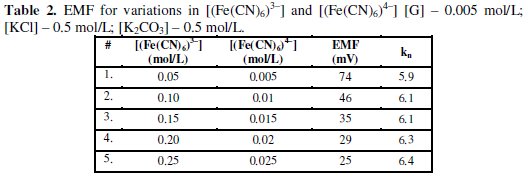
    <p><a href="#t2">Table 2</a> shows the observed EMF values for the variation in [(Fe(CN)<sub>6</sub>)<sup>3-</sup>] and 
[(Fe(CN)<sub>6</sub>)4-] values. It can be noted that kn values are increased gradually but 
reduction half-cell EMF decreased significantly, if [(Fe(CN)<sub>6</sub>)<sup>3-</sup>] values are 
increased. This shows that if [(Fe(CN)<sub>6</sub>)<sup>3-</sup>]<sub>r</sub> is increased then it leads to decrease 
both [G]<sub>x</sub> and 't', but can increase [(Fe(CN)<sub>6</sub>)<sup>4-</sup>]<sub>r</sub> significantly when compared to 
[(Fe(CN)<sub>6</sub>)<sup>4-</sup>]<sub>re</sub>. If both [G]<sub>t</sub> and [(Fe(CN)<sub>6</sub>)<sup>3-</sup>]<sub>r</sub> are higher it can leads to, 
[(Fe(CN)<sub>6</sub>)<sup>4-</sup>]<sub>r</sub> > [(Fe(CN)<sub>6</sub>)<sup>3-</sup>]<sub>r</sub> and [(Fe(CN)<sub>6</sub>)<sup>4-</sup>]<sub>r</sub> &#8810; [(Fe(CN)<sub>6</sub>)<sup>4-</sup>]<sub>re</sub>.</p>
    <p>&nbsp;</p>
<a name="t2">
<img src="/img/revistas/pea/v30n4/30n4a06t2.jpg">
    
<p>&nbsp;</p>

    <p><b><i>Determination of kn from EMF values</i></b></p>

    <p>The stoichiometric ratio 'kn' between [(Fe(CN)<sub>6</sub>)<sup>3-</sup>]<sub>r</sub> reduced to that of [G] can be 
used to predict the degree of completion of the reaction. The value of rred mainly 
depends on T, pH, t, [(Fe(CN)<sub>6</sub>)<sup>3-</sup>]<sub>r</sub>. For higher [(Fe(CN)<sub>6</sub>)<sup>3-</sup>]<sub>re</sub> values, 'kn' can 
also be higher for a given [G]<sub>t</sub> and it can vary between about 5.5 - 6.5. Similarly, 
if [G]<sub>t</sub> is increased, then [(Fe(CN)<sub>6</sub>)<sup>4-</sup>]<sub>r</sub> formed is also increased for the given 
[(Fe(CN)<sub>6</sub>)<sup>3-</sup>]<sub>re</sub> and this also leads to increase the 'kn' value. But it was noted that 
'kn' was increased significantly with increase in [(Fe(CN)<sub>6</sub>)<sup>3-</sup>]<sub>r</sub> with lowering of 
Ee rather than increase in [G]<sub>t</sub>. This confirms that more amount of [(Fe(CN)<sub>6</sub>)<sup>3-</sup>]<sub>r</sub> 
molecules are reduced per gluconic acid formed and it can be estimated through 
the following relations:</p> 

<img src="/img/revistas/pea/v30n4/30n4a06s10.jpg">


<p><b><i>Limitations</i></b></p>

    <p>This methodology uses simple cell design and modeling for correlation, but can 
be a viable supporting technique to sense the glucose concentration. At the same 
time (Fe(CN)<sub>6</sub>]<sup>3-</sup>) is not a specific oxidant for D-glucose alone and if other 
interferences that can reduce (Fe(CN)<sub>6</sub>]<sup>3-</sup>) are present, it can reduce the accuracy 
of the measurement. So to reduce the deviation, relatively specific oxidant should 
be chosen or the interferences should be masked and appropriate correction 
factors should be included in the models. Specific mathematical models should 
be developed for a given range of data to enhance the accuracy, or higher (nth) 
order polynomial equations should be derived to reduce the regression and the 
coefficients should be estimated precisely through iteration methods. Larger 'n' 
and narrow range of Ee data should be chosen to eliminate the deviations in 
Lagrange model. Further experimental studies are on the way by the authors, 
using blood samples and to discern the effect of other interfering factors such as 
ascorbic acid, fructose on 'Ee'.</p>


    <p>&nbsp;</p>
    ]]></body>
<body><![CDATA[<p><b>Conclusions</b></p>

    <p>The potential difference between reference and reduction half-cells can be 
correlated to concentration of the glucose oxidized, though the reduction 
potential of both half-cells becomes equal in the absence of glucose. Through the 
models it can be shown that, if the concentration of (Fe(CN)<sub>6</sub>)<sup>3-</sup> is increased, then 
the amount of glucose oxidized is also increased and the number of (Fe(CN)<sub>6</sub>)<sup>4-</sup> 
molecules formed per glucose molecule will be high, which leads to lower the 
cell EMF. If the glucose concentration is increased, then the concentration of 
(Fe(CN)<sub>6</sub>)<sup>4-</sup> in reduction half-cell is increased, which enhances the potential 
difference. From Legendre polynomials and Lagrange models, the glucose 
concentration could be interpolated from the measured EMF. Boundary 
conditions were evaluated to reduce the deviation. Numerical simulations, 
Legendre polynomials and Lagrange coefficients iterations can be executed 
through computer programs. The designed sensor model is a novel and viable 
supporting tool for glucose sensing mechanism.</p>


    <p>&nbsp;</p>
    <p><b>References</b></p>

    <!-- ref --><p>1. Newman JD, Turner APF. Biosens Bioelectron. 2005;20(12):2435-2453.    &nbsp;&nbsp;&nbsp;&nbsp;&nbsp;&nbsp;&nbsp;&nbsp;[&#160;<a href="javascript:void(0);" onclick="javascript: window.open('/scielo.php?script=sci_nlinks&ref=000107&pid=S0872-1904201200040000600001&lng=','','width=640,height=500,resizable=yes,scrollbars=1,menubar=yes,');">Links</a>&#160;]<!-- end-ref --></p>
    <p>2. Zhang F-F, Wan Q, Wang X-L, Sun Z-D, Zhu Z-Q, Xian Y-Z, Jin L-T, Yamamoto K. J Electroanal Chem. 2004;571(2):133-138.</p>
    <!-- ref --><p>3. Bakker E. Anal Chem. 2004;76(12):3285-3298.    &nbsp;&nbsp;&nbsp;&nbsp;&nbsp;&nbsp;&nbsp;&nbsp;[&#160;<a href="javascript:void(0);" onclick="javascript: window.open('/scielo.php?script=sci_nlinks&ref=000110&pid=S0872-1904201200040000600003&lng=','','width=640,height=500,resizable=yes,scrollbars=1,menubar=yes,');">Links</a>&#160;]<!-- end-ref --></p>
    <p>4. Wang Jo. Chem Rev. 2008;108(2):814-825.</p>
    ]]></body>
<body><![CDATA[<!-- ref --><p>5. Kim Y, Malliaras GG, Ober CK, Kim E. J Nanosc Nanotechnol. 2010;10(10):6869-6873.    &nbsp;&nbsp;&nbsp;&nbsp;&nbsp;&nbsp;&nbsp;&nbsp;[&#160;<a href="javascript:void(0);" onclick="javascript: window.open('/scielo.php?script=sci_nlinks&ref=000113&pid=S0872-1904201200040000600005&lng=','','width=640,height=500,resizable=yes,scrollbars=1,menubar=yes,');">Links</a>&#160;]<!-- end-ref --></p>
    <!-- ref --><p>6. Harper A, Anderson MR. Sensors. 2010;10:8248-8274.    &nbsp;&nbsp;&nbsp;&nbsp;&nbsp;&nbsp;&nbsp;&nbsp;[&#160;<a href="javascript:void(0);" onclick="javascript: window.open('/scielo.php?script=sci_nlinks&ref=000115&pid=S0872-1904201200040000600006&lng=','','width=640,height=500,resizable=yes,scrollbars=1,menubar=yes,');">Links</a>&#160;]<!-- end-ref --></p>
    <p>7. Vaddiraju S, Legassey A, Wang Y, Qiang L, Burgess DJ, Jain F, Papadimitrakopoulos F. J Diabetes Sci Technol. 2011;5(5):1044-1051.</p>
    <!-- ref --><p>8. Liu Q, Nayfeh MH, Yau S-T. J Electroanal Chem. 2011;657(1-2):172-175.    &nbsp;&nbsp;&nbsp;&nbsp;&nbsp;&nbsp;&nbsp;&nbsp;[&#160;<a href="javascript:void(0);" onclick="javascript: window.open('/scielo.php?script=sci_nlinks&ref=000118&pid=S0872-1904201200040000600008&lng=','','width=640,height=500,resizable=yes,scrollbars=1,menubar=yes,');">Links</a>&#160;]<!-- end-ref --></p>
    <!-- ref --><p>9. Wang J. Electroanal. 2001;13(12):983-988.    &nbsp;&nbsp;&nbsp;&nbsp;&nbsp;&nbsp;&nbsp;&nbsp;[&#160;<a href="javascript:void(0);" onclick="javascript: window.open('/scielo.php?script=sci_nlinks&ref=000120&pid=S0872-1904201200040000600009&lng=','','width=640,height=500,resizable=yes,scrollbars=1,menubar=yes,');">Links</a>&#160;]<!-- end-ref --></p>
    <!-- ref --><p>10. Heller A, Feldman B. Chem Rev. 2008;108(7):2482-2505.    &nbsp;&nbsp;&nbsp;&nbsp;&nbsp;&nbsp;&nbsp;&nbsp;[&#160;<a href="javascript:void(0);" onclick="javascript: window.open('/scielo.php?script=sci_nlinks&ref=000122&pid=S0872-1904201200040000600010&lng=','','width=640,height=500,resizable=yes,scrollbars=1,menubar=yes,');">Links</a>&#160;]<!-- end-ref --></p>
    <!-- ref --><p>11. Yoo E-H, Lee S-Y. Sensors. 2010;10:4558-4576.    &nbsp;&nbsp;&nbsp;&nbsp;&nbsp;&nbsp;&nbsp;&nbsp;[&#160;<a href="javascript:void(0);" onclick="javascript: window.open('/scielo.php?script=sci_nlinks&ref=000124&pid=S0872-1904201200040000600011&lng=','','width=640,height=500,resizable=yes,scrollbars=1,menubar=yes,');">Links</a>&#160;]<!-- end-ref --></p>
    <!-- ref --><p>12. Ronkainen NJ, Halsall HB, Heineman WR. Chem Soc Rev. 2010;39(5):1747-1763.    &nbsp;&nbsp;&nbsp;&nbsp;&nbsp;&nbsp;&nbsp;&nbsp;[&#160;<a href="javascript:void(0);" onclick="javascript: window.open('/scielo.php?script=sci_nlinks&ref=000126&pid=S0872-1904201200040000600012&lng=','','width=640,height=500,resizable=yes,scrollbars=1,menubar=yes,');">Links</a>&#160;]<!-- end-ref --></p>
    <!-- ref --><p>13. Zhang H, Meng Z, Wang Q, Zheng J. Sens. Actuators B. 2011;158(1):2327.    &nbsp;&nbsp;&nbsp;&nbsp;&nbsp;&nbsp;&nbsp;&nbsp;[&#160;<a href="javascript:void(0);" onclick="javascript: window.open('/scielo.php?script=sci_nlinks&ref=000128&pid=S0872-1904201200040000600013&lng=','','width=640,height=500,resizable=yes,scrollbars=1,menubar=yes,');">Links</a>&#160;]<!-- end-ref --></p>
    <!-- ref --><p>14. Ginsberg BH. J Diabetes Sci Technol. 2009;3(4):903-913.    &nbsp;&nbsp;&nbsp;&nbsp;&nbsp;&nbsp;&nbsp;&nbsp;[&#160;<a href="javascript:void(0);" onclick="javascript: window.open('/scielo.php?script=sci_nlinks&ref=000130&pid=S0872-1904201200040000600014&lng=','','width=640,height=500,resizable=yes,scrollbars=1,menubar=yes,');">Links</a>&#160;]<!-- end-ref --></p>
    <!-- ref --><p>15. Wilson R, Turner APF. Biosens Bioelectron. 1992;7(3):165-185.    &nbsp;&nbsp;&nbsp;&nbsp;&nbsp;&nbsp;&nbsp;&nbsp;[&#160;<a href="javascript:void(0);" onclick="javascript: window.open('/scielo.php?script=sci_nlinks&ref=000132&pid=S0872-1904201200040000600015&lng=','','width=640,height=500,resizable=yes,scrollbars=1,menubar=yes,');">Links</a>&#160;]<!-- end-ref --></p>
    <!-- ref --><p>16. Gorski W, Kennedy RT. J Electroanal Chem. 1997;424(1-2):43-48.    &nbsp;&nbsp;&nbsp;&nbsp;&nbsp;&nbsp;&nbsp;&nbsp;[&#160;<a href="javascript:void(0);" onclick="javascript: window.open('/scielo.php?script=sci_nlinks&ref=000134&pid=S0872-1904201200040000600016&lng=','','width=640,height=500,resizable=yes,scrollbars=1,menubar=yes,');">Links</a>&#160;]<!-- end-ref --></p>
    <!-- ref --><p>17. Park S, Boo H, Chung TD. Anal Chim Acta. 2006;556:46-57.    &nbsp;&nbsp;&nbsp;&nbsp;&nbsp;&nbsp;&nbsp;&nbsp;[&#160;<a href="javascript:void(0);" onclick="javascript: window.open('/scielo.php?script=sci_nlinks&ref=000136&pid=S0872-1904201200040000600017&lng=','','width=640,height=500,resizable=yes,scrollbars=1,menubar=yes,');">Links</a>&#160;]<!-- end-ref --></p>
    <p>18. Kang X, Mai Z, Zou X, Cai P, Mo J. Anal Biochem. 2007;363(1):143-150.</p>
    <!-- ref --><p>19. Wang J, Thomas DF, Chen A. Anal Chem. 2008;80(4):997-1004.    &nbsp;&nbsp;&nbsp;&nbsp;&nbsp;&nbsp;&nbsp;&nbsp;[&#160;<a href="javascript:void(0);" onclick="javascript: window.open('/scielo.php?script=sci_nlinks&ref=000139&pid=S0872-1904201200040000600019&lng=','','width=640,height=500,resizable=yes,scrollbars=1,menubar=yes,');">Links</a>&#160;]<!-- end-ref --></p>
    <p>20. Zhuang Z, Su X, Yuan H, Sun Q, Xiao D, Choi MMF. Analyst. 2008;133:126-132.</p>
    <!-- ref --><p>21. Xia C, Ning W. Electrochem Commun. 2010;12(11):1581-1584.    &nbsp;&nbsp;&nbsp;&nbsp;&nbsp;&nbsp;&nbsp;&nbsp;[&#160;<a href="javascript:void(0);" onclick="javascript: window.open('/scielo.php?script=sci_nlinks&ref=000142&pid=S0872-1904201200040000600021&lng=','','width=640,height=500,resizable=yes,scrollbars=1,menubar=yes,');">Links</a>&#160;]<!-- end-ref --></p>
    <!-- ref --><p>22. Britton HTS, Phillips L. Analyst. 1940;65(766):18-24.    &nbsp;&nbsp;&nbsp;&nbsp;&nbsp;&nbsp;&nbsp;&nbsp;[&#160;<a href="javascript:void(0);" onclick="javascript: window.open('/scielo.php?script=sci_nlinks&ref=000144&pid=S0872-1904201200040000600022&lng=','','width=640,height=500,resizable=yes,scrollbars=1,menubar=yes,');">Links</a>&#160;]<!-- end-ref --></p>
    <!-- ref --><p>23. Britton HTS, Phillips L. Analyst. 1940;65 (768):149-152.    &nbsp;&nbsp;&nbsp;&nbsp;&nbsp;&nbsp;&nbsp;&nbsp;[&#160;<a href="javascript:void(0);" onclick="javascript: window.open('/scielo.php?script=sci_nlinks&ref=000146&pid=S0872-1904201200040000600023&lng=','','width=640,height=500,resizable=yes,scrollbars=1,menubar=yes,');">Links</a>&#160;]<!-- end-ref --></p>
    <!-- ref --><p>24. Humoller FL. J Biol Chem. 1943;147:281-290.    &nbsp;&nbsp;&nbsp;&nbsp;&nbsp;&nbsp;&nbsp;&nbsp;[&#160;<a href="javascript:void(0);" onclick="javascript: window.open('/scielo.php?script=sci_nlinks&ref=000148&pid=S0872-1904201200040000600024&lng=','','width=640,height=500,resizable=yes,scrollbars=1,menubar=yes,');">Links</a>&#160;]<!-- end-ref --></p>
    <!-- ref --><p>25. Shoji E, Freund MS. J Am Chem Soc. 2001;123(14):3383-3384.    &nbsp;&nbsp;&nbsp;&nbsp;&nbsp;&nbsp;&nbsp;&nbsp;[&#160;<a href="javascript:void(0);" onclick="javascript: window.open('/scielo.php?script=sci_nlinks&ref=000150&pid=S0872-1904201200040000600025&lng=','','width=640,height=500,resizable=yes,scrollbars=1,menubar=yes,');">Links</a>&#160;]<!-- end-ref --></p>
    <!-- ref --><p>26. Shoji E, Freund MS. J Am Chem Soc. 2002;124(42):12486-12493.    &nbsp;&nbsp;&nbsp;&nbsp;&nbsp;&nbsp;&nbsp;&nbsp;[&#160;<a href="javascript:void(0);" onclick="javascript: window.open('/scielo.php?script=sci_nlinks&ref=000152&pid=S0872-1904201200040000600026&lng=','','width=640,height=500,resizable=yes,scrollbars=1,menubar=yes,');">Links</a>&#160;]<!-- end-ref --></p>
    <!-- ref --><p>27. Friedemann TE, Weber CW, Witt NF. Anal Biochem. 1962;4(5):358-377.    &nbsp;&nbsp;&nbsp;&nbsp;&nbsp;&nbsp;&nbsp;&nbsp;[&#160;<a href="javascript:void(0);" onclick="javascript: window.open('/scielo.php?script=sci_nlinks&ref=000154&pid=S0872-1904201200040000600027&lng=','','width=640,height=500,resizable=yes,scrollbars=1,menubar=yes,');">Links</a>&#160;]<!-- end-ref --></p>
    <p>28. BR Sant, SB. Sant Talanta. 1960;3(3):261-271.</p>
    <!-- ref --><p>29. Kanagasabapathy M. Technical computations by MATLAB (Online). <a href="http://techmatlab.blogspot.in/" target="_blank">http://techmatlab.blogspot.in/</a>&nbsp;&nbsp;&nbsp;&nbsp;&nbsp;&nbsp;&nbsp;&nbsp;[&#160;<a href="javascript:void(0);" onclick="javascript: window.open('/scielo.php?script=sci_nlinks&ref=000157&pid=S0872-1904201200040000600029&lng=','','width=640,height=500,resizable=yes,scrollbars=1,menubar=yes,');">Links</a>&#160;]<!-- end-ref --><p>&nbsp;</p>
    <p><a name=0></a><sup><a href="#top">*</a></sup>Corresponding author. E-mail address: <a href="mailto:rrcmks@gmail.com">rrcmks@gmail.com</a></p>

    <p>Received 3 May 2012; accepted 31 August 2012</p>

    <p><a href="http://www.peacta.org" target="_blank">www.peacta.org</a> </p>


     ]]></body>
<back>
<ref-list>
<ref id="B1">
<label>1</label><nlm-citation citation-type="journal">
<person-group person-group-type="author">
<name>
<surname><![CDATA[Newman]]></surname>
<given-names><![CDATA[JD]]></given-names>
</name>
<name>
<surname><![CDATA[Turner]]></surname>
<given-names><![CDATA[APF]]></given-names>
</name>
</person-group>
<source><![CDATA[Biosens Bioelectron]]></source>
<year>2005</year>
<volume>20</volume>
<numero>12</numero>
<issue>12</issue>
<page-range>2435-2453</page-range></nlm-citation>
</ref>
<ref id="B2">
<label>2</label><nlm-citation citation-type="journal">
<person-group person-group-type="author">
<name>
<surname><![CDATA[Zhang]]></surname>
<given-names><![CDATA[F-F]]></given-names>
</name>
<name>
<surname><![CDATA[Wan]]></surname>
<given-names><![CDATA[Q]]></given-names>
</name>
<name>
<surname><![CDATA[Wang]]></surname>
<given-names><![CDATA[X-L]]></given-names>
</name>
</person-group>
<source><![CDATA[J Electroanal Chem]]></source>
<year>2004</year>
<volume>571</volume>
<numero>2</numero>
<issue>2</issue>
<page-range>133-138</page-range></nlm-citation>
</ref>
<ref id="B3">
<label>3</label><nlm-citation citation-type="journal">
<person-group person-group-type="author">
<name>
<surname><![CDATA[Bakker]]></surname>
<given-names><![CDATA[E]]></given-names>
</name>
</person-group>
<source><![CDATA[Anal Chem]]></source>
<year>2004</year>
<volume>76</volume>
<numero>12</numero>
<issue>12</issue>
<page-range>3285-3298</page-range></nlm-citation>
</ref>
<ref id="B4">
<label>4</label><nlm-citation citation-type="journal">
<person-group person-group-type="author">
<name>
<surname><![CDATA[Wang]]></surname>
<given-names><![CDATA[J]]></given-names>
</name>
</person-group>
<source><![CDATA[Chem Rev]]></source>
<year>2008</year>
<volume>108</volume>
<numero>2</numero>
<issue>2</issue>
<page-range>814-825</page-range></nlm-citation>
</ref>
<ref id="B5">
<label>5</label><nlm-citation citation-type="journal">
<person-group person-group-type="author">
<name>
<surname><![CDATA[Kim]]></surname>
<given-names><![CDATA[Y]]></given-names>
</name>
<name>
<surname><![CDATA[Malliaras]]></surname>
<given-names><![CDATA[GG]]></given-names>
</name>
<name>
<surname><![CDATA[Ober]]></surname>
<given-names><![CDATA[CK]]></given-names>
</name>
<name>
<surname><![CDATA[Kim]]></surname>
<given-names><![CDATA[E]]></given-names>
</name>
</person-group>
<source><![CDATA[J Nanosc Nanotechnol]]></source>
<year>2010</year>
<volume>10</volume>
<numero>10</numero>
<issue>10</issue>
<page-range>6869-6873</page-range></nlm-citation>
</ref>
<ref id="B6">
<label>6</label><nlm-citation citation-type="journal">
<person-group person-group-type="author">
<name>
<surname><![CDATA[Harper]]></surname>
<given-names><![CDATA[A]]></given-names>
</name>
<name>
<surname><![CDATA[Anderson]]></surname>
<given-names><![CDATA[MR]]></given-names>
</name>
</person-group>
<source><![CDATA[Sensors]]></source>
<year>2010</year>
<volume>10</volume>
<page-range>8248-8274</page-range></nlm-citation>
</ref>
<ref id="B7">
<label>7</label><nlm-citation citation-type="journal">
<person-group person-group-type="author">
<name>
<surname><![CDATA[Vaddiraju]]></surname>
<given-names><![CDATA[S]]></given-names>
</name>
<name>
<surname><![CDATA[Legassey]]></surname>
<given-names><![CDATA[A]]></given-names>
</name>
<name>
<surname><![CDATA[Wang]]></surname>
<given-names><![CDATA[Y]]></given-names>
</name>
</person-group>
<source><![CDATA[J Diabetes Sci Technol]]></source>
<year>2011</year>
<volume>5</volume>
<numero>5</numero>
<issue>5</issue>
<page-range>1044-1051</page-range></nlm-citation>
</ref>
<ref id="B8">
<label>8</label><nlm-citation citation-type="journal">
<person-group person-group-type="author">
<name>
<surname><![CDATA[Liu]]></surname>
<given-names><![CDATA[Q]]></given-names>
</name>
<name>
<surname><![CDATA[Nayfeh]]></surname>
<given-names><![CDATA[MH]]></given-names>
</name>
<name>
<surname><![CDATA[Yau]]></surname>
<given-names><![CDATA[S-T]]></given-names>
</name>
</person-group>
<source><![CDATA[J Electroanal Chem]]></source>
<year>2011</year>
<volume>657</volume>
<numero>1-2</numero>
<issue>1-2</issue>
<page-range>172-175</page-range></nlm-citation>
</ref>
<ref id="B9">
<label>9</label><nlm-citation citation-type="journal">
<person-group person-group-type="author">
<name>
<surname><![CDATA[Wang]]></surname>
<given-names><![CDATA[J]]></given-names>
</name>
</person-group>
<source><![CDATA[Electroanal]]></source>
<year>2001</year>
<volume>13</volume>
<numero>12</numero>
<issue>12</issue>
<page-range>983-988</page-range></nlm-citation>
</ref>
<ref id="B10">
<label>10</label><nlm-citation citation-type="journal">
<person-group person-group-type="author">
<name>
<surname><![CDATA[Heller]]></surname>
<given-names><![CDATA[A]]></given-names>
</name>
<name>
<surname><![CDATA[Feldman]]></surname>
<given-names><![CDATA[B]]></given-names>
</name>
</person-group>
<source><![CDATA[Chem Rev]]></source>
<year>2008</year>
<volume>108</volume>
<numero>7</numero>
<issue>7</issue>
<page-range>2482-2505</page-range></nlm-citation>
</ref>
<ref id="B11">
<label>11</label><nlm-citation citation-type="journal">
<person-group person-group-type="author">
<name>
<surname><![CDATA[Yoo]]></surname>
<given-names><![CDATA[E-H]]></given-names>
</name>
<name>
<surname><![CDATA[Lee]]></surname>
<given-names><![CDATA[S-Y]]></given-names>
</name>
</person-group>
<source><![CDATA[Sensors]]></source>
<year>2010</year>
<volume>10</volume>
<page-range>4558-4576</page-range></nlm-citation>
</ref>
<ref id="B12">
<label>12</label><nlm-citation citation-type="journal">
<person-group person-group-type="author">
<name>
<surname><![CDATA[Ronkainen]]></surname>
<given-names><![CDATA[NJ]]></given-names>
</name>
<name>
<surname><![CDATA[Halsall]]></surname>
<given-names><![CDATA[HB]]></given-names>
</name>
<name>
<surname><![CDATA[Heineman]]></surname>
<given-names><![CDATA[WR]]></given-names>
</name>
</person-group>
<source><![CDATA[Chem Soc Rev]]></source>
<year>2010</year>
<volume>39</volume>
<numero>5</numero>
<issue>5</issue>
<page-range>1747-1763</page-range></nlm-citation>
</ref>
<ref id="B13">
<label>13</label><nlm-citation citation-type="journal">
<person-group person-group-type="author">
<name>
<surname><![CDATA[Zhang]]></surname>
<given-names><![CDATA[H]]></given-names>
</name>
<name>
<surname><![CDATA[Meng]]></surname>
<given-names><![CDATA[Z]]></given-names>
</name>
<name>
<surname><![CDATA[Wang]]></surname>
<given-names><![CDATA[Q]]></given-names>
</name>
<name>
<surname><![CDATA[Zheng]]></surname>
<given-names><![CDATA[J]]></given-names>
</name>
</person-group>
<source><![CDATA[Sens. Actuators B]]></source>
<year>2011</year>
<volume>158</volume>
<numero>1</numero>
<issue>1</issue>
<page-range>23-27</page-range></nlm-citation>
</ref>
<ref id="B14">
<label>14</label><nlm-citation citation-type="journal">
<person-group person-group-type="author">
<name>
<surname><![CDATA[Ginsberg]]></surname>
<given-names><![CDATA[BH]]></given-names>
</name>
</person-group>
<source><![CDATA[J Diabetes Sci Technol]]></source>
<year>2009</year>
<volume>3</volume>
<numero>4</numero>
<issue>4</issue>
<page-range>903-913</page-range></nlm-citation>
</ref>
<ref id="B15">
<label>15</label><nlm-citation citation-type="journal">
<person-group person-group-type="author">
<name>
<surname><![CDATA[Wilson]]></surname>
<given-names><![CDATA[R]]></given-names>
</name>
<name>
<surname><![CDATA[Turner]]></surname>
<given-names><![CDATA[APF]]></given-names>
</name>
</person-group>
<source><![CDATA[Biosens Bioelectron]]></source>
<year>1992</year>
<volume>7</volume>
<numero>3</numero>
<issue>3</issue>
<page-range>165-185</page-range></nlm-citation>
</ref>
<ref id="B16">
<label>16</label><nlm-citation citation-type="journal">
<person-group person-group-type="author">
<name>
<surname><![CDATA[Gorski]]></surname>
<given-names><![CDATA[W]]></given-names>
</name>
<name>
<surname><![CDATA[Kennedy]]></surname>
<given-names><![CDATA[RT]]></given-names>
</name>
</person-group>
<source><![CDATA[J Electroanal Chem]]></source>
<year>1997</year>
<volume>424</volume>
<numero>1-2</numero>
<issue>1-2</issue>
<page-range>43-48</page-range></nlm-citation>
</ref>
<ref id="B17">
<label>17</label><nlm-citation citation-type="journal">
<person-group person-group-type="author">
<name>
<surname><![CDATA[Park]]></surname>
<given-names><![CDATA[S]]></given-names>
</name>
<name>
<surname><![CDATA[Boo]]></surname>
<given-names><![CDATA[H]]></given-names>
</name>
<name>
<surname><![CDATA[Chung]]></surname>
<given-names><![CDATA[TD]]></given-names>
</name>
</person-group>
<source><![CDATA[Anal Chim Acta]]></source>
<year>2006</year>
<volume>556</volume>
<page-range>46-57</page-range></nlm-citation>
</ref>
<ref id="B18">
<label>18</label><nlm-citation citation-type="journal">
<person-group person-group-type="author">
<name>
<surname><![CDATA[Kang]]></surname>
<given-names><![CDATA[X]]></given-names>
</name>
<name>
<surname><![CDATA[Mai]]></surname>
<given-names><![CDATA[Z]]></given-names>
</name>
<name>
<surname><![CDATA[Zou]]></surname>
<given-names><![CDATA[X]]></given-names>
</name>
</person-group>
<source><![CDATA[Anal Biochem]]></source>
<year>2007</year>
<volume>363</volume>
<numero>1</numero>
<issue>1</issue>
<page-range>143-150</page-range></nlm-citation>
</ref>
<ref id="B19">
<label>19</label><nlm-citation citation-type="journal">
<person-group person-group-type="author">
<name>
<surname><![CDATA[Wang]]></surname>
<given-names><![CDATA[J]]></given-names>
</name>
<name>
<surname><![CDATA[Thomas]]></surname>
<given-names><![CDATA[DF]]></given-names>
</name>
<name>
<surname><![CDATA[Chen]]></surname>
<given-names><![CDATA[A]]></given-names>
</name>
</person-group>
<source><![CDATA[Anal Chem]]></source>
<year>2008</year>
<volume>80</volume>
<numero>4</numero>
<issue>4</issue>
<page-range>997-1004</page-range></nlm-citation>
</ref>
<ref id="B20">
<label>20</label><nlm-citation citation-type="journal">
<person-group person-group-type="author">
<name>
<surname><![CDATA[Zhuang]]></surname>
<given-names><![CDATA[Z]]></given-names>
</name>
<name>
<surname><![CDATA[Su]]></surname>
<given-names><![CDATA[X]]></given-names>
</name>
<name>
<surname><![CDATA[Yuan]]></surname>
<given-names><![CDATA[H]]></given-names>
</name>
</person-group>
<source><![CDATA[Analyst]]></source>
<year>2008</year>
<volume>133</volume>
<page-range>126-132</page-range></nlm-citation>
</ref>
<ref id="B21">
<label>21</label><nlm-citation citation-type="journal">
<person-group person-group-type="author">
<name>
<surname><![CDATA[Xia]]></surname>
<given-names><![CDATA[C]]></given-names>
</name>
<name>
<surname><![CDATA[Ning]]></surname>
<given-names><![CDATA[W]]></given-names>
</name>
</person-group>
<source><![CDATA[Electrochem Commun]]></source>
<year>2010</year>
<volume>12</volume>
<numero>11</numero>
<issue>11</issue>
<page-range>1581-1584</page-range></nlm-citation>
</ref>
<ref id="B22">
<label>22</label><nlm-citation citation-type="journal">
<person-group person-group-type="author">
<name>
<surname><![CDATA[Britton]]></surname>
<given-names><![CDATA[HTS]]></given-names>
</name>
<name>
<surname><![CDATA[Phillips]]></surname>
<given-names><![CDATA[L]]></given-names>
</name>
</person-group>
<source><![CDATA[Analyst]]></source>
<year>1940</year>
<volume>65</volume>
<numero>766</numero>
<issue>766</issue>
<page-range>18-24</page-range></nlm-citation>
</ref>
<ref id="B23">
<label>23</label><nlm-citation citation-type="journal">
<person-group person-group-type="author">
<name>
<surname><![CDATA[Britton]]></surname>
<given-names><![CDATA[HTS]]></given-names>
</name>
<name>
<surname><![CDATA[Phillips]]></surname>
<given-names><![CDATA[L]]></given-names>
</name>
</person-group>
<source><![CDATA[Analyst]]></source>
<year>1940</year>
<volume>65</volume>
<numero>768</numero>
<issue>768</issue>
<page-range>149-152</page-range></nlm-citation>
</ref>
<ref id="B24">
<label>24</label><nlm-citation citation-type="journal">
<person-group person-group-type="author">
<name>
<surname><![CDATA[Humoller]]></surname>
<given-names><![CDATA[FL]]></given-names>
</name>
</person-group>
<source><![CDATA[J Biol Chem]]></source>
<year>1943</year>
<volume>147</volume>
<page-range>281-290</page-range></nlm-citation>
</ref>
<ref id="B25">
<label>25</label><nlm-citation citation-type="journal">
<person-group person-group-type="author">
<name>
<surname><![CDATA[Shoji]]></surname>
<given-names><![CDATA[E]]></given-names>
</name>
<name>
<surname><![CDATA[Freund]]></surname>
<given-names><![CDATA[MS]]></given-names>
</name>
</person-group>
<source><![CDATA[J Am Chem Soc]]></source>
<year>2001</year>
<volume>123</volume>
<numero>14</numero>
<issue>14</issue>
<page-range>3383-3384</page-range></nlm-citation>
</ref>
<ref id="B26">
<label>26</label><nlm-citation citation-type="journal">
<person-group person-group-type="author">
<name>
<surname><![CDATA[Shoji]]></surname>
<given-names><![CDATA[E]]></given-names>
</name>
<name>
<surname><![CDATA[Freund]]></surname>
<given-names><![CDATA[MS]]></given-names>
</name>
</person-group>
<source><![CDATA[J Am Chem Soc]]></source>
<year>2002</year>
<volume>124</volume>
<numero>42</numero>
<issue>42</issue>
<page-range>12486-12493</page-range></nlm-citation>
</ref>
<ref id="B27">
<label>27</label><nlm-citation citation-type="journal">
<person-group person-group-type="author">
<name>
<surname><![CDATA[Friedemann]]></surname>
<given-names><![CDATA[TE]]></given-names>
</name>
<name>
<surname><![CDATA[Weber]]></surname>
<given-names><![CDATA[CW]]></given-names>
</name>
<name>
<surname><![CDATA[Witt]]></surname>
<given-names><![CDATA[NF]]></given-names>
</name>
</person-group>
<source><![CDATA[Anal Biochem]]></source>
<year>1962</year>
<volume>4</volume>
<numero>5</numero>
<issue>5</issue>
<page-range>358-377</page-range></nlm-citation>
</ref>
<ref id="B28">
<label>28</label><nlm-citation citation-type="journal">
<person-group person-group-type="author">
<name>
<surname><![CDATA[Sant]]></surname>
<given-names><![CDATA[BR]]></given-names>
</name>
<name>
<surname><![CDATA[Sant]]></surname>
<given-names><![CDATA[SB]]></given-names>
</name>
</person-group>
<source><![CDATA[Talanta]]></source>
<year>1960</year>
<volume>3</volume>
<numero>3</numero>
<issue>3</issue>
<page-range>261-271</page-range></nlm-citation>
</ref>
<ref id="B29">
<label>29</label><nlm-citation citation-type="">
<person-group person-group-type="author">
<name>
<surname><![CDATA[Kanagasabapathy]]></surname>
<given-names><![CDATA[M.]]></given-names>
</name>
</person-group>
<source><![CDATA[Technical computations by MATLAB]]></source>
<year></year>
</nlm-citation>
</ref>
</ref-list>
</back>
</article>