<?xml version="1.0" encoding="ISO-8859-1"?><article xmlns:mml="http://www.w3.org/1998/Math/MathML" xmlns:xlink="http://www.w3.org/1999/xlink" xmlns:xsi="http://www.w3.org/2001/XMLSchema-instance">
<front>
<journal-meta>
<journal-id>0430-5027</journal-id>
<journal-title><![CDATA[Finisterra - Revista Portuguesa de Geografia]]></journal-title>
<abbrev-journal-title><![CDATA[Finisterra]]></abbrev-journal-title>
<issn>0430-5027</issn>
<publisher>
<publisher-name><![CDATA[Centro de Estudos Geográficos]]></publisher-name>
</publisher>
</journal-meta>
<article-meta>
<article-id>S0430-50272017000100008</article-id>
<article-id pub-id-type="doi">10.18055/Finis6969</article-id>
<title-group>
<article-title xml:lang="en"><![CDATA[Environmental mediation: an instrument for collaborative decision making in territorial planning]]></article-title>
<article-title xml:lang="pt"><![CDATA[Mediação ambiental: um instrumento de apoio à decisão colaborativa no âmbito do ordenamento do território]]></article-title>
<article-title xml:lang="fr"><![CDATA[Mediation environnementale: un outil pou aider aux decisions collectives relatives a l’amenagement du territoire]]></article-title>
</title-group>
<contrib-group>
<contrib contrib-type="author">
<name>
<surname><![CDATA[Caser]]></surname>
<given-names><![CDATA[Ursula]]></given-names>
</name>
<xref ref-type="aff" rid="A01"/>
<xref ref-type="aff" rid="A02"/>
<xref ref-type="aff" rid="A03"/>
</contrib>
<contrib contrib-type="author">
<name>
<surname><![CDATA[Cebola]]></surname>
<given-names><![CDATA[Cátia Marques]]></given-names>
</name>
<xref ref-type="aff" rid="A04"/>
<xref ref-type="aff" rid="A05"/>
</contrib>
<contrib contrib-type="author">
<name>
<surname><![CDATA[Vasconcelos]]></surname>
<given-names><![CDATA[Lia]]></given-names>
</name>
<xref ref-type="aff" rid="A01"/>
<xref ref-type="aff" rid="A06"/>
</contrib>
<contrib contrib-type="author">
<name>
<surname><![CDATA[Ferro]]></surname>
<given-names><![CDATA[Filipa]]></given-names>
</name>
<xref ref-type="aff" rid="A01"/>
<xref ref-type="aff" rid="A03"/>
</contrib>
</contrib-group>
<aff id="A02">
<institution><![CDATA[,Technische Universität München Munich Center for Technology in Society ]]></institution>
<addr-line><![CDATA[ ]]></addr-line>
</aff>
<aff id="A03">
<institution><![CDATA[,Mediatedomain, Lda  ]]></institution>
<addr-line><![CDATA[Parede ]]></addr-line>
<country>Portugal</country>
</aff>
<aff id="A04">
<institution><![CDATA[,Polytechnic Institute of Leiria Escola Superior de Tecnologia e Gestão ]]></institution>
<addr-line><![CDATA[ ]]></addr-line>
</aff>
<aff id="A05">
<institution><![CDATA[,Polytechnic Institute of Leiria Research Centre on Legal Studies ]]></institution>
<addr-line><![CDATA[Leiria ]]></addr-line>
<country>Portugal</country>
</aff>
<aff id="A06">
<institution><![CDATA[,New University of Lisbon  ]]></institution>
<addr-line><![CDATA[ ]]></addr-line>
</aff>
<aff id="A01">
<institution><![CDATA[,New University of Lisbon Faculdade de Ciências e Tecnologia Marine and Environmental Sciences Centre]]></institution>
<addr-line><![CDATA[Parede ]]></addr-line>
<country>Portugal</country>
</aff>
<pub-date pub-type="pub">
<day>00</day>
<month>04</month>
<year>2017</year>
</pub-date>
<pub-date pub-type="epub">
<day>00</day>
<month>04</month>
<year>2017</year>
</pub-date>
<numero>104</numero>
<fpage>109</fpage>
<lpage>120</lpage>
<copyright-statement/>
<copyright-year/>
<self-uri xlink:href="http://www.scielo.pt/scielo.php?script=sci_arttext&amp;pid=S0430-50272017000100008&amp;lng=en&amp;nrm=iso"></self-uri><self-uri xlink:href="http://www.scielo.pt/scielo.php?script=sci_abstract&amp;pid=S0430-50272017000100008&amp;lng=en&amp;nrm=iso"></self-uri><self-uri xlink:href="http://www.scielo.pt/scielo.php?script=sci_pdf&amp;pid=S0430-50272017000100008&amp;lng=en&amp;nrm=iso"></self-uri><abstract abstract-type="short" xml:lang="en"><p><![CDATA[Environmental Mediation allows, besides formal participation, true collaborative decision making as well as prevention and resolution of conflicts. This paper analyses the advantages of mediation applied in environmental and territorial planning conflicts (Mediação Ambiental e Sócio-Territorial - MAST) following the requirements of the Portuguese Mediation Law No 29/2013, of April 19th. It aims to understand if this legal basis prevents or encourages a more intense and efficient use of Environmental Mediation in land use planning as a means within public policy]]></p></abstract>
<abstract abstract-type="short" xml:lang="pt"><p><![CDATA[A Mediação Ambiental permite, além da participação formal dos interessados, um verdadeiro processo de decisão colaborativa, constituindo ainda um meio de prevenção e resolução de conflitos. O presente trabalho analisa as vantagens da mediação aplicada a conflitos ambientais e de planeamento territorial (Mediação Ambiental e Sócio-Territorial - MAST). Face à publicação da Lei de Mediação em Portugal n.º 29/2013, de 19 de Abril, importa perceber se esta base legal impede ou possibilita a aplicação da MAST no ordenamento jurídico português e em que termos]]></p></abstract>
<abstract abstract-type="short" xml:lang="fr"><p><![CDATA[Une nouvelle loi de médiation, Mediação Ambiental e Socio-Territorial - MAST (Nº 29/2013,19 Avril). Lá présente étude analyse ses avantages et ses inconvénients, dans le cadre de la prévention et de la résolution des conflits résultant de la planification territoriale au Portugal]]></p></abstract>
<kwd-group>
<kwd lng="en"><![CDATA[Conflict]]></kwd>
<kwd lng="en"><![CDATA[mediation]]></kwd>
<kwd lng="en"><![CDATA[land use]]></kwd>
<kwd lng="en"><![CDATA[territorial planning]]></kwd>
<kwd lng="en"><![CDATA[mediation law (Law No 29/2013, of April 19th)]]></kwd>
<kwd lng="pt"><![CDATA[Conflito]]></kwd>
<kwd lng="pt"><![CDATA[mediação]]></kwd>
<kwd lng="pt"><![CDATA[ordenamento do território]]></kwd>
<kwd lng="pt"><![CDATA[planeamento territorial]]></kwd>
<kwd lng="pt"><![CDATA[lei de mediação (Lei n.º 29/2013, de 19 de Abril)]]></kwd>
<kwd lng="fr"><![CDATA[Conflit]]></kwd>
<kwd lng="fr"><![CDATA[médiation]]></kwd>
<kwd lng="fr"><![CDATA[aménagement du territoire]]></kwd>
<kwd lng="fr"><![CDATA[loi de médiation (Lei nº 29/2013, de 19 de Abril)]]></kwd>
</kwd-group>
</article-meta>
</front><body><![CDATA[ <p align="right"><b>COMENTÁRIO</b></p>  <br/>       <p><b>&nbsp;</b></p>

    <p><b>Environmental mediation: an instrument for collaborative decision making in territorial planning</b></p>       <p><b>&nbsp;</b></p>      <p><b>Mediação ambiental: um instrumento de apoio à decisão colaborativa no âmbito do ordenamento do território</b></p> 
     <p><b>&nbsp;</b></p>      <p><b>Mediation environnementale: un outil pou aider aux decisions collectives relatives a l’amenagement du territoire</b></p> 

    <p><b>&nbsp;</b></p>     <p><b>&nbsp;</b></p>


    <p><b>Ursula Caser<sup>1</sup>; Cátia Marques Cebola<sup>2</sup>; Lia Vasconcelos<sup>3</sup>; Filipa Ferro<sup>4</sup></b></p>

    ]]></body>
<body><![CDATA[<p><sup>1</sup>European Master in Mediation and  Dipl. Geographer, Researcher of MARE – Marine and Environmental Sciences Centre and TUM MCTS – Munich Center for Technology in Society and CEO of  Mediatedomain, Lda. Address: Rua Nery Delgado 9-1, 2775 253 Parede, Portugal. E  mail: <a href="mailto:ursicaser@gmail.com">ursicaser@gmail.com</a> </p>
     <p><sup>2</sup>Associate Professor at ESTG – Polytechnic  Institute of Leiria and Director of the Research Centre on Legal Studies (CIEJ) – IPLeiria. Address: Campus 2 – Morro do Lena – Alto do Vieiro, Apartado  4163, 2411 901 Leiria, Portugal. E mail: <a href="mailto:catia.cebola@ipleiria.pt">catia.cebola@ipleiria.pt</a> </p>

    <p><sup>3</sup>Assistant Professor at UNL - New  University of Lisbon, Researcher of MARE - Marine and Environmental Sciences Centre and Coordinator of MARE Thematic Research Line in Policy and Governance.  Address: Campus of Caparica, Faculdade de Ciências e Tecnologia,  2829-516 Caparica, Portugal. E-mail: <a href="mailto:ltv@fct.unl.pt">ltv@fct.unl.pt</a> </p>

<sup>4</sup>Master in  Environmental Engineering, Project Manager at Mediatedomain, Lda. and Researcher of MARE – Marine and Environmental Sciences Centre. Address: Rua Nery  Delgado 9-1, 2775 253 Parede, Portugal. E-mail: <a href="mailto:filipa.ferro.5@gmail.com">filipa.ferro.5@gmail.com</a> </p>
     <p><b>&nbsp;</b></p>     <p><b>&nbsp;</b></p> 
    <p><b>ABSTRACT</b></p> 

    <p>Environmental Mediation allows, besides formal participation, true  collaborative decision making as well as prevention and resolution of conflicts. This paper analyses the advantages of mediation applied in environmental and  territorial planning conflicts (<i>Mediação Ambiental e  Sócio-Territorial </i>- MAST) following the requirements of the Portuguese Mediation Law No 29/2013, of April 19<sup>th</sup>. It aims to understand if this  legal basis prevents or encourages a more intense and efficient use of  Environmental Mediation in land use planning as a means within public policy.</p> 

    <p><b>Keywords: </b>Conflict; mediation; land  use; territorial planning; mediation law (Law No 29/2013, of April 19<sup>th</sup>).</p> 

    <p><b>&nbsp;</b></p>

    <p><b>RESUMO</b></p> 

    ]]></body>
<body><![CDATA[<p>A Mediação Ambiental permite, além da participação formal dos  interessados, um verdadeiro processo de decisão colaborativa, constituindo  ainda um meio de prevenção e resolução de conflitos. O presente trabalho analisa as vantagens da mediação aplicada a conflitos ambientais e de planeamento  territorial (Mediação Ambiental e Sócio-Territorial - MAST). Face à  publicação da Lei de Mediação em Portugal n.º 29/2013, de 19 de Abril, importa perceber se esta base legal impede ou possibilita a aplicação da MAST no  ordenamento jurídico português e em que termos.</p> 

<b>Palavras-chave: </b>Conflito; mediação; ordenamento do território;  planeamento territorial; lei de mediação (Lei n.º 29/2013, de 19 de  Abril).</p> 

    <p><b>&nbsp;</b></p>

    <p><b>RÉSUMÉ</b></p>       <p>Une nouvelle loi de médiation, <i>Mediação Ambiental e Socio-Territorial - MAST</i> (Nº 29/2013,19 Avril). Lá présente étude  analyse ses avantages et ses inconvénients, dans le cadre de la prévention  et de la résolution des conflits résultant de la planification territoriale au Portugal.</p>

    <p><b>Mots clés</b>: Conflit;  médiation; aménagement du territoire; loi de médiation (Lei nº 29/2013, de 19 de Abril).</p> 

    <p><b>&nbsp;</b></p>     <p><b>&nbsp;</b></p>
     <p><b>I. INTRODUCTION</b></p>       <p>Environmental Mediation allows, in addition to formal participation, true collaborative decision making as well as the prevention  and resolution of conflicts, through the involvement of all  stakeholders in territorial planning and urban design. Mediation on environmental issues is based on the idea that all available knowledge (technical and  non-technical), from all parts of society should be integrated in  decision-making processes to guarantee that the chosen projects and development plans reflect best possible ideas and interests for the future users. </p> 

    <p>As referred to by Susskind and Weinstein (1980), “Environmental disputes, in particular, are characterized by  their scientific and technical content. Judges, lawyers, and government  officials routinely encounter questions involving the most sophisticated concepts in such disciplines as statistics, demographics, limnology (the study of  bodies of fresh water), radiology, public health, and more. Even the  most conscientious among them cannot hope to grasp more than broad dimensions of a given case”. The authors added that “The ability of the courts to deal with  “polycentric problems” – problems in which a large number of results are  possible and many interests and values are involved – has long been questioned” and that “environmental disputes are just such problems and often exceed the  decision-making capacity of the courts” (Susskind &amp; Weinstein,  1980). </p>

    ]]></body>
<body><![CDATA[<p>In the jurisdictional field, the Directive  2008/52/EC of the European Parliament and of the Council of 21 May  2008 on certain aspects of mediation in civil and commercial matters imposed the regulation of mediation in all Member States. In Portugal, the mediation is  now regulated by Law No 29/2013, of April 19<sup>th</sup>, whose  principles, according to Article 3, are generally applicable to any mediation in Portugal. </p> 

    <p>In this paper we provide  insight into the process of Environmental Mediation and discuss how the Portuguese Law on Mediation (Law No 29/2013, of April 19<sup>th</sup>) may encourage  (or not) a more intense and efficient use of Environmental Mediation  in land use planning as a means for public policy.</p>
     <p><b>&nbsp;</b></p> 
    <p><b>II. ENVIRONMENTAL MEDIATION</b></p>       <p><b>1. Territorial planning</b></p>

    <p><i>1.1. Conflicts in territorial  planning </i></p> 

    <p>The principle of coordination  provided in the National Programme on Spatial Planning Policy  (PNPOT)<a name="topi"></a><a href="#i"><sup>i</sup></a> states that there should be an appropriate balance of public and private interests in spatial planning. In practice there are naturally a  variety of adverse ideas and attitudes between stakeholders from  civil society and from the public and private sectors, and as well from local or central governments (Castro e Almeida &amp; Caser, 2012). Conflicting positions,  interests and needs are manifold, as can be seen from a set of  illustrative examples revealing the origins of conflicts:</p> 

    <p>- economic growth <i>versus</i> conservation of nature;</p> 

    <p>- tradition <i>versus</i> innovation;</p> </p>

    <p>- technical knowledge  <i>versus</i> local “livelihood” knowledge;</p>       ]]></body>
<body><![CDATA[<p>- institutional interests <i>versus</i> individual interests;</p> 

    <p>- complex interdependencies in an environment of multiple uncertainties;</p> 

    <p>- highly dynamic development processes or social topics to handle;</p>       <p>- imponderables of eventually involved risks and potential trade-offs.</p> 


    <p>Obviously all these complex distinct  positions, resulting from different views of the world, give room to  highly diverging political, economic, social, environmental, and moreover, guide decision options. As these contexts for planning and decision making show  great complexity, conflict is frequently a constant. Therefore, there is  an enormous demand for competent and efficient conflict management and the requirement to include the institutionalised stakeholders from the public and  private sectors. Additionally, it is paramount to also bring to the  process the perspectives and interests of the future “users”, the citizens<a name="topii"></a><a href="#ii"><sup>ii</sup></a>.</p>

    <p>Quite often the use of the same  resource for different purposes creates incompatibility of usage in the same space. For example, in the Marine Park of <i>Arrábida</i> fishermen want to use the space  for fishing, maritime-touristic activities for visits and park  managers for conservation. If the three users do not come to an agreement of its usage, by delimitating the spaces for different activities or agreeing on a  schedule of usage, conflict emerges.</p> 

    <p><i>1.2. Public Participation - The Involvement of Civil Society</i></p> 

    <p>In order to promote sustainable territorial planning and urban development, simultaneously bearing in mind that  the citizens should have their say as they are the targets of the  territorial policy decisions and the “final users”, public participation has become increasingly mandatory by the requirements of planning laws. Building on  a philosophy that involves different technical experts as well as the  civil society in territorial planning, “Participation” became a magic word, suddenly heard all around. However, hope turned into frustration in many cases.  What had happened? Participation was understood by the planning  authorities as convening meetings with planners, experts and citizens in traditional formats, where the technical experts present their ideas to public  scrutiny and approval (or even: the already nearly consolidated plan) and  open the debate to citizens in an auditorium – in a merely consultation format. People are welcome to agree or disagree with what is presented. When the  document presented involves controversial issues, it has the “merit” of  bringing to the public audition those against the proposal. In this setting, quite often conflicts may emerge, leading to the generation of myths and fears  on the part of the technicians and decision makers against wider  decision making involvement (Caser, 2009). When this happens, public participation is seen as overly critical by municipalities and central government  authorities.</p> 

    <p>One of the most important lessons learnt is that successful participation processes have to be professionally  designed and facilitated. For this to happen they must involve the civil  society from the very beginning of the planning process, when ideas can be discussed, challenged and worked on, and before decisions are already taken. Of  course, inconvenient decisions will never be pacific and consensual  (i.e., airport construction, location of waste treatment plants, etc.) so conflict is and will always be a natural phenomenon in territorial planning. To  promote long lasting and sustainable decision making, mediation is a  promising instrument to prevent, mitigate, address and resolve territorial conflicts in a more constructive way. In mediation, stakeholders are not seen as  “passive consumers” but they are an active part of the planning and  implementation process (Carvalho-Ribeiro, Lovett, &amp; O’Riordan, 2010). As such, they contribute genuinely with their knowledge, are part of the process of  conflict resolution and share responsibilities for the decisions  taken and chosen solutions (Lang <i>et al.,</i> 2012).</p> 

    <p>Overcoming the conflict and being able to create dialogue among the  parts is one of the functions of mediation that can lead to more successful results of wider participation. Moreover, a continuous process where stakeholders  are truly part of the process, phased and structured, can offer  promising results as shown by the MARGov Project (Vasconcelos, Caser, Pereira, Gonçalves, &amp; Sá<i>,</i> 2012; Vasconcelos, <i>et al.,</i> 2013; Cebola,  Caser, &amp; Vasconcelos, 2014).</p> 

    ]]></body>
<body><![CDATA[<p><i>1.3. Management and conflict resolution presently </i></p>

    <p>The Law No 19/2014, April 14<sup>th</sup>, which sets out the basis of environmental policy in Portugal, does not provide any  extrajudicial mechanism of dispute resolution in environmental matters.  This law was under discussion but Alternative Dispute Resolution (ADR) processes were not a strong issue in the debate. Except for the <i>Bloco de Esquerda  </i>(BE), all other political parties have excluded the introduction of  environmental ADR in their proposals and the final document kept silent on this matter.</p> 

    <p>Despite the inexistence of a  specific legal rule with respect to and governing the implementation of mediation in environmental issues, one of the basic principles of environmental  legislation is based on the right of participation of citizens in several  environmental decisions. In fact, the principle of participation is described by the Law on Policy Planning and Urbanism<a name="topiii"></a><a href="#iii"><sup>iii</sup></a> and in the Legal  Framework of Land Management Instruments (RJIGT)<a name="topiv"></a><a href="#iv"><sup>iv</sup></a>.</p> 

    <p>Realising this principle, the Legal Framework of Land  Management Instruments establishes an intervention phase by citizens in  the development of all urban plans<a name="topv"></a><a href="#v"><sup>v</sup></a> and the Law on Policy Planning and Urbanism prescribes that the development and adoption of binding land  management instruments are subject to enhanced mechanisms for citizens’  participation, particularly through forms of concerted interests.</p> 

    <p>These legal documents appeal, therefore, to the  concertation of private and public interests. As Oliveira and Lopes (2003) state: concertation is a qualified form of participation, which requires the  dialogue to be extended to the search for commitment and mutually  acceptable  solutions to all parties.</p> 

    <p>Thus, we believe that the best way to implement the principle of participation enshrined in  the law and the inherent interest of concertation will be through the implementation of mediation on conflict resolution, as well as on urban planning,  providing, in this case, a form of conflict prevention.</p> 

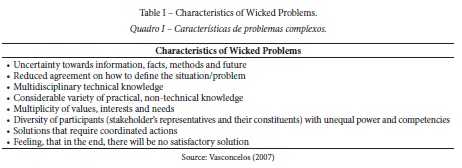
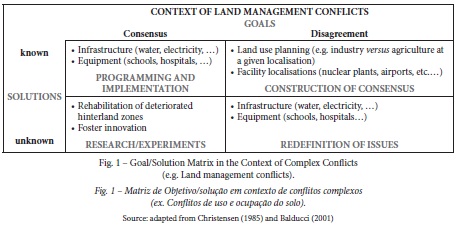
    <p>The implementation of environmental mediation as a mechanism for  citizens’ participation in environmental decision-making is crucial, since  participation increases the acceptability of the public decisions and promotes the accountability of the community (Gomes, 2009).</p>       <p><b>2. Environmental Mediation - a methodology for structured conflict management and resolution </b></p>       <p>The choice of mediation (or mediated negotiations) is especially recommendable in a context of wicked problems (Rittel &amp;  Weber, 1973) and in environments where disagreements on goals combined with  the existence of many technical solutions originate discussion and conflict. Wicked problems are characterised by complex interdependencies where the  resolution of one aspect usually creates new challenges. <a href="#q1">Table I</a> shows a  compilation of the key challenges associated with wicked problems that fall in the above-right category of the goal/solution matrix (<a href="#f1">fig. 1</a>).</p> 

    <p>&nbsp;</p> <a name="q1"></a>  <img src="/img/revistas/fin/n104/n104a08q1.jpg">     
]]></body>
<body><![CDATA[<p>&nbsp;</p>

    <p>&nbsp;</p> <a name="f1"></a>  <img src="/img/revistas/fin/n104/n104a08f1.jpg">     
<p>&nbsp;</p>

    <p>In these environments a structured process of consensus  construction - mediation - is most likely to lead to sustainable  solutions that best serve the interests and needs of all involved stakeholders. When there is a genuine inclusive dialogue process involving the multiple  stakeholders in these complex contexts, the chances for success increase  (Wiegand, 2014). For example, the case of the MARGov project that carried out such a process, based on a spinal cord of open forums out of which a core group  emerged, willing to carry on the process further. This group, which  had been previously involved in most of the forums, did not stop working together to get to consensual rules of management for the marine park. The new  strategic council for the Marine Park created in 2015 invited this group to  become the consulting Group of the Sea attributing it a mandate.</p>

    <p><i>2.1. How does Mediation work?</i></p>

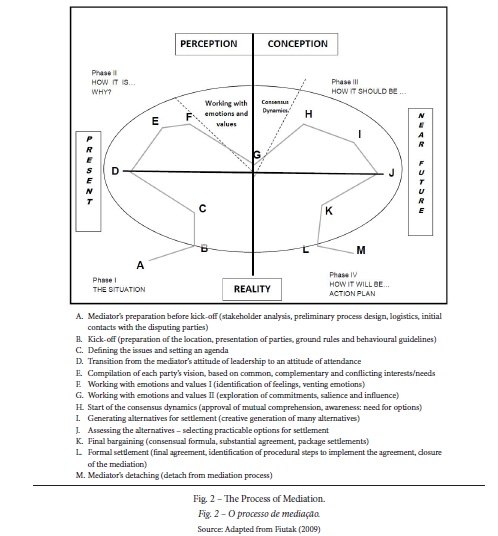
    <p>Mediation is a process of direct negotiation between  actors<a name="topvi"></a><a href="#vi"><sup>vi</sup></a>, which is assisted by one or more professionally  trained mediators. The mediators are responsible for creating a conversational arena where participants can educate each other on their perspectives and  values, identify common, compatible and conflicting interests and needs  and search collaboratively options for solution (Moore, 2003). Any decision is taken by the stakeholders, the mediator must not have any personal or professional  interest in the outcome or any decision making power (see also in  this text III below).</p>

    <p>The mediation procedure can be divided largely into 13 phases (<a href="#f2">fig. 2</a>):</p> 

    <p>&nbsp;</p> <a name="f2"></a>  <img src="/img/revistas/fin/n104/n104a08f2.jpg">     
<p>&nbsp;</p>

    <p>The process designed  above also demonstrates the advantages of mediation in power imbalance situations, so common in environmental and territorial conflicts. In fact, an  environmental or territorial conflict may involve citizens, private entities  with economic or social goals and public and government entities, which is quite revealing of the different power forces in conflict. The mediation process  and methodology, based on dialogue and equal treatment of the parties,  can mitigate the existing power imbalances. The mediators’ impartiality and neutrality principles consolidate mediation as a balancing arena. The mediator  has the task of putting all the parties’ interests at the same level,  using convenient methodologies, techniques and instruments. Empowerment of “weaker stakeholders” and creating a power balance between involved parties attest  to the advantages of mediation in resolving environmental  conflicts.</p> 


    ]]></body>
<body><![CDATA[<p><i>2.2. European Examples of the MAST </i></p>

    <p>The implementation of mediation is starting to have an increased adherence and implementation in the resolution of  environmental conflicts. Next we give a quick insight into specific cases. </p> 

    <p>In European terms, IMPEL (European Union  Network for the Implementation and Enforcement of Environmental Law) has  undertaken, in 2004, the project &quot;Informal Resolution of Environmental Conflict by Neighborhood Dialogue&quot;, which is born out of an experience in  Hannover, Germany. In fact, the German Department of Labour and  Environmental Inspection implements, since 1995, the dialogue between neighbours and several industrial companies in resolving environmental conflicts.</p> 

    <p>In this context, IMPEL has developed a practical guide (toolkit) to disclose the referred project that would,  simultaneously, support the authorities and companies in the  implementation  of guidelines and techniques to promote dialogue with the stakeholders in conflict<a name="topvii"></a><a href="#vii"><sup>vii</sup></a>. The purpose of IMPEL is based on the methodological  premises of mediation.</p> 

    <p>The IMPEL's project was implemented in Germany in a specific conflict  that emerged between a city’s population and a steel factory  (ThyssenKrupp  Nirosta), because of the limestone dust emission produced by this company. In 2005, the inspection authority convinced the factory representatives to engage  in a dialogue with local residents. It was the company itself that  hired a professional facilitator to assess the possibility of a dialogue with the population, which began in May 2006. A “group of interconnection”  (Kontaktgruppe) was created and deemed responsible for the preparation of  meetings between all involved stakeholders. After a year and a half of dialogue implementation, relations between neighbours and factory representatives had  improved and the level of distrust towards the company’s actions had  declined substantially (Schüpphaus, 2007).</p> 

    <p>In Portugal, this process was also successfully applied, namely in a conflict  related with emissions of fumes and odours by a company that produced pulp paper. Through dialogue, the conflict was resolved, and the company provided the  use of its own wastewater treatment plant for water treatment of the  urban population (Cebola, 2010b).</p>

    <p>Within the  territorial conflicts in Norway, mediation has being playing an essential  role in resolving boundary disputes (Sky, 2003). In this type of conflict, the parties could disagree about how maintenance costs should be split, the  standard to which the road should be maintained, how much it should cost to  buy a right to use the road, etc. The mediation process allows for dispute resolutions with a great variety of solutions to a problem. In 1996, mediation  helped solve approx. 43% of boundary line disputes at the land  consolidation courts (Sky, 2003).</p> 

    <p>In Portugal, so  far there has not been any explicitly declared environmental  mediation,  but, for example, the above mentioned process MARGov, focused on the engagement of stakeholders in dialogue in a conflict context, aiming to achieve an  agreement between parts in conflict on the management rules for the marine  park of <i>Arrábida</i> (e.g. artisan fishermen and the managers).</p>       <p><b>&nbsp;</b></p>

    <p><b>III. LEGAL ADMISSIBILITY OF ENVIRONMENTAL AND SOCIO TERRITORIAL MEDIATION (MAST)</b></p> 

    ]]></body>
<body><![CDATA[<p><b>1. The Portuguese Mediation Law - general framework</b></p> 

    <p>In order to  transpose the Directive 2008/52/EU, in 2009, Portugal introduced a few legal rules in the Civil Procedure Code, with the objective of regulating the  essential aspects of mediation in our country (Cebola, 2010a). However, this  legal transposition left out some important questions, such as the professional status of the mediator or the regulation of the private mediation (Gouveia,  2010; Morais, 2011; Schmidt, 2013).</p> 

    <p>Therefore, to increase the implementation of mediation, an autonomous and  specific mediation law was promulgated in 2013 (Law No 29/2013, of  April 19<sup>th</sup>)<a name="topviii"></a><a href="#viii"><sup>viii</sup></a> that covers four important questions:</p>

    <p>- the general principles applicable to every mediation held in Portugal;</p>      <p>- specific rules of civil and commercial mediation;</p>      <p>- the mediators’ professional status; </p>      <p>- the principles that regulate in general the public mediation systems.</p>       <p>Next we will give an account of how this new law may encourage the application of the MAST in Portugal, or even if the MAST is  allowed by this new legal framework.</p> 

    <p><b>2. The MAST implementation in the Portuguese legal system</b></p> 

    <p>The Law No 29/2013 does not establish a general criterion for conflicts that could be submitted to mediation. Indeed, in its  general provisions, this law, in Article 2, merely defines mediation as a  means for alternative dispute resolution, carried out by public or private entities, through which two or more parties in a dispute voluntarily try to  achieve an agreement with the assistance of a mediator. The Law does not,  therefore, refer to any limitation or scope.</p>

    ]]></body>
<body><![CDATA[<p>On  the other hand, the Law No 29/2013, in Article 11, just establishes  limits regarding conflicts in civil and commercial matters. Consequently, this new law does not <i>expressis verbis</i> preclude the implementation of  mediation to public conflicts, or more specifically to environmental  conflicts. However, it also does not make reference to them.</p> 

    <p>With regard to private environmental conflicts (e.g. water  easements, easements boundaries, tree planting), no obstacle stands up to the application of mediation. In any case, a private mediator can be hired to help  the conflicting parties - through genuine dialogue - to try and find a  solution to their conflict.</p> 

    <p>Regarding conflicts  involving public entities, doubts concerning the implementation of  mediation can be raised as in many conflicts an administrative decision is needed.</p>

    <p>However, as mentioned earlier in this  study, the participation of citizens and other stakeholders in decision-making processes of public bodies is a constant principle in administrative and  environmental law. Thus, as a mediation law exists, which regulates the  general action of mediators in Portugal, their intervention could also be legitimised in the context of environmental conflicts in order to implement the  legally required principle of participation, particularly when it comes  to land use plans. </p>

    <p>We must highlight that the laws  recently approved on the environmental field<a name="topix"></a><a href="#ix"><sup>ix</sup></a> stress the  importance of concertation and participation which justified our position. In fact, mediation may be the best, if not the only way to put all stakeholders  involved in environmental questions in dialogue in order to achieve the  required principle of participation and concertation. Otherwise, the public discussion of environmental issues may lead to an empty space of opinions without  reaching constructive contributions.</p> 

    <p>The MARGov project, for instance, proves that fact<a name="topx"></a><a href="#x"><sup>x</sup></a>. This  project intended to implement a Model of Collaborative Governance in  <i>Arrábida Marine Park Professor Luiz Saldanha</i> (MPLS). The creation of a Marine Protected Area (MPA) in this Park led to usage restrictions and hence  towards conflicts between the affected stakeholders. A public discussion  period existed before the creation of the restricted areas. Even so, stakeholders felt they had not been heard and the conflictual situation was only  overcome after the intervention of a mediating team (Vasconcelos <i>et  al.,</i> 2011a; Vasconcelos <i>et al.,</i> 2011b).</p> 

    <p>Without mediation, the public discussion period becomes a mere  collection of opinions, with no dialogue between the stakeholders in order to transform the isolated proposals into a joint solution to resolve the conflict.  That is why we advocate the implementation of mediation as a way to  achieve the required participation prescribed in recent environmental laws above mentioned.</p>

    <p><b>3. The (environmental) mediator in the new law</b></p> 

    <p>So far the profession  “conflict mediator” is not a protected designation, neither in  Portugal, or worldwide. The mediator assumes themself as a new type of professional who provides his or her services independently and impartially. </p>

    <p>The Law No 29/2013 establishes rights and duties of the mediator, whose action has a legal regulation that legitimises his or her  intervention, which will be essential to provide a communication  channel between citizens and public authorities.</p> 

    ]]></body>
<body><![CDATA[<p>To be a professional conflict mediator personal characteristics are  important as well as a highly competent intervention. Although the profession “mediator” is not protected so far, for certification a sound training is  recommended by national and international mediators’  associations<a name="topxi"></a><a href="#xi"><sup>xi</sup></a>. In Portugal - especially for being a mediator in the public sector - an academic course is required (which can be practically any)  as well as the attendance of a course on conflict mediation (the  training institute has to be certified by the Portuguese Ministry of Justice).</p>

    <p>To act as a conflict mediator in  environmental conflicts or in processes of public participation, no official requirements exist at all (so far). Anybody can declare themself a mediator and  conduct mediations or consensus construction processes. Standards and  certifications are required to be developed to guarantee the specific competence of environmental mediators and the quality of their intervention.</p>      <p><b>&nbsp;</b></p>

    <p><b>IV. RECOMMENDATIONS</b></p>  
    <p><b>1. Recommendation to public services responsible for spatial planning </b></p>       <p>When defining a new vision for land use planning, the Royal Town Planning Institute (RTPI, 2001) emphasises that mediation should  be implemented in all planning processes, as spatial planning is  characterised by the constant presence of competing interests, particularly with regard to land use and different goals in the short and long run.</p> 

    <p>We support this idea, as without a sound conflict management strategy, conflict might bear incommensurable risks - especially in  the actual context of financial crisis. Interested stakeholders demand  more and more to be effectively considered in decision making, and they have a legitimate right to have their say. As actors are diverse and disorganised and  no clear rules and procedures exist to steer multi-stakeholder  dialogues or resolve conflicts (Putnam &amp; Wondolleck, 2003), central and local governments are asked to invest in a professional handling of these  situations, where interests and values involved are manifold, the number of  interested parties is considerably high, the amount of issues under discussion grows and conflict and the cost of the resolution constantly increasing.</p> 

    <p>According to the requirements for a successful process of conflict resolution it is absolutely crucial that the  parts in conflict hand over the mediation role to a third party viewed  as independent. Therefore, in this context, it is crucial that the central, regional and local governments or public institutions understand that they should  hand over the mediator role. Moreover, usually public servants do not  have methodological competence to design and conduct these types of processes, but the uttermost important argument against their intervention as a mediator,  in contexts of conflict, is that they as a member (or even as a  representative) of one of the powerful stakeholders have a genuine self-interest in the outcome, and - of course - are not at all seen as neutral and  independent interveners by the majority of private institutionalised or  individual stakeholders (Caser &amp; Vasconcelos, 2012).</p> 

    <p><b>2. Recommendations to the lawmaker</b></p> 

    <p>The advantages of implementing mediation in environmental and territorial  conflicts should receive special attention from the legislator.</p> 

    ]]></body>
<body><![CDATA[<p>In this context, a Law on mediation in public issues  should be published, including environmental matters, in order to create  the necessary legal framework for the implementation of the MAST in Portugal and consequently allow public entities and citizens to collaborate and reach  consensus about the decisions that concern them (Cebola, 2010b).</p>

    <p>On the other hand, mediator training should be made  mandatory. The training has to be provided by recognised competent experts  that already work in the field. Training that offers a specialisation in environmental issues should give way to the elaboration of a list of specialised  mediators whose services would be used by citizens and also entities when  faced with an environmental or land use conflict.</p> </p>
     <p><b>&nbsp;</b></p> 
    <p><b>V. FINAL CONSIDERATIONS AND FUTURE PERSPECTIVES</b></p>       <p>In this paper we demonstrated that the MAST offers public bodies, citizens and private companies operating in a given area, a  complementary solution to judicial or civil protest, ensuring that all the  parties feel co-responsible and part of decisions taken. Mediation outcomes reflect all stakeholders’ aspirations, interests and needs. In a context of  austerity and crisis, where public money is scarce, early consensus  building  can save time, financial and human resources and contributes to more sustainable spatial planning with a potentially smooth implementation of the decisions  taken.</p> 

    <p>We have presented some effective experiences that showed how mediation can transform the conflict into a dialogue  arena where all stakeholders can intervene and create the best  collective solution to address the conflict. In this way, mediation can increase the acceptability of the final decision.</p>       <p>We described here the process of mediation in detail. Obviously, however, mediation is not the one and only process for best  decision making and conflict resolution in all complex situations, but if  the process is professionally professionally (well) conducted, mediation is enormously powerful to solve planning issues and land use conflicts in a  sustainable way. The tangible consensus based results like formal settlements,  action plans or management models, together with the great variety of intangible social results contribute to create participative co-responsible societies  and social peace.</p>

    <p>Despite these successful examples, environmental and territorial planning  mediation has still not attracted the legislator’s attention.  However, the existent legal framework does not preclude the implementation of mediation to environmental and territorial conflicts. </p>       <p><b>&nbsp;</b></p>

    <p><b>REFERENCES </b></p> 

    ]]></body>
<body><![CDATA[<!-- ref --><p>Balducci, J. (2001). <i>Complex Problems</i>. Not published, Departamento de Ciências e Engenharia do Ambiente da  Faculdade de Ciências e Tecnologia, Universidade Nova de Lisboa.    &nbsp;&nbsp;&nbsp;&nbsp;&nbsp;&nbsp;&nbsp;&nbsp;[&#160;<a href="javascript:void(0);" onclick="javascript: window.open('/scielo.php?script=sci_nlinks&ref=283271&pid=S0430-5027201700010000800001&lng=','','width=640,height=500,resizable=yes,scrollbars=1,menubar=yes,');">Links</a>&#160;]<!-- end-ref --></p> 
    <!-- ref --><p>Carvalho-Ribeiro, S. M., Lovett, A., &amp; O'Riordan, T. (2010). Multifunctional forest management in Northern  Portugal: Moving from scenarios to governance for sustainable  development. <i>Land Use Policy, 27</i>(4), 1111-1122. doi: 10.1016/j.landusepol.2010.02.008.    &nbsp;&nbsp;&nbsp;&nbsp;&nbsp;&nbsp;&nbsp;&nbsp;[&#160;<a href="javascript:void(0);" onclick="javascript: window.open('/scielo.php?script=sci_nlinks&ref=283273&pid=S0430-5027201700010000800002&lng=','','width=640,height=500,resizable=yes,scrollbars=1,menubar=yes,');">Links</a>&#160;]<!-- end-ref --></p>
    <!-- ref --><p>Caser, U. (2009).  Socio-Environmental Mediation: Myths and Fears. <i>Revista de Estudos  Universitários, 35</i>(2), 67-83.    &nbsp;&nbsp;&nbsp;&nbsp;&nbsp;&nbsp;&nbsp;&nbsp;[&#160;<a href="javascript:void(0);" onclick="javascript: window.open('/scielo.php?script=sci_nlinks&ref=283275&pid=S0430-5027201700010000800003&lng=','','width=640,height=500,resizable=yes,scrollbars=1,menubar=yes,');">Links</a>&#160;]<!-- end-ref --></p> 
    <!-- ref --><p>Caser, U., &amp; Vasconcelos, L. (2012). A Mediação Ambiental e  Sócio-Territorial (MAST) - Um Campo de Intervenção por Excelência para  Geógrafos! [Environmental and Socio-Territorial Mediation (MAST) - A Field of Intervention for Excellence for Geographers!]. <i>Revista de Geografia e  Ordenamento do Território, 2</i>, 75-96. doi: 10.17127/got/2012.2.004.    &nbsp;&nbsp;&nbsp;&nbsp;&nbsp;&nbsp;&nbsp;&nbsp;[&#160;<a href="javascript:void(0);" onclick="javascript: window.open('/scielo.php?script=sci_nlinks&ref=283277&pid=S0430-5027201700010000800004&lng=','','width=640,height=500,resizable=yes,scrollbars=1,menubar=yes,');">Links</a>&#160;]<!-- end-ref --></p> 
    <p>Castro e Almeida, J., &amp; Caser, U. (2012, outubro). A Mediação de  Conflitos no Planeamento do Território em Portugal [The Mediation of  Conflicts in Territory Planning in Portugal]. In <i>III International Congress on Mediation - Mediation and Arbitration.</i> Conducted at the Centre for  Public Administration and Public Policies (CAPP) of the School of Social  and Political Sciences (ISCSP), Technical University of Lisbon (UTL), Lisbon, PT.</p> 
    <!-- ref --><p>Cebola, C. M. (2010a). A  mediação pré-judicial em Portugal: Análise do novo regime jurídico  [Pre-judicial mediation in Portugal: Analysis of the new legal regime]. [electronic version]. <i>Revista da Ordem dos Advogados, 70</i>(I/IV), 441-459.  Retrieved from: <a href="http://portal.oa.pt/comunicacao/publicacoes/revista/ano-2010/ano-70-vol-iiv-2010/doutrina/catia-marques-cebola-a-mediacao-pre-judicial-em-portugal-anaali se-do-novo-regime-juridico/" target="_blank">http://portal.oa.pt/comunicacao/publicacoes/revista/ano-2010/ano-70-vol-iiv-2010/doutrina/catia-marques-cebola-a-mediacao-pre-judicial-em-portugal-anaali se-do-novo-regime-juridico/</a> &nbsp;&nbsp;&nbsp;&nbsp;&nbsp;&nbsp;&nbsp;&nbsp;[&#160;<a href="javascript:void(0);" onclick="javascript: window.open('/scielo.php?script=sci_nlinks&ref=283280&pid=S0430-5027201700010000800006&lng=','','width=640,height=500,resizable=yes,scrollbars=1,menubar=yes,');">Links</a>&#160;]<!-- end-ref --><!-- ref --><p>Cebola, C. M. (2010b). Da  admissibilidade de meios extrajudiciais de resolução de conflitos em matéria ambiental e urbanística - experiências presentes, possibilidades futuras [The  admissibility of extrajudicial means of conflict resolution in  environmental and urban matters - present experiences, future possibilities]. <i>RevCEDOUA - Revista do Centro de Estudos de Direito do Ordenamento, do  Urbanismo e do Ambiente, 25</i>, 65-84.    &nbsp;&nbsp;&nbsp;&nbsp;&nbsp;&nbsp;&nbsp;&nbsp;[&#160;<a href="javascript:void(0);" onclick="javascript: window.open('/scielo.php?script=sci_nlinks&ref=283281&pid=S0430-5027201700010000800007&lng=','','width=640,height=500,resizable=yes,scrollbars=1,menubar=yes,');">Links</a>&#160;]<!-- end-ref --></p>      <!-- ref --><p>Cebola, C. M., Caser, U., &amp; Vasconcelos, L. (2014). La confidencialidad en mediación ambiental. Su aplicación al Proyecto  MARGov en Portugal [Confidentiality in environmental mediation. Its  application to the MARGov Project in Portugal]. [electronic version]. <i>La Trama - Revista Interdisciplinaria de Mediación y Resolución, 41</i>, 1-22.  Retrieved from:  <a href="http://www.revistalatrama.com.ar/contenidos/larevista_tapa_anterior.php?id=41" target="_blank">http://www.revistalatrama.com.ar/contenidos/larevista_tapa_anterior.php?id=41</a>&nbsp;&nbsp;&nbsp;&nbsp;&nbsp;&nbsp;&nbsp;&nbsp;[&#160;<a href="javascript:void(0);" onclick="javascript: window.open('/scielo.php?script=sci_nlinks&ref=283283&pid=S0430-5027201700010000800008&lng=','','width=640,height=500,resizable=yes,scrollbars=1,menubar=yes,');">Links</a>&#160;]<!-- end-ref --><!-- ref --><p>Christensen, K.  (1985). Coping with Uncertainty in Planning. <i>Journal of the American Planning Association, 51</i>(1),<i> </i>63-73. doi: 10.1080/01944368508976801.    &nbsp;&nbsp;&nbsp;&nbsp;&nbsp;&nbsp;&nbsp;&nbsp;[&#160;<a href="javascript:void(0);" onclick="javascript: window.open('/scielo.php?script=sci_nlinks&ref=283284&pid=S0430-5027201700010000800009&lng=','','width=640,height=500,resizable=yes,scrollbars=1,menubar=yes,');">Links</a>&#160;]<!-- end-ref --></p> 
    <!-- ref --><p>Fiutak, T., Planès G.,  &amp; Colin Y. (2009). <i>Le médiateur dans l'arène: Réflexion sur l'art de la médiation</i> [The mediator in the arena: Reflection on the art of mediation].  Toulouse: Éditions érès.    &nbsp;&nbsp;&nbsp;&nbsp;&nbsp;&nbsp;&nbsp;&nbsp;[&#160;<a href="javascript:void(0);" onclick="javascript: window.open('/scielo.php?script=sci_nlinks&ref=283286&pid=S0430-5027201700010000800010&lng=','','width=640,height=500,resizable=yes,scrollbars=1,menubar=yes,');">Links</a>&#160;]<!-- end-ref --></p>      <p>Gomes, C. A. (2009). Participação pública e defesa do ambiente: um silêncio crescentemente ensurdecedor [Public participation and  environmental protection: an increasingly deafening silence]. Monólogo  com jurisprudência em fundo. <i>Cadernos de Justiça Administrativa, 77</i>, 3-15.</p> 
    <!-- ref --><p>Gouveia, M. F. (2010).  Algumas questões jurídicas a propósito da mediação [Some legal issues  regarding mediation] In J. Vasconcelos-Sousa (Ed.), <i>Mediação e criação de consensos: os novos instrumentos de empoderamento do cidadão na União Europeia  </i>[Mediation and consensus building: the new instruments for citizen  empowerment in the European Union]<i> </i>(pp. 213-242). Coimbra: Ed. Minerva.    &nbsp;&nbsp;&nbsp;&nbsp;&nbsp;&nbsp;&nbsp;&nbsp;[&#160;<a href="javascript:void(0);" onclick="javascript: window.open('/scielo.php?script=sci_nlinks&ref=283289&pid=S0430-5027201700010000800012&lng=','','width=640,height=500,resizable=yes,scrollbars=1,menubar=yes,');">Links</a>&#160;]<!-- end-ref --></p> 
    ]]></body>
<body><![CDATA[<!-- ref --><p>Gouveia, M. F. (2014).  <i>Curso de Resolução Alternativa de Litígios</i> [Alternative Dispute  Resolution Course]. (3<sup>rd</sup> ed.). Coimbra: Ed. Almedina.    &nbsp;&nbsp;&nbsp;&nbsp;&nbsp;&nbsp;&nbsp;&nbsp;[&#160;<a href="javascript:void(0);" onclick="javascript: window.open('/scielo.php?script=sci_nlinks&ref=283291&pid=S0430-5027201700010000800013&lng=','','width=640,height=500,resizable=yes,scrollbars=1,menubar=yes,');">Links</a>&#160;]<!-- end-ref --></p> 
    <!-- ref --><p>Gualini, E. (2015). <i>Planning and  Conflict: Critical Perspectives on Contentious Urban Developments</i>. New  York and London: Routledge.    &nbsp;&nbsp;&nbsp;&nbsp;&nbsp;&nbsp;&nbsp;&nbsp;[&#160;<a href="javascript:void(0);" onclick="javascript: window.open('/scielo.php?script=sci_nlinks&ref=283293&pid=S0430-5027201700010000800014&lng=','','width=640,height=500,resizable=yes,scrollbars=1,menubar=yes,');">Links</a>&#160;]<!-- end-ref --></p> 
    <!-- ref --><p>Lang, D. J., Wiek, A., Bergmann, M., Stauffacher, M., Martens, P., Moll, P…  Thomas, C. J. (2012). Transdisciplinary research in sustainability  science: Practice, principles, and challenges. <i>Sustainability Science, 7</i>(SUPPL.1), 24-43. doi: 10.1007/s11625-011-0149-x.    &nbsp;&nbsp;&nbsp;&nbsp;&nbsp;&nbsp;&nbsp;&nbsp;[&#160;<a href="javascript:void(0);" onclick="javascript: window.open('/scielo.php?script=sci_nlinks&ref=283295&pid=S0430-5027201700010000800015&lng=','','width=640,height=500,resizable=yes,scrollbars=1,menubar=yes,');">Links</a>&#160;]<!-- end-ref --></p>      <!-- ref --><p>Lopes, D., &amp; Patrão, A. (2016). <i>Lei da  Mediação Comentada</i> [Commented Mediation Law]. (2<sup>nd</sup> ed.). Coimbra: Ed. Almedina.    &nbsp;&nbsp;&nbsp;&nbsp;&nbsp;&nbsp;&nbsp;&nbsp;[&#160;<a href="javascript:void(0);" onclick="javascript: window.open('/scielo.php?script=sci_nlinks&ref=283297&pid=S0430-5027201700010000800016&lng=','','width=640,height=500,resizable=yes,scrollbars=1,menubar=yes,');">Links</a>&#160;]<!-- end-ref --></p>
    <!-- ref --><p>Moore, C.  (2003). <i>The Mediation Process - Practical Strategies for Resolving  Conflict </i>(3<sup>rd</sup> ed.). San Francisco: Jossey-Bass.    &nbsp;&nbsp;&nbsp;&nbsp;&nbsp;&nbsp;&nbsp;&nbsp;[&#160;<a href="javascript:void(0);" onclick="javascript: window.open('/scielo.php?script=sci_nlinks&ref=283299&pid=S0430-5027201700010000800017&lng=','','width=640,height=500,resizable=yes,scrollbars=1,menubar=yes,');">Links</a>&#160;]<!-- end-ref --></p>
    ]]></body>
<body><![CDATA[<!-- ref --><p>Morais, J. C. (2011). A consagração legal da  mediação em Portugal [The legal consecration of mediation in  Portugal]. <i>Julgar, 15</i>, 271-290. Retrieved from:  <a href="http://julgar.pt/a-consagracao-legal-da-mediacao-em-portugal" target="_blank">http://julgar.pt/a-consagracao-legal-da-mediacao-em-portugal</a>&nbsp;&nbsp;&nbsp;&nbsp;&nbsp;&nbsp;&nbsp;&nbsp;[&#160;<a href="javascript:void(0);" onclick="javascript: window.open('/scielo.php?script=sci_nlinks&ref=283301&pid=S0430-5027201700010000800018&lng=','','width=640,height=500,resizable=yes,scrollbars=1,menubar=yes,');">Links</a>&#160;]<!-- end-ref --><!-- ref --><p>Oliveira, F. P., &amp; Lopes, D. (2003). O papel dos privados no planeamento: que formas de intervenção? [The role of the private  in planning: what forms of intervention?]. <i>Revista Jurídica do  Urbanismo e do Ambiente, 20</i>, 43-79.    &nbsp;&nbsp;&nbsp;&nbsp;&nbsp;&nbsp;&nbsp;&nbsp;[&#160;<a href="javascript:void(0);" onclick="javascript: window.open('/scielo.php?script=sci_nlinks&ref=283302&pid=S0430-5027201700010000800019&lng=','','width=640,height=500,resizable=yes,scrollbars=1,menubar=yes,');">Links</a>&#160;]<!-- end-ref --></p> 
    <!-- ref --><p>Putnam, L. L., &amp; Wondolleck, J. M. (2003). Intractability:  Definitions, Dimensions, and Distinctions. In R. Lewicki, B. Gray &amp; M.  Elliott (Eds.), <i>Making sense of intractable environmental conflicts: frames and cases</i> (pp. 35-63). Washington, DC: Island Press.    &nbsp;&nbsp;&nbsp;&nbsp;&nbsp;&nbsp;&nbsp;&nbsp;[&#160;<a href="javascript:void(0);" onclick="javascript: window.open('/scielo.php?script=sci_nlinks&ref=283304&pid=S0430-5027201700010000800020&lng=','','width=640,height=500,resizable=yes,scrollbars=1,menubar=yes,');">Links</a>&#160;]<!-- end-ref --></p> 
    <!-- ref --><p>Rittel, H. W. J., &amp; Webber, M. M.  (1973). Dilemmas in a General Theory of Planning. <i>Policy Sciences, 4</i>(2), 155–169. doi:10.1007/BF01405730.    &nbsp;&nbsp;&nbsp;&nbsp;&nbsp;&nbsp;&nbsp;&nbsp;[&#160;<a href="javascript:void(0);" onclick="javascript: window.open('/scielo.php?script=sci_nlinks&ref=283306&pid=S0430-5027201700010000800021&lng=','','width=640,height=500,resizable=yes,scrollbars=1,menubar=yes,');">Links</a>&#160;]<!-- end-ref --></p>      <!-- ref --><p>RTPI - Royal Town Planning Institute. (2001). <i>Existing Tools  for Neighbourhood Planning</i>. Retrieved from:  <a href="http://www.rtpi.org.uk/media/7334/Existing-Tools-for-Neighbourhood-Planning.pdf" target="_blank">http://www.rtpi.org.uk/media/7334/Existing-Tools-for-Neighbourhood-Planning.pdf</a> &nbsp;&nbsp;&nbsp;&nbsp;&nbsp;&nbsp;&nbsp;&nbsp;[&#160;<a href="javascript:void(0);" onclick="javascript: window.open('/scielo.php?script=sci_nlinks&ref=283308&pid=S0430-5027201700010000800022&lng=','','width=640,height=500,resizable=yes,scrollbars=1,menubar=yes,');">Links</a>&#160;]<!-- end-ref --><!-- ref --><p>Schmidt, J. P. (2013). Mediation in Portugal: Growing Up in a Sheltered Home. In K. J. Hopt &amp; F. Steffek  (Eds.), <i>Mediation: Principles and Regulation in Comparative  Perspective </i>(pp. 809-837). Oxford: Oxford University Press.    &nbsp;&nbsp;&nbsp;&nbsp;&nbsp;&nbsp;&nbsp;&nbsp;[&#160;<a href="javascript:void(0);" onclick="javascript: window.open('/scielo.php?script=sci_nlinks&ref=283309&pid=S0430-5027201700010000800023&lng=','','width=640,height=500,resizable=yes,scrollbars=1,menubar=yes,');">Links</a>&#160;]<!-- end-ref --></p>
    ]]></body>
<body><![CDATA[<!-- ref --><p>Schüpphaus, M. (2007, November).  Establishing neighbourhood dialogue – toolkit. Available at IMPEL - European  Union Network for the Implementation and Enforcement of Environmental Law. Retrieved from:  <a href="http://www.impel.eu/wp-content/uploads/2016/08/2007-01-neighbourhood-dialogue-TOOLKIT.pdf" target="_blank">http://www.impel.eu/wp-content/uploads/2016/08/2007-01-neighbourhood-dialogue-TOOLKIT.pdf</a> &nbsp;&nbsp;&nbsp;&nbsp;&nbsp;&nbsp;&nbsp;&nbsp;[&#160;<a href="javascript:void(0);" onclick="javascript: window.open('/scielo.php?script=sci_nlinks&ref=283311&pid=S0430-5027201700010000800024&lng=','','width=640,height=500,resizable=yes,scrollbars=1,menubar=yes,');">Links</a>&#160;]<!-- end-ref --><p>Sky, P. K. (2003, December). <i>Land Tenure Disputes: Suitable for mediation? </i>Paper presented at the 2nd FIG Regional  Conference - Urban-Rural Interrelationship for Sustainable Environment,  Marrakech, Morocco. Retrieved from:  <a href="http://www.fig.net/resources/proceedings/fig_proceedings/morocco/proceedings/TS10/TS10_2_sky.pdf" target="_blank">http://www.fig.net/resources/proceedings/fig_proceedings/morocco/proceedings/TS10/TS10_2_sky.pdf</a> </p>      <!-- ref --><p>Susskind, L., &amp; Weinstein, A. (1980). Towards a Theory of Environmental Dispute Resolution. <i>Boston College Environmental  Affairs Law Review, 9</i>(2), 311-357. Retrieved from:  <a href="http://lawdigitalcommons.bc.edu/ealr/vol9/iss2/4" target="_blank">http://lawdigitalcommons.bc.edu/ealr/vol9/iss2/4</a>&nbsp;&nbsp;&nbsp;&nbsp;&nbsp;&nbsp;&nbsp;&nbsp;[&#160;<a href="javascript:void(0);" onclick="javascript: window.open('/scielo.php?script=sci_nlinks&ref=283313&pid=S0430-5027201700010000800026&lng=','','width=640,height=500,resizable=yes,scrollbars=1,menubar=yes,');">Links</a>&#160;]<!-- end-ref --><!-- ref --><p>Vasconcelos, L. (2007). Participatory Governance in Complex  Projects.<i> </i>In G. Gunkel, &amp; M. C. Sobral (Eds.), <i>Reservoir and River Basin Management: Exchange of Experiences from Brazil, Portugal and Germany  </i>(pp. 114-124)<i>. </i>Berlin: Technical University of Berlin.    &nbsp;&nbsp;&nbsp;&nbsp;&nbsp;&nbsp;&nbsp;&nbsp;[&#160;<a href="javascript:void(0);" onclick="javascript: window.open('/scielo.php?script=sci_nlinks&ref=283314&pid=S0430-5027201700010000800027&lng=','','width=640,height=500,resizable=yes,scrollbars=1,menubar=yes,');">Links</a>&#160;]<!-- end-ref --> </p> 
    <!-- ref --><p>Vasconcelos, L., Caser, U., Sá, R., Coelho, M., Silva, F., Ferreira, J. C... Bastos, M. (2011a).&nbsp;<i>MARGov  - Governância Colaborativa de Áreas Marinhas Protegidas &amp;  Cientistas Como Cidadãos E Cidadãos Como Cientistas: Relatório final - PARTE A&nbsp;</i>[electronic version] Caparica: IMAR - Instituto do Mar/ DCEA/ FCT/  UNL. Retrieved from: <a href="http://www.wteamup.com" target="_blank">http://www.wteamup.com</a> &nbsp;&nbsp;&nbsp;&nbsp;&nbsp;&nbsp;&nbsp;&nbsp;[&#160;<a href="javascript:void(0);" onclick="javascript: window.open('/scielo.php?script=sci_nlinks&ref=283316&pid=S0430-5027201700010000800028&lng=','','width=640,height=500,resizable=yes,scrollbars=1,menubar=yes,');">Links</a>&#160;]<!-- end-ref --><!-- ref --><p>Vasconcelos, L., Caser, U., Sá, R., Coelho, M., Silva, F., Ferreira, J. C... Bastos, M.  (2011b).&nbsp;<i>MARGov - Governância Colaborativa de Áreas Marinhas Protegidas &amp;  Cientistas Como Cidadãos E Cidadãos Como Cientistas: Relatório final - PARTE B</i>&nbsp; [Collaborative Governance of Marine Protected Areas &amp; Scientists  As Citizens and Citizens as Scientists: Final Report - PART B]  [electronic version] Caparica: IMAR - Instituto do Mar/ DCEA/ FCT/ UNL. Retrieved from:  <a href="http://www.wteamup.com" target="_blank">http://www.wteamup.com</a> &nbsp;&nbsp;&nbsp;&nbsp;&nbsp;&nbsp;&nbsp;&nbsp;[&#160;<a href="javascript:void(0);" onclick="javascript: window.open('/scielo.php?script=sci_nlinks&ref=283317&pid=S0430-5027201700010000800029&lng=','','width=640,height=500,resizable=yes,scrollbars=1,menubar=yes,');">Links</a>&#160;]<!-- end-ref --><!-- ref --><p>Vasconcelos, L., Caser, U., Pereira,  M. J., Gonçalves, G., &amp; Sá, R. (2012). MARGOV – building social sustainability. <i>Journal of Coastal Conservation, 16</i>(4), 523-530.    &nbsp;&nbsp;&nbsp;&nbsp;&nbsp;&nbsp;&nbsp;&nbsp;[&#160;<a href="javascript:void(0);" onclick="javascript: window.open('/scielo.php?script=sci_nlinks&ref=283318&pid=S0430-5027201700010000800030&lng=','','width=640,height=500,resizable=yes,scrollbars=1,menubar=yes,');">Links</a>&#160;]<!-- end-ref --></p>
    <!-- ref --><p>Vasconcelos, L., Pereira, M. J.,  Caser, U., Gonçalves, G., Silva, F., &amp; Sá, R. (2013). MARGov –Setting the ground for the governance of Marine Protected Areas. <i>Ocean &amp; Coastal  Management, 72</i>, 46-53.    &nbsp;&nbsp;&nbsp;&nbsp;&nbsp;&nbsp;&nbsp;&nbsp;[&#160;<a href="javascript:void(0);" onclick="javascript: window.open('/scielo.php?script=sci_nlinks&ref=283320&pid=S0430-5027201700010000800031&lng=','','width=640,height=500,resizable=yes,scrollbars=1,menubar=yes,');">Links</a>&#160;]<!-- end-ref --> </p>      <!-- ref --><p>Wiegand, K. E. (2014). Mediation in Territorial, Maritime and River Disputes. <i>International Negotiation,&nbsp;19</i>(2),  343-370. doi: 10.1163/15718069-12341281.    &nbsp;&nbsp;&nbsp;&nbsp;&nbsp;&nbsp;&nbsp;&nbsp;[&#160;<a href="javascript:void(0);" onclick="javascript: window.open('/scielo.php?script=sci_nlinks&ref=283322&pid=S0430-5027201700010000800032&lng=','','width=640,height=500,resizable=yes,scrollbars=1,menubar=yes,');">Links</a>&#160;]<!-- end-ref --></p>       <p><b>&nbsp;</b></p>      <p>Recebido: Maio 2015. Aceite: Dezembro 2016.</p> 
     <p><b>&nbsp;</b></p>     <p><b>&nbsp;</b></p>      <p><b>NOTAS</b></p>


<a name="i"></a><a href="#topi"><sup>i</sup></a>O PNPOT, approved by  the Law No 58/2007, of 4th September, is a strategic instrument for  spatial development, which sets out the most relevant options for national spatial planning. Furthermore, it constitutes the reference framework to be  considered in the development of all other instruments for spatial planning,  and is an instrument of cooperation with all other Member States, aiming at an European Union wide coordinated spatial planning.</p>  <a name="ii"></a><a href="#topii"><sup>ii</sup></a>Regarding conflicts in territorial  planning see, among others, Gualini (2015).</p>
<a name="iii"></a><a href="#topiii"><sup>iii</sup></a>Article 3(1)(g), Article 6(2)(a) and Article 49  of Law No 31/2014, of May 30th.</p>  <a name="iv"></a><a href="#topiv"><sup>iv</sup></a>Article 6 of the Decree Law No 80/2015, of May 14th.</p>  <a name="v"></a><a href="#topv"><sup>v</sup></a>Articles 37, 50, 59, 67, 88 of the Decree Law No 80/2015, of May 14th.</p>
<a name="vi"></a><a href="#topvi"><sup>vi</sup></a>Actors/ Stakeholders means interested organisations and individuals (in this sense the  designations “actor”, “stakeholder” are synonyms and do NOT refer to different theoretical concepts).</p>
<a name="vii"></a><a href="#topvii"><sup>vii</sup></a>IMPEL - European Union Network for the Implementation and  Enforcement of Environmental Law. (s.d.). Solving environmental  conflicts by dialogue. Available at: <a href="http://www.impel.eu/wp-content/uploads/2016/08/brochure-dialoque-25-10-05.pdf" target="_blank">http://www.impel.eu/wp-content/uploads/2016/08/brochure-dialoque-25-10-05.pdf</a></p>  <a name="viii"></a><a href="#topviii"><sup>viii</sup></a>Regarding the Law No 29/2013 in Portugal, see Gouveia (2014) and Lopes &amp; Patrão (2016).</p>  <a name="ix"></a><a href="#topix"><sup>ix</sup></a>Law No 31/2014, of May 30th and Decree-Law No 80/2015, of May 14th.</p>
<a name="x"></a><a href="#topx"><sup>x</sup></a>Further information about the MARGov project available at  <a href="http://http://www.maia-network.org/homepage/related_initiatives/projects_and_initiatives/22_991/margov_governancia_colaborative_de_areas_marinhas_protegidas" target="_blank">http://www.maia-network.org/homepage/related_initiatives/projects_and_initiatives/22_991/margov_governancia_colaborative_de_areas_marinhas_protegidas</a></p>
<a name="xi"></a><a href="#topxi"><sup>xi</sup></a>See International  Mediation Institute (IMI): <a href="https://imimediation.org" target="_blank">https://imimediation.org</a> Center for  Effective Dispute Resolution (CEDR): <a href="www.cedr.com/skills/mediation-training" target="_blank">www.cedr.com/skills/mediation-training</a>; Bundesverband Mediation (in Germany):  <a href="http://http://www.bmev.de/aus-fortbildung/wie-werde-ich-mediatorin/standards.html" target="_blank">http://www.bmev.de/aus-fortbildung/wie-werde-ich-mediatorin/standards.html</a></p>        ]]></body>
<back>
<ref-list>
<ref id="B1">
<nlm-citation citation-type="book">
<person-group person-group-type="author">
<name>
<surname><![CDATA[Balducci]]></surname>
<given-names><![CDATA[J]]></given-names>
</name>
</person-group>
<source><![CDATA[Complex Problems]]></source>
<year>2001</year>
<publisher-name><![CDATA[Universidade Nova de Lisboa]]></publisher-name>
</nlm-citation>
</ref>
<ref id="B2">
<nlm-citation citation-type="journal">
<person-group person-group-type="author">
<name>
<surname><![CDATA[Carvalho-Ribeiro]]></surname>
<given-names><![CDATA[S. M]]></given-names>
</name>
<name>
<surname><![CDATA[Lovett]]></surname>
<given-names><![CDATA[A]]></given-names>
</name>
<name>
<surname><![CDATA[O'Riordan]]></surname>
<given-names><![CDATA[T]]></given-names>
</name>
</person-group>
<article-title xml:lang="en"><![CDATA[Multifunctional forest management in Northern Portugal: Moving from scenarios to governance for sustainable development]]></article-title>
<source><![CDATA[Land Use Policy]]></source>
<year>2010</year>
<volume>27</volume>
<numero>4</numero>
<issue>4</issue>
<page-range>1111-1122</page-range></nlm-citation>
</ref>
<ref id="B3">
<nlm-citation citation-type="journal">
<person-group person-group-type="author">
<name>
<surname><![CDATA[Caser]]></surname>
<given-names><![CDATA[U]]></given-names>
</name>
</person-group>
<article-title xml:lang="en"><![CDATA[Socio-Environmental Mediation: Myths and Fears]]></article-title>
<source><![CDATA[Revista de Estudos Universitários]]></source>
<year>2009</year>
<volume>35</volume>
<numero>2</numero>
<issue>2</issue>
<page-range>67-83</page-range></nlm-citation>
</ref>
<ref id="B4">
<nlm-citation citation-type="journal">
<person-group person-group-type="author">
<name>
<surname><![CDATA[Caser]]></surname>
<given-names><![CDATA[U]]></given-names>
</name>
<name>
<surname><![CDATA[Vasconcelos]]></surname>
<given-names><![CDATA[L]]></given-names>
</name>
</person-group>
<article-title xml:lang="pt"><![CDATA[A Mediação Ambiental e Sócio-Territorial (MAST): Um Campo de Intervenção por Excelência para Geógrafos!]]></article-title>
<source><![CDATA[Revista de Geografia e Ordenamento do Território]]></source>
<year>2012</year>
<volume>2</volume>
<page-range>75-96</page-range></nlm-citation>
</ref>
<ref id="B5">
<nlm-citation citation-type="">
<person-group person-group-type="author">
<name>
<surname><![CDATA[Castro e Almeida]]></surname>
<given-names><![CDATA[J]]></given-names>
</name>
<name>
<surname><![CDATA[Caser]]></surname>
<given-names><![CDATA[U]]></given-names>
</name>
</person-group>
<source><![CDATA[A Mediação de Conflitos no Planeamento do Território em Portugal]]></source>
<year>2012</year>
</nlm-citation>
</ref>
<ref id="B6">
<nlm-citation citation-type="journal">
<person-group person-group-type="author">
<name>
<surname><![CDATA[Cebola]]></surname>
<given-names><![CDATA[C. M]]></given-names>
</name>
</person-group>
<article-title xml:lang="pt"><![CDATA[A mediação pré-judicial em Portugal: Análise do novo regime jurídico]]></article-title>
<source><![CDATA[Revista da Ordem dos Advogados]]></source>
<year>2010</year>
<volume>70</volume>
<numero>I/IV</numero>
<issue>I/IV</issue>
<page-range>441-459</page-range></nlm-citation>
</ref>
<ref id="B7">
<nlm-citation citation-type="journal">
<person-group person-group-type="author">
<name>
<surname><![CDATA[Cebola]]></surname>
<given-names><![CDATA[C. M]]></given-names>
</name>
</person-group>
<article-title xml:lang="pt"><![CDATA[Da admissibilidade de meios extrajudiciais de resolução de conflitos em matéria ambiental e urbanística: experiências presentes, possibilidades futuras]]></article-title>
<source><![CDATA[RevCEDOUA - Revista do Centro de Estudos de Direito do Ordenamento, do Urbanismo e do Ambiente]]></source>
<year>2010</year>
<volume>25</volume>
<page-range>65-84</page-range></nlm-citation>
</ref>
<ref id="B8">
<nlm-citation citation-type="journal">
<person-group person-group-type="author">
<name>
<surname><![CDATA[Cebola]]></surname>
<given-names><![CDATA[C. M]]></given-names>
</name>
<name>
<surname><![CDATA[Caser]]></surname>
<given-names><![CDATA[U]]></given-names>
</name>
<name>
<surname><![CDATA[Vasconcelos]]></surname>
<given-names><![CDATA[L]]></given-names>
</name>
</person-group>
<article-title xml:lang="es"><![CDATA[La confidencialidad en mediación ambiental: Su aplicación al Proyecto MARGov en Portugal]]></article-title>
<source><![CDATA[La Trama - Revista Interdisciplinaria de Mediación y Resolución]]></source>
<year>2014</year>
<volume>41</volume>
<page-range>1-22</page-range></nlm-citation>
</ref>
<ref id="B9">
<nlm-citation citation-type="journal">
<person-group person-group-type="author">
<name>
<surname><![CDATA[Christensen]]></surname>
<given-names><![CDATA[K]]></given-names>
</name>
</person-group>
<article-title xml:lang="en"><![CDATA[Coping with Uncertainty in Planning]]></article-title>
<source><![CDATA[Journal of the American Planning Association]]></source>
<year>1985</year>
<volume>51</volume>
<numero>1</numero>
<issue>1</issue>
<page-range>63-73</page-range></nlm-citation>
</ref>
<ref id="B10">
<nlm-citation citation-type="book">
<person-group person-group-type="author">
<name>
<surname><![CDATA[Fiutak]]></surname>
<given-names><![CDATA[T]]></given-names>
</name>
<name>
<surname><![CDATA[Planès]]></surname>
<given-names><![CDATA[G]]></given-names>
</name>
<name>
<surname><![CDATA[Colin]]></surname>
<given-names><![CDATA[Y]]></given-names>
</name>
</person-group>
<source><![CDATA[Le médiateur dans l'arène: Réflexion sur l'art de la médiation]]></source>
<year>2009</year>
<publisher-loc><![CDATA[Toulouse ]]></publisher-loc>
<publisher-name><![CDATA[Éditions érès]]></publisher-name>
</nlm-citation>
</ref>
<ref id="B11">
<nlm-citation citation-type="journal">
<person-group person-group-type="author">
<name>
<surname><![CDATA[Gomes]]></surname>
<given-names><![CDATA[C. A]]></given-names>
</name>
</person-group>
<article-title xml:lang="pt"><![CDATA[Participação pública e defesa do ambiente: um silêncio crescentemente ensurdecedor]]></article-title>
<source><![CDATA[Cadernos de Justiça Administrativa]]></source>
<year>2009</year>
<volume>77</volume>
<page-range>3-15</page-range></nlm-citation>
</ref>
<ref id="B12">
<nlm-citation citation-type="book">
<person-group person-group-type="author">
<name>
<surname><![CDATA[Gouveia]]></surname>
<given-names><![CDATA[M. F]]></given-names>
</name>
</person-group>
<article-title xml:lang="pt"><![CDATA[Algumas questões jurídicas a propósito da mediação]]></article-title>
<person-group person-group-type="editor">
<name>
<surname><![CDATA[Vasconcelos-Sousa]]></surname>
<given-names><![CDATA[J]]></given-names>
</name>
</person-group>
<source><![CDATA[Mediação e criação de consensos: os novos instrumentos de empoderamento do cidadão na União Europeia]]></source>
<year>2010</year>
<page-range>213-242</page-range><publisher-loc><![CDATA[Coimbra ]]></publisher-loc>
<publisher-name><![CDATA[Ed. Minerva]]></publisher-name>
</nlm-citation>
</ref>
<ref id="B13">
<nlm-citation citation-type="book">
<person-group person-group-type="author">
<name>
<surname><![CDATA[Gouveia]]></surname>
<given-names><![CDATA[M. F]]></given-names>
</name>
</person-group>
<source><![CDATA[Curso de Resolução Alternativa de Litígios]]></source>
<year>2014</year>
<edition>3</edition>
<publisher-loc><![CDATA[Coimbra ]]></publisher-loc>
<publisher-name><![CDATA[Ed. Almedina]]></publisher-name>
</nlm-citation>
</ref>
<ref id="B14">
<nlm-citation citation-type="book">
<person-group person-group-type="author">
<name>
<surname><![CDATA[Gualini]]></surname>
<given-names><![CDATA[E]]></given-names>
</name>
</person-group>
<source><![CDATA[Planning and Conflict: Critical Perspectives on Contentious Urban Developments]]></source>
<year>2015</year>
<publisher-loc><![CDATA[New York and London ]]></publisher-loc>
<publisher-name><![CDATA[Routledge]]></publisher-name>
</nlm-citation>
</ref>
<ref id="B15">
<nlm-citation citation-type="journal">
<person-group person-group-type="author">
<name>
<surname><![CDATA[Lang]]></surname>
<given-names><![CDATA[D. J]]></given-names>
</name>
<name>
<surname><![CDATA[Wiek]]></surname>
<given-names><![CDATA[A]]></given-names>
</name>
<name>
<surname><![CDATA[Bergmann]]></surname>
<given-names><![CDATA[M]]></given-names>
</name>
<name>
<surname><![CDATA[Stauffacher]]></surname>
<given-names><![CDATA[M]]></given-names>
</name>
<name>
<surname><![CDATA[Martens]]></surname>
<given-names><![CDATA[P]]></given-names>
</name>
<name>
<surname><![CDATA[Moll]]></surname>
<given-names><![CDATA[P]]></given-names>
</name>
<name>
<surname><![CDATA[Thomas]]></surname>
<given-names><![CDATA[C. J]]></given-names>
</name>
</person-group>
<article-title xml:lang="en"><![CDATA[Transdisciplinary research in sustainability science: Practice, principles, and challenges]]></article-title>
<source><![CDATA[Sustainability Science]]></source>
<year>2012</year>
<volume>7</volume>
<numero>^s1</numero>
<issue>^s1</issue>
<supplement>1</supplement>
<page-range>24-43</page-range></nlm-citation>
</ref>
<ref id="B16">
<nlm-citation citation-type="book">
<person-group person-group-type="author">
<name>
<surname><![CDATA[Lopes]]></surname>
<given-names><![CDATA[D]]></given-names>
</name>
<name>
<surname><![CDATA[Patrão]]></surname>
<given-names><![CDATA[A]]></given-names>
</name>
</person-group>
<source><![CDATA[Lei da Mediação Comentada]]></source>
<year>2016</year>
<edition>2</edition>
<publisher-loc><![CDATA[Coimbra ]]></publisher-loc>
<publisher-name><![CDATA[Ed. Almedina]]></publisher-name>
</nlm-citation>
</ref>
<ref id="B17">
<nlm-citation citation-type="book">
<person-group person-group-type="author">
<name>
<surname><![CDATA[Moore]]></surname>
<given-names><![CDATA[C]]></given-names>
</name>
</person-group>
<source><![CDATA[The Mediation Process: Practical Strategies for Resolving Conflict]]></source>
<year>2003</year>
<edition>3</edition>
<publisher-loc><![CDATA[San Francisco ]]></publisher-loc>
<publisher-name><![CDATA[Jossey-Bass]]></publisher-name>
</nlm-citation>
</ref>
<ref id="B18">
<nlm-citation citation-type="journal">
<person-group person-group-type="author">
<name>
<surname><![CDATA[Morais]]></surname>
<given-names><![CDATA[J. C]]></given-names>
</name>
</person-group>
<article-title xml:lang="pt"><![CDATA[A consagração legal da mediação em Portugal]]></article-title>
<source><![CDATA[Julgar]]></source>
<year>2011</year>
<volume>15</volume>
<page-range>271-290</page-range></nlm-citation>
</ref>
<ref id="B19">
<nlm-citation citation-type="journal">
<person-group person-group-type="author">
<name>
<surname><![CDATA[Oliveira]]></surname>
<given-names><![CDATA[F. P]]></given-names>
</name>
<name>
<surname><![CDATA[Lopes]]></surname>
<given-names><![CDATA[D]]></given-names>
</name>
</person-group>
<article-title xml:lang="pt"><![CDATA[O papel dos privados no planeamento: que formas de intervenção?]]></article-title>
<source><![CDATA[Revista Jurídica do Urbanismo e do Ambiente]]></source>
<year>2003</year>
<volume>20</volume>
<page-range>43-79</page-range></nlm-citation>
</ref>
<ref id="B20">
<nlm-citation citation-type="book">
<person-group person-group-type="author">
<name>
<surname><![CDATA[Putnam]]></surname>
<given-names><![CDATA[L. L]]></given-names>
</name>
<name>
<surname><![CDATA[Wondolleck]]></surname>
<given-names><![CDATA[J. M]]></given-names>
</name>
</person-group>
<article-title xml:lang="en"><![CDATA[Intractability: Definitions, Dimensions, and Distinctions]]></article-title>
<person-group person-group-type="editor">
<name>
<surname><![CDATA[Lewicki]]></surname>
<given-names><![CDATA[R]]></given-names>
</name>
<name>
<surname><![CDATA[Gray]]></surname>
<given-names><![CDATA[B]]></given-names>
</name>
<name>
<surname><![CDATA[Elliott]]></surname>
<given-names><![CDATA[M]]></given-names>
</name>
</person-group>
<source><![CDATA[Making sense of intractable environmental conflicts: frames and cases]]></source>
<year>2003</year>
<page-range>35-63</page-range><publisher-loc><![CDATA[Washington ]]></publisher-loc>
<publisher-name><![CDATA[Island Press]]></publisher-name>
</nlm-citation>
</ref>
<ref id="B21">
<nlm-citation citation-type="journal">
<person-group person-group-type="author">
<name>
<surname><![CDATA[Rittel]]></surname>
<given-names><![CDATA[H. W. J]]></given-names>
</name>
<name>
<surname><![CDATA[Webber]]></surname>
<given-names><![CDATA[M. M]]></given-names>
</name>
</person-group>
<article-title xml:lang="en"><![CDATA[Dilemmas in a General Theory of Planning]]></article-title>
<source><![CDATA[Policy Sciences]]></source>
<year>1973</year>
<volume>4</volume>
<numero>2</numero>
<issue>2</issue>
<page-range>155–169</page-range></nlm-citation>
</ref>
<ref id="B22">
<nlm-citation citation-type="">
<collab>RTPI - Royal Town Planning Institute</collab>
<source><![CDATA[Existing Tools for Neighbourhood Planning]]></source>
<year>2001</year>
</nlm-citation>
</ref>
<ref id="B23">
<nlm-citation citation-type="book">
<person-group person-group-type="author">
<name>
<surname><![CDATA[Schmidt]]></surname>
<given-names><![CDATA[J. P]]></given-names>
</name>
</person-group>
<article-title xml:lang="en"><![CDATA[Mediation in Portugal: Growing Up in a Sheltered Home]]></article-title>
<person-group person-group-type="editor">
<name>
<surname><![CDATA[Hopt]]></surname>
<given-names><![CDATA[K. J]]></given-names>
</name>
<name>
<surname><![CDATA[Steffek]]></surname>
<given-names><![CDATA[F]]></given-names>
</name>
</person-group>
<source><![CDATA[Mediation: Principles and Regulation in Comparative Perspective]]></source>
<year>2013</year>
<page-range>809-837</page-range><publisher-loc><![CDATA[Oxford ]]></publisher-loc>
<publisher-name><![CDATA[Oxford University Press]]></publisher-name>
</nlm-citation>
</ref>
<ref id="B24">
<nlm-citation citation-type="book">
<person-group person-group-type="author">
<name>
<surname><![CDATA[Schüpphaus]]></surname>
<given-names><![CDATA[M]]></given-names>
</name>
</person-group>
<source><![CDATA[Establishing neighbourhood dialogue: toolkit]]></source>
<year>2007</year>
<month>, </month>
<day>No</day>
<publisher-name><![CDATA[European Union Network for the Implementation and Enforcement of Environmental Law]]></publisher-name>
</nlm-citation>
</ref>
<ref id="B25">
<nlm-citation citation-type="">
<person-group person-group-type="author">
<name>
<surname><![CDATA[Sky]]></surname>
<given-names><![CDATA[P. K]]></given-names>
</name>
</person-group>
<source><![CDATA[Land Tenure Disputes: Suitable for mediation?]]></source>
<year>2003</year>
<month>, </month>
<day>De</day>
</nlm-citation>
</ref>
<ref id="B26">
<nlm-citation citation-type="journal">
<person-group person-group-type="author">
<name>
<surname><![CDATA[Susskind]]></surname>
<given-names><![CDATA[L]]></given-names>
</name>
<name>
<surname><![CDATA[Weinstein]]></surname>
<given-names><![CDATA[A]]></given-names>
</name>
</person-group>
<article-title xml:lang="en"><![CDATA[Towards a Theory of Environmental Dispute Resolution]]></article-title>
<source><![CDATA[Boston College Environmental Affairs Law Review]]></source>
<year>1980</year>
<volume>9</volume>
<numero>2</numero>
<issue>2</issue>
<page-range>311-357</page-range></nlm-citation>
</ref>
<ref id="B27">
<nlm-citation citation-type="book">
<person-group person-group-type="author">
<name>
<surname><![CDATA[Vasconcelos]]></surname>
<given-names><![CDATA[L]]></given-names>
</name>
</person-group>
<article-title xml:lang="en"><![CDATA[Participatory Governance in Complex Projects]]></article-title>
<person-group person-group-type="editor">
<name>
<surname><![CDATA[Gunkel]]></surname>
<given-names><![CDATA[G]]></given-names>
</name>
<name>
<surname><![CDATA[Sobral]]></surname>
<given-names><![CDATA[M. C]]></given-names>
</name>
</person-group>
<source><![CDATA[Reservoir and River Basin Management: Exchange of Experiences from Brazil, Portugal and Germany]]></source>
<year>2007</year>
<page-range>114-124</page-range><publisher-loc><![CDATA[Berlin ]]></publisher-loc>
<publisher-name><![CDATA[Technical University of Berlin]]></publisher-name>
</nlm-citation>
</ref>
<ref id="B28">
<nlm-citation citation-type="book">
<person-group person-group-type="author">
<name>
<surname><![CDATA[Vasconcelos]]></surname>
<given-names><![CDATA[L]]></given-names>
</name>
<name>
<surname><![CDATA[Caser]]></surname>
<given-names><![CDATA[U]]></given-names>
</name>
<name>
<surname><![CDATA[Sá]]></surname>
<given-names><![CDATA[R]]></given-names>
</name>
<name>
<surname><![CDATA[Coelho]]></surname>
<given-names><![CDATA[M]]></given-names>
</name>
<name>
<surname><![CDATA[Silva]]></surname>
<given-names><![CDATA[F]]></given-names>
</name>
<name>
<surname><![CDATA[Ferreira]]></surname>
<given-names><![CDATA[J. C]]></given-names>
</name>
<name>
<surname><![CDATA[Bastos]]></surname>
<given-names><![CDATA[M]]></given-names>
</name>
</person-group>
<source><![CDATA[MARGov: Governância Colaborativa de Áreas Marinhas Protegidas & Cientistas Como Cidadãos E Cidadãos Como Cientistas: Relatório final - PARTE A]]></source>
<year>2011</year>
<publisher-loc><![CDATA[Caparica ]]></publisher-loc>
<publisher-name><![CDATA[IMAR - Instituto do Mar/ DCEA/ FCT/ UNL]]></publisher-name>
</nlm-citation>
</ref>
<ref id="B29">
<nlm-citation citation-type="book">
<person-group person-group-type="author">
<name>
<surname><![CDATA[Vasconcelos]]></surname>
<given-names><![CDATA[L]]></given-names>
</name>
<name>
<surname><![CDATA[Caser]]></surname>
<given-names><![CDATA[U]]></given-names>
</name>
<name>
<surname><![CDATA[Sá]]></surname>
<given-names><![CDATA[R]]></given-names>
</name>
<name>
<surname><![CDATA[Coelho]]></surname>
<given-names><![CDATA[M]]></given-names>
</name>
<name>
<surname><![CDATA[Silva]]></surname>
<given-names><![CDATA[F]]></given-names>
</name>
<name>
<surname><![CDATA[Ferreira]]></surname>
<given-names><![CDATA[J. C]]></given-names>
</name>
<name>
<surname><![CDATA[Bastos]]></surname>
<given-names><![CDATA[M]]></given-names>
</name>
</person-group>
<source><![CDATA[MARGov: Governância Colaborativa de Áreas Marinhas Protegidas & Cientistas Como Cidadãos E Cidadãos Como Cientistas: Relatório final - PARTE B]]></source>
<year>2011</year>
<publisher-loc><![CDATA[Caparica ]]></publisher-loc>
<publisher-name><![CDATA[IMAR - Instituto do Mar/ DCEA/ FCT/ UNL]]></publisher-name>
</nlm-citation>
</ref>
<ref id="B30">
<nlm-citation citation-type="journal">
<person-group person-group-type="author">
<name>
<surname><![CDATA[Vasconcelos]]></surname>
<given-names><![CDATA[L]]></given-names>
</name>
<name>
<surname><![CDATA[Caser]]></surname>
<given-names><![CDATA[U]]></given-names>
</name>
<name>
<surname><![CDATA[Pereira]]></surname>
<given-names><![CDATA[M. J]]></given-names>
</name>
<name>
<surname><![CDATA[Gonçalves]]></surname>
<given-names><![CDATA[G]]></given-names>
</name>
<name>
<surname><![CDATA[Sá]]></surname>
<given-names><![CDATA[R]]></given-names>
</name>
</person-group>
<article-title xml:lang="en"><![CDATA[MARGOV: building social sustainability]]></article-title>
<source><![CDATA[Journal of Coastal Conservation]]></source>
<year>2012</year>
<volume>16</volume>
<numero>4</numero>
<issue>4</issue>
<page-range>523-530</page-range></nlm-citation>
</ref>
<ref id="B31">
<nlm-citation citation-type="journal">
<person-group person-group-type="author">
<name>
<surname><![CDATA[Vasconcelos]]></surname>
<given-names><![CDATA[L]]></given-names>
</name>
<name>
<surname><![CDATA[Pereira]]></surname>
<given-names><![CDATA[M. J]]></given-names>
</name>
<name>
<surname><![CDATA[Caser]]></surname>
<given-names><![CDATA[U]]></given-names>
</name>
<name>
<surname><![CDATA[Gonçalves]]></surname>
<given-names><![CDATA[G]]></given-names>
</name>
<name>
<surname><![CDATA[Silva]]></surname>
<given-names><![CDATA[F]]></given-names>
</name>
<name>
<surname><![CDATA[Sá]]></surname>
<given-names><![CDATA[R]]></given-names>
</name>
</person-group>
<article-title xml:lang="en"><![CDATA[MARGov: Setting the ground for the governance of Marine Protected Areas]]></article-title>
<source><![CDATA[Ocean & Coastal Management]]></source>
<year>2013</year>
<volume>72</volume>
<page-range>46-53</page-range></nlm-citation>
</ref>
<ref id="B32">
<nlm-citation citation-type="journal">
<person-group person-group-type="author">
<name>
<surname><![CDATA[Wiegand]]></surname>
<given-names><![CDATA[K. E]]></given-names>
</name>
</person-group>
<article-title xml:lang="en"><![CDATA[Mediation in Territorial, Maritime and River Disputes]]></article-title>
<source><![CDATA[International Negotiation]]></source>
<year>2014</year>
<volume>19</volume>
<numero>2</numero>
<issue>2</issue>
<page-range>343-370</page-range></nlm-citation>
</ref>
</ref-list>
</back>
</article>