




 Inglês (pdf)
 Artigo em XML
 Referências do artigo
 Tradução automática
 Enviar este artigo por email
 Citado por SciELO
  Similares em
SciELO
Similares em
SciELO 
 Permalink

The great negative impact that Burnout Syndrome (BS) has on the work and personal lives of workers, which also affects the economy and public health, led the World Health Organization (WHO, 2019) to include this syndrome in the 11th Revision of the International Classification of Diseases (ICD-11) as a phenomenon exclusive to the occupational context (Edú-Valsania et al., 2022) and not as an occupational disease (Shoman et al., 2021).
BS is a phenomenon that has received considerable research attention in the past 50 years (Demerouti et al., 2021). Furthermore, according to the authors, although advanced knowledge is now available, the syndrome continues to be a problem due to persistent stress factors present in the work context. In teachers, it has received increasing attention from researchers and the practical community in several countries due to its serious consequences for the quality of teaching and the physical and mental health of this professional category (Agyapong et al., 2022). Therefore, adapting instruments that may be useful to identify prevalence and risk factors in this category, according to the specificities of teachers and culture in each country, is an important need to support quality and effective interventions.
Burnout Syndrome
Burnout Syndrome (BS) has been defined as an individual's response to chronic stressors present in the work context, characterized by a subjective experience in which negative feelings and attitudes occur. This results in changes, problems and psychophysiological dysfunctions, with consequences harmful to the worker and the organization (Gil-Monte, 2005, 2019). Thus, BS is characterized by the presence of low illusion feelings about work, psychological exhaustion, indolence, and guilt (Gil-Monte, 2005, 2019; Gil-Monte et al., 2010; Gil-Monte et al., 2022).
Workers affected by BS may therefore manifest cognitive deterioration (loss of motivation and low personal fulfillment at work - low illusion about work), and affective deterioration (emotional and physical exhaustion - psychological exhaustion). As a result, they begin to develop negative attitudes and behaviors towards customers and the organization (behaviors of indifference, coldness, and detachment - indolence) (Gil-Monte, 2019; Gil-Monte et al., 2010; Gil-Monte et al., 2022).
The feeling of guilt appears after these symptoms but does not necessarily occur in all individuals (Figueiredo-Ferraz et al., 2019; Gil-Monte, 2019). The enthusiasm for work dimension is defined as the individual's desire to achieve work goals because it is a source of personal pleasure. Individuals perceive their work as attractive, and achieving professional goals is a source of personal fulfillment. It also incorporates a professional self-efficacy component. Given the positive formulation of the items in this dimension, low scores here signify high levels of BS (Gil-Monte, 2005, 2019).
Psychic exhaustion is defined as the appearance of emotional and physical exhaustion due to having to deal daily with people who present or cause problems at work. High scores in this dimension are an indicator of high levels of psychological exhaustion that, combined with low levels of work illusion and high scores of indolence, indicate high levels of BS. In turn, indolence is characterized by negative attitudes of indifference and cynicism towards the organization's customers. Individuals who score high on this dimension demonstrate insensitivity and do not care about customers' problems (Gil-Monte, 2019; Gil-Monte at al., 2022).
The guilt dimension is manifested by guilty feelings about negative behaviors and attitudes developed at work, especially in relation to people with whom work relationships are established (Gil-Monte, 2019). The simultaneous presence of high levels in this dimension, in psychic exhaustion and indolence, as well as low levels in illusion due to work, is an indicator of severe levels of BS.
So, by looking at the different aspects of BS, the theoretical model permits us to figure out how common two different profiles are: Profile 1 (global BS) and Profile 2 (severe levels of BS) (Gil-Monte, 2005; Llorca-Pellicer et al., 2021). Profile 1 is characterized by a set of feelings and behaviors linked to work stress that impact worker well-being. This discomfort does not impair professional practice; however, it negatively affects the productivity and quality of their work. Profile 2 presents the same characteristics as Profile 1, plus the guilt dimension. Professionals affected by Profile 2 present serious problems in the execution of their work, including greater cognitive, emotional, and behavioral deterioration and increased health problems (Gil-Monte, 2005, 2019).
Spanish Burnout Inventory
Gil-Monte's (2005) theoretical model gave rise to the Spanish Burnout Inventory (SBI), in its Spanish version called the Cuestionario para la Evaluación del Síndrome de Quemarse por el Trabajo (CESQT). The instrument has been adapted to several languages, such as Portuguese/Portugal, Portuguese/Brazil, Italian and German and evidence of validity has been verified in several countries, such as Brazil (Gil-Monte et al., 2010), Portugal (Figueiredo-Ferraz et al., 2014), Chile (Olivares-Faúndez et al., 2018), Mexico (Gil-Monte et al., 2013), Colombia (Hermosa-Rodriguez et al., 2022), Peru (Deroncele-Acosta et al., 2023), Italy (Viotti et al., 2015) and Germany (Bosle & Gil-Monte, 2010).
In these countries, the instrument presented the same factorial structure and good internal consistency indexes, overcoming the difficulties encountered in the adaptations found in the Maslach Burnout Inventory (MBI) (Maslach & Jackson, 1986), which in some non-English speaking countries presented psychometric insufficiencies (Carlotto & Câmara, 2004; Kristensen et al., 2005; Olmedo Montes et al., 2001). In addition, there are conceptual problems with the definition of the SB based on the MBI, as well as psychometric and practical issues with the instrument that is based on this conceptualization and is considered the gold standard to measure BS. Therefore, BS was redefined as a syndrome that includes four symptoms: exhaustion, mental distance, and cognitive and emotional impairment. In this view, a lack of energy impedes the functional capacity to adequately regulate one’s cognitive and emotional processes, whereas mental distancing serves as an ineffective coping strategy to reduce exhaustion by withdrawing from work (Figueiredo-Ferraz et al., 2019; Schaufeli & De Witte, 2023; Schaufeli et al., 2020). Such inconsistencies and limitations have motivated researchers to develop alternative instruments that have been used and/or adapted in non-English speaking countries, for example, the SBI.
Recently, a study developed by Gil-Monte et al. (2022) tested the measurement invariance of the SBI. This investigation involved researchers from 17 countries and regions in Europe, Latin America, and Asia, and in different languages. The result revealed that a good fit to the four-factor model was identified in all countries, except in the Indian sample.
The SBI has been widely used to assess BS in different professional groups, such as teachers (Bonfim et al., 2022; Villaverde et al., 2019), health workers (Alves et al., 2020; Bastos & Sousa, 2019), civil servants of the court of justice (Carlotto & Câmara, 2019), firefighters (Melo & Carlotto, 2016), penitentiary officers (Corrêa et al., 2019) and legal medicine workers (López-Andreu et al., 2023), among others. Therefore, it appears that the SBI has been gaining visibility as an instrument for assessing BS (Cardoso et al., 2017; Carlotto et al., 2024) in non-English speaking countries, overcoming the difficulties identified in adapting the MBI to these countries. As can be seen, the SBI was validated in countries in Europe and Latin America, but a validated and adapted version in African countries has yet to be identified.
Furthermore, SBI was chosen because the use of some instruments, such as the MBI, requires the payment of authorship fees even for research purposes (Carlotto & Câmara, 2020; Santos et al., 2018). Moreover, there are versions of the instrument in European and Brazilian Portuguese, which is the language spoken in Mozambique, although with certain particularities.
Objective and research hypothesis
The present study aimed to evaluate the validity evidence of the Spanish Burnout Inventory in Mozambican teachers. The study's hypothesis is that the Spanish Burnout Inventory has the same four-dimensional structure as the original version and good internal reliability values.
Method
Step 1. Adaptation and evidence of SBI content validity
The objective of this stage of the study was to adapt and evaluate SBI content validity evidence in the Mozambican context. The procedures were carried out in accordance with the guidelines of the International Test Commission (2017). Based on the SBI versions adapted to Portuguese from Portugal and Brazil, the items were analyzed by three Mozambican researchers. At this stage, the term ‘work’ was changed to ‘school’ in items 2, 3, 6, 7, 9, 11, 14, 16 and 20. In Mozambique, ‘work’ is used to refer to the craft and ‘service’ to designate the place of carrying out the craft, in this case ‘work’. ‘Service’ was thus considered as ‘school’ and ‘work’ as teaching. Afterwards, the two versions of the instrument in Portuguese from Portugal and Brazil were sent to two Mozambicans trained in Literature (Portuguese Language), who suggested replacing the term 'label' with 'classify' in item 14 and ‘school’ with 'service' in the previously mentioned items, which were included in the final version of the instrument.
Step 2. Validity evidence of the SBI internal structure
From the adaptation of the instrument carried out in Stage 1, we sought to evaluate the validity evidence of the SBI’s internal structure.
Participants
The study included a sample of 263 teachers, mostly female (n = 148; 56.3%). The average age was 33.2 years (SD = 6.7; Min = 20, Max = 58). Regarding marital status, 198 (75.3%) declared they had a partner. Regarding education, 216 (82.1%) had secondary education; 24 (9.1%) had higher education, and 23 (8.8%) had basic education. Regarding the type of employment relationship, 239 (90.9%) had a stable professional relationship. Regarding length of service, the average was 10 years (SD = 5.5; Min = 1, Max = 34) and the average weekly workload was 25 hours (SD = 3.4).
In terms of career, 105 (39.9%) were level four teachers (DN4); 147 (55.9%) were level three teachers (DN3), i.e. middle professionals; and 11 (4.2%) were higher level teachers (one level two teacher - DN2 and 10 level one teachers - DN1). As for the professional training models, the 10th + 1 year predominated with 126 (47.9%) participants, followed by the 10th + 2 years with 79 (30.0%), the 7th + 3 years with 28 (10.7%), and the 10th + 3 years with 13 (4.9%). Finally, the 12th + 1 year and higher models had 11 (4.2%) and six (2.3%) participants, respectively.
This study involved teachers of all sexes, with different academic levels and categories, with at least two years of service, who worked in public primary schools in the city of Nampula. In contrast, teachers with less than 2 years of service, retired, from other education subsystems, from private schools, and who did not work in the city of Nampula were excluded.
Measures
Questionnaire for sociodemographic data (gender, age, marital status, and academic level) and employment data (workload, teaching category, and length of service).
Spanish Burnout Inventory (Gil-Monte, 2005). The instrument has 20 items distributed in four subscales: enthusiasm toward the job (five items, e.g., I see my work as a source of personal fulfillment), psychological exhaustion (four items, e.g., I feel emotionally worn out), indolence (six items, e.g., I don't like teaching some students), and guilt (five items, e.g., I have remorse for some of my behaviors in service). Items are evaluated using a five-point frequency scale, from 0 (never) to 4 (very frequent: every day).
Data Collection Procedures
Data collection for this research was preceded by a request for authorization addressed to the director of the District Education, Youth and Technology Service of Nampula who, after knowing the objective, method, and relevance of the investigation, approved and provided a favorable opinion [N/Ref. n. 258/SDEJTN/SG/010.2/2018, on February 18, 2018].
After authorization was granted, the institution's secretariat issued the credential: a document that allows and enables access to the research target audience without hindrance. Subsequently, contact was maintained with the management of the schools drawn based on the number of teachers, where the researcher who collected the data was presented. The researcher then reported the objective of the research, its method, and future benefits for the professional category of teachers.
Once this was done, the school management introduced the researcher to teachers, students and other employees in a public event, at the beginning of classes on each shift. The questionnaires were administered to teachers who worked in primary schools located in Nampula, a city in the northern region of Mozambique, between the months of February and June 2018.
Ethical Considerations
This study was undertaken in line with the Declaration of Helsinki. Participation was voluntary, and all participants were assured of their confidentiality, and provided informed consent before they were allowed to proceed with the survey.
Data Analysis Procedures
Initially, a descriptive analysis was carried out on the participants, along with the asymmetry and kurtosis of the items, means and standard deviation of the SBI dimensions in the study population. To analyze the evidence validity relating to the internal structure, confirmatory factor analysis (CFA) was performed through the Robust Weighted Least Squares estimation method, using Mplus®, version 6.2. This method was used because the scale responses are ordinal (Wang & Wang, 2019).
As parameters for a satisfactory fit of the model, the chi-square test (p < .05) and the comparative fit index (Bentler's Comparative Fit Index, CFI) were considered with values greater than ≥ .95 (Wang & Wang, 2019) and residuals by Root Mean Square Error of Approximation (RMSEA) with expected value < .08 and considering a 90% confidence interval (Byrne, 2016). A first-order model was tested, with correlation between the four latent factors of the SBI considering the theoretical model proposed for the original instrument (Gil-Monte, 2005). The reliability of the total scale and its dimensions was assessed using the McDonald omega estimator (ωt), a more robust estimator when the estimated model contains more than one factor (Flora, 2020). According to Hair et al. (2014), reliability coefficient > .70 is good, while reliability coefficient between .60 and .70 can be accepted if the model's construct validity indicator is good.
Results
Descriptive Statistics
Item means ranged from 0.86 to 2.55 and SD between 0.77 and 1.61. Therefore, it can be said that there was no floor or ceiling effect in any of the items. The dimension of enthusiasm toward the job obtained the highest mean (M = 2.32; SD = 0.97). The lowest mean was presented by the psychological exhaustion dimension (M = 1.24; SD = 1.01). Asymmetry values (below +- 2) indicate that there are no deviations from the normality of data distribution (George & Mallery, 2010).
Regarding the item-total correlations, the values ranged from r = .21 to r = .53 in the enthusiasm toward the job dimension; r = .46 to r = .54 in the psychological exhaustion dimension; r = .11 to r = .49 in the indolence dimension and r = .32 to r = .48 in the guilt dimension. The enthusiasm toward the job dimension obtained an omega of .64; the psychological exhaustion dimension .79; the indolence dimension .80 and guilt .71. This is considered acceptable when the theoretical model is considered good (Hair et al. 2014) (Table 1).
Table 1 Descriptive statistics and internal consistency of SBI-PE items and dimensions
| Dimension/Item Alpha Omega | M(SD) | Factor loading | Item-total correlation corrected | Kurtosis | Skewness | Omega without item |
|---|---|---|---|---|---|---|
| Enthusiasm toward the job (ωt = .64) | 2.32(0.97) | 0.27 | -0.70 | |||
| SB1 | 2.29(1.54) | .76 | .51 | -0.53 | -0.71 | .59 |
| SB5 | 1.92(1.61) | .69 | .45 | -1.30 | 0.10 | .56 |
| SB10 | 2.33(1.61) | .80 | .53 | -0.73 | -0.64 | .49 |
| SB15 | 2.55(1.46) | .33 | .26 | -0.96 | -0.60 | .63 |
| SB19 | 2.53(1.39) | .26 | .21 | -0.56 | -0.51 | .68 |
| Psychological exhaustion (ωt = .79) | 1.24(1.01) | -1.04 | -0.32 | |||
| SB8 | 0.86(1.11) | .77 | .51 | -1.20 | -0.08 | .72 |
| SB12 | 1.49(1.52) | .66 | .46 | -1.35 | -0.34 | .73 |
| SB17 | 1.18(1.36) | .70 | .51 | -1.34 | -0.09 | .71 |
| SB18 | 1.47(1.46) | .70 | .54 | -1.18 | 0.00 | .76 |
| Indolence (ωt = .80) | 1.36(0.77) | -1.14 | -0.26 | |||
| SB2 | 1.25(1.30) | .49 | .43 | -1.35 | 0.01 | .75 |
| SB3 | 1.25(1.17) | .50 | .40 | -1.01 | 0.08 | .77 |
| SB6 | 0.90(1.25) | .72 | .45 | -1.51 | -0.09 | .73 |
| SB7 | 1.02(1.22) | .73 | .49 | -1.40 | -.010 | .74 |
| SB11 | 1.48(1.45) | .61 | .39 | -1.33 | -0.10 | .78 |
| SB14 | 2.28(1.34) | .12 | .11 | -1.03 | -.039 | .81 |
| Guilt (ωt = .71) | 1.46(0.82) | -0.87 | -0.32 | |||
| SB4 | 1.60(1.32) | .42 | .32 | -1.11 | -0.05 | .70 |
| SB9 | 1.32(1.10) | .70 | .42 | -1.08 | -0.35 | .65 |
| SB13 | 1.19(1.22) | .69 | .38 | -1.13 | 0.12 | .66 |
| SB16 | 1.78(1.41) | .48 | .43 | -1.16 | 0.20 | .67 |
| SB20 | 1.42(1.26) | .59 | .48 | -1.18 | 0.50 | .65 |
Confirmatory Factor Analysis
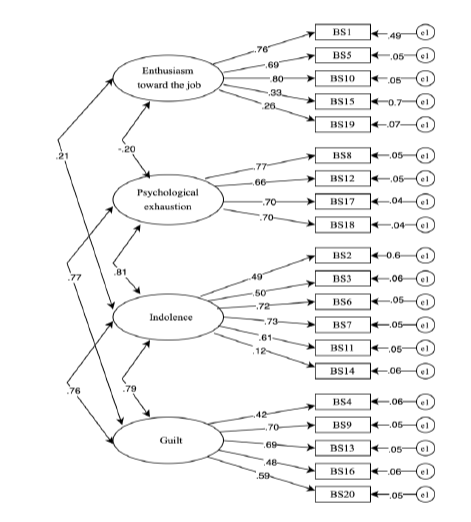
In the confirmatory factor analysis, the model referring to the theoretical proposal of a four-dimensional factor structure was evaluated. All factor weights (Lambdas-λ) were positive and statistically different from zero with values between .12 and .80. The polychoric correlation analysis between items fluctuated between .05 and .59. The model presented satisfactory indices with CFI values close to those recommended. The items 15 and 19 presented factor loadings lower than .40. However, it was decided not to exclude items with low factor loading or to make post-hoc modifications and maintain the original scale, since the literature has indicated that factor loadings between .30 and .40 meet a minimum criterion and can be maintained in a scale (Hair et al., 2014; Merenda, 1997).
The model presented is: χ2 = 337.313 (p < .01); gl = 164; CFI = .95; TLI = .94 and RMSEA = .06 (I.C. = .05 - .07). The model is presented in Figure 1.
Discussion
This study used confirmatory factor analysis (CFA) and the McDonald omega estimator to look at the validity evidence of the SBI in Mozambican teachers. In the hypothesis, the SBI presents the same four-dimensional structure as the original version and good internal reliability values.
In AFC, the model presented satisfactory indices with CFI values within the recommended range, CFI = .95, according to Wang and Wang (2019). The model’s fit indices supported the hypothesis of a four-factor structure. This finding is like results obtained in previous studies conducted in Portugal (Figueiredo-Ferraz et al., 2014), Brazil (Gil-Monte et al., 2010), other European countries (Bosle & Gil-Monte, 2010; Viotti et al., 2015), and Latin America (Deroncelo-Acosta et al., 2023; Olivares-Faúndez et al., 2018). It supports the instrument’s validation and the psychometric validation of the theoretical four-factor model.
Regarding the reliability of the dimensions, as evaluated by alpha Omega, the enthusiasm toward the job dimension obtained a value of .64; the psychological exhaustion dimension .79; the indolence dimension .80 and guilt .71. These outcomes are in line with those that Deroncele-Acosta et al. (2023) obtained with teachers from Lima, Peru. The values obtained were .83, .94, .87 and .88 for illusion due to work, psychic exhaustion, indolence, and guilt, respectively. It is observed that the illusion through work dimension also presented the lowest reliability value among the SBI dimensions.
A similar result was obtained in a Spanish study by Rabasa et al. (2016), who, when inspecting the internal consistency of SBI with a sample of secondary school teachers, identified that the dimensions had internal reliability values greater than .70, except for indolence, which revealed a value of .69.
In Chile, similarly, Olivares-Faúndez et al. (2018), when analyzing the validity of SBI with a sample of service workers, found that the dimensions of psychological exhaustion and illusion due to work reached α values greater than .70, while those of indolence and guilt obtained .66 and .60, respectively.
Thus, the result regarding the value of .64 in the illusion through work dimension, according to Sijtsma (2009), is that sometimes there are discrepancies that can vary from .10, not invalidating the adequacy of a measure. In the case of the present study, the Omega alpha presents less risk of overestimation or underestimation of reliability (Dunn et al., 2014), improving the precision of the dimension. According to Hair et al. (2014), the value obtained, the reliability coefficient between .60 and .70 can be accepted if the model's construct validity indicator is good.
The results of this study were different from those found in other international studies. This might be because the participants from Mozambique had different academic levels. For example, teachers with basic and secondary education, a scenario that differs from other countries like Brazil, where the minimum level for teaching in basic education is higher education (bachelor's degree and licentiate degree).
Therefore, the present study provides an instrument with validity evidence for use in the assessment of BS with Mozambican teachers, being, to the best of our knowledge, the pioneer at the level of the country and the African continent. The validation of the SBI can increase the level of research on the construct in various professional categories, both in Mozambique and in Africa, especially in Portuguese-speaking countries such as Angola, São Tome and Principe, Guinea-Bissau, and Cape Verde.
Finally, the results of this study allow us to conclude that the SBI is a reliable and valid instrument for evaluating BS in Mozambican teachers, as the model's overall fit indices to the data confirmed the hypothesis of the four-factor structure and presented Omega reliability values considered acceptable (Dunn et al., 2014; Hair et al., 2014). This investigation contributes to the literature by providing a scale that measures BS in Mozambican teachers. The scale can be used to identify the profiles of the syndrome, its prevalence, and associated factors.
Furthermore, the availability of an instrument with evidence of validity to assess BS could increase the level of research on the phenomenon, not only among teachers but also among other professionals in the country. Research in Portuguese-speaking African countries can also utilize this instrument.
However, it is important to describe some limitations of the study that can be overcome in new studies. The first is the distribution of teacher categories; the second is the type of non-random sample; and the third is the regionality of the sample collected in an African country that may have different characteristics from others. To ensure that the scale can be used in Mozambican culture, it is suggested that new studies be done on its validity, with a larger sample that is more evenly made up of teachers.
Credit authorship contribution statement
Gildo Aliante: Conceptualization; Data Curation; Formal analysis; Investigation; Methodology; Visualization; Writing - Original Draft; Writing - Review & Editing. Mary Sandra Carlotto: Conceptualization; Data Curation; Formal analysis; Investigation; Methodology; Resources; Writing - Original Draft; Writing - Review & Editing. Mussa Abacar: Conceptualization; Data Curation; Formal analysis; Methodology; Validation; Visualization; Writing - Original Draft; Writing - Review & Editing. Sheila Gonçalves Câmara: Formal analysis; Investigation; Validation; Writing - Original Draft; Writing - Review & Editing. Coutinho Maurício José: Data Curation; Formal analysis; Investigation; Methodology; Visualization; Writing - Original Draft.

